
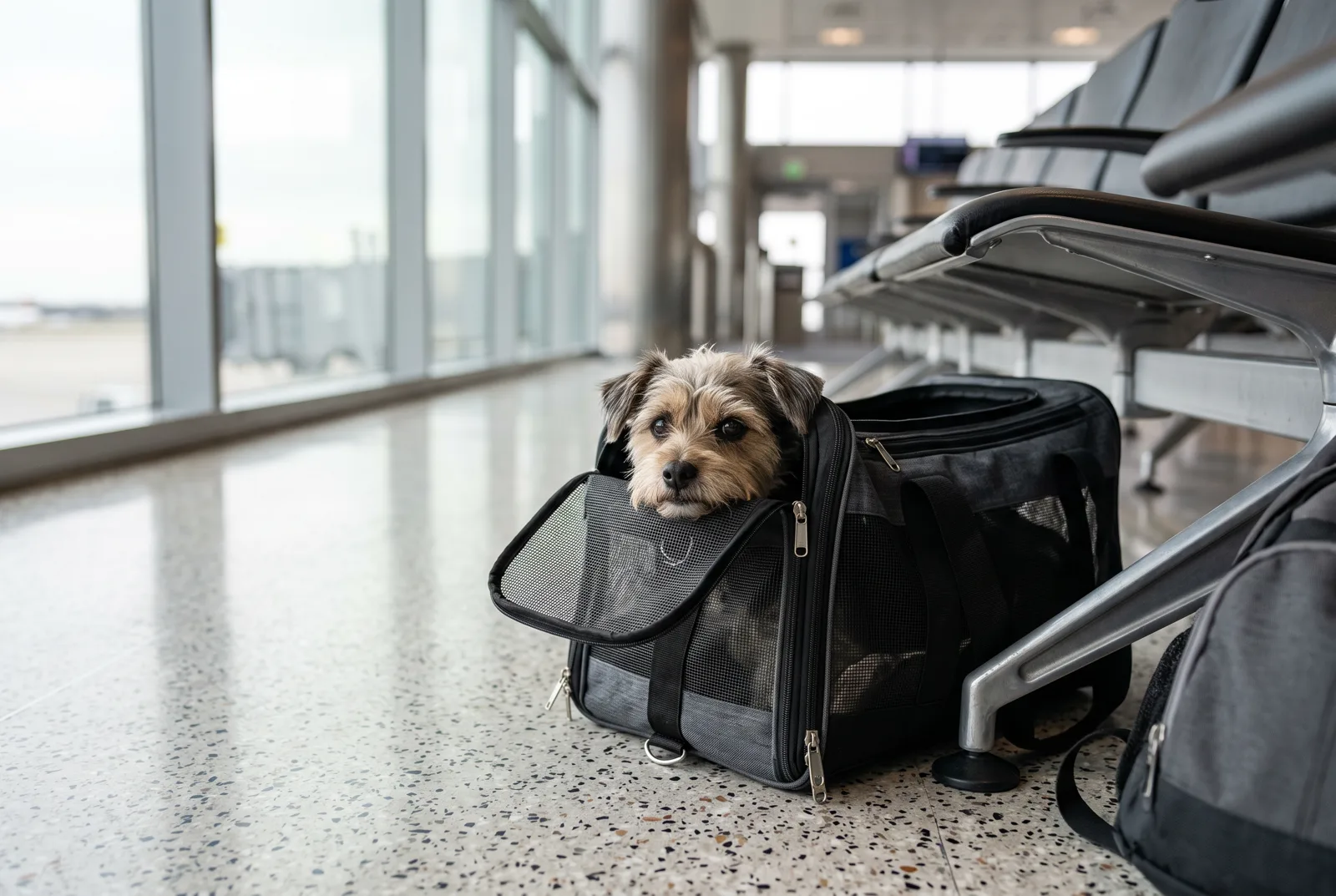
Flying with a dog is possible in the cabin if the dog is small and in the hold if it is heavier, but every airline sets its own limits. At Air France, for example, the cabin limit is under 8 kg (18 lb) including the carrier, and the hold limit is 75 kg (165 lb) including the crate. On the paperwork side, a dog entering the European Union must be microchipped, vaccinated against rabies at least 21 days earlier and, for travelers from the US or UK, carry an animal health certificate.
This guide separates two levels of rules: the health regulations (the EU’s Your Europe portal, USDA APHIS and GOV.UK, all checked on 12 November 2026) and the airline’s own carriage conditions (Air France as an example, consulted on 23 October 2026).
Flying with a dog: key points
- EU entry: microchip (or a clearly readable tattoo applied before 3 July 2011) and a valid rabies vaccination; the pet passport is issued only to EU residents, so travelers from the US or UK use an EU animal health certificate.
- Rabies vaccine: possible from 12 weeks of age, valid 21 days later, and given after the microchip.
- Finland, Ireland, Malta, Norway and Northern Ireland: tapeworm treatment 120 to 24 hours before arrival.
- Air France: cabin under 8 kg (18 lb) including the carrier; hold from 8 kg to 75 kg (165 lb) including the crate, to be booked at least 24 hours before departure.
- Outside the EU: check the entry rules of the destination country (and of any transit country) with its embassy or official veterinary authority.
Health requirements for a dog
Entering the European Union
According to Your Europe (European Union, last checked 1 September 2026), a dog must meet these conditions:
- it must be microchipped, or carry a clearly readable tattoo applied before 3 July 2011;
- travel between EU countries uses a European pet passport, issued only to EU residents by an authorized vet; travel from a non-EU country (the US or UK, for example) requires an EU animal health certificate issued by an official vet no more than 10 days before arrival, valid for 6 months or until the rabies vaccination expires, plus a written declaration that the move is non-commercial;
- it must be vaccinated against rabies after microchipping: the first vaccination at 12 weeks of age or older, then a wait of at least 21 days before travel; boosters must be given before the previous vaccination expires, or the 21-day wait applies again.
Dogs traveling from most non-EU countries may also need a rabies antibody titration test, with exceptions (Your Europe has a tool to check). You can travel with up to five pets; with more, you must show they are going to a competition, exhibition or sporting event and are over 6 months old. Dogs enter the EU through a designated travelers’ point of entry, where documents and identity are checked. Some breeds are restricted in some countries: check this in advance.
Finland, Ireland, Malta, Norway and Northern Ireland
These destinations also require a treatment against the tapeworm Echinococcus multilocularis, given 24 to 120 hours (1 to 5 days) before travel and recorded in the passport or the EU health certificate (Your Europe, last checked 1 September 2026).
Great Britain
According to GOV.UK (pet travel guidance, checked 12 November 2026), a pet entering Great Britain must travel on an approved route (not needed within the UK or from Ireland), be microchipped before its rabies vaccination, and wait at least 21 full days after the first vaccination (some countries also require a blood test). Dogs must be given tapeworm treatment no less than 24 hours and no more than 5 days before arrival. A pet that does not meet the rules may be quarantined for up to 4 months, or refused entry if it arrived by sea, and a dog of a banned breed needs a valid Certificate of Exemption.
Leaving the United States with a dog
According to USDA APHIS (pet travel pages, last modified 20 March 2026, checked 12 November 2026), you should contact a USDA-accredited veterinarian as soon as you decide to travel: the vet explains the destination’s entry requirements (vaccinations, tests or treatments) and helps obtain a USDA-endorsed pet health certificate or other required documents. Allow enough time. For a U.S.-vaccinated dog that has been in a high-risk rabies country within the past 6 months, the CDC requires a certification of U.S.-issued rabies vaccination, submitted by a USDA-accredited vet before the dog leaves the United States.
Other destinations and coming home
Each country sets its own rules (vaccines, rabies antibody titration, quarantine and so on): contact the embassy or the veterinary authority of the destination country and check any transit country too. Some countries restrict or ban dog imports altogether. For the return trip to the US, the CDC says it recommends that all dogs be vaccinated against rabies, and that requirements depend on where the dog was vaccinated and which countries it visited in the previous 6 months; an unvaccinated dog that has been in a high-risk country in that period will not be allowed to enter (CDC, page dated 1 August 2024, checked 12 November 2026). For the UK, see the GOV.UK rules above.
Countdown before departure
Destination de Voyage calculation based on the Your Europe timings. For a puppy, the minimum age to travel to the EU under the general rules is therefore 15 weeks (12 weeks for the first vaccine plus 21 days of waiting), once the microchip is in place.
| When? | What? |
|---|---|
| Several weeks before | Microchip first, then rabies vaccine (not the other way round), and the paperwork from your vet |
| At least 21 days before | Initial rabies vaccine given (the waiting period runs from the vaccination date) |
| As soon as you book the flight | Book the pet’s place with the airline (cabin or hold); spaces are often limited |
| Between 120 h and 24 h before arrival | Tapeworm treatment if the destination is Finland, Ireland, Malta, Norway or Northern Ireland (example: arrival on 10 July 2027 at 2 pm: treatment between 5 July 2027 at 2 pm and 9 July 2027 at 2 pm) |
| No later than 24 h before departure | At Air France: adding a pet in the hold to the booking (after that, a surcharge applies and acceptance is not guaranteed) |
Cabin or hold: how it works
Airlines set the weights, carrier or crate dimensions, number of animals per flight, accepted breeds and price. Air France example (page on traveling with pets, consulted on 23 October 2026):
| In the cabin | In the hold | |
|---|---|---|
| Maximum weight | Under 8 kg (18 lb), carrier included | Over 8 kg (18 lb) and up to 75 kg (165 lb), crate included |
| Booking | Add to the booking | At least 24 hours before departure; after that, a 50% surcharge (flights within mainland France and within the Caribbean) or 25% (international), subject to acceptance |
| Possible refusal | Depending on flight availability | Depending on flight availability or if hold conditions are not met |
| Above that | — | As air freight, through an approved carrier |
Air France also states that the animal must have all compulsory vaccinations up to date, and declines responsibility for costs if the animal is refused at departure (carriage conditions not met) or on arrival (destination rules not met). In its lounges, the animal stays in its carrier.
Dogs to the United States and assistance dogs
Assistance dogs follow specific rules set by each airline. For the United States, Air France asks for a dog booking request 48 hours before departure; the deadline is 96 hours for assistance dogs traveling to or from the United Kingdom and the United Arab Emirates. Air France refers to the CDC requirements for the United States, which come on top of existing formalities.
Mistakes that get a dog refused
Destination de Voyage summary based on the official rules cited above:
- vaccinating against rabies before microchipping: the vaccination is then not recognized;
- leaving less than 21 days after the first rabies vaccine;
- forgetting the tapeworm treatment for Ireland, Malta, Finland, Norway or Northern Ireland, or giving it outside the 120 h to 24 h window;
- booking the hold at the last minute: at Air France, a surcharge applies and carriage is not guaranteed;
- not checking the rules of the arrival country and of transit countries;
- assuming one airline’s limits apply to another.
Frequently asked questions
What weight limit applies to a dog in the cabin?
It depends on the airline. At Air France, under 8 kg (18 lb) including the carrier; above that and up to 75 kg (165 lb) with the crate, the dog travels in the hold.
What documents do I need to fly with my dog to Europe?
A microchip (or a readable tattoo applied before 3 July 2011) and a valid rabies vaccination given after identification and at least 21 days before travel. From the US or UK, an EU animal health certificate issued no more than 10 days before arrival replaces the pet passport, which is issued only to EU residents.
How old must a puppy be to fly?
To travel to the EU under the general rules, the first rabies vaccine can be given at 12 weeks at the earliest, followed by 21 days of waiting: 15 weeks minimum (our calculation from Your Europe). Airlines may set their own minimum ages.
Does my dog need a tapeworm treatment before flying?
Yes for Finland, Ireland, Malta, Norway and Northern Ireland: treatment 24 to 120 hours before arrival, recorded in the paperwork. For Great Britain, GOV.UK gives a window of 24 hours to 5 days before arrival.
How many dogs can I take?
The EU rules allow up to five pets traveling with you (more only for competitions or shows, for animals over 6 months); airlines often limit the number further.
Our sources
- Your Europe (European Union), Pets and other animals in the EU, last checked 1 September 2026, read on 12 November 2026.
- USDA APHIS, Pet travel, last modified 20 March 2026, checked 12 November 2026.
- GOV.UK, Pet travel guidance (bringing a pet into Great Britain), checked 12 November 2026.
- CDC, Bringing a dog into the United States (page dated 1 August 2024), checked 12 November 2026.
- Air France, « Travelling with pets on Air France », consulted on 23 October 2026.
- Our methodology
Updated November 2026.