
What is banned on planes? In your carry-on: liquids in containers over 100 ml (3.4 oz) unless they are in the transparent bag the airport requires, knives, weapons and imitations, and other sharp or dangerous objects. Flammable products are banned everywhere. Spare lithium batteries and power banks must travel in the cabin, never in the hold. For battery limits in watt-hours, read our guide to power banks on planes.
Security rules are set by the country you fly from, so the TSA (United States), the UK Department for Transport via GOV.UK, or EU rules apply depending on your departure airport, and your return flight may follow different rules. Airlines can be stricter. This guide pulls them together in one cabin / hold / banned-everywhere checklist, with a mAh to Wh converter to see whether your power bank passes, and the mistakes that cost time at the checkpoint. Before security, keep your ID and your boarding pass, paper or mobile handy.
Banned items on planes: the essentials
- Liquids in the cabin: containers of 3.4 oz (100 ml) or less in one transparent resealable bag per passenger: a quart-size bag in the US (TSA); about 20 cm x 20 cm and up to 1 litre in the UK, if the airport asks for a bag (GOV.UK)
- Exceptions: medication and infant nourishment are exempt from the TSA limits; in the UK, up to 2 litres for essential medical purposes, special dietary needs or baby food and milk (GOV.UK)
- Not allowed in carry-on: knives (TSA), axes, ammunition, aerosol insecticide, and liquids over 100 ml outside the exceptions
- Not allowed in checked bags: spare lithium batteries and power banks (TSA); alcohol over 70% (140 proof) is allowed in neither (TSA)
- Final say: the security officer decides; both TSA and GOV.UK say staff will stop anything they consider dangerous
The checklist: cabin, hold or banned?
Our table combines the TSA « What Can I Bring? » pages, GOV.UK hand luggage restrictions and, for items those pages do not cover, EU rules as summarized by service-public.gouv.fr (France) and EASA (the EU Aviation Safety Agency). ✅ = allowed, ⚠️ = conditions apply, ❌ = not allowed.
| Item | Carry-on | Checked bag |
|---|---|---|
| Liquids, gels, pastes and aerosols of 100 ml (3.4 oz) or less | ✅ in the transparent bag (TSA, GOV.UK) | ✅ |
| Liquids over 100 ml (3.4 oz) | ❌ except exemptions; some UK airports allow up to 2 litres (GOV.UK) | ✅ (TSA) |
| Medication, baby milk and food | ⚠️ exempt from the TSA limits; up to 2 litres in the UK (GOV.UK) | ✅ |
| Duty-free liquids bought after security | ⚠️ sealed tamper-evident bag with the receipt visible; do not open it before your final destination (GOV.UK). For connections to the US, TSA also requires the original receipt, with the purchase made within 48 hours | ✅ |
| Knives | ❌ (TSA) | ✅ wrapped; round-bladed and blunt knives, butter knives and plastic cutlery are the exceptions (TSA) |
| Scissors | ⚠️ allowed if blades are under 4 inches (10 cm) from the pivot point (TSA) | ✅ wrapped (TSA) |
| Axes and hatchets | ❌ (TSA) | ✅ (TSA) |
| Ammunition | ❌ (TSA) | ⚠️ special instructions; check with your airline (TSA) |
| Aerosol insecticide | ❌ (TSA) | ✅ unless labeled hazardous material (TSA) |
| Alcohol over 70% (140 proof) | ❌ (TSA) | ❌ (TSA) |
| Lighter | ⚠️ UK: one lighter, in a resealable plastic bag you keep on you through the flight (GOV.UK) | ❌ UK: not in hold luggage (GOV.UK) |
| Flammable products | ❌ | ❌ |
| Phone, laptop, camera (built-in battery, up to 100 Wh) | ✅ | ⚠️ switched off and protected against accidental activation (EU rules, service-public.gouv.fr) |
| Power bank or spare battery, up to 100 Wh | ✅ terminals protected | ❌ (TSA) |
| Battery from 100 to 160 Wh | ⚠️ up to two spares, with airline approval (TSA) | ❌ (TSA) |
| Battery over 160 Wh | ❌ (EASA) | ❌ (EASA) |
| E-cigarette | ✅ switched off, not recharged on board (EU rules) | ❌ (EU rules) |
Liquids in the cabin: the 100 ml rule
According to the TSA, liquids, aerosols, gels, creams and pastes in carry-on bags must be 3.4 oz (100 ml) or less per container and fit in one quart-size bag, kept separate from the rest of your carry-on. Larger containers go in checked baggage. In the UK, GOV.UK says containers over 100 ml cannot go through security at most airports, even if only partly full, that you should use one transparent resealable bag of up to 1 litre (about 20 cm x 20 cm) if the airport asks for it, and that frozen liquids are not allowed in hand luggage.
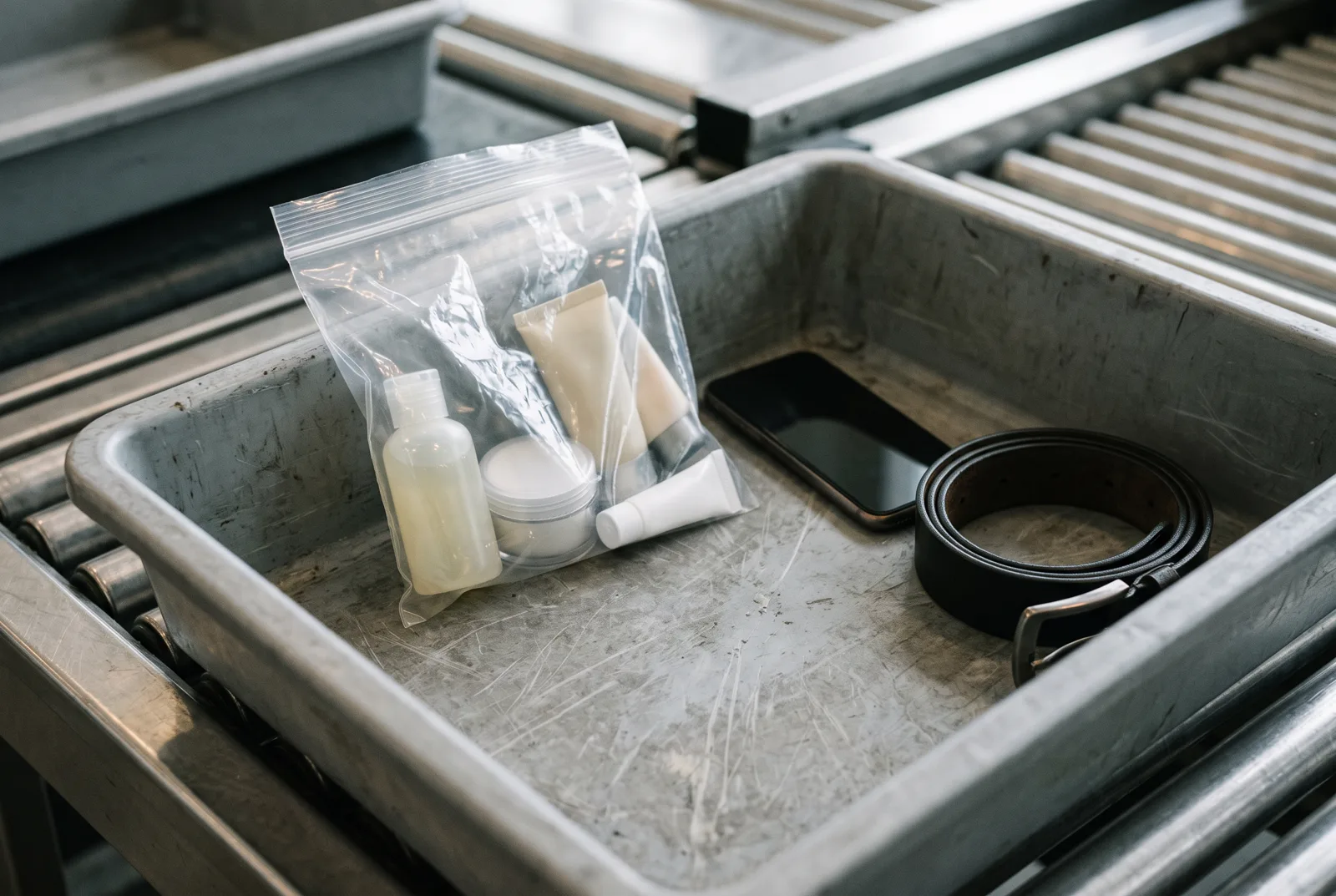
- It is the capacity printed on the container that counts, not what is left inside: a half-empty 150 ml tube can be refused.
- Liquids include drinks, perfume, creams, toothpaste, gels, liquid mascara, sauces, jam, soft cheese and sprays.
- Exceptions: TSA exempts medications and infant and child nourishment from the limits. GOV.UK allows up to 2 litres at all UK airports for essential medical purposes, special dietary requirements, and baby food or baby milk.
- Duty free: liquids bought after security stay in the sealed bag the shop gives you, with the receipt inside and visible; GOV.UK says not to open it before you reach your final destination, and staff may open items to screen the liquid.
Some airports with new-generation scanners have allowed larger containers: GOV.UK says some UK airports may allow containers of up to 2 litres. In the EU, however, the European Commission imposed a temporary return to 100 ml from 1 September 2024 at airports that were using such equipment, until a technical problem was resolved (Commission notice of 31 July 2024, implementing regulation (EU) 2024/2108, checked 14 October 2026). The situation changes airport by airport: pack as if the 100 ml limit applied, especially for the return flight, which leaves from a different airport.
Power banks: the mAh to Wh converter
Battery limits are set in watt-hours (Wh), but power banks are usually labeled in mAh. EASA gives the formula Wh = voltage (V) × capacity (Ah). We applied it to common capacities, using the 3.7 V nominal voltage of lithium-ion cells (check the real voltage on your battery’s label).
| Labeled capacity | Energy at 3.7 V | In the cabin |
|---|---|---|
| 5,000 mAh | 18.5 Wh | ✅ cabin |
| 10,000 mAh | 37.0 Wh | ✅ cabin |
| 20,000 mAh | 74.0 Wh | ✅ cabin |
| 26,800 mAh | 99.2 Wh | ✅ cabin |
| 30,000 mAh | 111.0 Wh | ⚠️ airline approval |
| 40,000 mAh | 148.0 Wh | ⚠️ airline approval |
| 45,000 mAh | 166.5 Wh | ❌ not allowed |
- Up to about 27,000 mAh (at 3.7 V), a power bank stays under 100 Wh.
- Protect the terminals: original packaging, tape over the contacts or one bag per battery, to prevent a short circuit (EASA).
- On board, EASA recommends not recharging a power bank and not using it to power a device.
- Carry-on bag gate-checked: take the batteries and electronic devices out before handing it over.
- Battery that swells, overheats or smokes: tell the crew immediately; do not try to put out a battery fire yourself.
- Device dropped between the seats: call the crew and do not move your seat, which could crush the battery.
Mistakes that cost time at security
- The oversized bottle that is almost empty: refused, even with only 30 ml left.
- The toiletry bag closed inside the carry-on: take the liquids bag out and screen it separately where the airport asks for it.
- The forgotten pocket knife: not allowed in the TSA carry-on at all; put it in checked baggage.
- The power bank in checked luggage: not allowed in the hold; your bag may be opened or held.
- The jar of jam or the soft cheese: they count as liquids under the rule.
- The toy that looks like a weapon: an imitation can be treated like a weapon in the cabin.
- Hiding a prohibited item: at best it is confiscated; penalties vary by country, so do not risk it.
Decision tree: where do I pack this?
- It is flammable (gas, solvent, paint, chemical) → neither cabin nor hold: leave it at home.
- It contains a removable lithium battery or it is a power bank → cabin only, terminals protected; above 100 Wh, ask your airline for approval.
- It is an electronic device → cabin preferably; in the hold only if fully switched off and protected.
- It is a liquid over 100 ml → hold, unless it is medication or baby food you can justify.
- It cuts, pricks or can be used as a club → hold.
- You are unsure → the security officer has the final say: put the item in the hold or check with your airline before leaving.
To prepare the rest of your luggage, see our guides to carry-on bags: size and weight by airline and what to pack. To book smartly, our guide to cheap flights explains baggage options on tickets.
Frequently asked questions
What items are banned in carry-on bags?
Knives (TSA), axes, ammunition, aerosol insecticide, weapons and imitations, other dangerous objects, flammable products, and liquids over 100 ml (3.4 oz) outside the exceptions. Scissors are allowed in TSA carry-on if the blades are under 4 inches (10 cm) from the pivot.
Can I take my toiletry bag in the cabin?
Yes, if all liquids, gels and creams are in containers of 100 ml (3.4 oz) or less, together in one transparent resealable bag (a quart-size bag in the US; about 20 cm x 20 cm and up to 1 litre in the UK where the airport asks for one). Solid items such as bar soap or solid shampoo are not liquids.
Can I put a power bank in checked luggage?
No. Spare lithium batteries and power banks must travel in the cabin (TSA), with terminals protected, up to 100 Wh, or up to two spares between 101 and 160 Wh with airline approval.
How many mAh can a power bank have on a plane?
At 3.7 V, a 27,000 mAh battery is about 100 Wh, the limit without formalities. Above that, you need your airline’s approval up to 160 Wh (about 43,000 mAh).
Are liquid medicines allowed in the cabin?
Yes, above 100 ml if needed during the trip: TSA exempts medications from the limits, and GOV.UK allows up to 2 litres for essential medical purposes at UK airports.
What happens if I bring a prohibited item?
It can be confiscated, and the officer has the final decision. Concealing a prohibited item can bring penalties that vary by country.
Our sources
- TSA, Liquids, Aerosols and Gels Rule, and TSA « What Can I Bring? » pages on knives (updated September 14, 2023), scissors (updated May 11, 2017), power banks (updated May 14, 2025) and lithium batteries over 100 Wh (updated March 29, 2023), checked 12 November 2026.
- GOV.UK, « Hand luggage restrictions at UK airports » and its liquids page, checked 12 November 2026.
- Service-public.gouv.fr (France), « Vol en avion : quels sont les objets interdits en cabine ? » (F16085, verified July 4, 2025), consulted 14 October 2026, for EU rules on devices and e-cigarettes.
- European Union Aviation Safety Agency (EASA): « More practical information – Lithium batteries » and Dangerous Goods page, consulted 14 October 2026.
- European Commission, DG Mobility and Transport: notice of 31 July 2024 on temporary restrictions on liquids screening (implementing regulation (EU) 2024/2108), consulted 14 October 2026.
- Calculation by Destination de Voyage: mAh to Wh conversion at 3.7 V.
- Our methodology
Updated November 2026.