
Sapporo, the capital of the island of Hokkaidō, is Japan’s fifth most populous city and one of the few to follow a grid plan, laid out from the 1870s around Ōdōri Park. People come for the Snow Festival in February, the miso ramen of Susukino, the beer and as a base for Otaru, the hot-spring resorts and the national parks. This guide covers what to see in Sapporo, how to get there, where to stay and what weather to expect month by month, based on the official normals of the Japan Meteorological Agency, plus what the US and UK governments say about entry and safety.
To place Sapporo in an itinerary, see our Hokkaido guide, the Japan travel guide, the best time to visit Japan calendar and the map of Japan.

Our travel deals for Sapporo
Affiliate links: we earn a commission, at no extra cost to you.
 Learn the languageTargumiLearn a few words of Japanese before you go — 30% off via our link.See the course
- FlightsKiwi.comCompare flights and airline combinations to Sapporo.Compare flights
- Airport transferKiwitaxiPrivate driver booked in advance at a fixed price.Book a transfer
- eSIMAiraloData plan to install before you leave (eSIM-compatible phone).See plans




Sapporo at a glance
- Time zone UTC+9 all year (Japan does not change its clocks): 9 h ahead of London in winter (8 h in summer) and 14 h ahead of New York in winter (13 h in summer)
- Climate −0.4 °C (31 °F) average maximum in January, 26.4 °C (80 °F) in August (JMA 1991-2020 normals)
- Peak seasons February for the snow and the festival, June to September for the outdoors
- Entry US citizens: visa-free stays of up to 90 days (U.S. State Department); UK citizens: visa on arrival for up to 90 days (UK FCDO)
- See Ōdōri Park, the Clock Tower, Susukino, Hokkaidō Shrine, Mount Moiwa, Otaru
What to see in Sapporo: the highlights
Ōdōri Park and the TV Tower
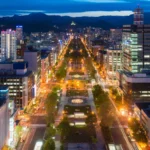
Ōdōri Park runs through the centre from east to west: it is the heart of the city and the axis around which the grid plan was drawn in the 19th century. It hosts the year’s big events, including the Snow Festival in February and a beer festival in summer. At its east end, the TV Tower, built in 1957, has an observation deck with an overall view of the park. Under the park, an underground passage links the subway stations and lets you get around under cover in winter.
The Clock Tower and the historic centre
Built in 1878, the Clock Tower is Sapporo’s oldest landmark; it houses a small museum on the city’s development. Not far away, the former Hokkaidō Government Office, in red brick (Akarenga), built in 1888, recalls the time when the Meiji government made Sapporo the capital of the island, in 1868, then brought in American advisers to develop it. The centre can be visited on foot in half a day.
Susukino and Hokkaidō cuisine
South of Ōdōri Park, Susukino is the district of restaurants and nightlife. Sapporo is presented as the birthplace of miso ramen; in Susukino an entire lane (Ramen Yokochō) is lined with counters. Breweries were among the industries encouraged from the start of the colonisation of Hokkaidō, and beer remains associated with the city’s name. In February Susukino also hosts a Snow Festival site devoted to ice sculptures.
Maruyama Park and Hokkaidō Shrine
To the west, Maruyama Park surrounds the Shinto shrine of Hokkaidō, consecrated in 1869 by the Meiji Emperor. It is a quiet place for a walk.
Mount Moiwa and Nakajima Park
The city’s highest point (531 m / 1,742 ft), Mount Moiwa offers a view over Sapporo by day and by night; a ski area opens each winter on its far side. Nakajima Park, further south, has ponds, the Kitara concert hall and the Hōheikan, a former Western-style hotel from 1880, listed as an important cultural property. Further out, Moerenuma Park was designed by the sculptor Isamu Noguchi.
The Snow Festival
The Snow Festival is held every year in February: monumental snow and ice sculptures in Ōdōri Park and at satellite sites. It is the busiest period of the winter: book accommodation early and check the dates of the edition on the festival’s official site. Bring non-slip shoes: in February the average minimum is −6.2 °C (21 °F).
Around Sapporo: Otaru, lakes and onsen
To the west, Otaru, a former trading port, is visited for its canal lined with warehouses. Further south, the hot-spring resorts and volcanic lakes of Hokkaidō combine well over two or three days: see our Hokkaido guide.
Sapporo in 2 or 3 days
- Day 1: Ōdōri Park, the TV Tower, the Clock Tower, Akarenga, then Susukino in the evening.
- Day 2: Hokkaido University and its campus in the morning, Maruyama Park and Hokkaidō Shrine, Mount Moiwa at sunset.
- Day 3: day trip to Otaru; in winter, a day of skiing at a nearby resort.
Where to stay in Sapporo
Three areas share most of the offer: around Sapporo Station, practical for trains to the airport and Otaru; along Ōdōri Park, central for sightseeing and the Snow Festival; and Susukino, for restaurants and evenings. The subway links the three. In February, hotels near Ōdōri Park are the first to fill up.
Getting to Sapporo and getting around
Sapporo is served by New Chitose Airport (Shin-Chitose), south-east of the city; the route to Tokyo-Haneda is one of the busiest in Japan. From abroad you will usually arrive with at least one connection: check routes on the airport and airline sites. From Honshū, the Hokkaidō Shinkansen has so far stopped at Shin-Hakodate-Hokuto, with the extension to Sapporo under construction according to Wikipedia: check the current end of the line before you plan a rail journey.
In the city, three subway lines (Namboku, Tōzai, Tōhō), a tram line and buses meet visitors’ needs. The centre is easy to walk thanks to the grid plan and the underground passages.
Airport transfer: train, bus or car?
JR trains and buses link New Chitose Airport to central Sapporo. A rental car is useful only to leave the city (lakes, Niseko, Furano): in winter, check snow equipment and road conditions. Driving in Japan is on the left, and GOV.UK says UK visitors need the 1949 version of the international driving permit plus their UK licence and insurance documents. Before booking a transfer or a rental, compare the operator’s official site and resellers: cancellation terms, insurance, excess.
When to go to Sapporo: month-by-month climate
Sapporo has a humid continental climate: a long, snowy winter and a mild summer. The table combines the official normals with our calculations: day/night range, sunrise and sunset, day length.
| Month | Max °C (°F) | Min °C (°F) | Rain mm (in) | Precipitation days (≥ 1 mm) | Day/night range °C (°F) | Sunrise / sunset on the 15th | Day length |
|---|---|---|---|---|---|---|---|
| January | −0.4 (31) | −6.4 (20) | 108 (4.3) | 18.3 | 6.0 (10.8) | 07:03 / 16:24 | 9 h 21 min |
| February | 0.4 (33) | −6.2 (21) | 92 (3.6) | 16.0 | 6.6 (11.9) | 06:33 / 17:04 | 10 h 32 min |
| March | 4.5 (40) | −2.4 (28) | 78 (3.1) | 13.9 | 6.9 (12.4) | 05:48 / 17:40 | 11 h 52 min |
| April | 11.7 (53) | 3.4 (38) | 55 (2.2) | 9.6 | 8.3 (14.9) | 04:53 / 18:16 | 13 h 22 min |
| May | 17.9 (64) | 9.0 (48) | 56 (2.2) | 8.5 | 8.9 (16.0) | 04:12 / 18:50 | 14 h 38 min |
| June | 21.8 (71) | 13.4 (56) | 60 (2.4) | 7.5 | 8.4 (15.1) | 03:54 / 19:15 | 15 h 21 min |
| July | 25.4 (78) | 17.9 (64) | 91 (3.6) | 7.7 | 7.5 (13.5) | 04:08 / 19:12 | 15 h 04 min |
| August | 26.4 (80) | 19.1 (66) | 127 (5.0) | 9.5 | 7.3 (13.1) | 04:39 / 18:38 | 13 h 59 min |
| September | 22.8 (73) | 14.8 (59) | 142 (5.6) | 10.2 | 8.0 (14.4) | 05:13 / 17:45 | 12 h 33 min |
| October | 16.4 (62) | 8.0 (46) | 110 (4.3) | 11.6 | 8.4 (15.1) | 05:47 / 16:53 | 11 h 06 min |
| November | 8.7 (48) | 1.6 (35) | 114 (4.5) | 14.6 | 7.1 (12.8) | 06:26 / 16:11 | 9 h 45 min |
| December | 2.0 (36) | −4.0 (25) | 114 (4.5) | 16.0 | 6.0 (10.8) | 06:58 / 16:00 | 9 h 02 min |
Reading the table: from December to February the average maximum stays around 0 °C (32 °F) and at least 1 mm of precipitation falls, mostly as snow, on more than one day in two in January (18.3 days). In mid-December the sun sets around 16:00 and the day lasts barely more than 9 hours (calculated). May and June are the driest months (fewer than 9 precipitation days); May is the sunniest according to the JMA (200 hours of sunshine). July and August are mild (25.4 and 26.4 °C, 78 and 80 °F, average maximum). September is the wettest month (142 mm, 5.6 in).
To compare with Tokyo, Kyoto or Okinawa, see the best time to visit Japan.
Entry requirements, health and safety
US citizens
- According to the U.S. Department of State (travel.state.gov, last updated August 11, 2025), US citizens can make « visa free » tourist or business stays of up to 90 days. Your passport must be valid for the entire time you are staying in Japan, and you should have proof of a return or onward ticket. You cannot work on the local economy or change to another visa while in Japan. All visitors must provide fingerprints and have their photo taken on arrival, and immigration officers may deny entry if you lack proof of how you will support yourself.
UK citizens
- According to the UK FCDO (GOV.UK foreign travel advice, updated 28 August 2026), you can get a visa on arrival for tourism or business for up to 90 days and do not need to apply before you travel. Your passport must be valid for the length of your stay (no additional validity is required) and you need a blank page for your visa stamp. You can apply at your nearest immigration office for an extension of another 90 days.
- If the two governments’ wording differs (US: « visa free »; UK: visa on arrival), check the current rules with the Japanese embassy before you travel.
Health and safety
- Bears: GOV.UK says bear sightings and attacks have increased in parts of Japan, especially in mountainous and forested areas, including near populated zones. It advises researching local wildlife, avoiding walking alone where bears have been sighted, taking all rubbish (including food waste) with you and reporting sightings to the local authorities.
- Winter: the U.S. State Department lists heavy snow among the main weather events in Japan: in winter, northern Japan and the mountains get a lot of snow, which can disrupt travel.
- Regional note: Hokkaido is not among the regions for which GOV.UK gives specific regional advice in the sections we read.
- Emergencies: dial 110 for police and 119 for ambulance and fire (GOV.UK).
- Earthquakes and tsunamis: GOV.UK says Japan is in a major earthquake zone; take note of instructions in hotel rooms and at train stations, and monitor Japan Meteorological Agency information, including tsunami warnings.
- Typhoons and heavy rain: according to GOV.UK, the typhoon season runs from June to December and peaks from July to September, with the highest risk in the south; intense rain can cause floods and landslides. Follow local authorities and any evacuation orders.
- Medication: GOV.UK warns that some common medicines are illegal in Japan, including Vicks inhalers, cold and flu medication containing pseudoephedrine and some painkillers containing codeine; the U.S. State Department notes that some prescription drugs legal in the United States are illegal in Japan. Check with the Japanese embassy before you travel.
- Food imports: it is illegal to bring meat products, including sausages, bacon and ham, into Japan without permission from the Animal Quarantine Service (GOV.UK).
- Money: GOV.UK says Japan is still a predominantly cash-based society and that cards issued outside Japan may not always work; post offices, 7-Eleven stores and JP Post Bank cash machines accept some foreign cards.
- Health care: medical facilities are of a high quality but treatment is expensive (GOV.UK); make sure your travel insurance covers medical costs.
Our travel documents guide summarises the formalities.
Staying connected
An eSIM installed before departure lets you use maps and train timetables as soon as you land at New Chitose. Check that your phone is compatible: see our Japan eSIM page and the travel eSIM guide.
If you… then…
| If you… | Then… |
|---|---|
| Want to see the Snow Festival | Aim for February and book accommodation well in advance |
| Dislike the cold | Come from June to September: highs of 22 to 26 °C (72 to 79 °F) |
| Like long days | June: more than 15 hours of daylight (calculated) |
| Plan to ski off-piste | Hire a professional guide and check local conditions and warnings before you go |
| Plan to hike around the city | Ask locally about bears and follow the authorities’ advice (GOV.UK) |
| Have only one day | Ōdōri, the Clock Tower, Akarenga, then Susukino in the evening |
Frequently asked questions
What is the best time to visit Sapporo?
February for the snow and the festival, June to September for mild weather (highs of 22 to 26 °C, 72 to 79 °F; JMA 1991-2020 normals). May and June are the driest months.
Is Sapporo very cold in winter?
Yes: in January the average maximum is −0.4 °C (31 °F) and the minimum −6.4 °C (20 °F) (JMA). Precipitation falls on more than one day in two, mostly as snow.
How many days should I stay in Sapporo?
Two days for the city, one or two more for Otaru or the lakes and onsen to the south-west.
How do I get from the airport to central Sapporo?
By JR train or bus from New Chitose Airport. Check timetables on the operators’ sites.
Do I need a visa for Sapporo?
According to the U.S. State Department (last updated August 11, 2025), US citizens can stay visa-free for up to 90 days; according to the UK FCDO (updated 28 August 2026), UK citizens get a visa on arrival for up to 90 days. Check the Japanese embassy before you travel.
Are there bears around Sapporo?
GOV.UK says bear sightings and attacks have increased in parts of Japan, especially in mountainous and forested areas. Follow local advice and alerts when hiking.
Our sources
- World Meteorological Organization, 1991-2020 climate normals, Sapporo station (47412), Japan Meteorological Agency (NOAA/NCEI archive)
- Wikipedia articles « Sapporo » (French and English), « Sapporo Snow Festival », « New Chitose Airport »
- Astronomical calculations: NOAA solar algorithm, applied by Destination de Voyage to the coordinates of Sapporo (15th of each month, year 2027)
- Entry requirements, health and safety checked between 26 October and 12 November 2026: U.S. Department of State, Japan country information (last updated August 11, 2025) and UK FCDO, GOV.UK foreign travel advice for Japan (updated 28 August 2026)
- Our methodology
Updated November 2026.