
Jet lag (time zone change syndrome) is a mismatch between your body clock and local time after a flight across several time zones. According to the French health insurance service (Assurance maladie), effects generally appear from a 3-hour time difference, and traveling east is often harder than traveling west. To limit it: shift your schedule before departure, set your watch to arrival time as soon as you board, and use daylight at your destination. This advice applies to a flight west, for example to South America: our page on the time difference in Argentina gives the exact gap.
This page combines guidance from the NHS (UK), the CDC Yellow Book (US), the French Assurance maladie (ameli.fr) and the Réseau Morphée, a French sleep-disorder health network. To find the exact time at your destination, see our time difference pages by country. For a trip to the far end of South America, for example, the time difference in Chile is detailed by season and region.
Jet lag: key points
- Effects are possible from a 3-hour difference (ameli.fr); some people feel them from 1 to 2 hours.
- Eastward (Asia, Oceania): harder, because you must fall asleep earlier than usual.
- Before departure: shift bedtime, wake-up and meals by one hour a day toward destination time.
- On arrival: a short nap (20 to 30 minutes) if needed, then local times for sleeping and eating.
- Stay of 2 to 3 days: it may be better to keep your home schedule (NHS).
- Melatonin and sleeping pills: only on medical advice; the NHS does not recommend melatonin tablets for jet lag.
What is jet lag and why do you feel it?
The internal clock sets sleep, alertness, appetite and body temperature on a cycle of about 24 hours, reset each day mainly by light. After a long-haul flight, it stays set to departure time for a few days. The symptoms described by the French Assurance maladie: difficulty falling asleep, daytime sleepiness, fatigue and irritability, concentration and memory problems, loss of appetite. The NHS (page last reviewed 31 May 2023, read on 12 November 2026) lists similar symptoms, adds indigestion, nausea, constipation and mild anxiety, and says jet lag usually improves within a few days as your body adjusts.

East or west: why it is not the same
| Direction of travel | Examples | What the clock must do | Difficulty |
|---|---|---|---|
| Eastward | Japan, Thailand, Australia (from Europe or the Americas) | Advance: fall asleep earlier | Often harder |
| Westward | United States, Canada, Caribbean (from Europe) | Delay: stay up later | Often easier |
Before you leave
- If you can, choose a daytime flight to limit sleep debt (ameli.fr).
- Get plenty of rest, and gradually shift your bedtime, wake-up time and meals, one hour a day, toward the destination’s rhythm (NHS, ameli.fr).
- Eastward: go to bed and get up earlier, and get light in the morning. Westward: do the opposite and seek light in the evening (Réseau Morphée). The CDC Yellow Book (2026 edition) likewise centers its advice on timed light exposure or avoidance, and says choosing a flight that arrives at a time giving the best timing of light exposure can help.
- For an important event (wedding, meeting), arrive a few days earlier.
During the flight
- Set your watch to destination time as soon as you board, and sleep or stay awake according to that time.
- Drink water regularly; limit alcohol, coffee and tea (the NHS says caffeine and alcohol can worsen jet lag).
- If a meal is served, eat light, preferably at destination times.
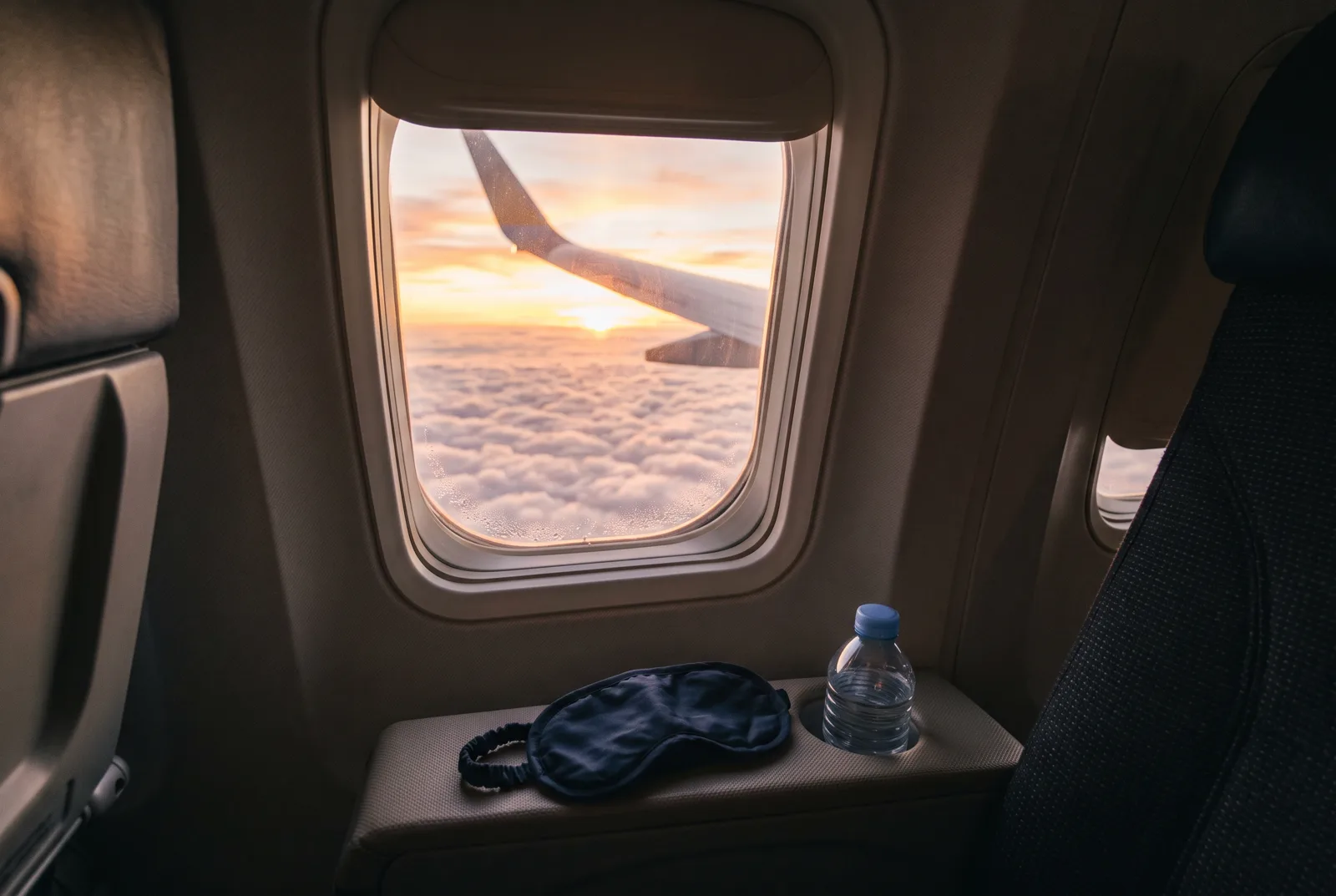
- Stand up and walk along the aisle from time to time; an eye mask and earplugs may help you sleep (NHS).
On arrival: light is your best ally
| After an eastward flight | After a westward flight | |
|---|---|---|
| Light | Get light in the morning (later in the morning if the shift exceeds 6 h, according to the Réseau Morphée) | Avoid bright light in the morning, get light in late afternoon and evening |
| Sunglasses | In the afternoon | In the morning |
| Physical activity | In the morning (a walk of at least 30 minutes) | In the afternoon or evening |
| Nap | 20 to 30 minutes at most | 20 to 30 minutes at most |
- Adopt local time as soon as possible for meals and bedtime, and set an alarm to avoid oversleeping (NHS).
- Avoid intense exercise and stressful activities (screens, video games) in the hours before bed.
- Keep good sleeping conditions: a cool, dark, quiet room.
Melatonin and sleeping pills: what health bodies say
Melatonin. The NHS does not recommend melatonin tablets for jet lag because there is not enough evidence that they work. The CDC Yellow Book (2026 edition) says some evidence suggests melatonin supplements can help with sleep problems caused by jet lag for eastward and westward travel, and that for short periods they appear safe for most people; long-term safety is less certain, and supplement quality is a concern, since a 2017 Canadian analysis found content ranging widely from the labeled amount. It frames light timing as the core strategy, with melatonin as a possible addition. The French Assurance maladie (ameli.fr) says the benefit of prescription melatonin is greater after more than five time zones eastward, taken at bedtime from the day of arrival for 4 to 5 days at most, and that over-the-counter melatonin supplements have no demonstrated efficacy against jet lag. Melatonin can cause side effects and interact with other medicines: ask a pharmacist or doctor, and avoid it for children and adolescents, pregnant or breastfeeding women and several groups of patients. For nausea on flights, boats or in cars, our guide to motion sickness details the solutions.
Sleeping pills. The NHS says medicines are not usually needed for jet lag, and that sleeping tablets can be addictive, so they should be used only briefly and when symptoms are severe. Ameli.fr says they are taken only on prescription, once you have arrived, never during the flight (risk of heavy sleep and of clots linked to immobility). Ask your doctor before any treatment. If fear of flying is what keeps you from sleeping, our guide to fear of flying offers solutions.
And on the way back?
The same rules apply in the other direction: a return from Asia to Europe is westward (often easier), a return from the United States to Europe is eastward. Plan a recovery day before going back to work if possible. For a long-haul destination with a small time difference, see for example the 2 to 3 hours of La Réunion or Morocco time.
Frequently asked questions
How long does jet lag last?
It varies with the number of time zones crossed, the direction of travel and the person. The NHS says it usually improves within a few days as your body adjusts, faster if you follow local times and daylight.
Which direction is harder?
Eastward, generally: you have to fall asleep earlier than your internal clock asks, which is harder than staying up later.
Should I sleep on arrival?
A short nap of 20 to 30 minutes can help. Avoid a long nap that would delay adaptation, and go to bed at local time.
Does melatonin work against jet lag?
The NHS does not recommend melatonin tablets for jet lag because there is not enough evidence. The CDC Yellow Book says some evidence suggests supplements can help, with caveats on long-term safety and product quality. Ask for medical advice.
What should I do for a short trip?
For a stay of 2 to 3 days, the NHS suggests keeping your home eating and sleeping times rather than adapting; ameli.fr and the Réseau Morphée give similar advice.
Our sources
- NHS (UK), Jet lag (page last reviewed 31 May 2023), read on 12 November 2026.
- CDC, Yellow Book 2026, Jet Lag Disorder, summary of the page found on 12 November 2026.
- Assurance maladie (ameli.fr), « Time difference and health » and « Jet lag: what to do? », consulted on 14 October 2026.
- Réseau Morphée, « Time difference (jet lag) advice », consulted on 14 October 2026.
- Our methodology
Updated November 2026.