
The EES (Entry/Exit System) is the European IT system that records non-EU travellers on short stays each time they cross an external border of the countries using it: identity, facial image, fingerprints, and the date and place of entry and exit. It replaces passport stamps. Launched on 12 October 2025, it has been fully operational since 10 April 2026. US and UK citizens are covered: you are registered on your first crossing, at no cost and with nothing to apply for in advance.
This guide draws on the EU’s official website (travel-europe.europa.eu, pages read on 12 November 2026), the European Commission’s page on the system and the UK government’s EES guidance (GOV.UK, last updated 10 April 2026). It is written for US and UK travellers heading to Europe, including those travelling with an EU-national partner or child, dual nationals and people with residence permits, because they are the ones with the most questions.
The essentials on the EES
- Applies to non-EU nationals on short stays (90 days in any 180-day period), with or without a visa, which includes US and UK citizens.
- Does not apply to EU citizens, nor to citizens of Iceland, Liechtenstein, Norway and Switzerland.
- 29 European countries use it; it replaces the stamp in your passport.
- Data: travel document data, facial image, 4 fingerprints for visa-exempt travellers (fingerprints are not scanned for children under 12), dates and places of entry and exit.
- Free and automatic: there is nothing to apply for or pay in advance.
- Not to be confused with ETIAS, the paid travel authorisation that visa-exempt travellers apply for online.
What is the EES?
According to the EU’s official site, the EES is an automated IT system that registers non-EU nationals travelling for a short stay each time they cross the external borders of the European countries using it. It also records refusals of entry. The European Commission says 29 European countries apply it and that, since 10 April 2026, it replaces passport stamping, which makes it possible to detect overstays automatically. The system is developed and managed by the EU agency eu-LISA. The UK government’s guidance adds that it applies to UK passport holders on short stays in Schengen countries, and lists some exempt UK nationals.
The start-up was gradual: from 12 October 2025 to 9 April 2026, countries introduced the various elements in phases, and biometric collection was not yet done everywhere. Since 10 April 2026, the EES has operated at all external border crossing points of the countries using it (official FAQ). In Cyprus and Ireland, which are EU members, passports are still stamped manually.

EES, ETIAS and your passport: do not mix them up
| EES | ETIAS | Your passport | |
|---|---|---|---|
| What it is | Automatic registration at the border | Travel authorisation to apply for before you leave | Travel document |
| Who? | Non-EU nationals on short stays | Visa-exempt non-EU nationals | You, as a US or UK citizen |
| Process | None in advance (kiosk or desk at the border) | Paid online application, once the system has launched | Issued by your own government |
| Does it apply to US and UK citizens? | Yes | Yes, once it launches | You need a valid one |
For the details of each scheme, see our ETIAS and passport guides. The EES requires no prior step: be wary of any site offering to « register you for the EES » for a fee. GOV.UK also warns that websites selling ETIAS authorisations before the system is open are operating fraudulently.
Who is covered by the EES?
The system covers you if you are a non-EU national travelling for a short stay, whether or not you need a short-stay visa. « Non-EU national » means someone who does not hold the nationality of any EU country, nor of Iceland, Liechtenstein, Norway or Switzerland. « Short stay » means up to 90 days in any 180-day period, calculated as a single period for all the countries using the EES.
US citizens
The U.S. Department of State says US citizens may enter the Schengen area for up to 90 days for tourist and business purposes without a visa (France country page, travel.state.gov, last updated August 11, 2025). As non-EU nationals travelling for a short stay, US citizens are registered in the EES.
UK citizens
The UK government says the EES applies to UK passport holders on short stays in Schengen countries (GOV.UK, last updated 10 April 2026). The FCDO’s France advice (GOV.UK, updated 22 October 2026) says that you can travel without a visa to the Schengen area for up to 90 days in any 180-day period, and that if you overstay you may be banned from entering Schengen countries for up to 3 years.
According to the official page « To whom does the EES not apply? » (legal basis: Article 2(3) of Regulation (EU) 2017/2226), the following are among those exempt:
- nationals of the European countries using the EES, as well as Cyprus and Ireland;
- non-EU nationals who hold a residence card and are immediately related to an EU national;
- holders of residence permits and long-stay visas;
- nationals of Andorra, Monaco and San Marino, and holders of a passport issued by the Vatican City State or the Holy See;
- people travelling to Europe as part of an intra-corporate transfer, or for research, studies, training, voluntary service, pupil exchange schemes or educational projects, or au-pairing;
- people exempt from border checks or granted certain privileges (heads of state, accredited diplomats, cross-border workers and so on), holders of a local border traffic permit, and certain train crew members.
UK nationals who are beneficiaries of the EU-UK Withdrawal Agreement are exempt only if they hold a specific residence document (the official FAQ lists them); those who do not hold one are registered in the EES.
Your situation: decision table
Destination de Voyage summary based on the official rules above (if in doubt, the official page prevails):
| Situation | Registered in the EES? |
|---|---|
| You are a US or UK citizen on holiday or a business trip | Yes |
| You are a citizen of an EU country, Iceland, Liechtenstein, Norway or Switzerland | No |
| You are a UK national with a valid Withdrawal Agreement residence document | No (exempt only with the specific document) |
| You are a US or UK citizen with a residence permit or long-stay visa for a European country using the EES | No (residence permit or long-stay visa) |
| You are a non-EU national with a residence card and a spouse who is an EU national | No (residence card, immediately related to an EU national) |
| You are a US citizen married to a French national and visiting them in France, where they live | Yes, as a regular traveller: the general retention rules and the automated stay calculator apply (official EES FAQ, example 2) |
| You are a 17-year-old US citizen visiting your German father, who lives in Spain | Yes, as a family member of an EU national: reduced data retention applies and the stay calculator does not (official EES FAQ, example 1) |
| Tourist with a short-stay Schengen visa | Yes (fingerprints already in the VIS: only the facial image is added) |
What happens on your first crossing?
According to the page « How does the EES work? »:
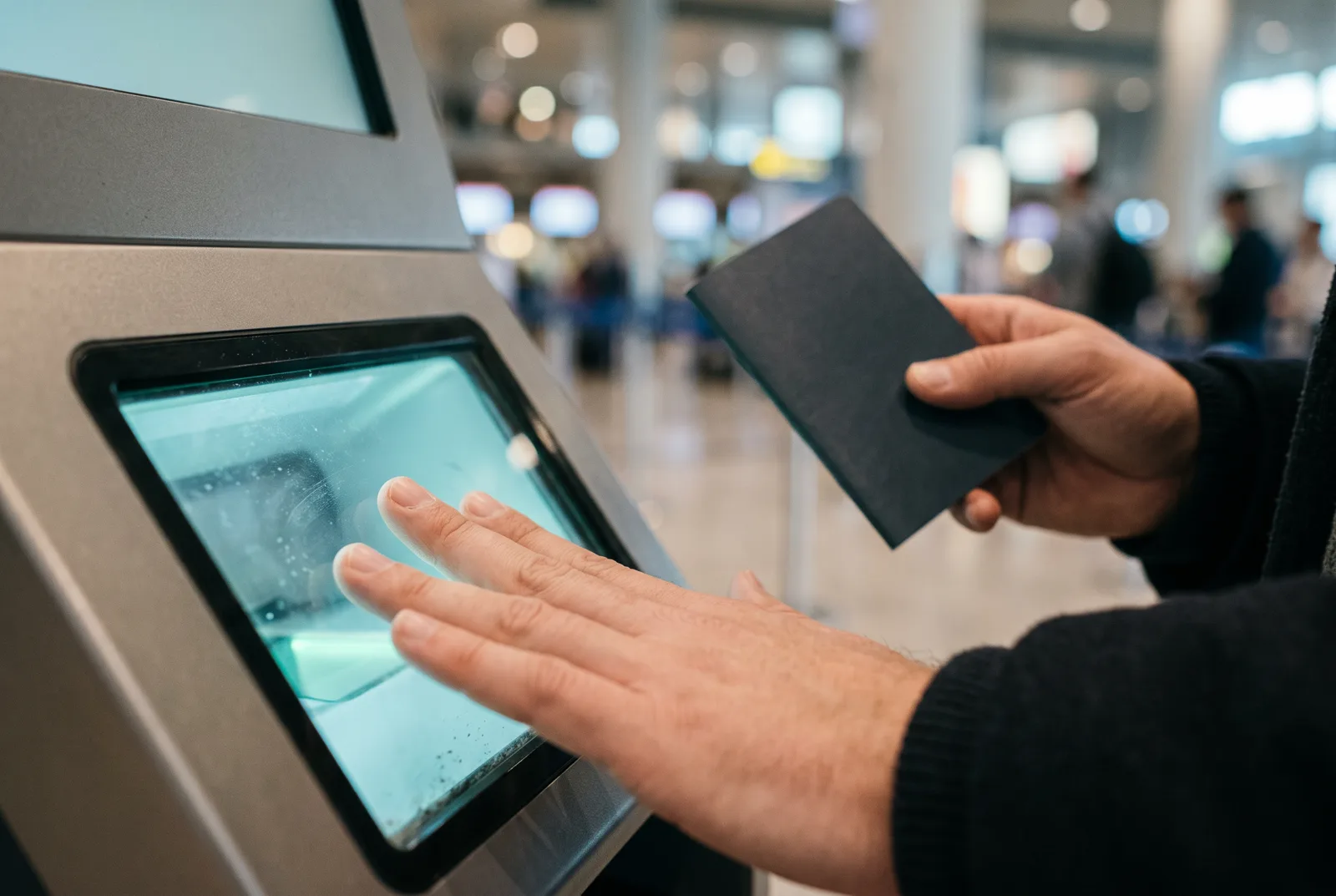
- First crossing since the EES started: the officer photographs your face and/or scans your fingerprints, and creates a digital file. No stamp is put in your passport, whether it is biometric or not.
- Advance registration is possible: at a self-service kiosk where available, or with a mobile app if the country of arrival or departure offers one. You still then see a passport control officer.
- Later crossings: the officer only checks your fingerprints or photo. With a biometric passport and a kiosk available, you can usually pass without seeing an officer if your file is clear of impediments.
- Refusal: if you refuse to provide your biometric data, you will be denied entry.
The GOV.UK guidance adds that you do not need to provide any information before travelling; that at Dover, Folkestone (Eurotunnel) and St Pancras (Eurostar) the checks are completed before you leave the UK; that checks take longer per passenger, so you should expect longer waits, especially at busy times; and that for cruises that start and end outside the Schengen area, day trips usually do not need EES checks, although port authorities can require them in some cases.
A biometric passport is not required to enter: according to the official FAQ, valid passports, biometric or not, are accepted; a biometric passport is only needed to use the self-service kiosks.
What data is recorded, and for how long?
The EES collects the data from your travel document (surname, first names, date of birth and so on), the date and place of each entry and exit, your facial image and fingerprints, and any refusals of entry. For a visa-exempt traveller, the system keeps four fingerprints and the facial image; for a visa holder, only the facial image. Fingerprints of children under 12 are not scanned, even if they are covered by the EES.
| Data | Retention period |
|---|---|
| Entry, exit and refusal-of-entry records | 3 years from the date they were created |
| Individual file | 3 years and 1 day from the date of the last exit (or refusal of entry) |
| No exit recorded | 5 years from the expiry date of your authorised stay |
| Family member of an EU citizen without a residence document, accompanying them | 1 year from the creation of the exit record |
Example calculated by Destination de Voyage from this table: a Canadian friend who leaves the Schengen area on 20 August 2026 and does not come back will have their file erased automatically on 21 August 2029 (3 years and 1 day). Each new trip pushes this date back. GOV.UK, in simpler terms, says your digital EES record is valid for 3 years.
90 days in 180: the EES does the sum
A short stay is limited to 90 days in any 180-day period, across all the countries using the EES taken together. With the EES this calculation is automatic: you can ask the officer for your remaining time, use the « Check how long you can stay » online tool on the official site, or use the kiosks at some border crossing points. If you overstay, you are placed on a list that the authorities can consult, with possible consequences depending on the country: removal, a fine, detention, or a ban on re-entering the EU. If you provide credible evidence of unforeseeable or mitigating circumstances (hospitalisation after a serious injury, for example), your data can be amended and you can be taken off the list. GOV.UK points out that penalties and enforcement vary by member state.
The « Travel to Europe » app
The official app lets travellers subject to the EES who hold a biometric passport pre-register their passport data, facial image and the entry questionnaire within the 72 hours before crossing. When we read the official site, it was usable when entering Sweden (passport data, facial image and questionnaire) and Portugal (questionnaire only); other countries may offer it later. It is optional and does not replace the border check.
What this means for you as a US or UK traveller
- Expect a registration step on your first crossing: photo and, for adults, fingerprints. There is no stamp any more; the EES is what counts for your 90 days.
- Allow extra time at the border, especially at busy times, and tell border staff if you expect problems with biometric checks (GOV.UK).
- You will also need to apply for ETIAS when that system opens: see our ETIAS guide. GOV.UK says it is expected to start in autumn 2026 and that the EU will announce the exact date before launch.
- For trips elsewhere, other countries have their own electronic authorisations: the ESTA for UK citizens going to the United States and the UK ETA for US citizens going to the United Kingdom.
Frequently asked questions
Does the EES apply to US and UK citizens?
Yes. The EES applies to non-EU nationals travelling for a short stay, with or without a visa, which includes US and UK citizens. It does not apply to nationals of EU countries, Iceland, Liechtenstein, Norway or Switzerland.
Does the EES cost anything?
No. There is no application and no payment: registration is done at the border. Do not confuse it with ETIAS.
Since when has the EES been in place?
It was launched in phases on 12 October 2025 and has been fully operational since 10 April 2026.
Do children have their fingerprints taken?
Not under 12: their fingerprints are not scanned, even if they are covered by the EES. The facial image is still recorded.
How long is EES data kept?
Generally 3 years (entry, exit and refusal records) and 3 years and 1 day after the last exit (individual file); 5 years if no exit is recorded.
Do you need a biometric passport for the EES?
No, valid non-biometric passports are still accepted. A biometric passport is used for the automatic kiosks.
Our sources
- European Union, travel-europe.europa.eu/ees: « What is the EES? », « To whom does the EES not apply? », « How does the EES work? », « Data held by the EES », « Travel to Europe mobile app » and FAQ, read on 12 November 2026.
- European Commission, DG Migration and Home Affairs, « Entry/Exit System » page (updated 10 April 2026), read on 12 November 2026.
- UK government, EU Entry/Exit System (GOV.UK, last updated 10 April 2026), and FCDO foreign travel advice for France (GOV.UK, updated 22 October 2026).
- U.S. Department of State, France country information (travel.state.gov, last updated August 11, 2025).
- Regulation (EU) 2017/2226, cited by the official site.
- Our methodology
Updated November 2026.