
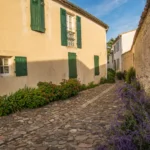
Things to do on the Île de Ré: explore the island by bike, stroll round the harbour and along the UNESCO-listed ramparts of Saint-Martin-de-Ré, discover the white villages with green shutters of La Flotte, Ars-en-Ré and Loix, climb the Phare des Baleines, cross the salt marshes, taste oysters and fleur de sel, and enjoy the long beaches of the south coast. Linked to La Rochelle by a bridge, the Île de Ré can be visited in two or three days, longer for a beach holiday.
About 25 km (16 mi) long and 1.3 to 6 km (0.8 to 4 mi) wide, the Île de Ré has ten municipalities and barely 18,000 year-round residents, a figure that multiplies in summer. It is flat, covered with vineyards, marshes and, on the south side, forests, and criss-crossed by cycle paths. The north, around Ars, Loix and Les Portes, is the wildest, with the Lilleau des Niges nature reserve; the east, between Rivedoux, La Flotte and Saint-Martin, the liveliest. This guide covers the highlights, the budget, access by the bridge and the month-by-month climate based on Météo-France.

Our travel deals for Île de Ré
Affiliate links: we earn a commission, at no extra cost to you.
 FlightsKiwi.comCompare flights and airline combinations to Île de Ré.Compare flights

Île de Ré at a glance
- Department Charente-Maritime, opposite La Rochelle
- Municipalities Rivedoux-PlageLa Flotte, Saint-Martin-de-Ré, Sainte-Marie-de-Ré, Le Bois-Plage-en-Ré, La Couarde-sur-Mer, Loix, Ars-en-Ré, Saint-Clément-des-Baleines, Les Portes-en-Ré
- Access a bridge of almost 3 km (2 mi) from La Rochelle · details
- Train La Rochelle station, then coach or bike to the island
- Entry Schengen rules: US and UK citizens visa-free up to 90 days · details
- Getting around cycling is the most practical option
- Currency euro · currencies
- Electricity 220 V, 50 Hz, type E sockets; US plugs need an adapter (france.fr, checked 26 October 2026)
- Suggested length 2 to 3 days, a week for a beach holiday
- Budget see our budget section
Things to do on the Île de Ré: the highlights
Saint-Martin-de-Ré and its fortifications
The island’s historic capital, Saint-Martin is built around a two-basin harbour lined with café terraces and shops. Its ramparts and citadel, built to Vauban’s plans, are part of the fortifications on the UNESCO World Heritage list; you can walk along much of the walls, around the monumental gates. The bell tower of the church of Saint-Martin offers a view over the rooftops and the sea. The Ernest-Cognacq museum traces the island’s history.
La Flotte
A few kilometres to the east, La Flotte is a fishing village with a very photogenic little harbour and a covered medieval-style market. Next to it, the ruins of the Abbaye des Châteliers, a Cistercian abbey founded in the 12th century, stand at the edge of the fields facing the sea, and Fort La Prée guards the entrance to the strait.
The Phare des Baleines
At the north-western tip, in Saint-Clément-des-Baleines, the Phare des Baleines lighthouse was built in 1853 and is about 57 m (187 ft) tall. You can climb to the top for a view over the whole island and the ocean. At low tide, the fish weirs, traditional low stone walls, are exposed at the foot of the lighthouse. The nearby Conche des Baleines beach is one of the finest on the island.
Ars-en-Ré, Loix and the salt marshes
The north of the island is salt country. Between La Couarde, Loix and Ars, the salt marshes form a chequerboard of pans worked by the salt makers; cycle paths cross them, and the Écomusée du Marais Salant in Loix explains the harvest. Ars-en-Ré is recognisable by its black-and-white bell tower, which served as a landmark for sailors. Loix, almost entirely surrounded by marshes, is the most peaceful village.
The Lilleau des Niges nature reserve
In the north, around Les Portes-en-Ré, this national nature reserve welcomes tens of thousands of migrating birds every year. It is the best place for birdwatching, especially in autumn and winter; guided outings are available. Stay on the paths and respect the quiet zones.
The beaches
The south coast, from Le Bois-Plage to La Couarde, lines up long sandy beaches backed by dunes and forest, more exposed to the waves: surfing and sand yachting are practised at some spots. In the north, the Conche des Baleines and the beaches of Les Portes are wilder. On the east side, Rivedoux and La Flotte have more sheltered beaches, handy for families. Swim at lifeguarded beaches in summer.
The island by bike
The cycle path network links every village, partly along old railway lines and through marshes, vineyards and forests. As the island is flat, the effort depends mainly on the wind, which can be strong. Rental shops are found in every village; in summer, book your bikes, especially for children.
Food and local produce
Oysters tasted in the oyster farmers’ huts, fleur de sel and coarse salt from the marshes, Île de Ré potatoes (PDO), wine and pineau from the cooperative: local produce is sold at markets and by producers. The donkeys in trousers (ânes en culotte), long used for work in the fields and marshes, delight children.
When to go to the Île de Ré
The best months are June and September: the weather is fine and the crowds much smaller than in July-August. The climate is oceanic and among the sunniest on the Atlantic coast: at the La Rochelle-Île de Ré station, highs reach 24.6 °C (76 °F) in July and 24.9 °C (77 °F) in August, and June-July are the driest months (about 40 mm, 1.6 in). Rain is concentrated from October to January. In summer, the island is very busy and the bridge can be congested. Further south, the Île d’Oléron, also linked to the mainland by a bridge, has its own guide with its beaches and sunshine.
When to go to the Île de Ré: key points
- Best periods: June and September
- Swimming: June to September
- Cycling and villages: April to October
- Birdwatching: autumn and winter, Lilleau des Niges reserve
- Warmest month: August, average high of 24.9 °C (77 °F)
- Wettest month: November, 94.6 mm (3.7 in)
- Avoid if possible: mid-July to mid-August without a booking
| Month | High °C (°F) | Low °C (°F) | Rain mm (in) | Crowds | Prices | Verdict |
|---|---|---|---|---|---|---|
| January | 9.6 (49) | 4.4 (40) | 76.3 (3.0) | Very low | Low | ⚠️ Quiet, ideal for birds, many shops closed |
| February | 10.6 (51) | 4.1 (39) | 56.1 (2.2) | Low | Low | ⚠️ Cool, bike rides on fine days |
| March | 13.6 (56) | 6.1 (43) | 57.4 (2.3) | Low | Low | ⚠️ Quiet villages, frequent wind |
| April | 16.1 (61) | 7.9 (46) | 60.7 (2.4) | Medium (Easter) | Medium | ✅ Cycling and villages, cold sea |
| May | 19.6 (67) | 11.3 (52) | 50.9 (2.0) | High (public holidays) | Medium to high | ✅ Mild and in bloom, busy weekends |
| June | 22.8 (73) | 14.4 (58) | 39.3 (1.5) | High | High | ✅ Pleasant beaches, before the crowds |
| July | 24.6 (76) | 16.4 (62) | 40 (1.6) | Very high | Very high | ⚠️ Fine and dry, but the island is saturated |
| August | 24.9 (77) | 16.3 (61) | 46.2 (1.8) | Very high | Very high | ⚠️ The warmest, booking essential |
| September | 22.5 (72) | 13.6 (56) | 59.7 (2.4) | Medium | Medium to high | ✅ Sea still pleasant, calmer island |
| October | 18.3 (65) | 11.2 (52) | 83.7 (3.3) | Low | Medium | ⚠️ Mild, marshes and birds, more rain |
| November | 13.4 (56) | 7.4 (45) | 94.6 (3.7) | Very low | Low | ❌ The wettest |
| December | 10.3 (51) | 4.8 (41) | 89.5 (3.5) | Very low | Low | ❌ Damp, except over the holidays |
- Spring (March to May): 14 to 20 °C (57 to 68 °F) in the afternoon, hollyhocks in the lanes from May. Ideal for cycling; May weekends are busy.
- Summer (June to August): 23 to 25 °C (73 to 77 °F), the driest months. Beaches and café terraces are full in July-August; set off early in the morning to cross the bridge and find a bike.
- Autumn (September to November): September still feels like summer; October is mild and good for birdwatching. Rain increases in November.
- Winter (December to February): about 10 °C (50 °F) in the afternoon, a quiet island. Some shops close, but the villages and marshes can be visited without crowds.
For other late-summer destinations, see our selection of where to go in September.
Itinerary ideas for the Île de Ré
A weekend on the Île de Ré
- Day 1 morning: Saint-Martin-de-Ré, the harbour, ramparts and bell tower
- Day 1 afternoon: La Flotte, the Abbaye des Châteliers, oysters in a hut
- Day 2 morning: by bike to Loix and the salt marshes, then Ars-en-Ré
- Day 2 afternoon: the Phare des Baleines and the Conche des Baleines
A week
- Days 1-2: Saint-Martin, La Flotte, Rivedoux
- Day 3: the salt marshes, the Loix eco-museum
- Day 4: Ars-en-Ré, Saint-Clément, the Phare des Baleines
- Day 5: Les Portes-en-Ré and the Lilleau des Niges reserve
- Days 6-7: the south-coast beaches (Le Bois-Plage, La Couarde), then a day in La Rochelle
For a short break, see also our ideas for cheap weekend breaks.
Budget for a stay on the Île de Ré
| Item (per person per day) | Tight budget | Comfortable |
|---|---|---|
| Accommodation (sharing a double room) | about €40 to 70 (campsite, simple room) | about €110 to 220 |
| Meals | about €30 to 40 (markets, crêperies) | about €50 to 90 |
| Bike rental | about €10 to 15 | about €15 to 25 |
| Activities (lighthouse, museums, nature outings) | about €5 to 15 | about €10 to 20 |
| Total | roughly €90 to 140 per person per day | roughly €180 to 350 per person per day |
Getting around the Île de Ré
- Bridge: almost 3 km (2 mi) long, it opened in 1988. Vehicles pay a crossing charge (eco-tax) that varies with the season; check the current rates and conditions with the Charente-Maritime department before you go.
- Train: La Rochelle station, then a coach to the island villages, or cycle across the bridge. See our tips for travelling cheaply by train.
- Bike: the most practical option, on a network of paths linking every village.
- Car: useful for arriving with luggage, but parking is difficult and paid in the villages in summer. Leave it at your accommodation. US and UK licence holders should read the driving sections of travel.state.gov and GOV.UK.
- Boat: in season, boat trips leave the island for Fort Boyard and the neighbouring islands, depending on the year.
Where to stay on the Île de Ré
Saint-Martin and La Flotte are the liveliest, with restaurants, shops and quick access to the bridge. Le Bois-Plage and La Couarde suit beach stays and the south-coast campsites. Ars, Loix, Saint-Clément and Les Portes are quieter and closer to nature. On a tight budget, staying in La Rochelle and cycling over is still an option. For July-August, book several months ahead. For the city itself, see our guide to visiting La Rochelle.
Entry requirements, health and safety
- US citizens: France is in the Schengen area, which you may enter for up to 90 days for tourism or business without a visa. Immigration officers may ask for proof of sufficient funds and a return ticket, and France does not recognise the 12-page US emergency passport for visa-free entry (U.S. Department of State, travel.state.gov, last updated August 11, 2025).
- UK citizens: no visa for up to 90 days in any 180-day period as a tourist. Your passport must have been issued less than 10 years before the day you arrive and be valid at least 3 months after the day you plan to leave the Schengen area. The EU Entry/Exit System (EES) may require fingerprints and a photo at your first entry (UK FCDO, GOV.UK, updated 22 October 2026).
- ID: you must be able to prove your identity when asked by the police, or within 4 hours at a police station (GOV.UK, updated 22 October 2026).
- Health and emergencies: UK travellers need a GHIC or a valid EHIC for medically necessary state healthcare, which is not a substitute for travel insurance; the European emergency number is 112 (GOV.UK).
- Swimming: sea conditions can be dangerous even for strong swimmers, and some beaches have strong undercurrents, especially along the Atlantic coast. Learn the flag system and follow lifeguards’ advice (GOV.UK, updated 22 October 2026).
- Cycling: a helmet is recommended, and lights in the evening; take care at road crossings in summer.
- Tides: the sea goes out a long way on the north and east coasts; check tide times before shellfish gathering.
For surfing, kitesurfing or sand yachting, check what your travel insurance covers.
Practical tips for the Île de Ré
- Arrive early: in summer, cross the bridge before about 10 am to avoid the queues.
- Markets: every village has one; it is the best place for salt, oysters and potatoes.
- With children: bikes with trailers, the sheltered beaches in the east, the donkeys in trousers; see our ideas for family holidays.
- Internet: good coverage across the island.
Frequently asked questions
What to do on the Île de Ré in one day?
Start with Saint-Martin-de-Ré and its ramparts, cycle to La Flotte for lunch, then cross the salt marshes to Ars-en-Ré and finish at the Phare des Baleines.
Do you have to pay to get onto the Île de Ré?
Vehicles pay a crossing charge (eco-tax) at the bridge, which varies with the season. Check the current rates and conditions with the Charente-Maritime department before you go.
Can you visit the Île de Ré without a car?
Yes: train to La Rochelle, then coach or bike over the bridge. On the island, cycling is the most practical way to get around.
What is the best time to visit the Île de Ré?
June and September: 22 to 23 °C (72 to 73 °F) in the afternoon according to Météo-France’s 1991-2020 normals at La Rochelle-Île de Ré, little rain and far fewer people than in July-August.
How many days do you need on the Île de Ré?
Two to three days for the villages and main sights by bike, a week for a beach holiday.
What is the prettiest village on the Île de Ré?
Saint-Martin-de-Ré is the best known for its harbour and ramparts; La Flotte, Ars-en-Ré and Loix charm with their white lanes and calm.
Our sources
- Météo-France: climate data sheet, 1991-2020 statistics, La Rochelle-Île de Ré station, at the entrance to the bridge (via Wikipedia, « La Rochelle » articles in French and English)
- Wikipedia: « Île de Ré » and « Pont de l’île de Ré » articles, consulted on 14 October 2026
- Entry requirements, health and safety checked on 26 October 2026: U.S. Department of State, France country information (last updated August 11, 2025) and UK FCDO, GOV.UK foreign travel advice for France (updated 22 October 2026)
- France tourism board (france.fr), electricity requirements, checked 26 October 2026
- Our methodology
Updated October 2026.
For more ideas, see our France travel guide and our destinations in Europe.

