What to visit in France? This France travel guide starts from a simple idea: in a few hours by train you go from the cliffs of Normandy to the villages of Provence, from the Loire châteaux to the peaks of the Alps. It helps you choose a region by season, organise your journeys and estimate your budget for a stay in France. Among the less famous regions, our guide to things to do in Auvergne presents volcanoes, lakes and villages for a nature trip. On the Atlantic coast, our guide to visiting the Île d’Oléron ranks the beaches by exposure.
To locate the cities, regions, relief, national parks and airports, see our map of France.
France at a glance
- Capital Paris
- Language French
- Currency the euro (€) · currenciesKeep some cash for markets and motorway tolls
- Time zone UTC+1, UTC+2 in summer (mainland France): 1 hour ahead of London, 6 hours ahead of New York
- Airports Paris-Charles de Gaulle (CDG), Paris-Orly (ORY), Nice (NCE), Lyon (LYS), Marseille (MRS)By TGV, Lyon is about 2 hours from the capital, Marseille about 3 h 30
- Entry Schengen area: no visa for up to 90 days for US citizens (tourism or business) and UK citizens (in any 180-day period) · travel.state.gov · GOV.UKEU Entry/Exit System (EES): fingerprints and photo at the border
- Electricity check voltage and plug types before you go · plugsReference: IEC World Plugs
- Peak season 14 July to 15 August, French school holidays and the May bank holiday weekends
- Budget see our budget section
When to go to France: ideas by season
France can be visited all year round, provided you choose the right region. The climate is oceanic in the west, more continental in the east and in the mountains, and Mediterranean in the south-east. According to Météo-France normals, afternoon highs at Paris-Orly range from 7 °C (45 °F) in January to nearly 26 °C (79 °F) in July; in Nice, from 13 to 28 °C (55 to 82 °F), with very dry summers. For details on the Riviera, see our article on the best time to visit the French Riviera.
In the Hautes-Pyrénées, our guide to visiting the Pic du Midi gives cable car times, prices and temperatures at the summit.
| Season | Trip ideas | Good to know |
|---|---|---|
| Spring (March to May) | Loire châteaux, Provence and the Riviera, Paris, hiking in the south | May bank holiday weekends are very busy; the sea is still cold |
| Summer (June to August) | Brittany, Normandy, the Atlantic coast, hiking in the Alps and Pyrenees, Corsica | Peak season from 14 July to 15 August; June and late August are quieter |
| Autumn (September to November) | Grape harvest in Burgundy, Alsace and the Bordeaux region, the Mediterranean in September, the Dordogne | Heavy rain possible in the south-east in October–November |
| Winter (December to March) | Skiing in the Alps and Pyrenees, Christmas markets in Alsace, mild weather on the Riviera, Paris museums | Ski resorts are expensive during French school holidays |
For month-by-month destination ideas, in France and elsewhere, see also our pages on where to go in May, where to go in June and where to go in September.
What to see in France: the key regions
Paris and the Île-de-France
Paris rewards a few days of exploring: museums (Louvre, Orsay, Orangerie), districts to wander on foot such as the Marais, Montmartre and its Sacré-Cœur or the Latin Quarter, and the banks of the Seine as far as the Île de la Cité and Notre-Dame de Paris. Around the capital, Versailles, Fontainebleau, Chantilly and Giverny make easy day trips. Further afield, Troyes and its half-timbered centre are reached by direct train leaving Paris Gare de l’Est. Book the big museums in advance.
Normandy
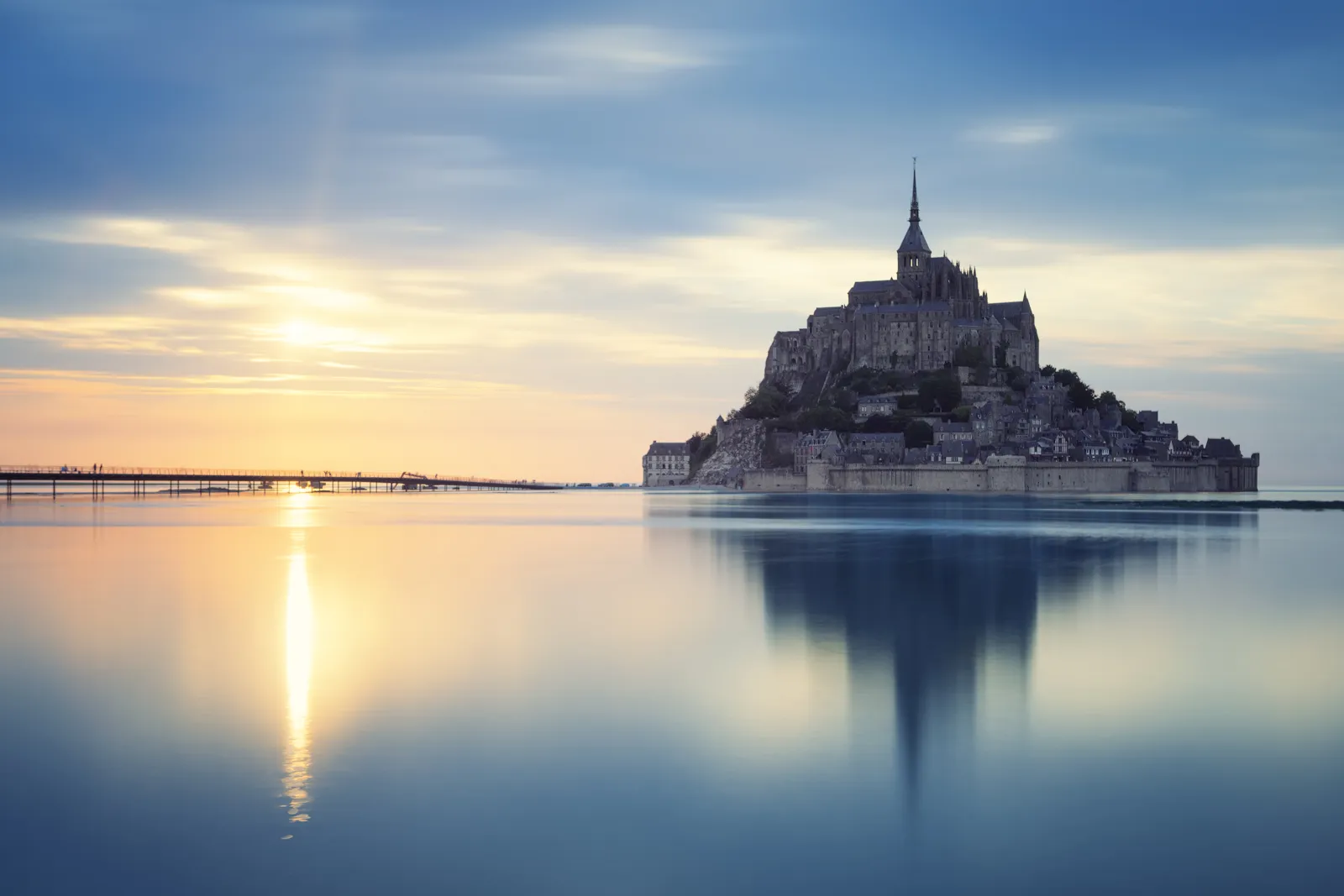
Mont-Saint-Michel and its bay, the cliffs of Étretat, the port of Honfleur, the D-Day beaches and the American Cemetery at Colleville-sur-Mer, the Bayeux Tapestry: Normandy lends itself to a one-week tour. Mont-Saint-Michel is very busy in summer; arrive early or late in the day, and check the times of the big tides. Mont-Saint-Michel, Bayeux, beaches: to plan a trip to Normandy over a week, our guide suggests a complete route.
Brittany
Rugged coasts, lighthouses, fishing ports and islands: Brittany is all about the sea. Saint-Malo and its ramparts, the Pink Granite Coast, the Crozon Peninsula, the Gulf of Morbihan and Belle-Île are the great classics. The climate is oceanic: summers are rarely very hot and the weather changes quickly, so a rain jacket is always useful. Pink Granite Coast or Gulf of Morbihan: our Brittany travel guide helps you choose between these classics.
The Loire châteaux
Chambord, Chenonceau, Amboise, Blois, Cheverny, Villandry and its gardens: the Loire Valley packs many châteaux into a small area. The valley can be explored by car or by bike, along the Loire à Vélo route. Allow two or three châteaux a day at most. Spring and early autumn are the best seasons.
Alsace
Strasbourg and its cathedral, Colmar and its Little Venice, the wine route and its flower-decked villages such as Riquewihr and Eguisheim, the Haut-Kœnigsbourg castle: Alsace can be visited all year round. In December, its Christmas markets draw huge crowds; book accommodation very early. Flower-decked villages in summer or Christmas markets in December: our Alsace travel guide helps you choose according to the season.
Provence and the French Riviera
Provence combines art cities (Avignon, Arles, Aix-en-Provence), Luberon villages, lavender fields, the Camargue and the calanques of Marseille. Lavender usually blooms between late June and late July, depending on altitude and the year. On the Riviera, Nice, Èze, Monaco, Menton, Antibes, Cannes and Saint-Tropez can be combined in a week. Everything is covered in our French Riviera guide. West of Provence, the Rhône delta offers a very different landscape: see things to do in the Camargue, among lagoons and flamingos.
The Alps and the Pyrenees
In winter, the northern Alps (Savoie, Haute-Savoie) and the Pyrenees are the great ski areas. In summer, the mountains become hiking country: Chamonix and the Mont Blanc massif, Vanoise National Park, Écrins National Park, the Cirque de Gavarnie in the Pyrenees. High-altitude trails are generally passable from late June to September, depending on snow cover. For the Mont Blanc massif, our Chamonix travel guide covers the Aiguille du Midi, hikes and seasons. Across the Pyrenean border, our Andorra guide compares the ski season and summer hiking.
In the Pyrenees, our guide to hiking the Cirque de Gavarnie compares the trails to the Grande Cascade and when they are accessible.
The south-west, the Dordogne and Corsica
Bordeaux and its vineyards, the Arcachon Bay and the Dune du Pilat, the French Basque Country, the Dordogne and its riverside villages, the decorated caves of the Périgord: the south-west mixes food, heritage and nature. Corsica, reached by plane or by ferry from Marseille, Toulon or Nice, deserves a trip of its own, ideally in June or September to avoid the summer crowds. June or September, as suggested here: the best time to visit Corsica is detailed region by region in our dedicated guide.
Near the Arcachon Bay, our guide to visiting the Dune du Pilat covers access, parking and sunset times.
Itinerary ideas and road trips in France
One week: the French Riviera by train
- Days 1 and 2: Nice and its museums
- Day 3: Villefranche-sur-Mer and Cap Ferrat
- Day 4: Èze and Monaco
- Day 5: Menton
- Days 6 and 7: Antibes, Cannes and the Lérins Islands
10 days: Normandy and Brittany by car
- Days 1 and 2: Rouen, Étretat, Honfleur
- Days 3 and 4: Bayeux and the D-Day beaches
- Day 5: Mont-Saint-Michel
- Days 6 and 7: Saint-Malo, Dinan, Cap Fréhel
- Days 8 to 10: the Pink Granite Coast, then the Crozon Peninsula or the Gulf of Morbihan
2 weeks: the Loire, Provence and the Riviera
- Days 1 to 3: the Loire châteaux
- Days 4 and 5: Lyon
- Days 6 to 9: Avignon, the Luberon, Arles and the Camargue
- Day 10: Marseille and the calanques
- Days 11 to 14: the Riviera, from Cannes to Menton
France: who is it for?
Our verdict depending on how you like to travel, based on the information in this guide:
| Profile | Our verdict | Why |
|---|---|---|
| Culture | ✅ Ideal | Paris museums, Versailles, the Loire châteaux, Mont-Saint-Michel, the art cities of Provence. |
| Couples | ✅ Yes | Luberon villages, the Alsace wine route, the Loire by bike, the Riviera outside midsummer. |
| Families | ✅ Yes | Beaches in Brittany and Normandy, the mountains in summer, short TGV journeys. |
| Nature and hiking | ✅ Yes | The Mont Blanc massif, Vanoise, the Pyrenees, the Marseille calanques, Corsica. |
| Beach | ✅ Yes | The Riviera, Corsica, Brittany, the Arcachon Bay, depending on the season. |
| Tight budget | ⚠️ Possible | Roughly €75–135 per person per day on a budget trip, more in Paris and on the Riviera in summer; aim for June or September. |

Budget for a trip to France
| Item (per person per day) | Tight budget | Comfortable |
|---|---|---|
| Accommodation (based on a double room) | About €35–60 | About €90–180 |
| Meals | About €25–40 | About €50–100 |
| Local transport | About €10–20 | About €25–50 |
| Sightseeing and activities | About €5–15 | About €15–30 |
| Approximate total | About €75–135 | About €180–360 |
To keep costs down: travel in June or September rather than midsummer, book train tickets early, choose gîtes and rentals shared between several people, and check museums’ free-admission days. In the south-west, in Toulouse, the Cité de l’espace and its tickets is one of the most popular family outings.
Getting around France
- Train: the TGV links Paris with the major cities in a few hours, and cheap fares sell out fast for holidays. TER regional trains serve mid-sized towns and some very scenic lines, such as the Riviera coast. The State Department advises keeping your validated ticket until you have completely left the station, as inspectors carry out random checks with immediate fines (travel.state.gov, last updated August 11, 2025). GOV.UK notes that strikes can be frequent and disrupt transport (updated 22 October 2026).
- Car: essential for the countryside, villages and nature parks. Motorways are mostly toll roads; the State Department warns that toll booths may not accept US credit cards and suggests paying in cash euros. UK photocard licences can be used in France; rental companies may require a year of driving experience, a higher minimum age or an International Driving Permit. The drink-drive limit is a third lower than in England and Wales, winter tyres or chains are compulsory in certain mountain areas from 1 November to 31 March, and a pollution sticker is required in central Paris, Lyon and Grenoble on weekdays from 8 am to 8 pm (GOV.UK). Avoid the big departure Saturdays in July and August.
- Car-sharing and long-distance coaches: budget options between major cities.
- Bike: many cycle routes, such as La Loire à Vélo or the routes along the Canal du Midi, are ideal for a touring trip.
- Plane: mainly useful for Corsica and the longest journeys, such as Lille–Nice.
Getting there
France’s main international airports are Paris-Charles de Gaulle (CDG) and Paris-Orly (ORY), followed by Nice (NCE), Lyon (LYS) and Marseille (MRS). From the UK, Eurostar trains and cross-Channel ferries are alternatives to flying. Check current routes from your home airport with the airlines and the airports.
Where to stay in France
The choice is very wide: city hotels, B&Bs (chambres d’hôtes) and gîtes in the countryside, often well-equipped campsites, holiday residences by the sea and in the mountains, and hostels in the big cities. In July and August on the coast, and in ski resorts during the winter school holidays, book several months ahead. Elsewhere and out of season, you can often book a few days before.
Entry requirements for France, health and safety
- US citizens: you may enter the Schengen area, including France, for up to 90 days for tourism or business without a visa. Your passport should be valid at least three months beyond your period of stay (six months recommended), and immigration officers may ask for proof of sufficient funds and a return ticket. France does not recognise the 12-page US emergency passport for visa-free entry (U.S. Department of State, travel.state.gov, last updated August 11, 2025).
- UK citizens: no visa for up to 90 days in any 180-day period as a tourist. Your passport must have been issued less than 10 years before the day you arrive and be valid at least 3 months after the day you plan to leave the Schengen area. At the border you may be asked for proof of travel insurance, sufficient funds, accommodation and a return ticket. The EU Entry/Exit System (EES) is being implemented: fingerprints and a photo may be taken at your first entry, free of charge; at Dover, Folkestone and St Pancras, checks happen before you leave the UK (GOV.UK, updated 22 October 2026).
- ID: you must be able to prove your identity when asked by the police, or within 4 hours at a police station (GOV.UK). Covering your face in public places is illegal.
- Health: UK travellers need a GHIC or valid EHIC for medically necessary state healthcare; whatever your nationality, take out travel insurance covering medical costs, and mountain rescue if you hike or ski. Emergency numbers: 15 (medical emergencies), 17 (police), 18 (fire), 112 (European emergency number, with some English-speaking staff) (travel.state.gov, GOV.UK).
- Safety: the UK FCDO considers that terrorists are very likely to try to carry out attacks in France: stay vigilant in public places. Pickpockets operate on the Paris Métro, RER lines and at mainline stations; GOV.UK reports serious assaults on RER line B (serving CDG and Orly airports and Gare du Nord) and line D. Demonstrations can take place at short notice.
- Mountains: check the weather and conditions, do not go alone, leave your itinerary with someone and check avalanche risks on Météo-France before skiing off-piste (GOV.UK).
- Sea: swim where lifeguards are present and follow the flags; GOV.UK warns of strong undercurrents along the Atlantic coast and riptides (baïnes) in Gironde and the Landes.
- Summer and autumn: wildfires can occur in summer, especially along the Mediterranean, in Corsica and in the south-west, and causing one, even by accident, is illegal; there is also a flood risk in some areas (GOV.UK). In autumn, follow Météo-France warnings for heavy rain in the south-east.
Practical tips for France
- Museums and sites: many close one day a week (often Monday or Tuesday); book the busiest ones online.
- Restaurants: outside the big cities, lunch service often ends around 2 pm and dinner starts around 7 pm; in small towns it can be hard to eat outside these hours.
- Mobile data: good coverage in towns, patchier in the mountains and some rural areas: download offline maps. Check your home carrier’s roaming charges; an eSIM is a simple way to get local data.
- Public holidays: the long weekends in May (1 and 8 May, Ascension, Whit Monday) push up crowds and prices.
Read also to plan your trip
For the most popular regions, see the best time to visit Corsica, with our page on Corsica in April, and the best time to visit the French Riviera.
For more seasonal ideas, France features in our selection of places to go in September; our guides to Alsace and Lyon complete the picture. For a city weekend, see also our guides to visiting Bordeaux or visiting Toulouse, visiting Nantes and its Voyage à Nantes trail, visiting Dijon and its Cité de la gastronomie, the Roman monuments when visiting Nîmes, or visiting Grenoble at the foot of the mountains.
Frequently asked questions
When is the best time to visit France?
May, June and September offer the best balance almost everywhere: pleasant temperatures, long days and reasonable crowds. Summer suits Brittany, Normandy and the mountains; winter suits skiing, Christmas markets and the Riviera.
Which region of France to visit in summer without too much heat?
Brittany and Normandy, with their oceanic climate, and the mountains (Alps, Pyrenees, Massif Central), where temperatures stay cooler than on the plains or the Mediterranean.
Where to go in France in winter?
Skiing in the Alps or the Pyrenees, Alsace for the Christmas markets in December, or the Riviera, where average afternoon highs reach 13 to 14 °C (55 to 57 °F) in Nice.
Do you need a car to travel in France?
Not for the big cities or the Riviera coast, which are well served by train. For the countryside, Normandy, inland Brittany, the Dordogne or the nature parks, a car remains much more practical.
How much does a week in France cost?
Excluding international travel, allow roughly €75–135 per person per day on a budget trip and €180–360 for a comfortable one, or about €500–950 or €1,250–2,500 for the week. Paris and the Riviera in summer are more expensive.
What are the must-see places in France?
For a first trip: Paris and Versailles, Mont-Saint-Michel and the cliffs of Étretat in Normandy, the Loire châteaux, Alsace, Provence and the Riviera, the Alps, the Dordogne and Corsica. Choose two or three regions according to the season rather than trying to see everything.
Do I need a visa to visit France?
Not for short stays if you are a US or UK citizen: up to 90 days for tourism without a visa (in any 180-day period for UK citizens), with a passport valid at least 3 months beyond your stay. Check travel.state.gov or GOV.UK before you leave.
For a show park in the Vendée, our guide Puy du Fou: 2027 calendar and prices counts the opening days month by month and ranks the shows by length.
For a theme park near Poitiers, our guide Futuroscope: prices, calendar and minimum heights shows which rides your child can go on according to height.
On the Opal Coast, our guide to visiting Nausicaá gives opening hours, prices and off-peak times for the Boulogne-sur-Mer aquarium.
North of Paris, our guide to visiting the Château de Chantilly covers opening hours, tickets and access by regional train.
Between Le Mans and Angers, our guide to visiting La Flèche Zoo gives month-by-month opening hours and prices.
On the A75, our page on visiting the Millau Viaduct brings together official figures, the toll, the viaduct rest area and viewpoints.
In the Île-de-France, our page on visiting the Château de Fontainebleau gives opening hours, prices and train access.
In the Yvelines, our guide to visiting Thoiry Zoo covers the drive-through safari, prices and opening hours.
In the Oise, our guide to visiting the Château de Pierrefonds covers opening hours, prices and the history of Viollet-le-Duc’s restoration.
In Seine-et-Marne, our guide to visiting the Château de Vaux-le-Vicomte covers opening hours, prices and the candlelit evenings.
Near Royan, our guide to visiting La Palmyre Zoo covers opening hours, prices and how to organise the day.
In the Lozère, our page on visiting the Gorges du Tarn brings together canoe routes, villages and viewpoints.
Our sources
- Climate normals: Météo-France 1991-2020 normals for Paris-Orly, Marseille-Marignane (Marseille Provence Airport) and Nice (Nice Côte d’Azur Airport)
- Entry requirements, health, safety and driving checked on 24 October 2026: U.S. Department of State, France country information (last updated August 11, 2025) and UK FCDO, GOV.UK foreign travel advice for France (updated 22 October 2026).
- Our methodology
Updated October 2026.
Discover our other European destinations in our Europe section, including our guides to Italy, the United Kingdom, Belgium, Switzerland, Spain and Portugal.
Transparency: this page contains affiliate links, labelled as such. If you book through them we may earn a commission at no extra cost to you; it does not influence our content or recommendations. How we fund the site.