Planning a trip to England or elsewhere in the United Kingdom? This UK travel guide covers a country made up of four nations: England, Wales, Northern Ireland and Scotland. London is the gateway, but the country offers much more: Stonehenge and the historic towns of the south, the villages of the Cotswolds, the lakes of northern England, the castles and mountains of Wales, the wild coast of Northern Ireland. This guide covers England, Wales and Northern Ireland; Scotland has its own travel guide.
The best period is May to September: in London, average highs rise from 18.4 °C (65 °F) in May to 23.9 °C (75 °F) in July according to Met Office normals, and the days are very long. May, June and September offer the best balance between weather, prices and crowds. The west is much wetter than the east: Cardiff gets more than 125 mm (4.9 in) of rain a month from October to January, against 57 to 67 mm (2.2 to 2.6 in) in London. Winter is cool and damp but rarely freezing, and Christmas livens up the towns in December. Month-by-month climate and events: our article best time to visit London, and for the north, best time to visit Scotland.
What to see in England and the UK: the highlights
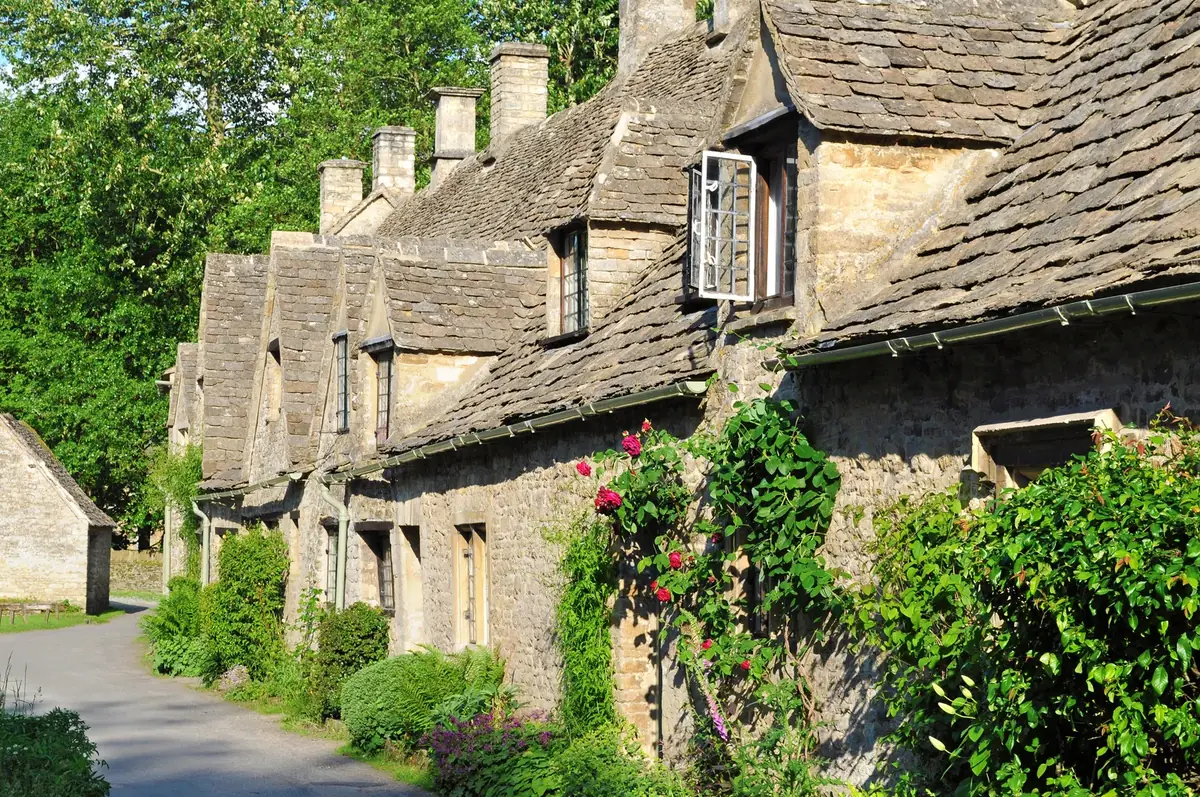
Stone houses in a Cotswolds village in England
London
The capital alone justifies 3 to 5 days: the Tower of London and the Crown Jewels, Westminster and Big Ben, Buckingham Palace, the British Museum and the big free museums, the South Bank of the Thames, markets and lively neighborhoods such as Shoreditch or Camden. Windsor Castle makes a day trip. Our London guide details the sights, the neighborhoods and a day-by-day itinerary.
Stonehenge, Salisbury and Bath
Standing on Salisbury Plain in Wiltshire, Stonehenge is the most famous prehistoric stone circle in the world. The site was built in several phases: a first circular ditch around 3000 BC, then the raising of the large sandstone blocks (the sarsens) around 2500 BC. The smaller bluestones were brought from the Preseli Hills in Wales, more than 200 km (124 mi) away. The monument is aligned on the sunrise at the summer solstice and the sunset at the winter solstice, but its exact purpose is still debated: sanctuary, place of funerary ceremonies, solar calendar. It is a UNESCO World Heritage Site together with nearby Avebury.
Visiting: the site is managed by English Heritage, with timed tickets to book in advance. A visitor center, with a museum and reconstructed Neolithic houses, stands about 2.5 km (1.6 mi) from the stones, linked by shuttle or on foot
Getting close to the stones: the standard visit follows a path around the circle; access inside is only possible on special visits outside opening hours, in limited numbers
The solstices: the site opens free to the public at sunrise on the summer solstice, drawing thousands of people
Getting there: by train from London Waterloo to Salisbury (about 1 h 30), then by tour bus; or on an organized day trip from London, often combined with Bath or Windsor
Avebury: about forty kilometers (25 mi) to the north, this even larger stone circle surrounds a village and is free to visit
Salisbury, about 15 km (9 mi) away, is worth a stop for its 13th-century Gothic cathedral, topped by the tallest spire in the country, which holds one of the original copies of Magna Carta. Further northwest, Bath, a World Heritage city in its entirety, lines up Georgian façades in honey-colored stone, such as the Royal Crescent, around the Roman baths that gave it its name.
Oxford, Cambridge and the Cotswolds
Oxford and Cambridge, about an hour from London, are visited for their medieval colleges, their libraries and their rivers, explored by flat-bottomed boat (punt). Between Oxford and Bath, the Cotswolds are a region of hills and honey-colored stone villages, such as Bibury, Castle Combe or Bourton-on-the-Water; they are best explored by car or on foot, from one village to the next.
York and the north of England
York has kept its walls, its Gothic cathedral (York Minster) and its half-timbered lanes, including the Shambles. Further west, the Lake District, a national park and World Heritage Site, lines up lakes and peaks in the landscapes that inspired the Romantic poets and Beatrix Potter. Liverpool, for its port and Beatles history, and Manchester, for its museums and music scene, round off a trip to the north.
Cornwall and Devon
At the southwestern tip, Cornwall lines up cliffs, coves and fishing harbors: St Ives and its artist’s-studio light, St Michael’s Mount, linked to the shore by a tidal causeway, and the headland of Land’s End. Further east, the Jurassic Coast of Dorset and Devon, a World Heritage Site for its fossil-rich cliffs, offers fine walks on the coast path.
Wales
Wales has its own language, visible on every sign. In the north, Eryri National Park (Snowdonia) surrounds Yr Wyddfa (Snowdon), the highest Welsh peak, reached on foot or by rack railway in season. Edward I’s castles, such as Conwy and Caernarfon, are World Heritage Sites. In the southwest, the Pembrokeshire coast is a coastal national park, and Cardiff, the capital, combines a castle, a redeveloped bay and the national stadium.
Northern Ireland
The Giant’s Causeway, on the Antrim coast, is made up of tens of thousands of basalt columns formed by ancient lava flows; it is a World Heritage Site. The coast road leading to it passes the Carrick-a-Rede rope bridge and the beech avenue of the Dark Hedges. In Belfast, the Titanic Belfast museum tells the story of the liner’s construction in the city’s shipyards, and the murals of the west of the city bear witness to recent history. Derry-Londonderry has kept its 17th-century walls.
Edinburgh, the Highlands, the Isle of Skye and Loch Ness make a trip in their own right, reached by train from London in about 4 h 30. See our Scotland travel guide.
Itinerary ideas: a road trip in England and the UK
8 to 10 days: London and southern England
Days 1 to 4: London, with a day at Windsor Castle
Day 5: Oxford
Days 6 and 7: the Cotswolds by car or local bus
Day 8: Bath
Day 9: Stonehenge and Salisbury
Day 10: back to London (about 1 h 30 by train from Salisbury)
2 weeks: England and Wales
Days 1 to 4: London
Days 5 and 6: Stonehenge, Salisbury and Bath
Days 7 and 8: Cardiff, then the Pembrokeshire coast
Days 9 and 10: Eryri National Park, Caernarfon and Conwy
Days 11 and 12: Liverpool, then the Lake District
Days 13 and 14: York, then back to London by train
1 week: Northern Ireland
Days 1 and 2: Belfast (Titanic Belfast, the city center, the murals)
Days 3 to 5: the Antrim coast road, Carrick-a-Rede, the Giant’s Causeway, the Dark Hedges
Day 6: Derry-Londonderry and its walls
Day 7: back to Belfast for your flight
In the UK, traffic drives on the left (U.S. Department of State): if you rent a car, pick it up on the edge of London, where driving and parking are difficult and expensive.
Budget for a trip to the UK
The UK is an expensive destination, especially for accommodation in London and at the most popular sights in summer. Indicative amounts per person per day, excluding international travel (converted from our euro estimates at the ECB rate of 23 October 2026, €1 = £0.83728):
Item
Budget
Comfort
Accommodation (based on a shared double room)
roughly £35–60 (hostels, simple B&Bs)
roughly £85–165
Meals
roughly £20–40
roughly £50–90
Transport (trains booked in advance, buses, shared car)
roughly £15–25
roughly £25–50
Activities and admissions
roughly £10–15
roughly £15–35
Total per day
roughly £75–140
roughly £175–345
Indicative estimates, to be checked when booking. Allow considerably more in London, and less in small towns and the countryside out of season.
To keep costs down: book trains well in advance (« Advance » tickets are much cheaper than those bought on the day), take advantage of the many free national museums, in London as well as in Cardiff or Liverpool, and have lunch at the pub. Sites managed by English Heritage and the National Trust charge admission; their passes for overseas visitors can pay off on a multi-day tour.
Who is the UK for?
Our verdicts by traveler profile, based on the places, conditions and budget ranges in this guide:
Culture and history: ideal: the Tower of London, the big free national museums, Stonehenge and Avebury, Salisbury Cathedral, Bath, the Oxford and Cambridge colleges, Edward I’s castles in Wales.
Hiking and nature: a very good choice: the Lake District, Eryri National Park and Yr Wyddfa, the Devon and Jurassic Coast path, Pembrokeshire, the Giant’s Causeway.
Road trips: yes: the Cotswolds, Cornwall, rural Wales and the Antrim coast are best explored by car, driving on the left. Pick up the car on the edge of London.
Couples: yes: the stone villages of the Cotswolds, B&Bs and pubs with rooms, the cliffs and coves of Cornwall.
Families: yes: free museums, the Yr Wyddfa rack railway in season, cottages rented by the week, Cornish beaches in summer.
Budget travelers: difficult: roughly £75–140 per person per day, more in London. « Advance » train tickets, free national museums and pub lunches help keep the bill down.
Getting around the UK
Train: the network covers the whole country and links London with the main cities in about 1 to 3 hours. Prices vary enormously: book ahead and avoid peak hours to pay less. National Rail Enquiries (and Translink in Northern Ireland) publish timetables.
Long-distance buses: coach companies (National Express, Megabus) are the cheapest option, but slower than the train.
Car: essential for the Cotswolds, Cornwall, rural Wales or the Antrim coast. According to the U.S. Department of State (travel.state.gov, last updated August 11, 2025), traffic drives on the left; the motorway speed limit is 70 mph (113 km/h) unless a lower limit is posted; the blood alcohol limit is 0.08 in England, Wales and Northern Ireland and about 0.05 in Scotland; hand-held phone use while driving is illegal; and Central London has a congestion charge, with fines if you do not pay it. Check on the UK government website whether your licence is valid in the UK.
Plane: useful for reaching Belfast or the north of Scotland from London.
Where to stay in the UK
B&Bs (bed and breakfast) and pubs with rooms (inns) are the most typical option outside the big cities, full English breakfast included. In the cities, chain hotels offer good value, especially when booked ahead. Youth hostels are plentiful and open to all ages. In the countryside, cottages rented by the week suit families. In summer, in Bath, the Cotswolds, Cornwall and the Lake District, book several months ahead; in London, choose a hotel near a Tube station rather than in a distant suburb.
Entry requirements for the UK
US citizens: according to the U.S. Department of State (travel.state.gov, last updated August 11, 2025), all US citizens traveling to the UK for tourism, family visits, business meetings or short-term study for 6 months or less must have an Electronic Travel Authorisation (ETA) before travel, and the passport must be valid for the entire stay. According to GOV.UK (Apply for an electronic travel authorisation, read on 24 October 2026), an ETA costs £20, lets you travel to the UK for up to 6 months, and every traveler needs their own, including children; other websites may charge more, so apply through the official service. An ETA does not guarantee entry. US passport holders can use the ePassport gates on arrival.
UK citizens: travel within the UK is domestic: no entry formalities apply. If you travel on to the Republic of Ireland or elsewhere, check the requirements for that destination.
Prohibited items: according to the U.S. Department of State, you will be arrested if you bring pocket knives, blades, mace, tasers or pepper spray into the UK.
Medication: confirm that your medication is legal in the UK: some US-approved drugs are controlled substances there. Carry it in its original labeled packaging with a copy of your prescription (U.S. Department of State). For your return home, check your country’s customs allowances (e.g. CBP in the US). Entry requirements checked on 24 October 2026; check them again before you travel.
Health and safety in the UK
Health: according to the U.S. Department of State (travel.state.gov, last updated August 11, 2025), medical care is widely available, but free NHS treatment is only for UK residents, EU nationals and some visa holders: tourists and short-term visitors are charged 150% of the cost of NHS treatment. US travelers should check that their health insurance covers them abroad; Medicare and Medicaid do not. Supplemental insurance covering medical evacuation is recommended.
Safety: violent crime is rare, but be aware of pickpocketing, mugging and « snatch and grab » thefts of phones, watches and jewelry; use only licensed black taxis or pre-booked minicabs; and beware of impostors posing as police officers demanding cash fines (UK police never ask for immediate cash payments). Demonstrations are frequent in cities. The UK Security Service publishes the national terrorism threat level. In Northern Ireland, there is a risk of isolated violence linked to political tensions, which may be higher during the marching season (April to August) and around 12 July (U.S. Department of State).
Pedestrians: traffic comes from the right: look both ways before crossing, and do not expect vehicles to stop for you (U.S. Department of State).
Emergencies: dial 999 for all emergencies (U.S. Department of State).
Practical tips for the UK
Money: the pound sterling is the currency; check your bank’s foreign transaction fees before you leave. The U.S. Department of State advises using ATMs inside bank branches and avoiding temporary-looking or isolated machines. Our currency converter helps you convert prices.
Internet: check your provider’s roaming charges before you leave; a UK eSIM is a simple alternative.
Etiquette: people queue in an orderly way, at bus stops as at the counter. On London Underground escalators, stand on the right and let people pass on the left. In pubs, you order and pay at the bar.
Drinking age: the legal drinking age is 18 (U.S. Department of State).
Read more
To choose your season, our page best time to visit London details the climate month by month and the events, valid for the whole of southern England. The UK is 5 hours ahead of New York: see the time difference with the UK. For the capital, our London guide offers a day-by-day itinerary, and to continue north, our Scotland travel guide covers Edinburgh and the Highlands.
Frequently asked questions
Do I need an ETA to visit the UK?
Yes if you are a US citizen: an Electronic Travel Authorisation is required before travel for visits of up to 6 months (travel.state.gov). It costs £20 according to GOV.UK, and every traveler needs their own. British citizens need no formalities. Checked on 24 October 2026.
What is the best time to visit the UK?
May to September, with the best balance in May, June and September. July and August are the warmest months but also the busiest. The southeast, around London, is the driest region; the west and Wales are much wetter.
How do you visit Stonehenge?
Book a timed ticket with English Heritage. From London, take the train to Salisbury (about 1 h 30), then a tour bus, or join an organized day trip. The visitor path goes around the circle; access inside is only possible on special visits.
How long do you need to visit the UK?
A week to ten days lets you see London and southern England (Windsor, Oxford, the Cotswolds, Bath, Stonehenge). Allow two weeks to add Wales or the north of England, and another week for Scotland or Northern Ireland. Along the way, the university city of Oxford is worth a stop.
How much does a trip to the UK cost?
Excluding international travel, allow roughly £75–140 per person per day on a budget, and roughly £175–345 in comfort. London is considerably more expensive; the countryside and small towns are more affordable, especially out of season.
What to do in England on a first trip?
Combine a few days in London with a loop through the south: Stonehenge, Salisbury and Bath, then Oxford and the Cotswold villages. With more time, add York and the lakes of northern England, or Cornwall and Devon for the coast. Film fans can also book a tour of the Harry Potter studio in London, at Leavesden, northwest of the capital.
Discover our other destinations in Europe, including our guide to Scotland.
Transparency: this page contains affiliate links, labelled as such. If you book through them we may earn a commission at no extra cost to you; it does not influence our content or recommendations. How we fund the site.