Maya and Aztec pyramids, colonial cities, cenotes, beaches on the Caribbean and the Pacific: a trip to Mexico offers a great variety of landscapes and cultures. The country is vast, so you need to choose your regions. This Mexico travel guide brings together the essentials: what to see, which itinerary to choose, what budget to plan and which entry formalities to complete.
To locate cities, regions, terrain, national parks and airports, see our map of Mexico.
Mexico at a glance
CapitalMexico City (Ciudad de México)
LanguageSpanish (and many Indigenous languages: Nahuatl, Maya, Zapotec…)English is common in tourist areas
The best period runs from November to April, during the dry season: clear skies almost everywhere, pleasant heat on the coasts and mild days in Mexico City, where nights stay cool because of the altitude. From June to October, rain falls mostly in afternoon storms. According to the UK FCDO (GOV.UK, updated 20 October 2026), the hurricane season normally runs from June to November and can affect both the Pacific and Atlantic coasts; the U.S. Department of State gives May to November for tropical storms. The risk peaks in September–October. On the Caribbean coast, sargassum seaweed is more frequent from spring to late summer. All the details, month by month and region by region, are in our article best time to visit Mexico.
What to see in Mexico: the highlights
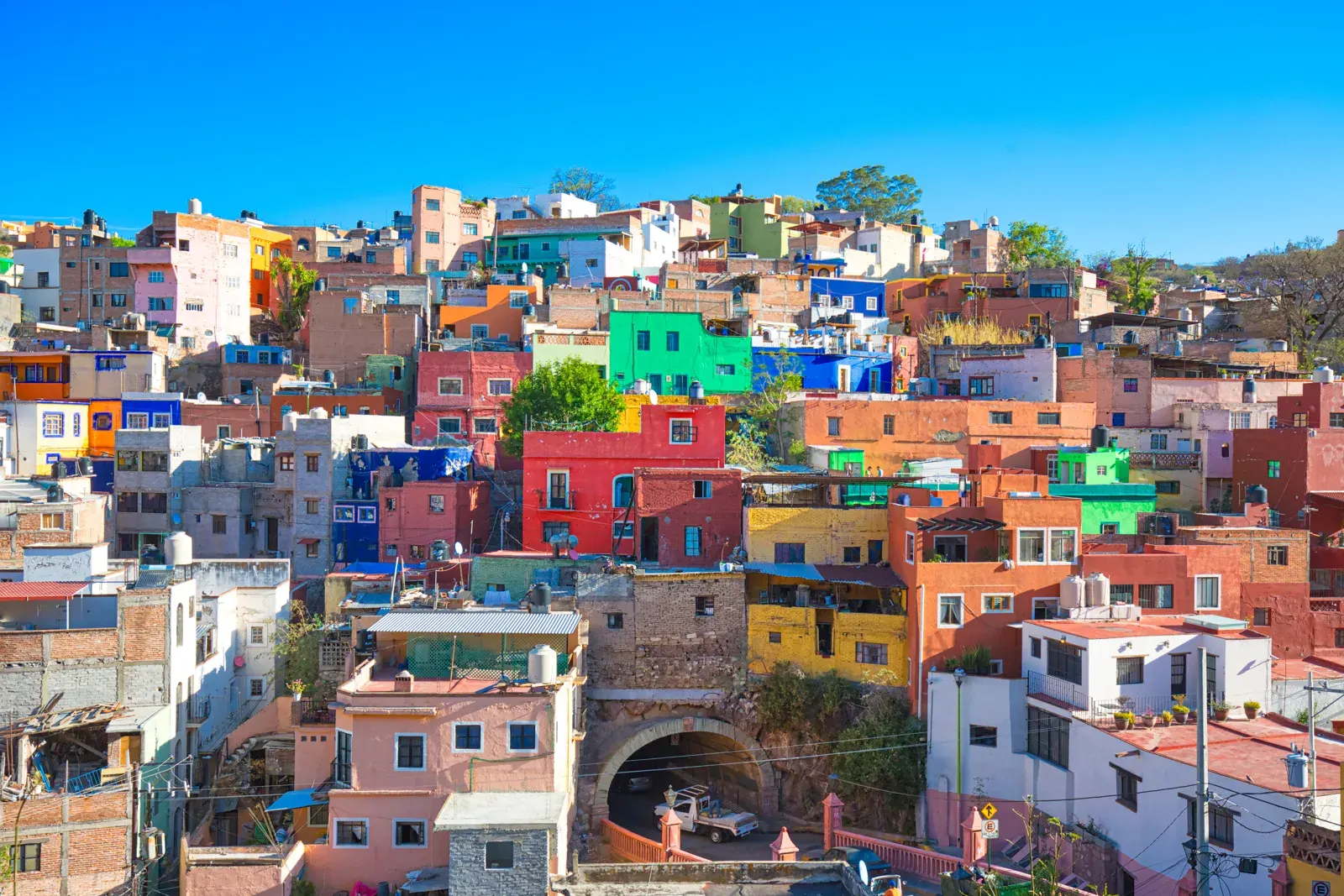
Colorful houses and colonial architecture in the historic center of Guanajuato, Mexico
Mexico City and Teotihuacan
The capital deserves at least three days: the Zócalo and the Aztec Templo Mayor, the National Museum of Anthropology, the Coyoacán (Frida Kahlo’s house), Roma and Condesa neighborhoods, and the canals of Xochimilco. About an hour’s drive away, the site of Teotihuacan and its Pyramids of the Sun and Moon make a day trip. Mexico City is also a good gateway to discover Mexican food.
Puebla, Guanajuato and San Miguel de Allende
The colonial cities of central Mexico stand out for their colorful facades and baroque churches. Puebla, about two hours from Mexico City, is known for its azulejo tiles and its food (mole poblano). Guanajuato, built in a mining ravine, and the more touristy San Miguel de Allende are easy to combine. Note that the UK FCDO (GOV.UK, updated 20 October 2026) advises against all but essential travel to the areas of Guanajuato state south-west of road 45D, including Celaya, Irapuato and Silao.
Guadalajara and Tequila
The country’s second city, Guadalajara is the birthplace of mariachi and charrería. Its historic center, the Hospicio Cabañas (a UNESCO site with murals by José Clemente Orozco) and the crafts district of Tlaquepaque can be visited in two days. About an hour’s drive away, the town of Tequila and its blue agave fields, also UNESCO-listed, offer distillery visits. Guadalajara combines easily with Guanajuato or with the Pacific coast (Puerto Vallarta).
Oaxaca
Oaxaca is the cultural capital of the south: a UNESCO-listed historic center, markets, crafts, mezcal and a cuisine with many moles. Around the city, the Zapotec site of Monte Albán, the petrified waterfalls of Hierve el Agua and craft villages make day trips. The Oaxaca coast (Puerto Escondido, Mazunte) is reached by road or plane. GOV.UK reports ongoing protests blocking road access to Oaxaca airport: allow extra time.
Chiapas: San Cristóbal de las Casas and Palenque
In the mountains of Chiapas, San Cristóbal de las Casas is a colonial town surrounded by Tzotzil Indigenous villages. Further north, in the jungle, the Maya site of Palenque is one of the finest in the country. The UK FCDO (GOV.UK, updated 20 October 2026) advises against all but essential travel on Federal Highway 199 between Rancho Nuevo (just outside San Cristóbal) and the Chancalá junction near Palenque, and within 40 km (25 mi) of the Guatemalan border from the Pacific coast up to Gracias a Dios: plan your route accordingly.
Yucatán: Mérida, Chichén Itzá and the cenotes
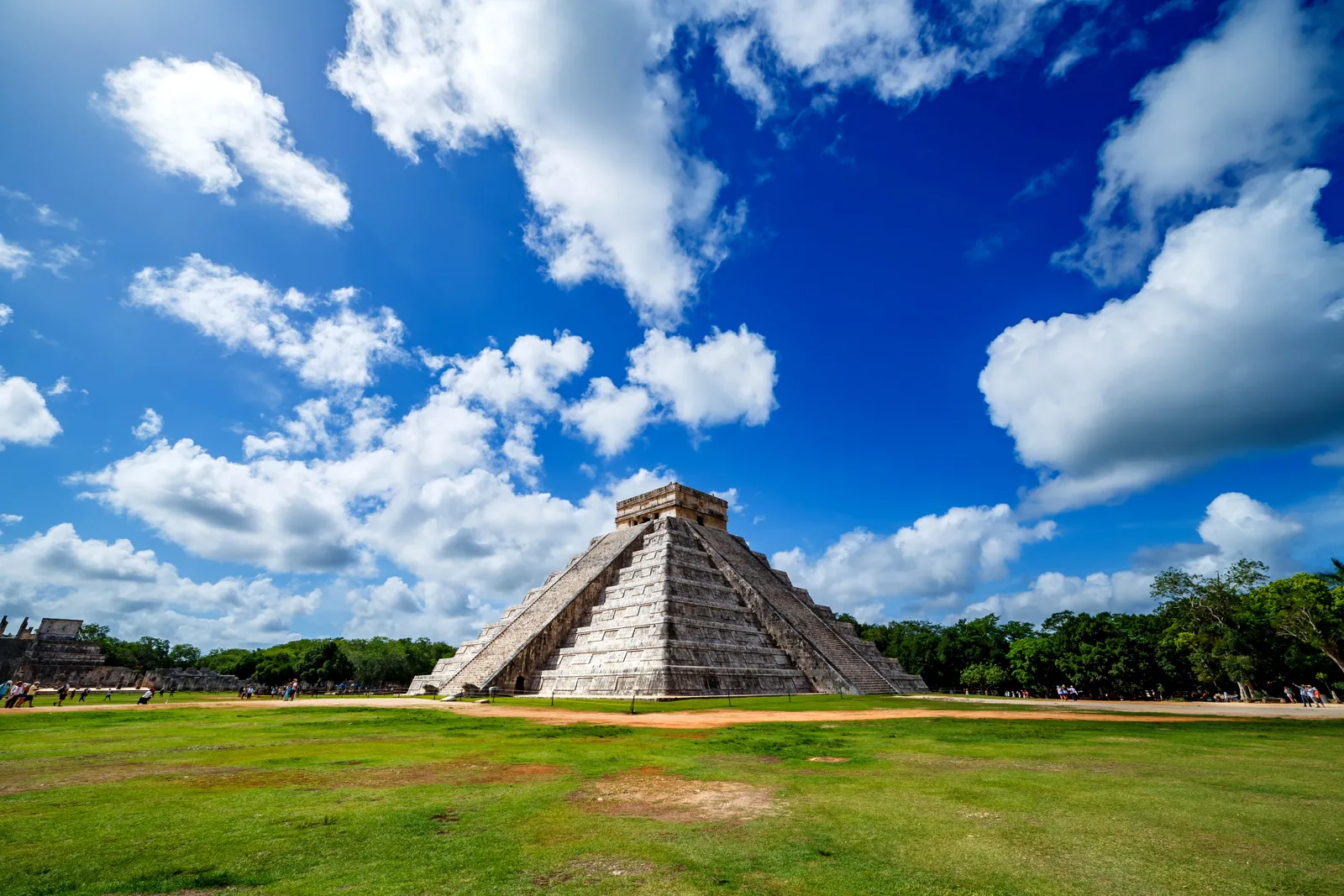
Pyramid of Kukulcán at the Maya site of Chichén Itzá, Yucatán
The peninsula has the most famous Maya sites: Chichén Itzá, Uxmal, Ek Balam. Mérida, the capital of Yucatán, is a practical and lively base. The region is dotted with cenotes, natural freshwater sinkholes where you can swim. Valladolid and Izamal, the « yellow city », round off a tour nicely.
Riviera Maya: Tulum, Playa del Carmen and Bacalar
From Cancún to Tulum, the Caribbean coast lines up white sand beaches, hotels and archaeological sites, including Tulum’s by the sea. Further south, the Bacalar lagoon is quieter. Isla Mujeres, Cozumel (diving) and Holbox round out the region. Tulum, Bacalar, Isla Mujeres: a stay in Cancún can cover the whole Riviera Maya, provided you choose your base well.
The Pacific coast and Baja California
Puerto Vallarta, Puerto Escondido (surfing) or Zihuatanejo appeal to those who prefer the ocean to the Caribbean. GOV.UK advises against all but essential travel to the state of Guerrero, except Zihuatanejo/Ixtapa accessed by air, and to the city of Acapulco. Further north, Baja California offers desert landscapes, the Sea of Cortez and, in winter, whale watching.
Things to do in Mexico: experiences not to miss
Beyond the cities and sites, these are the activities that feature in most trips to Mexico:
Explore Maya and Aztec sites: Teotihuacan near Mexico City, Chichén Itzá, Uxmal and Ek Balam in Yucatán, Palenque in Chiapas, Monte Albán near Oaxaca
Swim in cenotes: around Valladolid, Mérida and Tulum (biodegradable sunscreen, or none at all depending on the site)
Dive or snorkel: Cozumel and the Caribbean coast
Stroll through colonial cities: Puebla, Guanajuato, San Miguel de Allende, Oaxaca, San Cristóbal de las Casas
Taste regional food: markets, taquerias, Oaxaca’s moles, mole poblano in Puebla; see our guide to Mexican food
Visit a distillery: tequila around the town of Tequila, mezcal around Oaxaca
Watch whales: in winter, in Baja California
Surf or enjoy the Pacific: Puerto Escondido, Puerto Vallarta, Zihuatanejo
Tour, road trip or beach stay: which trip to choose?
Type of trip
Who for
Best regions
Points to watch
Road trip in a rental car
Independent travelers, families
Yucatán and Riviera Maya
Speed bumps (topes), avoid driving at night, check official travel advice
Bus and domestic flights
Budget travelers, multi-stop trips
Central Mexico (Mexico City, Puebla, Oaxaca), then Yucatán
Long distances: at least one domestic flight over two weeks
Organized or tailor-made tour
First trip, short on time
Mexico City, Chiapas, Yucatán
Higher cost, set pace
Beach or all-inclusive stay
Relaxation, beach
Cancún, Riviera Maya, Los Cabos
Higher prices, Quintana Roo entry tax, sargassum depending on the season
Indicative comparison of ways to travel in Mexico.
Itinerary ideas for Mexico
7 to 10 days: Yucatán and the Riviera Maya
Days 1–2: Cancún or Playa del Carmen, Isla Mujeres
Days 3–4: Valladolid, Chichén Itzá and cenotes
Days 5–6: Mérida and Uxmal
Days 7–8: Tulum (site and beaches)
Days 9–10: Bacalar, then back to Cancún
2 weeks: from central Mexico to Yucatán
Days 1–4: Mexico City, Teotihuacan
Days 5–6: Puebla
Days 7–9: Oaxaca and surroundings
Day 10: flight to Mérida (or Cancún)
Days 11–12: Mérida, Uxmal, Chichén Itzá
Days 13–14: Tulum or Bacalar before flying home from Cancún
3 weeks: Mexico City, Oaxaca, Chiapas and Yucatán
Days 1–4: Mexico City, Teotihuacan
Days 5–6: Puebla
Days 7–10: Oaxaca, Monte Albán, Hierve el Agua
Days 11–13: San Cristóbal de las Casas (after checking current official travel advice for Chiapas)
Days 14–15: Palenque (GOV.UK advises against Federal Highway 199 between San Cristóbal and Palenque: consider flying or another route)
Days 16–18: Mérida, Uxmal, Chichén Itzá, Valladolid
Days 19–21: Bacalar or Tulum, flight home from Cancún
Distances are long: for a two-week tour, plan at least one domestic flight to avoid spending several days on buses.
Budget for a trip to Mexico
Indicative amounts per person per day, excluding international flights, converted from our euro estimates at the ECB rate of 23 October 2026 (€1 = MXN 21.02) and rounded:
Item (per person per day)
Budget
Comfort
Accommodation
roughly MXN 300–750 (hostel, single room)
roughly MXN 1,250–3,150 (boutique hotel, based on a shared double room)
roughly MXN 400–1,050 (first-class buses, taxis, car rental)
Activities
roughly MXN 100–300 (sites, cenotes)
roughly MXN 650–1,700 (guided tours, diving)
Indicative total
roughly MXN 850–1,450
roughly MXN 2,500–5,250
Indicative estimates excluding international flights. Prices are much higher in Cancún, Tulum and Los Cabos than in central and southern Mexico.
Archaeological sites and cenotes charge admission. According to the UK FCDO (GOV.UK, updated 20 October 2026), you must pay an entry tax to visit the state of Quintana Roo (home to Cancún and Tulum), online before or during your stay, and show proof of payment at the airport before leaving. Check the current amount before your trip. This tax also covers the Riviera Maya: our Tulum travel guide helps you budget around the beaches and the Maya site.
How much does a trip to Mexico cost in total? Applying the ranges above, excluding international flights:
Length
Budget
Comfort
10 days
roughly MXN 8,500–14,500
roughly MXN 25,000–52,500
2 weeks
roughly MXN 12,000–20,500
roughly MXN 35,500–73,500
3 weeks
roughly MXN 17,500–31,000
roughly MXN 53,000–110,500
Per person, based on this guide’s indicative daily budgets. Add the round-trip flight, whose price varies by season and booking date, and any domestic flights.
Who is Mexico for?
Our verdicts by travel style, based on the information in this guide:
Culture and archaeology: ideal: Teotihuacan, Chichén Itzá, Palenque, Monte Albán, the colonial cities from Puebla to Oaxaca.
Beach: yes: the Riviera Maya and Bacalar on the Caribbean side, Puerto Escondido or Puerto Vallarta on the Pacific.
Families: yes: a rental-car road trip in Yucatán and the Riviera Maya suits independent families, with cenotes for swimming.
Budget travelers: yes: roughly MXN 850–1,450 per person per day in central and southern Mexico; Cancún, Tulum and Los Cabos are much more expensive.
Food lovers: ideal: Oaxaca’s moles, mole poblano in Puebla, markets and taquerias, tequila and mezcal.
First trip with little time: yes, on an organized or tailor-made tour (Mexico City, Chiapas, Yucatán), at the cost of a set pace.
Getting around Mexico
Mexico has a dense and comfortable long-distance bus network: first-class companies (ADO in the southeast, ETN or Primera Plus in the center) offer reclining seats and overnight journeys. For long distances (Mexico City – Mérida, Oaxaca – Cancún), domestic flights save a lot of time.
Bus: book online or at the station the day before, earlier during Mexican holidays. GOV.UK advises first-class buses on toll roads, which have fewer incidents than second- and third-class buses on free roads; the U.S. Department of State advises traveling between cities only in daylight.
Tren Maya: this recent line serves several towns on the Yucatán Peninsula; check timetables and which sections are running before relying on it.
Car rental: practical in Yucatán. Watch out for speed bumps (topes). The U.S. Department of State (travel.state.gov, last updated August 11, 2025) says US driver’s licenses are valid in Mexico, Mexican car insurance is required for all vehicles, and you should drive between cities only during the day, on toll roads (« cuota ») rather than free roads. According to GOV.UK, you can drive with a UK photocard licence (paper licence holders may need the 1926 IDP). Using a phone while driving and drink-driving are illegal.
In cities: the metro in Mexico City; both governments advise against hailing taxis in the street: use authorized « sitio » taxi stands, taxis booked by your hotel or trusted ride-hailing apps.
Where to stay in Mexico
In Mexico City, the Roma, Condesa and Coyoacán neighborhoods are pleasant and well located; the historic Centro is practical for sightseeing. In Oaxaca, Mérida or San Cristóbal, stay in the historic center, often in former colonial houses turned into hotels. On the Riviera Maya, choose according to your style: Cancún’s Hotel Zone for large resorts, Playa del Carmen for nightlife, Tulum for small hotels near the beach (more expensive), Bacalar for peace and quiet.
Hostels: plentiful in tourist towns, with dorms and private rooms, often with breakfast included
Posadas and guesthouses: small family-run places, good value in the colonial cities
Boutique hotels: former haciendas in Yucatán, restored colonial houses in Oaxaca, Mérida or San Miguel de Allende
All-inclusive resorts: concentrated in Cancún’s Hotel Zone, on the Riviera Maya and in Los Cabos
Over the year-end holidays, Semana Santa and the Day of the Dead in Oaxaca, book several months ahead: well-located places fill up early.
Entry requirements for Mexico
US citizens
According to the U.S. Department of State (travel.state.gov, last updated August 11, 2025), you need a passport book to fly to Mexico (a passport card is not accepted for air travel). On arrival, Mexican immigration decides how long you may stay, stamps your passport and may send you through an e-gate that prints a receipt with a QR code; you can download your digital entry record (FMMD) from the National Migration Institute (INM). By land, you need a passport book or card and an FMM entry permit, even within 20 km (12 mi) of the border. Minors not traveling with both parents may need a notarized consent letter.
UK citizens
According to the UK FCDO (GOV.UK foreign travel advice, updated 20 October 2026), you do not need a visa to visit as a tourist; your passport is stamped with the number of days you may stay. Your passport must be valid for the duration of your stay, and the Mexican Embassy in the UK recommends at least 180 days’ validity. Border officers may ask for a return or onward ticket, proof of accommodation and proof of sufficient funds. If you use an airport e-gate, keep the printed ticket: you must show it when you leave. If you transit through the USA, you need an ESTA or a visa.
For all visitors
Keep proof of your status: authorities can ask to see your passport and entry stamp and do not accept copies or photos (GOV.UK). Tourists cannot do paid or voluntary work.
Quintana Roo entry tax: mandatory for visitors to Cancún, Tulum and the Riviera Maya, with proof shown at the airport on departure (GOV.UK).
Banned items: e-cigarettes and vaping devices are illegal to bring into Mexico and will be confiscated (GOV.UK; travel.state.gov). Some medicines sold over the counter elsewhere are controlled in Mexico: pseudoephedrine (found in Sudafed) is illegal, according to the U.S. Department of State.
Entry requirements checked on 24 October 2026; check them again before you travel.
Health and safety in Mexico
Health: according to the UK FCDO (GOV.UK, updated 20 October 2026), check vaccine recommendations at least 8 weeks before your trip; health risks include chikungunya, dengue and air pollution, and altitude sickness is a risk in parts of Mexico (Mexico City sits at about 2,240 m, or 7,350 ft). Only drink boiled or bottled water and avoid ice. See a doctor or travel clinic before departure.
Medical costs: according to the U.S. Department of State, Mexico City and major cities have excellent facilities, but providers usually require payment before treatment or discharge, and most hospitals do not accept US health insurance, including Medicare. Insurance covering medical costs and evacuation is strongly recommended.
Safety: crime is a risk for foreign nationals, particularly in major cities and resort areas (GOV.UK). The UK FCDO advises against all but essential travel to several states and areas, including Zacatecas, most of Sinaloa, Tamaulipas, Michoacán, Colima and Guerrero (except Zihuatanejo/Ixtapa by air), parts of Chihuahua, Jalisco, Guanajuato and Chiapas, and the cities of Tijuana, Tecate and Acapulco. GOV.UK also urges great caution after dark in downtown Cancún, Tulum and Playa del Carmen. Check the full list on GOV.UK and the U.S. State Department’s Mexico Travel Advisory before setting your itinerary.
Everyday precautions: use ATMs inside shops, malls or banks in daylight, do not leave drinks unattended, and beware of fake police officers and « virtual kidnapping » phone scams (GOV.UK; travel.state.gov). Do not join demonstrations: political activity by foreigners is illegal.
Natural hazards: hurricane season from June to November (GOV.UK) and earthquakes in most of the country, particularly Oaxaca and Guerrero. Follow local authorities’ instructions.
Emergencies: dial 911; 078 for tourist assistance and Green Angels roadside help on highways (travel.state.gov).
Practical tips for Mexico
Money: withdraw pesos from ATMs inside banks or malls rather than on the street. When a card terminal offers to charge you in your home currency, choose pesos to avoid an unfavorable conversion. Our currency converter helps you estimate prices.
Tipping: customary in restaurants, around 10 to 15% of the bill.
Internet: Wi-Fi is common in accommodation. A local SIM or eSIM is handy for maps, ride-hailing and bookings.
Etiquette: a few words of Spanish are much appreciated. Ask before photographing people, especially in Indigenous communities in Chiapas, where some churches ban photography.
Swimming: in cenotes, sunscreen is often banned or must be biodegradable. According to the U.S. Department of State, beaches can be dangerous because of strong currents, rip tides and rogue waves: stay out of the water when red or black flags are flying.
Customs on return: check your home country’s allowances (e.g. CBP in the US, HMRC in the UK).
Not as a US or British tourist. Immigration sets the length of your stay on arrival and stamps your passport; keep the stamp or e-gate receipt (travel.state.gov, last updated August 11, 2025; GOV.UK, updated 20 October 2026). Visitors to Quintana Roo must pay the state entry tax. Checked on 24 October 2026; check the latest rules before you travel.
How many days do you need in Mexico?
A week to ten days lets you discover one region, such as Yucatán and the Riviera Maya. Allow two to three weeks to combine Mexico City, Oaxaca and Yucatán, with at least one domestic flight.
How much does a trip to Mexico cost?
Excluding international flights, allow roughly MXN 850–1,450 per person per day on a budget and roughly MXN 2,500–5,250 in comfort. The Riviera Maya is much more expensive than central and southern Mexico.
Is Mexico safe for tourists?
It depends heavily on the region. The main tourist areas receive large numbers of visitors, but the UK FCDO advises against all but essential travel to several states and areas, and crime affects cities and resorts too. Check GOV.UK and the U.S. State Department’s travel advisory before you go, and avoid driving at night.
What is the best time to visit Mexico?
From November to April, during the dry season. If possible, avoid September and October on the coasts, at the peak of the rainy and hurricane season.
How much does a 10-day trip to Mexico cost?
Excluding international flights, allow roughly MXN 8,500–14,500 per person on a budget and roughly MXN 25,000–52,500 in comfort, based on our indicative daily budgets. Add the flight, whose price varies by season.
Which region should I choose for a first trip to Mexico?
It depends on what you want. Yucatán and the Riviera Maya combine Maya sites, cenotes and beaches over short distances; central Mexico (Mexico City, Puebla, Oaxaca) suits lovers of colonial cities, museums and food.
What time zone is Mexico in?
Mexico City is on UTC−6 and Cancún on UTC−5, with no daylight saving time. In winter, Mexico City is 6 hours behind London and 1 hour behind New York.
Our sources
Entry, health and safety information read on 24 October 2026: U.S. Department of State, Mexico country information (travel.state.gov, last updated August 11, 2025), and UK FCDO, foreign travel advice for Mexico (GOV.UK, updated 20 October 2026)
Servicio Meteorológico Nacional (Mexico): 1991–2020 climate normals
National Hurricane Center (NOAA): official hurricane season dates
European Central Bank: euro reference rate of 23 October 2026, used to convert our budgets
Transparency: this page contains affiliate links, labelled as such. If you book through them we may earn a commission at no extra cost to you; it does not influence our content or recommendations. How we fund the site.