Sri Lanka packs listed Buddhist sites, high-altitude tea plantations, national parks and beaches on two coasts into a compact island. Distances are short but roads are slow: a tour needs planning. This Sri Lanka travel guide covers what to see, 10-day and 2-week itineraries, budget and entry requirements. The authorization to obtain before you leave is detailed in our guide to the Sri Lanka visa.
To locate cities, regions, terrain, national parks and airports, see our map of Sri Lanka.
Sri Lanka at a glance
CapitalSri Jayawardenepura Kotte (administrative capital)Colombo is the commercial capital and main gateway
LanguagesSinhala and TamilEnglish is widely used in tourism
The island has two offset monsoons. The south and west coasts (Colombo, Galle, Mirissa) and the hill country are at their best from December to March. The east coast (Trincomalee, Arugam Bay) and the north have their dry season from April to September. October and November are the wettest months over much of the country. February and March are the best compromise for a full tour. All the details, month by month and with official climate data, are in our article best time to visit Sri Lanka.
What to see in Sri Lanka: the highlights
Sigiriya and Dambulla
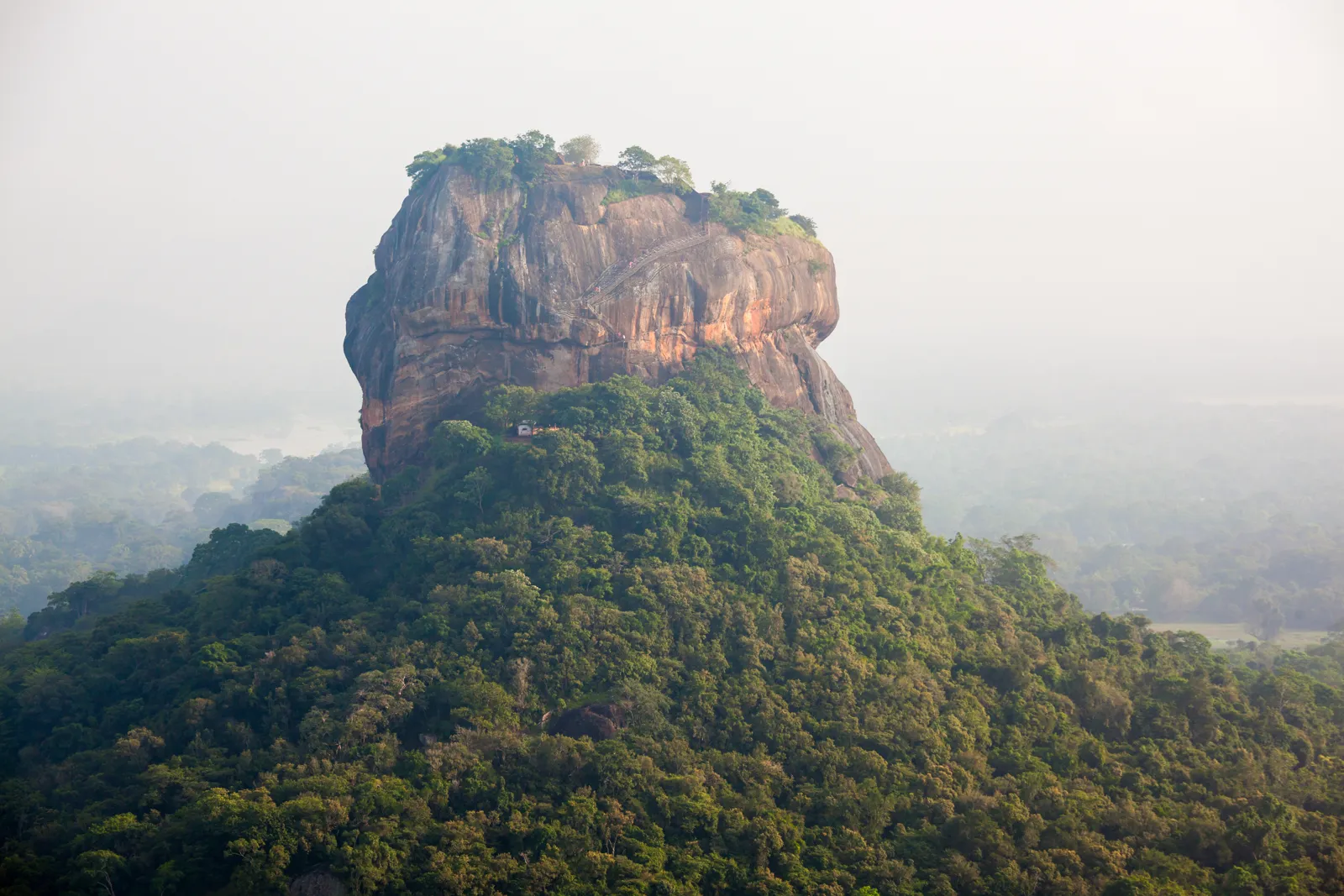
Sigiriya Lion Rock seen from Pidurangala Rock, near Dambulla
Sigiriya Rock, a former royal fortress and World Heritage Site, is climbed by a steep staircase that passes frescoes and the famous lion’s paws. Set off early in the morning to avoid the heat and the crowds. About thirty minutes away, the Dambulla cave temples are decorated with Buddhist statues and paintings.
Anuradhapura and Polonnaruwa
These two former capitals form the « Cultural Triangle » with Sigiriya. Anuradhapura, a major pilgrimage site, has huge white stupas and a sacred fig tree venerated for more than two thousand years. Polonnaruwa, more compact, is easy to explore by bike: palaces, temples and the rock-carved Buddhas of Gal Vihara.
Kandy
The last capital of the Sinhalese kings, Kandy is built around a lake and the Temple of the Tooth, which houses a relic of the Buddha. The city is a natural stop between the Cultural Triangle and the mountains, with the Peradeniya botanical garden close by. Temple of the Tooth, lake and Peradeniya: our Kandy travel guide helps you make the city a stop between the Cultural Triangle and the hills.
Nuwara Eliya and the tea plantations
At almost 1,900 m (6,230 ft), Nuwara Eliya is surrounded by plantations where you can visit a tea factory. Nearby Horton Plains National Park offers an early-morning hike to the World’s End viewpoint. Nights are cool all year round.
Ella
A mountain village that has become a must-see stop, Ella offers easy hikes (Little Adam’s Peak, Ella Rock) and the Nine Arches Bridge. The train ride from Kandy or Nuwara Eliya through the plantations is one of the highlights of a tour. The UK FCDO warns that visitors have died hanging out of open train doorways or windows: stay inside the carriage while the train is moving.
Galle and the south coast
Galle Fort, a UNESCO-listed fortified colonial town, can be explored on foot along its ramparts. Along the coast come the beaches of Unawatuna, Mirissa (the departure point for whale-watching trips), Weligama for beginner surfing and quieter Tangalle. This coast is best from December to March.
The national parks (Yala, Udawalawe, Minneriya)
Yala is known for its leopards, Udawalawe for its elephant herds, and Minneriya for the elephant gatherings around its reservoir during the dry season. Safaris are done by jeep with a driver, preferably early in the morning. Closure periods and fees change: check locally.
Trincomalee and the east coast
The beaches of Nilaveli and Uppuveli, snorkeling around Pigeon Island and the clifftop Hindu temple of Koneswaram: Trincomalee is the base for the east coast. Further south, Pasikudah has a shallow bay and Arugam Bay draws surfers. Best season: April to September. If you are hesitating with Southeast Asia, our comparison Sri Lanka or Thailand helps you choose.
Itinerary ideas: a Sri Lanka tour in 10 days or 2 weeks
7 to 10 days: the essentials
Day 1: arrive in Colombo or Negombo, near the airport
Days 2 and 3: Sigiriya and Dambulla, Polonnaruwa
Days 4 and 5: Kandy
Days 6 and 7: train to Nuwara Eliya then Ella
Days 8 to 10: south coast (Mirissa, Galle) from December to April, or back to Colombo
2 weeks: culture, mountains and beaches
Days 1 and 2: Negombo then Anuradhapura
Days 3 to 5: Sigiriya, Dambulla, Polonnaruwa, safari at Minneriya
Days 6 and 7: Kandy
Days 8 to 10: Nuwara Eliya, Horton Plains, Ella
Day 11: safari at Yala or Udawalawe
Days 12 to 14: south coast and Galle from December to April; from April to September, replace this stop with Trincomalee or Arugam Bay
Budget for a trip to Sri Lanka
Once there, Sri Lanka is affordable, but entrance fees at the major sites (Sigiriya, national parks) are high for foreigners and weigh on the budget. Indicative amounts per person per day, excluding international flights (converted from our euro estimates at the ECB rate of 23 October 2026, €1 = US$1.12):
Item
Budget
Comfort
Accommodation (based on a shared double room)
roughly US$11–28
roughly US$56–135
Meals
roughly US$9–17 (rice and curry, small restaurants)
roughly US$22–45
Transport
roughly US$3–11 (train, bus, tuk-tuk)
roughly US$34–56 (car with driver, shared by two)
Activities and sightseeing
roughly US$11–22 on average
roughly US$22–56
Total per day
roughly US$40–67
roughly US$110–225
Indicative estimates, varying by season and region. Prices rise sharply over the year-end holidays.
Who is Sri Lanka for?
Our verdicts by traveler profile, based on the places, conditions and budget ranges in this guide:
Culture: ideal: Sigiriya Rock, the Dambulla caves, Anuradhapura and Polonnaruwa, the Temple of the Tooth in Kandy, Galle Fort.
Nature and wildlife: excellent: Yala’s leopards, the elephants of Udawalawe and Minneriya, tea plantations, the Horton Plains hike, whales off Mirissa.
Beaches and surfing: a very good choice, depending on the season: the south coast from December to March (Mirissa, Weligama, Tangalle), the east coast from April to September (Trincomalee, Arugam Bay).
Families: yes: short distances, a car with driver recommended, the hill-country train, early-morning jeep safaris, the shallow bay at Pasikudah.
Couples: yes: former planters’ bungalows turned into hotels, nights inside Galle Fort, quiet beaches at Tangalle.
Budget travelers: yes: roughly US$40–67 a day in guesthouses, by train and bus. Entrance fees at Sigiriya and the national parks weigh on the budget.
Getting around Sri Lanka
Car with driver: the most common option for a tour. According to the UK FCDO (GOV.UK, updated 21 September 2026), driving is erratic and road accidents are frequent, particularly at night. Distances are short, but average speeds rarely exceed 40 km/h (25 mph).
Train: slow but very pleasant, especially on the hill-country line (Kandy, Nuwara Eliya, Ella). Reserved seats sell out fast in high season. Watch your belongings: theft and pickpocketing have been reported (GOV.UK).
Buses: very cheap and frequent, but the FCDO notes that public buses are often driven fast and poorly maintained.
Tuk-tuks: handy for short trips. Taxi apps work in Colombo and in tourist areas; otherwise, agree a price before setting off or choose a tuk-tuk with a working meter (GOV.UK). The U.S. Department of State warns about drivers offering « special » tours or gem-shop visits.
Driving yourself: to drive a hire vehicle, UK visitors need a 1949 International Driving Permit obtained in the UK plus a Sri Lankan « recognition permit » issued by the Automobile Association of Ceylon in Colombo (GOV.UK). Riding a motorbike can be especially dangerous.
At night: avoid traveling on the roads after dark when possible.
Where to stay in Sri Lanka
In Colombo, the Fort and Kollupitiya (Colpetty) districts are convenient. Many travelers prefer to spend the first and last nights in Negombo, closer to the airport. In the Cultural Triangle, Sigiriya and Habarana let you reach all the sites. In Kandy, stay near the lake or in the hills above the town. In Galle, sleeping inside the fort lets you enjoy the streets in the evening.
Options range from family guesthouses, often with meals, to beach bungalows, former planters’ bungalows turned into hotels and upscale hotels. Book ahead from December to March on the south coast and in the hills.
Entry requirements for Sri Lanka
US citizens
According to the U.S. Department of State (travel.state.gov, last updated October 16, 2025), US citizens need an Electronic Travel Authorization (ETA) or a visa. Tourists need an ETA approval, a return or onward ticket and proof of sufficient funds. The ETA is available online or on arrival, but the online system is strongly recommended to avoid long delays at the airport. Visas for religious or volunteer work must be obtained from a Sri Lankan embassy before travel.
UK citizens
According to the UK FCDO (GOV.UK foreign travel advice, updated 21 September 2026), you must apply online for an Electronic Travel Authorization (ETA) before traveling; it is issued free of charge and valid for 30 days, and can be extended online through the immigration portal. Your passport must have an expiry date at least 6 months after the day you arrive. Overstaying can lead to detention, a fine, deportation and a future travel ban.
Vaccines: a yellow fever certificate is required if you arrive from a country with a transmission risk (GOV.UK).
Prohibited items: e-cigarettes and vaping devices, weapons, gold, narcotics and pornography; exporting antiques without a licence is a criminal offense (U.S. Department of State).
Buddha tattoos: visible tattoos of the Buddha can lead to refusal of entry or deportation (GOV.UK).
Entry requirements checked on 24 October 2026; check them again before you travel.
Health and safety
Health: check vaccine recommendations at least 8 weeks before your trip (TravelHealthPro or CDC). Health risks include dengue, chikungunya and Zika (GOV.UK): use repellent and cover up. Emergency treatment outside the main cities is not readily available, and private hospitals can be expensive (GOV.UK): take out insurance that covers medical costs and evacuation.
Crime: opportunistic theft has increased, including bag-snatching from motorbikes and thefts from hotels and guesthouses; bank card fraud is common (GOV.UK). Violent crime against foreigners is rare. Sexual harassment is pervasive in crowded places (U.S. Department of State).
Terrorism and demonstrations: terrorist attacks cannot be ruled out; avoid demonstrations and large gatherings (GOV.UK).
North and east: demining continues; heed landmine warning signs and do not leave roads or cleared paths (GOV.UK).
Natural hazards: monsoon rains cause floods and landslides, and there is a risk of tropical cyclones (GOV.UK). Sri Lanka Tourism’s 24-hour hotline: 1912.
The sea: many beaches have dangerous surf or rip tides at certain times of year: ask your hotel before swimming (GOV.UK).
Money: there are ATMs in major towns and cities, but not all accept international cards; use ATMs inside banks or hotels where possible (GOV.UK). Cards are accepted in tourist hotels and restaurants, but tuk-tuks, markets and guesthouses are often paid in cash. Our currency converter helps you estimate your spending.
Internet: mobile coverage is good in towns and tourist areas. A local SIM card or an eSIM is useful for maps and transport apps.
In temples: cover your legs and shoulders, take off your shoes and hat (GOV.UK). Never pose for a photo with your back to a statue of the Buddha: it is a serious offense (GOV.UK and U.S. Department of State).
Poya days: each full moon is a public holiday, and alcohol is not usually available on religious holidays (GOV.UK).
Photography: do not photograph military bases, government buildings or VIP vehicles (GOV.UK). Carry your passport: you may be detained at checkpoints without it (U.S. Department of State).
Tipping: appreciated, especially by drivers and guesthouse staff.
Food: « rice and curry » (rice served with several vegetable, fish or meat curries) is the staple, served at lunchtime in small restaurants. Also try hoppers (bowl-shaped rice pancakes) and kottu. Dishes can be very spicy: ask for a mild version if needed.
You need an Electronic Travel Authorization (ETA). For British citizens it is free, valid for 30 days and must be obtained online before travel, with a passport valid 6 months after arrival (GOV.UK, updated 21 September 2026). US citizens need an ETA, a return ticket and proof of funds (travel.state.gov, last updated October 16, 2025). Checked on 24 October 2026.
How much does a two-week trip to Sri Lanka cost?
Excluding international flights, allow roughly US$40–67 per person per day on a budget, and US$110–225 in comfort with a driver. Entrance fees at the major sites and national parks are a significant expense.
What is the best time to visit Sri Lanka?
December to March for the south and west coasts and the hills, April to September for the east coast and the north. February and March are the best compromise for a full tour.
How many days do you need in Sri Lanka?
About ten days lets you see the Cultural Triangle, Kandy, the hills and a few days on the beach. Two weeks leaves time to add a safari and a longer stay by the sea.
Should you hire a car with driver in Sri Lanka?
It is the most common option, as driving is erratic and accidents are frequent according to the UK FCDO. You can combine it with the train on the hill-country line.
Is Sri Lanka safe?
Violent crime against foreigners is rare, but opportunistic theft, card fraud and tuk-tuk scams are common, according to GOV.UK and the U.S. Department of State. The main risks are road traffic, dangerous currents depending on the season and, in the north and east, landmines away from cleared roads. Avoid demonstrations.
Which airport serves Sri Lanka?
Most international flights land at Bandaranaike International Airport, north of Colombo near Negombo. Flight times depend on your departure city and connections: check current routes with the airlines.
Transparency: this page contains affiliate links, labelled as such. If you book through them we may earn a commission at no extra cost to you; it does not influence our content or recommendations. How we fund the site.