For a first trip, this India travel guide suggests 7 to 10 days for the Golden Triangle (Delhi, Agra, Jaipur) and two weeks to explore Rajasthan or South India, on a budget of roughly ₹2,700–4,800 per person per day (excluding flights and visa). India brings together the palaces of Rajasthan, the Taj Mahal, the ghats of Varanasi, the beaches of Goa, the backwaters of Kerala and the monasteries of Ladakh. It is a huge country, where it is better to choose one or two regions than to try to see everything. This guide gathers the essentials for planning your trip, north and south.
To locate cities, regions, terrain, national parks and airports, see our map of India.
India at a glance
CapitalNew Delhi
LanguagesHindi and English at federal level, many regional languages(Tamil, Malayalam, Bengali…); English is widely used in tourism
Advised against (all travel), UK FCDO (GOV.UK, updated 7 October 2026): within 10 km (6 mi) of the India–Pakistan border (the Wagah-Attari crossing is closed except for the daily border ceremony), and the Union Territory of Jammu and Kashmir, including Srinagar, Pahalgam, Gulmarg, Sonamarg and the Jammu–Srinagar highway (except travel by air to and within the city of Jammu).
All but essential travel: the state of Manipur, including Imphal (GOV.UK).
U.S. Department of State (travel.state.gov, last updated August 11, 2025): avoid traveling to Jammu and Kashmir; foreigners need Restricted Area Permits for some northeastern states and other protected areas.
Naxalite insurgents are active in parts of Chhattisgarh, Jharkhand, Odisha, Madhya Pradesh and Maharashtra: seek local advice before visiting affected areas (GOV.UK).
Rajasthan, Agra, Varanasi, Goa and Kerala are not in these areas. Check the latest advice before you leave.
When to go to India
The best period is October to March for most of the country: dry weather and mild temperatures in Rajasthan, Delhi and Agra, beach season in Goa, and good conditions in Kerala from December to March. April to June is very hot on the northern plains (over 40 °C / 104 °F in May in Delhi), then the monsoon soaks the country from June to September. Ladakh is the exception: go from June to September. All the details, month by month and with IMD normals, are in our article best time to visit India.
Where to go in India: the highlights
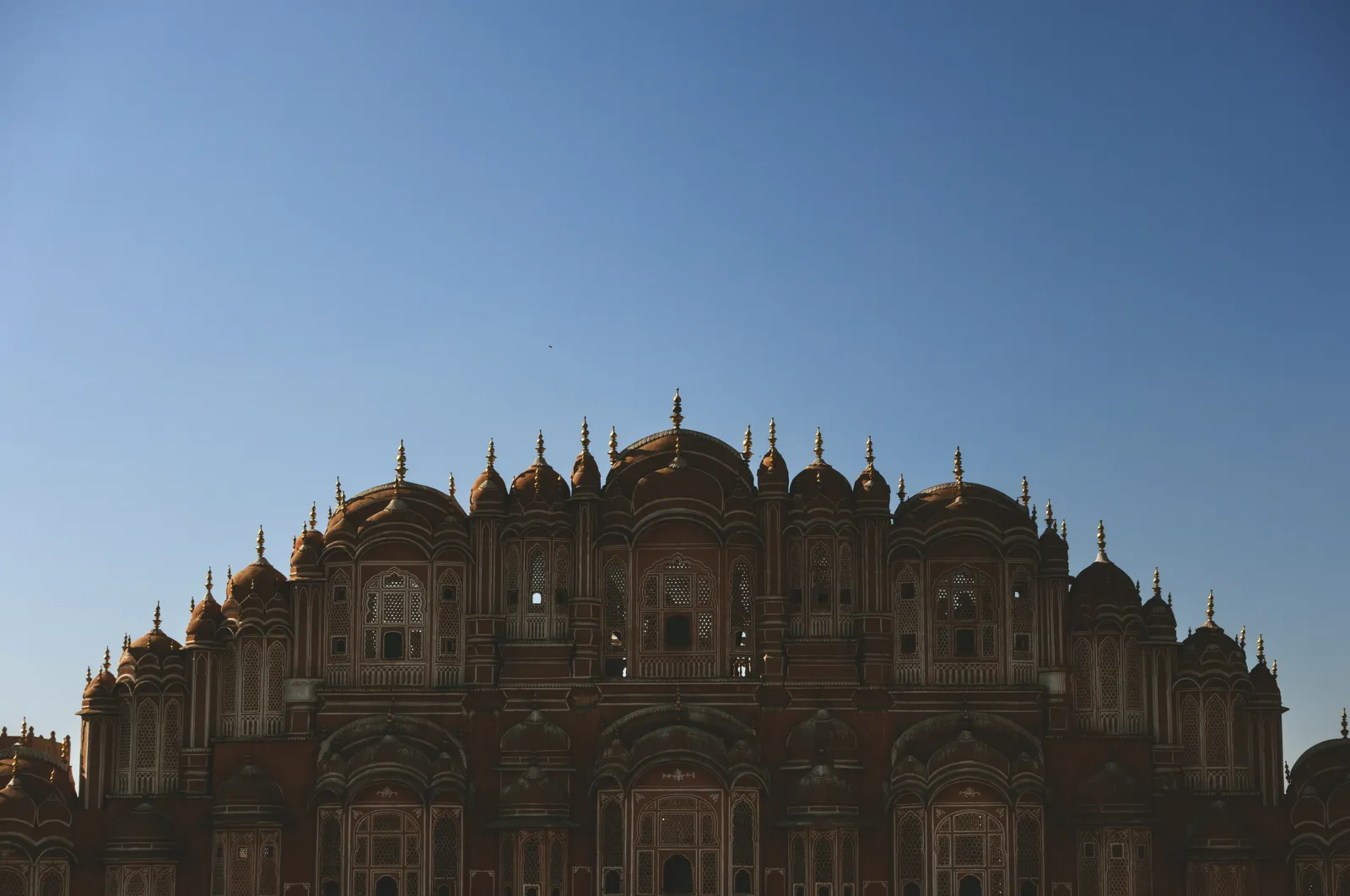
Hawa Mahal, the Palace of the Winds in Jaipur, Rajasthan
Delhi
The capital is the gateway for most tours of the north. Old Delhi has the Jama Masjid, the Red Fort and the market lanes of Chandni Chowk. New Delhi shows another face: Humayun’s Tomb, the Qutb Minar, India Gate and its broad avenues. Before exploring Old and New Delhi, check the paperwork: our page India visa explains the e-visa and the documents needed.
Agra and the Taj Mahal
About 200 km (124 mi) southeast of Delhi, Agra is home to the Taj Mahal, a white marble mausoleum from the 17th century, and Agra Fort. Fatehpur Sikri, a former Mughal capital, can be visited on the way to Rajasthan. Trains link Delhi and Agra in a few hours.
Jaipur and Rajasthan
Jaipur, the « Pink City », is the third stop of the Golden Triangle, with Amber Fort, the Hawa Mahal and the Jantar Mantar observatory. Further west, Rajasthan strings together royal cities: Udaipur and its lakes, Jodhpur the « Blue City » below Mehrangarh Fort, Jaisalmer and its citadel in the Thar Desert. Ranthambore National Park offers a chance to spot tigers.
Varanasi
A holy city of Hinduism on the banks of the Ganges, Varanasi is explored along its ghats, the steps leading down to the river. The evening ceremonies and dawn boat rides are the highlights. Sarnath, where the Buddha gave his first sermon, is close by. Khajuraho and its carved temples can complete a tour of north-central India.
Mumbai
India’s economic capital, Mumbai mixes colonial architecture (the UNESCO-listed Chhatrapati Shivaji Terminus), the Gateway of India, the Marine Drive seafront and lively neighborhoods. The Elephanta Caves are a boat trip from the city. It is a good gateway for combining western India and Goa.
Goa
A former Portuguese trading post, Goa is India’s smallest state. Visitors come for its beaches, livelier in the north and quieter in the south, and for the churches of Old Goa and the colorful houses of Panaji. The beach season runs from November to March; during the monsoon, swimming is dangerous. Lively north, quiet south: the best time to visit Goa is November to March to enjoy both.
Kerala
In the southwest, Kerala is known for its backwaters, a network of lagoons and canals explored by houseboat from Alleppey (Alappuzha) or Kumarakom. Kochi keeps a historic quarter shaped by Portuguese, Dutch and British influences. In the hills, Munnar is surrounded by tea plantations, and Periyar reserve can be explored on foot or by boat.
Ladakh
In the north, Ladakh is a high Himalayan plateau of Buddhist culture. From Leh, at 3,500 m (11,500 ft), visit Thiksey and Hemis monasteries, the Nubra Valley or high-altitude lakes. The season runs from June to September. Certain portions of Ladakh require a Restricted Area Permit (travel.state.gov), and altitude needs a gradual acclimatization.
Things to do in India: 10 experiences for a first trip
To sum up what to see and do in India, here are the experiences described above, to choose by region and season:
Explore Old Delhi, Humayun’s Tomb and the Qutb Minar
See the Taj Mahal and Agra Fort, then Fatehpur Sikri
Visit Amber Fort and the Hawa Mahal in Jaipur
Continue through Rajasthan to Jodhpur and Udaipur, staying in a haveli
Watch life on the ghats along the Ganges in Varanasi
Discover Mumbai before heading to the beaches of Goa
Spend a night on a houseboat on Kerala’s backwaters
Head up to Munnar, among the tea plantations
Visit the monasteries of Ladakh in summer
Taste regional cuisines, from northern curries to southern dosas
Itinerary ideas: how many days in India?
7 to 10 days: the Golden Triangle and Rajasthan
Days 1 and 2: Delhi (Old Delhi, Humayun’s Tomb, Qutb Minar)
Days 3 and 4: Agra (Taj Mahal, Agra Fort) and Fatehpur Sikri
Days 5 to 7: Jaipur (Amber Fort, Hawa Mahal, old city)
Days 8 to 10: Udaipur or Jodhpur, then back to Delhi (by train or plane)
2 weeks: north or south
North option: Delhi (2 days), Agra (2 days), Jaipur (2 days), Jodhpur (2 days), Udaipur (2 days), fly to Varanasi (3 days), back to Delhi
South option: Mumbai (2 days), fly to Goa (4 days), then Kochi (2 days), Munnar (2 days), Alleppey backwaters (2 days), Varkala beach or back to Kochi (2 days)
Summer option (June to September): Delhi (2 days), fly to Leh, acclimatization (2 days), Indus Valley monasteries (3 days), Nubra Valley (3 days), back via Leh and Delhi
Budget for a trip to India
India remains one of the most affordable destinations in Asia once you are there, but the range is wide: a palace hotel in Rajasthan or a villa in Goa costs far more than a guesthouse. Indicative amounts per person per day, excluding international flights and the visa (converted from our euro estimates at the ECB rate of 23 October 2026, roughly €1 = ₹106):
Item
Budget
Comfort
Accommodation (based on a shared double room)
roughly ₹850–2,100
roughly ₹4,300–10,600
Meals
roughly ₹500–1,050
roughly ₹2,100–4,300
Local transport
roughly ₹500–1,050
roughly ₹2,100–3,200 (with a shared driver)
Activities and sightseeing
roughly ₹500–1,050
roughly ₹1,050–2,100
Total per day
roughly ₹2,700–4,800
roughly ₹9,500–19,000
Indicative estimates, varying by season and region. Prices rise sharply from mid-December to early January.
Entrance fees at major monuments are much higher for foreign visitors than for Indians: set aside a budget for the Taj Mahal and the forts of Rajasthan. Hiring a car with driver for a Rajasthan tour is common and, shared between two or more, remains affordable.
Getting around India
Plane: the fastest way over long distances (Delhi – Goa, Delhi – Leh, Mumbai – Kochi). There are many domestic airlines.
Train: the network is huge and covers the whole country, and train travel is generally safe (GOV.UK, travel.state.gov). Book ahead in high season, at the station or on the official Indian Railways website, and avoid people at stations offering tickets and tours (GOV.UK). You must carry valid ID. Watch your belongings in sleeper berths.
Car with driver: the most comfortable option for Rajasthan. If you drive yourself, UK drivers need the 1949 International Driving Permit plus their UK licence (UK FCDO, GOV.UK, updated 7 October 2026); GOV.UK warns that wandering livestock, night and fog driving and fast, reckless buses make roads dangerous.
Bus: cheap and everywhere, of very variable comfort.
In town: metro in Delhi and Mumbai, auto-rickshaws (agree on the price or insist on the meter) and app-based taxis such as Uber and Ola, available in all airport terminals; GOV.UK advises against hailing taxis on the street alone, especially at night.
Where to stay in India
In Delhi, central New Delhi and the south of the city are practical for getting around by metro. In Rajasthan, havelis (traditional mansions) and palaces converted into hotels offer a typical setting at all prices. In Goa, choose the north for nightlife, the south for calm. In Kerala, a night on a houseboat on the backwaters is a popular experience, to be booked early in high season. Hotels must register foreign guests, and you need your passport with a valid visa to check in (GOV.UK).
Be wary of touts at Delhi airport and in stations, who sometimes claim your hotel is closed to steer you elsewhere. Book at least your first night before leaving and arrange your transfer.
Mistakes to avoid on a trip to India
Leaving without a visa: a visa or e-visa is required for US and UK citizens; US citizens can apply for an e-visa at least 4 days before arrival (travel.state.gov).
Forgetting the e-arrival card: it is completed online up to 72 hours before arrival (GOV.UK).
Trying to see everything: choose one or two regions rather than combining north and south in two weeks.
Going to Rajasthan in May or June: it is over 40 °C (104 °F) on the plains (see best time to visit India).
Following touts: at Delhi airport or in stations, some claim your hotel is closed; book your first night and your transfer.
Bringing a vape or a satellite phone: vapes are banned and cannot be brought in, and satellite phones and GPS devices need a license (GOV.UK).
Drinking tap water or touching animals: drink only bottled or treated water, and stay away from stray animals.
Entering a temple uncovered: shoulders and knees covered, shoes removed.
Entry requirements for India
US citizens
According to the U.S. Department of State (travel.state.gov, last updated August 11, 2025), you need a valid US passport and a valid Indian visa or an Overseas Citizen of India (OCI) card to enter and exit. You can apply for an eVisa at least 4 days before arriving; eVisas are not valid at land border crossings. Visa rules change often and with little warning.
Overstaying or breaking visa rules can require an exit permit from the Ministry of Home Affairs, which can take up to 90 days. Keep copies of your passport, visa and entry stamps with you.
UK citizens
According to the UK FCDO (GOV.UK foreign travel advice, updated 7 October 2026), you must have a visa unless you hold an OCI card; you may be able to apply for an e-visa (check restrictions on airports, land borders and seaports of entry). Your passport must have an expiry date at least 6 months after your arrival and at least 2 blank pages.
All foreign nationals must complete an e-arrival card online, up to 72 hours before arrival; it is not a visa. Make sure your passport is stamped on arrival.
A yellow fever certificate is required if you come from a country with a risk of transmission, and a polio vaccination certificate if you come from a polio-affected country. A health self-declaration form, to be completed via the Air Suvidha portal up to 24 hours before arrival, is currently required of all international passengers.
Restricted and protected areas, such as the Andaman and Nicobar Islands, Lakshadweep, Arunachal Pradesh and parts of Sikkim, Ladakh, Himachal Pradesh, Uttarakhand and Rajasthan, require a special permit (travel.state.gov); GOV.UK advises applying 3 months before arrival. Entry requirements checked on 24 October 2026; check them again before you travel.
Health and safety
Health: according to the UK FCDO (GOV.UK, updated 7 October 2026), check vaccine recommendations at least 8 weeks before your trip (TravelHealthPro); health risks include dengue, malaria and Zika. Drink only bottled or treated water and see a travel health clinic before you leave.
Pollution: severe air pollution is a major health hazard, especially from October to February in North Indian cities and big metros (GOV.UK).
Medication: most medicines that need a prescription in the UK also need one in India; bring your packaging (GOV.UK).
Safety: terrorists are very likely to try to carry out attacks in India (GOV.UK), and some regions are advised against (see the box at the top of the page). Female travelers often face harassment, and serious sexual assaults have been reported: avoid isolated areas, including beaches, when alone. Do not accept food or drink from strangers, as spiking has been reported.
Scams: cybercrime, card skimming and confidence scams are common, as are touts at tourist sites (GOV.UK).
Laws: vapes are banned; drinking alcohol in public places is illegal, including on open beaches in Goa; satellite phones and GPS devices require a license (GOV.UK).
Money: you can bring cash or a bank card and withdraw rupees in India (GOV.UK). Use the ATMs of major banks, keep cash in small notes for rickshaws, markets and tips, and watch for card skimming. Cards are accepted in mid-range and upscale hotels and restaurants. Our currency converter helps you estimate your spending.
Internet: the mobile network is good in cities but limited in remote Himalayan areas. A local SIM card or an eSIM is useful for transport apps and maps.
Dress: respect local dress codes, particularly at religious sites and in rural areas (GOV.UK): cover your shoulders and knees, and remove your shoes at temple entrances.
Etiquette: eat and give with your right hand, ask before photographing someone, and stay calm in disagreements.
Copies of documents: keep copies of your passport, visa and entry stamp, and a digital version on your phone. If your passport is lost, you need an exit permit to leave the country (travel.state.gov).
Food: cuisine changes from region to region: curries and breads (naan, chapati) in the north, dosas, idlis and coconut dishes in the south. Many dishes are vegetarian. Choose busy stalls and dishes that are well cooked and served hot, and avoid raw vegetables and ice outside reliable places.
Who is India for?
Culture and heritage: yes: the Taj Mahal, the forts and palaces of Rajasthan, the ghats of Varanasi, the monasteries of Ladakh.
Budget travelers: yes: one of the most affordable destinations in Asia on the ground, roughly ₹2,700–4,800 a day excluding flights and visa; entrance fees at major monuments are higher for foreigners.
Beaches and relaxation: yes, in the south: Goa from November to March, Kerala’s backwaters by houseboat, Varkala beach.
First trip to Asia: possible if you focus on one region, such as the Golden Triangle, with a car and driver or by train; touts, pollution and health precautions need preparation.
Women traveling solo: with particular caution, according to GOV.UK: avoid isolated areas, use app-based taxis, avoid traveling alone at night.
Mountains: yes, in summer: Ladakh from June to September, with the required permits for restricted areas.
Yes. US and UK citizens need a visa or e-visa before travel, unless they hold an OCI card (travel.state.gov, GOV.UK). UK guidance requires a passport valid for at least 6 months from arrival with 2 blank pages, and all foreign nationals complete an e-arrival card before arrival. Checked on 24 October 2026; check the latest rules before you leave.
How much does a two-week trip to India cost?
Excluding international flights and the visa, allow roughly ₹2,700–4,800 per person per day on a budget, and ₹9,500–19,000 in comfort. A car with driver, boutique hotels in Rajasthan or a high-season stay in Goa push the bill up.
What is the best time to visit India?
October to March for most of the country, north and south. For Ladakh, go from June to September.
Is it better to visit the north or the south of India?
For a first trip, the north (Delhi, Agra, Rajasthan, Varanasi) has the best-known sights. The south (Goa, Kerala) is more relaxed and combines culture, nature and beaches. In two weeks, it is better to choose one.
Is India safe?
Most of the main tourist areas are not covered by travel warnings, but the UK FCDO advises against travel to Jammu and Kashmir and near the Pakistan border, and warns of a terrorism risk. The main risks for travelers are roads, theft and scams; women travelers should be particularly vigilant.
How many days do you need in India?
Allow 7 to 10 days for the Golden Triangle (Delhi, Agra, Jaipur) and two weeks for Rajasthan with Varanasi, or for South India (Mumbai, Goa, Kerala). Beyond that, it is better to explore one region in depth than to take more flights.
What should you see in India on a first trip?
The Golden Triangle (Delhi, the Taj Mahal in Agra, Jaipur) is the classic route, often extended into Rajasthan (Jodhpur, Udaipur) or to Varanasi. South India combines Goa, Kerala’s backwaters and the tea plantations of Munnar.
Our sources
Entry, health and safety information read on 24 October 2026: U.S. Department of State, India country information (travel.state.gov, last updated August 11, 2025), and UK FCDO, foreign travel advice for India (GOV.UK, updated 7 October 2026)
European Central Bank: euro reference rates of 23 October 2026 (budget conversion)
India Meteorological Department (IMD), 1991–2020 climate normals (New Delhi, Jaipur, Mumbai, Panaji, Kochi) and 1951–2020 (Leh)
Discover our other destinations in Asia, such as Sri Lanka, near South India, Nepal, to combine with northern India, or Thailand. Remember to take out travel insurance before you leave.
Transparency: this page contains affiliate links, labelled as such. If you book through them we may earn a commission at no extra cost to you; it does not influence our content or recommendations. How we fund the site.