Volcanoes, rainforests, two oceans a few hours’ drive apart: Costa Rica packs a great diversity of landscapes and wildlife into a small country. More than a quarter of the country is protected by parks and reserves, and tourism revolves around nature. This Costa Rica travel guide helps you prepare your trip: what to see, which itinerary to follow, what budget to plan and which entry requirements to meet. Among these practical points, the time difference with Costa Rica has its own page, useful for planning your arrival.
To locate cities, regions, terrain, national parks and airports, see our map of Costa Rica.
Costa Rica at a glance
CapitalSan José
LanguageSpanishEnglish is common in tourist areas; an English-based creole is spoken on the Caribbean coast
Currencythe Costa Rican colón (CRC) · currenciesUS dollar widely accepted
Time zoneUTC−6, no daylight saving · details6 h behind London in winter (7 h during UK summer time), 1 h behind New York in winter
AirportsSan José Juan Santamaría (SJO), Liberia Daniel Oduber (LIR) in GuanacasteCheck current routes with the airlines
EntryUS and UK: visa-free, stay of up to 180 days at the officer’s discretion · travel.state.gov · GOV.UK
Electricitycheck the voltage and plug type with your accommodation before you travel · plugs
Budgetroughly US$65–100 per person per day on a budget, US$170–280 in comfort; see our budget section
When to go to Costa Rica
The dry season, from December to April, is the most reliable period for the Pacific coast, Guanacaste and the Central Valley. From May to November, the « green season » brings showers mostly in the afternoon, lower prices and turtle nesting at Tortuguero. The Caribbean coast follows a different rhythm: its driest months are September and October. All the details, with official climate normals, are in our guide best time to visit Costa Rica.
What to see in Costa Rica: the highlights
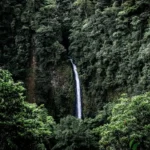
La Fortuna waterfall in the middle of the forest, Costa Rica
Arenal Volcano and La Fortuna
Arenal’s almost perfect cone towers over the small town of La Fortuna, a classic stop on a first trip. Things to do: hikes in the national park around old lava flows, La Fortuna waterfall, hanging bridges in the canopy and hot springs. The volcano has not been actively erupting since 2010 and climbing to the summit is prohibited. If Arenal’s volcanoes and canopy appeal to you, the neighboring country extends the adventure: see things to do in Nicaragua before adding that stop.
Monteverde and the cloud forest
At about 1,400 m (4,600 ft), this region is covered in a humid forest almost always in the mist. The Monteverde and Santa Elena reserves have well-maintained trails; a guided night walk lets you see insects, frogs and small mammals. The access road is winding: allow time.
Manuel Antonio National Park
A small coastal park on the central Pacific, known for its forest-fringed beaches, capuchin monkeys and sloths. It is one of the most visited parks in the country: entries are limited and booked online, and the park is closed on Tuesdays for maintenance, according to the Costa Rica Tourism Institute (ICT) (confirm hours when you book). Arrive at opening time and hire a guide to spot the animals.
Tortuguero
This village on the Caribbean coast is reachable only by boat or small plane. The national park is explored by canoe along forest-lined canals. From July to October, green turtles come to nest on the beach: night outings are only allowed with a licensed guide. The UK FCDO reports several incidents involving small boats in the Tortuguero area, including a fatality due to a falling tree: use an established company (GOV.UK, updated 19 May 2026).
Cahuita and Puerto Viejo de Talamanca
The southern Caribbean coast has a different atmosphere from the rest of the country, shaped by Afro-Caribbean culture. Cahuita National Park is explored on foot along the beach, and Puerto Viejo is the base for the beaches of Punta Uva and Manzanillo. Best time: September–October. The UK FCDO notes that muggings and theft are significant problems, particularly on the Atlantic (Caribbean) coast.
The Osa Peninsula and Corcovado National Park
The wildest region of the country, in the south of the Pacific coast. Corcovado has very rich wildlife (tapirs, four species of monkeys, scarlet macaws). Visiting the park requires a licensed guide. Access via Puerto Jiménez or Drake Bay; best in the dry season.
Guanacaste and the Nicoya Peninsula
The northwest is beach country: Tamarindo, Playa Conchal, Sámara, Nosara, Santa Teresa. The climate is the driest in the country from December to April. Inland, Rincón de la Vieja National Park offers fumaroles, mud pots and waterfalls; the U.S. Department of State notes that the Rincón de la Vieja volcano has become more active: follow park alerts.
Río Celeste and Tenorio Volcano National Park
A hike of about 3 hours round trip leads to a waterfall and a milky-blue river, colored by a chemical reaction between minerals where two streams meet. The color is less visible after heavy rain. An easy stop to combine with Arenal.
San José and the Central Valley
The capital is mainly an arrival point, but deserves half a day: the National Theater, the pre-Columbian gold and jade museums, the central market. Around it, the Central Valley offers easy excursions: the craters of Poás and Irazú volcanoes (access by reservation, opening subject to change with volcanic activity), the basilica in Cartago and coffee plantations, several of which offer guided tours. According to the UK FCDO, Poás has recently had a significant series of eruptions (GOV.UK). Mornings are the clearest for seeing the craters.
Things to do in Costa Rica: experiences not to miss
Watch wildlife in the national parks (Manuel Antonio, Corcovado, Tortuguero), ideally with a naturalist guide
Get close to the volcanoes: Arenal from La Fortuna, Tenorio and the Río Celeste
Tour, road trip or beach stay: which trip to choose?
Option
Who it suits
Points to watch
Road trip in a rental car
Independent travelers, families
4×4 advised on some roads, long drives, avoid driving at night
Public buses and shared shuttles
Budget travelers
Slower, check timetables locally
Organized or tailor-made tour
First trip, little time
Higher cost, set pace
Beach stay
Rest, beach
Guanacaste and Nicoya, driest from December to April
Indicative comparison of ways to travel in Costa Rica.
Itinerary ideas for Costa Rica
7 to 10 days: volcanoes, forest and the Pacific
San José (arrival), then drive to La Fortuna: 2 to 3 nights for Arenal
Option: half a day or a day at Río Celeste
Monteverde: 2 nights for the cloud forest
Manuel Antonio: 2 to 3 nights for the park and the beach
Back to San José (about 3 hours’ drive)
2 weeks: both coasts
San José, then Tortuguero (access via the Cariari or La Pavona road, then boat): 2 nights
Cahuita or Puerto Viejo: 2 to 3 nights
Back through the Central Valley, then La Fortuna and Arenal: 2 to 3 nights
Monteverde: 2 nights
Guanacaste or Nicoya for the beach: 3 nights, flying home from Liberia airport
Dry-season variant: replace the Caribbean coast with Manuel Antonio, Uvita and the Osa Peninsula
Who is Costa Rica for?
Our view by profile, based on the information in this guide:
Profile
Our view
Why
Nature and wildlife
✅ Ideal
Manuel Antonio, Corcovado, Tortuguero, the Monteverde cloud forest, Arenal Volcano.
Families
✅ Yes
A rental-car road trip suits families; beaches on both coasts.
Adventure
✅ Yes
Zip-lining, rafting, surfing, the Río Celeste hike.
Beaches
✅ Yes
Guanacaste and the Nicoya Peninsula on the Pacific side, Cahuita and Puerto Viejo on the Caribbean side.
Budget travelers
⚠️ Possible
One of the most expensive destinations in Central America: roughly US$65–100 a day on a budget.
Culture
⚠️ Limited
San José deserves half a day; the trip remains focused on nature.
Budget for a trip to Costa Rica
Costa Rica is one of the most expensive destinations in Central America: accommodation and guided activities cost about as much as in Europe or North America, or more. Orders of magnitude per person per day, in high season (converted from our euro estimates at the ECB rate of 23 October 2026, €1 = US$1.12):
Item
Budget
Comfort
Accommodation
roughly US$20–45 (hostel, single room)
roughly US$90–170 (lodge, boutique hotel, based on 2 people)
Indicative estimates, likely to vary with the season and exchange rate. Prices drop noticeably in the green season.
How much does a trip to Costa Rica cost in total? Adding up the ranges above, excluding international flights:
Length
Budget
Comfort
10 days
roughly US$560–1,230
roughly US$2,350–4,250
2 weeks
roughly US$785–1,725
roughly US$3,290–5,950
Per person, based on the indicative daily budgets in this guide (high season). Add your round-trip flight.
Getting around Costa Rica
A rental car is the most flexible option. A 4×4 is advised for some roads (Monteverde, the Osa Peninsula, Nicoya), especially in the rainy season. Distances are short but journeys are long: often 3 to 4 hours between two stops. According to the U.S. Department of State (travel.state.gov, last updated August 11, 2025), you need a valid passport and a US driver’s license or an international driving permit, and should try not to drive outside urban areas at night; bridges are often single-lane. UK visitors can use a UK photocard licence for up to 180 days, depending on the stay granted (UK FCDO, GOV.UK, updated 19 May 2026). Do not stop for strangers signaling for help, and in case of an accident, do not move the vehicle until the traffic police and insurance investigator arrive. Mandatory insurance is usually added to the price shown when booking: check the final price.
Public buses serve almost the whole country cheaply, from several bus stations in San José, but the U.S. Department of State advises avoiding them because of pickpocketing. Shared tourist shuttles link the classic stops (San José, La Fortuna, Monteverde, Manuel Antonio, Tamarindo, Puerto Viejo). Domestic flights by small plane save time to Tortuguero, Drake or Puerto Jiménez. Only use official taxis (red, or orange at the airport) or well-known ride-sharing services (GOV.UK).
Where to stay in Costa Rica
Accommodation is concentrated in the stopover towns: La Fortuna, Santa Elena (Monteverde), Quepos and Manuel Antonio, Puerto Viejo, Tamarindo. In San José, most travelers spend only the first or last night, often near the airport in Alajuela. The country has many lodges in the middle of nature, sometimes isolated: check access in the rainy season, and make sure isolated rentals have good security, as robberies have been reported (U.S. Department of State). At Tortuguero and on the Osa Peninsula, lodges often offer packages including transport, meals and guided outings. Hostels and family-run cabinas are the cheapest options.
Entry requirements for Costa Rica
US citizens
According to the U.S. Department of State (travel.state.gov, last updated August 11, 2025), you need a passport valid for the duration of your stay (a damaged passport may be refused) and a return or onward ticket. Authorities may allow stays of up to 180 days without a visa, but this is not guaranteed. Proof of yellow fever vaccination is required if you arrive from certain countries in South America or Africa.
Always carry copies of your ID and immigration papers. If you owe money in Costa Rica (for example unpaid bills from car accidents or medical costs), you may not be allowed to leave.
UK citizens
According to the UK FCDO (GOV.UK foreign travel advice, updated 19 May 2026), you can visit without a visa for up to 180 days under a tourist visa waiver, the exact period being at the discretion of the immigration officer. Your passport must be valid at least 1 day after the day you plan to leave.
A yellow fever certificate is required if you come from a country listed as a transmission risk. A departure tax of US$29 may apply when leaving by air (usually included in the ticket). Cash or goods worth US$10,000 or more must be declared.
Entry requirements checked on 24 October 2026; check them again before you travel. For customs allowances on your return, check your home country’s rules (e.g. CBP in the US, HMRC in the UK).
Health and safety
Health: the UK FCDO (GOV.UK, updated 19 May 2026) lists malaria, dengue and Zika among the health risks, and the U.S. Department of State adds chikungunya and recommends repellent. Check vaccine recommendations at least 8 weeks before your trip and ask a travel clinic about malaria for your itinerary. Medical care is generally of a high standard, but only initial emergency treatment is free for visitors; hospitals often require payment up front. Insurance covering medical costs and evacuation is essential. UK prescriptions cannot be used locally.
Water and alcohol: according to the U.S. Department of State, tap water is often not safe to drink: ask for bottled water. Methanol-tainted spirits, including cheap vodka and « guaro », have caused deaths (GOV.UK).
Swimming: rip currents are very common and there are often no lifeguards; drownings average 50 to 60 a year, a third of them tourists (GOV.UK). Crocodiles are regularly sighted along the Pacific coast between Playa Azul and Playa Esterillos. Do not swim alone or at night.
Safety: theft from rental cars and on beaches are the most common risks: never leave valuables in a vehicle, even in the trunk, and beware of the slashed-tyre scam (GOV.UK). Gang-related violence has become more frequent in some urban areas; avoid walking alone at night in poorly lit areas. Drinks have been spiked. Emergency number: 911.
Natural hazards: earthquakes, hurricane season from June to November, flooding and landslides in the rainy season; several volcanoes are active (Poás, Turrialba, Rincón de la Vieja).
Practical tips for Costa Rica
Money: cards are accepted almost everywhere; keep some colones or dollars in cash for sodas, buses and tips. Be aware of who is around you when using ATMs (GOV.UK). Use our currency converter for your estimates.
Tipping: in restaurants, a service charge is usually already included in the bill; tipping is customary for naturalist guides.
Internet: Wi-Fi is available in most accommodation, but the mobile network can be weak in remote areas (Osa, Tortuguero). A local SIM card or an eSIM is handy for GPS navigation.
Etiquette: « pura vida » is used as hello, thank you and « all good ». Never feed wild animals: it is prohibited in the parks.
ID: as a foreigner, you must carry ID; the police usually accept a printed copy of your passport (GOV.UK).
Allow at least 10 days to see Arenal, Monteverde and one coast without spending your days on the road. Two weeks lets you combine the Pacific and the Caribbean coast.
Should you rent a car in Costa Rica?
It is not essential: buses and tourist shuttles link the main stops. A car, ideally a 4×4, gives more freedom for isolated lodges and dirt roads.
Is Costa Rica expensive?
Yes, it is one of the most expensive destinations in Central America. Allow roughly US$65–100 a day on a budget and US$170–280 in comfort, with lower prices in the green season.
Do I need a visa for Costa Rica?
Not if you are a US or British citizen: stays of up to 180 days are possible without a visa, at the discretion of the immigration officer (travel.state.gov, GOV.UK). You need a valid passport and a return or onward ticket. Checked on 24 October 2026; check the latest rules before you leave.
What is the best time to visit Costa Rica?
December to April for the Pacific coast and the Central Valley, September–October for the Caribbean coast. Month-by-month details are in our dedicated guide.
What budget for 10 days in Costa Rica?
Excluding international flights, allow roughly US$560–1,230 per person on a budget (hostels, buses, sodas) and roughly US$2,350–4,250 in comfort (lodges, 4×4, guided tours), in high season. Prices drop in the green season.
Is Costa Rica a safe country?
The most common risks for travelers are theft from rental cars and on beaches, and rip currents when swimming. Leave nothing in your vehicle, swim only where it is safe and check the latest travel.state.gov or GOV.UK advice before you leave.
Transparency: this page contains affiliate links, labelled as such. If you book through them we may earn a commission at no extra cost to you; it does not influence our content or recommendations. How we fund the site.