An Egypt travel guide starts with the pyramids of Giza, the temples of the Nile Valley and the coral reefs of the Red Sea. Distances are long, but most of the highlights lie along the river, between Cairo and Aswan. This guide covers what you need to plan your trip: what to see, which itinerary to follow, what budget to plan and which precautions to take.
To locate cities, regions, terrain, national parks and airports, see our map of Egypt.
Egypt at a glance
CapitalCairo
LanguageArabicEnglish is widely used at tourist sites
The best period runs from October to April. From November to February, temperatures are ideal for visiting Luxor and Aswan or taking a Nile cruise, but this is also the high season. From June to September, average afternoon highs exceed 41 °C (106 °F) in Upper Egypt: this is the season for beach holidays on the Red Sea, where the breeze makes the heat more bearable. Spring can bring the khamsin, a sand-laden wind. All the details, month by month with official climate data, are in our article best time to visit Egypt.
Things to do in Egypt: the highlights
Cairo
The capital is a vast, lively metropolis. Allow at least two days for the Grand Egyptian Museum near Giza, Islamic Cairo and its mosques (Al-Azhar, Ibn Tulun, Sultan Hassan), the Saladin Citadel, the Khan el-Khalili bazaar and Coptic Cairo. Traffic is very heavy: use the metro or ride-hailing apps.
Giza, Saqqara and Dahshur
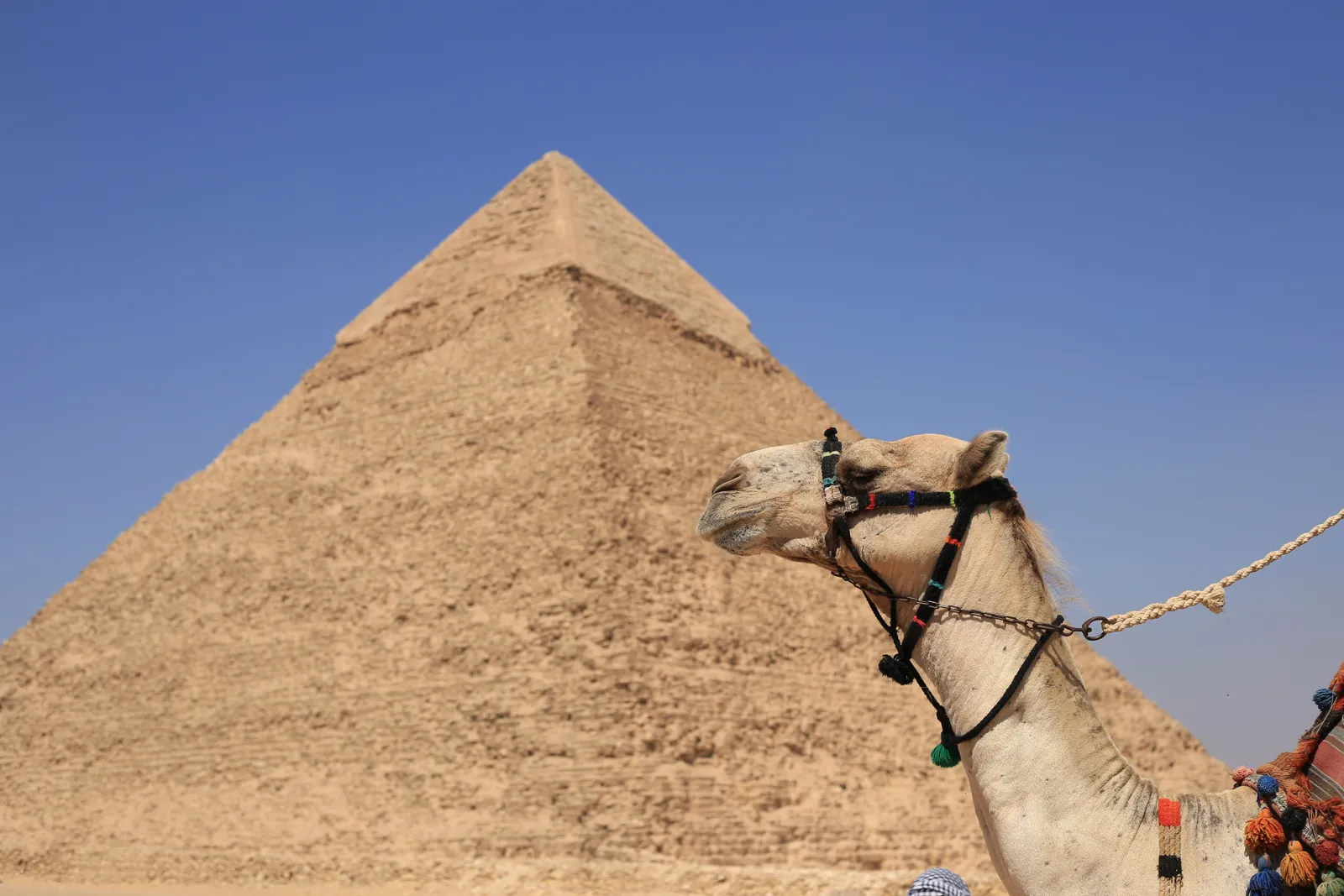
Camel in front of the pyramids of Giza
The Giza plateau, on the edge of Cairo, is home to the pyramids of Khufu, Khafre and Menkaure and the Sphinx. Further south, the necropolis of Saqqara with the Step Pyramid of Djoser, then Dahshur and its Bent Pyramid, can be visited on the same day, often with far fewer people. Arrive at opening time to avoid the heat and the tour groups.
Luxor
Ancient Thebes has an exceptional concentration of monuments. On the east bank: the temples of Karnak and Luxor. On the west bank: the Valley of the Kings, the Valley of the Queens, the Temple of Hatshepsut at Deir el-Bahari, the Colossi of Memnon and the temple of Medinet Habu. Allow at least three days. Sunrise hot-air balloon flights are a popular option; the UK FCDO (GOV.UK, updated 4 August 2026) advises speaking to your tour company before booking, as some UK operators have stopped selling them because they could not verify safety standards. Our guide things to do in Luxor covers these sites in detail.
Aswan and Abu Simbel
Further south, Aswan is quieter: felucca rides on the Nile, the Temple of Philae on its island, Nubian villages and the botanical garden on Kitchener Island. It is the starting point for Abu Simbel, the two temples of Ramesses II and Nefertari, about 280 km (174 mi) away, reached by road on a day trip or by plane. The U.S. Department of State advises avoiding all Egyptian border areas, including the Sudanese border (travel.state.gov, last updated August 11, 2025).
In the far south, our page visiting Abu Simbel gives opening hours, official prices and safety guidance.
Nile cruise
Between Luxor and Aswan, a three- to four-night cruise links the two cities, stopping at the temples of Edfu and Kom Ombo. Options range from large classic boats to dahabiyas, traditional sailing boats with a few cabins, more expensive but more intimate. The best period is November to February. As November opens this ideal window for the Nile, Egypt’s weather in November helps you choose between a large boat and a dahabiya according to the heat.
Hurghada, Marsa Alam and the Red Sea
The Red Sea coast is known for its coral reefs. Hurghada is the most developed resort, with many dive centers and boat trips to the islands. Further south, Marsa Alam is quieter, with reefs reachable from the beach. Hurghada is about four hours by road from Luxor, which makes it easy to combine a tour with a beach stay: a stay in Hurghada can include the Nile Valley.
Sharm El-Sheikh, Dahab and South Sinai
At the tip of Sinai, Sharm El-Sheikh is known for diving in Ras Mohammed National Park. Dahab has a more laid-back atmosphere. St Catherine’s Monastery, at the foot of Mount Sinai, can be visited from these resorts. According to the UK FCDO (GOV.UK, updated 4 August 2026), Red Sea tourist areas in the southern Sinai are generally low risk, but it advises against all travel to North Sinai and against all but essential travel to the northern part of South Sinai beyond the St Catherine–Nuweiba road (except the coastal areas). The U.S. Department of State advises avoiding the northern and middle Sinai and being cautious in Sharm El-Sheikh, Dahab, Taba and St Catherine’s (travel.state.gov, last updated August 11, 2025).
Alexandria
On the Mediterranean, about three hours from Cairo, Alexandria shows another side of Egypt: the Corniche, the modern library (Bibliotheca Alexandrina), the Citadel of Qaitbay on the site of the ancient lighthouse and the catacombs of Kom el-Shoqafa. One or two days are enough.
Itinerary ideas for Egypt
7 to 10 days: the essentials
Days 1 to 3: Cairo, Giza and Saqqara, the Grand Egyptian Museum
Day 4: flight or overnight train to Luxor
Days 5 and 6: Luxor, east and west banks
Days 7 to 9: cruise from Luxor to Aswan (Edfu, Kom Ombo), or the road with a private driver
Day 10: Abu Simbel, then a flight back to Cairo
2 weeks: the Nile and the Red Sea
Days 1 to 3: Cairo and the pyramids
Days 4 to 7: Luxor, then a cruise to Aswan
Days 8 and 9: Aswan, Philae and Abu Simbel
Day 10: back to Luxor and on by road to Hurghada or Marsa Alam
Days 11 to 14: beach, snorkeling or diving on the Red Sea
Budget for a trip to Egypt
Once there, Egypt remains affordable, but entrance fees at the major sites have risen sharply in recent years and add up quickly. Indicative amounts per person per day, excluding international flights (converted from our euro estimates at roughly €1 = US$1.12, ECB rate of 23 October 2026):
Item
Budget
Comfort
Accommodation (based on a shared double room)
roughly US$11–28
roughly US$56–134
Meals
roughly US$9–17 (canteens, local dishes)
roughly US$28–56
Local transport
roughly US$6–11
roughly US$22–45 (driver, domestic flights)
Sightseeing and entrance fees
roughly US$17–28
roughly US$28–56
Total per day
roughly US$45–78
roughly US$134–280
Indicative estimates, varying with the season. A Nile cruise is paid separately or as a package, with wide price differences depending on the boat.
Also budget for tips (« baksheesh »), expected for many small services: site guards, porters, boat crews. Always carry small notes in Egyptian pounds.
Getting around Egypt
Plane: the fastest way between Cairo, Luxor, Aswan, Abu Simbel, Hurghada and Sharm El-Sheikh.
Train: the Cairo – Luxor – Aswan line follows the Nile, and overnight sleeper trains link Cairo with Upper Egypt. Note that the U.S. Department of State considers public buses, microbuses and trains unsafe, citing regular train accidents (travel.state.gov, last updated August 11, 2025).
Boat: cruises between Luxor and Aswan, feluccas for short trips, ferries across the Nile in Luxor. The U.S. Department of State reports multiple fatal accidents involving dive boats on the Red Sea coast.
Car with driver: common for excursions (Saqqara, Abu Simbel, Luxor – Hurghada). The U.S. Department of State describes driving in Egypt as extremely dangerous and suggests taxis or hired drivers instead. If you do drive, UK licence holders need the 1949 International Driving Permit plus their UK licence, obtained in the UK before travel, for up to 6 months, and should not drive outside main cities and resorts at night (UK FCDO, GOV.UK, updated 4 August 2026).
In cities: the metro in Cairo, ride-hailing apps (Uber, Careem) that save you from haggling, and taxis (agree the fare before getting in).
Where to stay in Egypt
In Cairo, there are two options: stay near Giza, with pyramid views and quick access to the Grand Egyptian Museum, or in the center (Zamalek, Downtown) for Islamic Cairo and local life. In Luxor, the east bank has the large hotels and the station; the west bank is quieter and close to the Valley of the Kings. In Aswan, choose a place with a Nile view or a Nubian guesthouse. On the Red Sea, resort hotels dominate, often on an all-inclusive basis.
On a cruise, the boat is your accommodation for three or four nights. In high season, book the best-rated boats and hotels early.
Entry requirements for Egypt
US citizens
According to the U.S. Department of State (travel.state.gov, last updated August 11, 2025), US citizens need a visa. You can apply for an e-visa before travel on the Egyptian government’s official website (some unofficial sites charge double), or get a renewable single-entry 30-day tourist visa on arrival at Egyptian airports for about $25 in cash (US dollars); a multiple-entry visa costs about $60.
Travelers arriving from a yellow fever-infected area must show proof of vaccination. Keep prescription medicines in their original packaging with a doctor’s letter; medical marijuana and CBD products have led to arrests, even with a prescription (travel.state.gov).
UK citizens
According to the UK FCDO (GOV.UK foreign travel advice, updated 4 August 2026), British passport holders normally need a visa. Tourist e-visas bought online in advance are valid for up to 3 months; a visa on arrival costs 30 US dollars (cash only) at kiosks before immigration and is valid for up to 30 days. Since 1 August 2026, Cairo International Airport also sells digital visas on arrival (card only) for 36 US dollars, including a 6-dollar service fee. You do not need to buy a visa from an agent.
If you fly into Sharm El-Sheikh and stay under 15 days in the resorts of Sharm El-Sheikh, Dahab, Nuweiba or Taba, you get a free entry permission stamp instead of a visa (GOV.UK).
Your passport must have an expiry date at least 6 months after the date you arrive and at least one blank page. A yellow fever certificate is required if you are coming from a country listed as a transmission risk (GOV.UK).
The two sources give different visa-on-arrival prices (about $25 for travel.state.gov, 30 US dollars for GOV.UK): check with the Egyptian embassy before you travel. Entry requirements checked on 24 October 2026. Prices, e-visa and step-by-step instructions: our guide Egypt visa.
Health and safety
Health: according to the UK FCDO (GOV.UK, updated 4 August 2026), check the latest vaccine recommendations at least 8 weeks before your trip (TravelHealthPro); health risks include dengue and tick-borne diseases. The U.S. Department of State asks travelers to be up to date on all CDC-recommended vaccinations. For an ambulance, call 123.
Safety: the UK FCDO advises against all travel to North Sinai and within 20 km (12 mi) of the Libyan border, and against all but essential travel to the northern part of South Sinai, to the Ismailiyah Governorate east of the Suez Canal, and to most of the Western Desert, with exceptions including Luxor, Aswan, Abu Simbel, the Valley of the Kings, Siwa and the White and Black Deserts (GOV.UK, updated 4 August 2026). The U.S. Department of State advises avoiding the northern and middle Sinai, all border areas and parts of the Western Desert, and visiting the Black and White Deserts only with a licensed tour company (travel.state.gov, last updated August 11, 2025). Both warn of a terrorist threat in the country.
Scams: be cautious with touts and aggressive vendors at tourist sites; most sites have tourist police (travel.state.gov).
Diving: according to the UK FCDO (GOV.UK, updated 4 August 2026), safety standards of Red Sea dive operators vary considerably; make sure your insurance or the dive company covers air or sea rescue, which can cost more than 4,000 US dollars per hour, and do not dive below your policy’s depth limit.
Practical tips for Egypt
Money: cards are accepted in hotels and larger restaurants, but cash remains essential (tips, markets, short rides). Foreign currency worth more than 10,000 US dollars must be declared on arrival (GOV.UK). Our currency converter helps you estimate your spending.
Internet: mobile coverage is good in the cities and the Nile Valley. A local SIM or an eSIM is useful for ride-hailing apps and maps.
Dress: dress modestly, especially in rural areas, mosques and souks (GOV.UK). Women cover their hair in mosques; take your shoes off at the entrance.
Haggling: in the souks and for unmetered taxis, always agree the price first. Politely but firmly refuse persistent offers near the sites.
Photos and drones: according to the UK FCDO (GOV.UK, updated 4 August 2026), you need an Egyptian’s written permission to photograph them, photographing children is prohibited, and drones may not be imported or used without prior permission from the Ministry of Defence. Some sites and tombs ban or charge for photography.
Ramadan: eating, drinking or smoking in public during daylight hours is considered culturally insensitive (GOV.UK).
ID: police check ID regularly; carry your passport and visa, or a copy (GOV.UK).
Who is Egypt for?
Our verdicts by traveler profile, based on the places, budget and seasons in this guide.
Profile
Our verdict
Why
Couples
Good fit
Nile cruise, felucca in Aswan, Red Sea beaches.
Families
Good fit
Pyramids, snorkeling in the Red Sea; avoid summer heat for sightseeing.
Budget travelers
Very good fit
Roughly US$45–78 per person per day on the ground, even though entrance fees at the major sites have risen.
Culture
Very good fit
Giza, the Grand Egyptian Museum, Luxor, Abu Simbel.
Diving and beach
Very good fit
Reefs of Hurghada, Marsa Alam, Ras Mohammed and Dahab.
Frequently asked questions
Do I need a visa for Egypt?
Yes, in most cases. US citizens can get an e-visa or a 30-day visa on arrival for about $25 in cash (travel.state.gov). British citizens can buy an e-visa or a 30-day visa on arrival for 30 US dollars in cash, and need no visa for stays under 15 days in the South Sinai resorts if they fly into Sharm El-Sheikh (GOV.UK). Checked on 24 October 2026; check the latest rules before you leave.
How much does a week in Egypt cost?
Excluding international flights, allow roughly US$45–78 per person per day on a budget, and US$134–280 in comfort, Nile cruise included. Entrance fees at the sites are a significant part of the budget.
What is the best time to visit Egypt?
October to April, ideally November to February for Luxor, Aswan and a Nile cruise. For the Red Sea, April–May and October–November are the most pleasant.
Is Egypt safe to visit?
The UK FCDO’s advice against travel does not cover Cairo, Luxor, Aswan, Abu Simbel or the Red Sea resorts, but it advises against all travel to North Sinai and near the Libyan border (GOV.UK, updated 4 August 2026). The U.S. Department of State advises avoiding the northern and middle Sinai and all border areas. Both warn of a terrorist threat: check their advice before you leave.
How many days do you need in Egypt?
About ten days lets you see Cairo, Luxor, Aswan and Abu Simbel, cruise included. With two weeks, you can add a few days on the Red Sea.
What can you see in Egypt in a week?
A week lets you combine Cairo and the Giza plateau with Luxor (Karnak, Valley of the Kings) and Aswan, or a Nile cruise between Luxor and Aswan. To add Abu Simbel, Alexandria or a few days on the Red Sea, allow 10 to 14 days.
Entry, health and safety information read on 24 October 2026: U.S. Department of State, Egypt country information (travel.state.gov, last updated August 11, 2025), and UK FCDO, foreign travel advice for Egypt (GOV.UK, updated 4 August 2026)
Egyptian Meteorological Authority, 1991–2020 climate normals (via the World Meteorological Organization, NOAA archive)
European Central Bank, euro reference rates of 23 October 2026 (budget conversion)
Transparency: this page contains affiliate links, labelled as such. If you book through them we may earn a commission at no extra cost to you; it does not influence our content or recommendations. How we fund the site.