Havana and its colonial façades, the Viñales Valley, the towns of Trinidad and Cienfuegos, the beaches of Varadero and the cayos: Cuba is an island about 1,200 km (746 mi) long. This Cuba travel guide suggests 7 to 10 days for Havana, Viñales, Cienfuegos and Trinidad, two weeks to reach Santiago, and roughly US$55 to 90 per person per day on a tight budget. A trip here takes more preparation than elsewhere in the Caribbean, especially for US citizens: here is what to see, what to do, which itinerary to follow and which entry requirements apply.
⚠️ Warning: travel to Cuba advised against
The UK FCDO (GOV.UK, updated 25 September 2026) advises against all but essential travel to Cuba. It reports shortages of fuel, electricity, water and basic necessities, several collapses of the national electricity grid and frequent protests, and states that Cuban authorities have announced that all international airports are without aviation fuel: only Terminal 3 at Havana José Martí International Airport is operating, and several airlines have suspended flights to and from Cuba. The U.S. Department of State (travel.state.gov, last updated October 15, 2026) reports scheduled and unscheduled power cuts of up to 12 hours a day in Havana, and longer outside the capital. Check both sources just before booking and before departure.
To locate cities, regions, terrain, national parks and airports, see our map of Cuba.
Cuba at a glance
CapitalHavana
LanguageSpanishEnglish is spoken in some hotels and tourist areas
Currencythe Cuban peso (CUP) · currenciesInternational cards are not accepted (GOV.UK): bring cash
Time zoneUTC−5, with daylight saving time in summer · detailsSame time as New York for most of the year
AirportsHavana José Martí International (HAV) · detailsOnly Terminal 3 operating and several airlines suspended (GOV.UK, 25 September 2026): check with your airline
EntryUS: travel only under OFAC rules; UK: tourist visa (tourist card or eVisa) and D’Viajeros form · travel.state.gov · GOV.UK
Electricitycheck voltage and plug type with your accommodation · plugsFrequent power cuts: bring a power bank
The best period runs from December to April, during the dry season: sunny weather, around 26 to 29 °C (79 to 84 °F) in the afternoon in Havana and little rain. From May to October, the heat becomes humid and storms are frequent. The hurricane season runs from June to November according to the UK FCDO (GOV.UK, updated 25 September 2026); the U.S. Department of State (travel.state.gov, last updated October 15, 2026) mentions tropical storms and hurricanes between May and November. All the details, month by month and region by region, are in our article best time to visit Cuba.
What to see in Cuba: the highlights
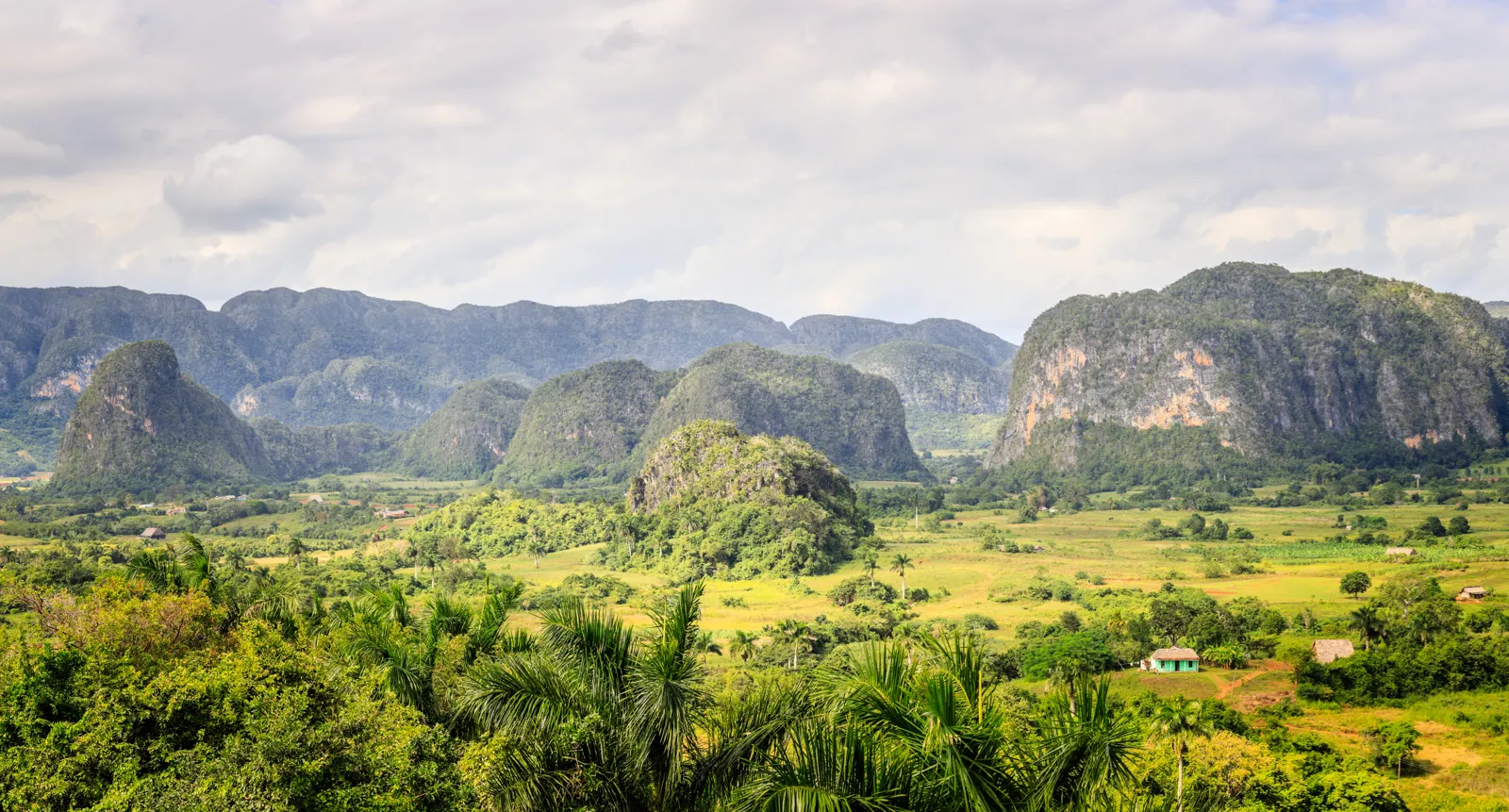
The Viñales Valley and its mogotes, Cuba
Havana
Allow at least three days. Habana Vieja, a UNESCO World Heritage site, gathers colonial squares (Plaza de la Catedral, Plaza Vieja), fortresses and museums. The Malecón, a long seafront boulevard, links the old town to Vedado, a district of wide avenues, hotels and concert venues. Vintage American cars are part of the scenery, and many venues host son, jazz or rumba concerts.
Viñales
About three hours’ drive west of Havana, the Viñales Valley is known for its mogotes, steep-sided limestone hills, and its tobacco plantations. You can explore on foot, on horseback or by bike, with a visit to a tobacco farm and the caves of the area.
Cienfuegos
On the south coast, Cienfuegos is a town with a regular grid plan, founded in the 19th century with settlers of French origin. Its historic center, around José Martí Park, is a UNESCO World Heritage site. It combines easily with Trinidad, about two hours away by road.
Trinidad and the Valle de los Ingenios
Trinidad has kept its cobbled streets and colorful colonial houses. Nearby, the Valle de los Ingenios, a former sugar-producing area, Playa Ancón and the Topes de Collantes massif (hiking, waterfalls) are reasons to stay several days.
Santa Clara
In the center of the island, Santa Clara is a convenient stop between Havana and the east. It is mostly visited for the Che Guevara memorial and the sites linked to the battle of late 1958.
Camagüey
The country’s third-largest city, Camagüey stands out for its historic center with an irregular layout of alleys and small squares, a UNESCO World Heritage site. It is a natural stop on the long road between the center of the island and Santiago, and can be explored at a relaxed pace on foot or by bicycle taxi in a day.
Varadero and the cayos
Varadero, on a long peninsula on the north coast, is home to the large beach hotels. Further east, the cayos (Cayo Coco, Cayo Guillermo, Cayo Santa María), linked to the mainland by causeways, offer white-sand beaches and all-inclusive resorts. These areas are far removed from everyday Cuban life.
Santiago de Cuba and Oriente
The country’s second city, Santiago is known for its music (son, trova) and its July festivities. Sights include the Castillo del Morro, Santa Ifigenia cemetery and, nearby, the Basilica of El Cobre. The region extends to Baracoa, at the far eastern tip, and the Sierra Maestra. Distances from Havana are long: plan several stops. According to the UK FCDO (GOV.UK, updated 25 September 2026), infrastructure and services, including electricity and water, remain severely affected in the east of Cuba after Hurricane Melissa in October 2025.
Itinerary ideas for Cuba
7 to 10 days: the west and the center
Days 1-3: Havana
Days 4-5: Viñales
Day 6: drive to the center, night in Cienfuegos
Days 7-8: Trinidad, Valle de los Ingenios, Playa Ancón
Days 9-10: Varadero or back to Havana before your flight
2 weeks: from Havana to Santiago
Days 1-3: Havana
Days 4-5: Viñales
Days 6-7: Cienfuegos then Trinidad
Days 8-9: Trinidad and Topes de Collantes
Day 10: Santa Clara
Days 11-12: Camagüey, then on to the east
Days 13-14: Santiago de Cuba, then back to Havana for your flight
Build in plenty of slack: the UK FCDO (GOV.UK, updated 25 September 2026) reports that fuel shortages are severely disrupting transport. Avoid tight connections with your international flight.
Budget for a trip to Cuba
Item (per person per day)
Tight budget
Comfort
Accommodation
Roughly US$15 to 35 (casa particular, sharing a double room)
Roughly US$55 to 135 (hotel or upscale casa)
Meals
Roughly US$15 to 30 (breakfast at the casa, simple paladares)
Roughly US$35 to 65 (well-known paladares)
Transport
Roughly US$10 to 20 (tourist buses, shared taxis)
Roughly US$35 to 65 (private taxis, car hire)
Activities
Roughly US$5 to 15 (museums, concerts)
Roughly US$20 to 55 (guided excursions, diving)
Indicative total
Roughly US$55 to 90
Roughly US$135 to 245
Indicative estimates excluding international flights, converted from euros at the European Central Bank rate of 23 October 2026. Prices vary a lot with the season and exchange rates; they are higher in beach resorts.
Cuba is not a cheap destination for foreign visitors: many tourist services are charged in foreign currency and prices change quickly. According to the UK FCDO (GOV.UK, updated 25 September 2026), international cards such as Visa and Mastercard are no longer accepted, so bring enough cash for your whole stay plus an emergency reserve.
Is Cuba right for you?
Our verdict depending on how you travel, based on the information in this guide:
First of all: the UK FCDO (GOV.UK, updated 25 September 2026) advises against all but essential travel to Cuba, and US citizens may only travel under OFAC rules: check both before booking.
Culture and music: ideal: Habana Vieja, Trinidad, Cienfuegos, son and trova concerts in Havana and Santiago.
Beach: yes: Varadero and the northern cayos, in all-inclusive resorts far from everyday Cuban life.
Nature: yes: the Viñales Valley on foot, on horseback or by bike, the waterfalls of Topes de Collantes.
Tight budget: average: roughly US$55 to 90 per person per day in a casa particular, as Cuba is not cheap for foreigners.
Travelers who like everything planned: not well suited: unreliable internet, no international cards, buses and flights sometimes canceled, long power cuts.
Getting around Cuba
Distances are long and infrastructure is limited. According to the U.S. Department of State (travel.state.gov, last updated October 15, 2026), buses designated for tourist travel between and within cities generally meet international standards, while public buses and trains are in poor condition. Book tourist buses (Viazul) early and expect delays.
Taxis: the UK FCDO (GOV.UK, updated 25 September 2026) says official yellow taxis are generally reliable and advises using a registered yellow taxi from the airport; avoid unlicensed private taxis. Both the UK FCDO and the U.S. Department of State warn against three-wheeled “coco-taxis”, which may be unsafe.
Car hire and driving: according to the UK FCDO (GOV.UK, updated 25 September 2026), you can drive with a UK driving licence for up to 6 months, but fuel shortages can make it hard to find petrol or diesel. Both sources advise against driving at night outside cities (unlit vehicles, animals, potholes). The U.S. Department of State notes that drivers involved in accidents causing injury or death face severe penalties and may be prevented from leaving the country until claims are settled.
Domestic flights: useful in principle to reach the east (Santiago, Holguín), but the U.S. Department of State (travel.state.gov, last updated October 15, 2026) states that the U.S. Embassy prohibits its employees from using any commercial airline for domestic flights within Cuba due to safety concerns.
In town: taxis, bicycle taxis and vintage cars; agree on the price before you get in.
Where to stay in Cuba
Outside the beach resorts, the most common option is the casa particular: a room in a local home, often with breakfast. In Havana, stay in Habana Vieja to explore on foot, or in Vedado for a quieter area. In Trinidad, Cienfuegos and Viñales, casas in the center are the most convenient.
Casas particulares: good value and contact with locals; ask whether the house has a generator or a water reserve
Hotels: found in the main cities, of varying quality
All-inclusive resorts: concentrated in Varadero and the northern cayos
Around Christmas and New Year, book several weeks ahead, and confirm your booking a few days before arrival.
Entry requirements for Cuba
US citizens
US travel rules: according to the U.S. Department of State (travel.state.gov, last updated October 15, 2026), the Office of Foreign Assets Control (OFAC) of the U.S. Treasury regulates travel to and from Cuba for all persons under U.S. jurisdiction, including U.S. citizens and residents. Travel falling within the 12 categories authorized by a general OFAC license needs no separate license; other travel requires a specific OFAC license. Travelers who fail to comply may face penalties and criminal prosecution. See 31 C.F.R. 515.560 and OFAC’s Cuba Sanctions website.
Restricted lists: the same source states that direct financial transactions with certain entities linked to the Cuban military, intelligence or security services are generally prohibited (Cuba Restricted List), and that staying at, paying for or booking accommodation listed on the Cuba Prohibited Accommodations List is prohibited.
Visa and passport: the U.S. Department of State refers you to the Embassy of Cuba for current visa information, and states that all U.S. citizens must carry their U.S. passport when traveling to Cuba. Cuban-born U.S. citizens who keep residency in Cuba are treated as Cuban citizens and must use a Cuban passport.
Medical insurance: Cuba requires visitors to have non-U.S. medical insurance, usually included in the ticket price on flights from the United States and valid for 30 days after arrival; otherwise it can be bought on arrival at an airport kiosk (Asistur). Hospitals in Cuba do not accept U.S. health insurance (U.S. Department of State).
Bringing goods back: according to the U.S. Department of State, you may not bring alcohol or tobacco products acquired in Cuba into the United States.
UK citizens
Visa: according to the UK FCDO (GOV.UK, updated 25 September 2026), tourists need a tourist visa, also called a tourist card, before travel: apply through the Cuban Embassy in the UK, your travel agent or tour operator, or online on the eVisa-Cuba site. The ten-character code you receive is entered on the D’Viajeros platform.
Passport: it must expire at least 6 months after your arrival date and 3 months after your planned departure date. You must also show proof of onward or return travel.
D’Viajeros form: complete it online within 72 hours before entering Cuba; you receive a QR code to show on arrival (electronic or printed). Airlines check it at check-in. Download or print it, as Wi-Fi may not be available on arrival.
Vaccines: a yellow fever vaccination certificate is required if you are coming from a country with a risk of transmission.
Travel from the US: the UK FCDO notes that US regulations do not authorize tourist travel to Cuba from the US, and that you cannot travel from Cuba to the US without a US visa.
Entry requirements checked on 24 October 2026; check them again with the Cuban embassy before you travel.
Health, safety and customs
Current situation: the UK FCDO (GOV.UK, updated 25 September 2026) advises against all but essential travel to Cuba because of the worsening economic situation, shortages and travel disruption.
Customs: according to the UK FCDO (GOV.UK, updated 25 September 2026), drones are not allowed and are confiscated on arrival until departure; GPS devices are subject to import requirements (the U.S. Department of State says stand-alone GPS devices are not allowed) and you must turn off GPS on phones, tablets and laptops; photography equipment may need an import license; some high-consumption electrical items may be confiscated. Declare foreign currency over US$5,000. Some art requires an export permit. For goods you bring home, check your home country’s customs allowances (e.g. CBP in the US, HMRC in the UK).
Health: both sources report severe shortages of medicines: according to the U.S. Department of State (travel.state.gov, last updated October 15, 2026), even common over-the-counter medicines are not available, so bring everything you need (repellent, sunscreen, anti-diarrheal medication, pain relievers, prescription medication in its original packaging). Dengue, Oropouche, chikungunya and Zika are among the risks listed: protect yourself from mosquitoes. Tap water is not potable and bottled water is often unavailable. See the CDC (US) or TravelHealthPro (UK) at least 8 weeks before travel.
Medical costs: according to the UK FCDO (GOV.UK, updated 25 September 2026), you or your insurer must pay in foreign currency (most likely US dollars) before treatment. The U.S. Department of State notes that medical evacuation flights cost from $15,000 and strongly recommends evacuation insurance. Check that your travel insurance covers Cuba.
Safety: both sources report an increase in crime linked to the economic situation (pickpocketing, bag snatching, muggings in Havana). The U.S. Department of State lists Habana Vieja, Playas del Este and Varadero among the areas with more property crime. Avoid walking at night, keep valuables in the safe, carry a photocopy of your passport, and stay away from demonstrations and large gatherings.
Emergency numbers: ambulance 104, fire 105, police 106 (GOV.UK and travel.state.gov). Ambulance services are limited and unreliable.
Hurricanes: season from June to November according to the UK FCDO; follow the bulletins of the National Hurricane Center and local civil defense instructions.
Practical tips for Cuba
Money: according to the UK FCDO (GOV.UK, updated 25 September 2026), international cards are no longer accepted and you cannot withdraw cash at ATMs with them; US dollars and euros are widely accepted and can be exchanged, but only at Cadeca exchange houses (exchanging elsewhere is illegal). The U.S. Department of State (travel.state.gov, last updated October 15, 2026) adds that U.S.-issued cards do not work, that the Cuban Central Bank prohibits certain US dollar cash transactions, including converting dollars to pesos and paying in dollars, and suggests bringing several currencies, such as euros. The two sources differ on dollars: check with the Cuban embassy and your accommodation. Our currency converter helps you estimate prices.
Phone and internet: according to the U.S. Department of State, AT&T, Verizon and T-Mobile have roaming agreements with ETECSA, the state telecom provider, and SIM cards with data can be bought at Havana airport and ETECSA offices. Wi-Fi is often slow and unreliable: print your documents (D’Viajeros, bookings, insurance certificate) and download offline maps.
Power: with daily power cuts, bring a headlamp and a power bank.
Etiquette: a few words of Spanish are appreciated. Tipping is customary in restaurants and for guides.
Documents: carry a photocopy of your passport and keep the original in the safe (GOV.UK and travel.state.gov).
Things to do in Cuba
Stroll through Habana Vieja and walk along the Malecón to Vedado.
Listen to son, trova or jazz in the venues of Havana and Santiago de Cuba.
Hike, ride or cycle around the mogotes of Viñales and visit a tobacco farm.
Walk the cobbled streets of Trinidad and head to the Valle de los Ingenios or the waterfalls of Topes de Collantes.
Swim at Playa Ancón, in Varadero or in the northern cayos.
Explore the historic center of Camagüey on foot or by bicycle taxi.
Mistakes to avoid on a trip to Cuba
Forgetting the D’Viajeros form: complete it online within 72 hours before arrival and print it (GOV.UK).
Traveling without medical insurance: Cuba requires it (travel.state.gov).
Relying on your bank card: international cards are not accepted (GOV.UK); bring cash.
Yes. According to the UK FCDO (GOV.UK, updated 25 September 2026), British tourists need a tourist visa (tourist card), available through the Cuban Embassy, a tour operator or the eVisa-Cuba site, a passport valid 6 months after arrival and 3 months after departure, proof of onward travel and the D’Viajeros form. US citizens must also comply with OFAC rules (travel.state.gov, last updated October 15, 2026) and should check visa details with the Embassy of Cuba.
Can Americans travel to Cuba?
Only under U.S. Treasury (OFAC) rules: according to the U.S. Department of State (travel.state.gov, last updated October 15, 2026), travel must fall within one of the 12 categories authorized by a general OFAC license, or be covered by a specific OFAC license. Failure to comply may lead to penalties and criminal prosecution.
Is it safe to travel to Cuba right now?
The UK FCDO (GOV.UK, updated 25 September 2026) advises against all but essential travel to Cuba because of fuel, electricity and water shortages, protests and flight disruption. Check the latest UK and US advice before booking.
How many days do you need in Cuba?
A week to ten days is enough for Havana, Viñales, Cienfuegos and Trinidad. Allow two weeks or more to reach Santiago de Cuba, with some slack for transport.
How much does a trip to Cuba cost?
Excluding international flights, allow roughly US$55 to 90 per person per day on a tight budget (casas particulares, buses) and roughly US$135 to 245 for a comfortable trip. Bring all your money in cash, as international cards are not accepted.
What is the best time to visit Cuba?
From December to April, during the dry season. If possible, avoid September and October, at the peak of the rains and the hurricane season.
What budget for 15 days in Cuba?
Based on our daily ranges, allow roughly US$840 to 1,340 per person on a tight budget and US$2,000 to 3,700 for a comfortable trip for 15 days on the ground, excluding international flights. Keep a cash reserve for emergencies.
What to see in Cuba in 10 days?
Havana (3 days), Viñales (2 days), Cienfuegos then Trinidad and the Valle de los Ingenios, and finally Varadero or a return to Havana before your flight.
Our sources
Entry, health and safety information read on 24 October 2026: U.S. Department of State, Cuba country information (travel.state.gov, last updated October 15, 2026), and UK FCDO, foreign travel advice for Cuba (GOV.UK, updated 25 September 2026)
U.S. Department of the Treasury, Office of Foreign Assets Control (OFAC): Cuba travel regulations (31 C.F.R. 515.560), as summarized by travel.state.gov
European Central Bank: euro reference rates of 23 October 2026 (budget conversion)
World Meteorological Organization, World Weather Information Service: 1961–1990 normals for Havana (Instituto de Meteorología de Cuba)
Transparency: this page contains affiliate links, labelled as such. If you book through them we may earn a commission at no extra cost to you; it does not influence our content or recommendations. How we fund the site.