This Vietnam travel guide follows the country from north to south: Hanoi, Ha Long Bay and Ninh Binh, then Hue and Hoi An, down to Ho Chi Minh City and the Mekong Delta. Allow two weeks for a first full tour and roughly US$40–56 a day on a budget. From the Red River Delta to the Mekong Delta, Vietnam lines up lively capitals, bays of limestone karsts, terraced rice fields and a former imperial city over more than 1,600 km (1,000 mi). The country is easy to travel from north to south and remains affordable. Here are the essentials for planning your trip: where to go, how long to stay, what budget and which entry requirements.
To locate cities, regions, terrain, national parks and airports, see our map of Vietnam.
Vietnam at a glance
CapitalHanoi
LanguageVietnameseEnglish is understood in tourism, less often elsewhere
Vietnam has three climates: a north with a cool winter and a rainy summer, a center whose rainy and typhoon season falls from September to December, and a south that is hot all year with a dry season from December to April. For a full north-to-south tour, February to April is the best window, and March to April the best compromise. All the details, month by month and region by region, are in our guide best time to visit Vietnam.
What to see in Vietnam: the highlights
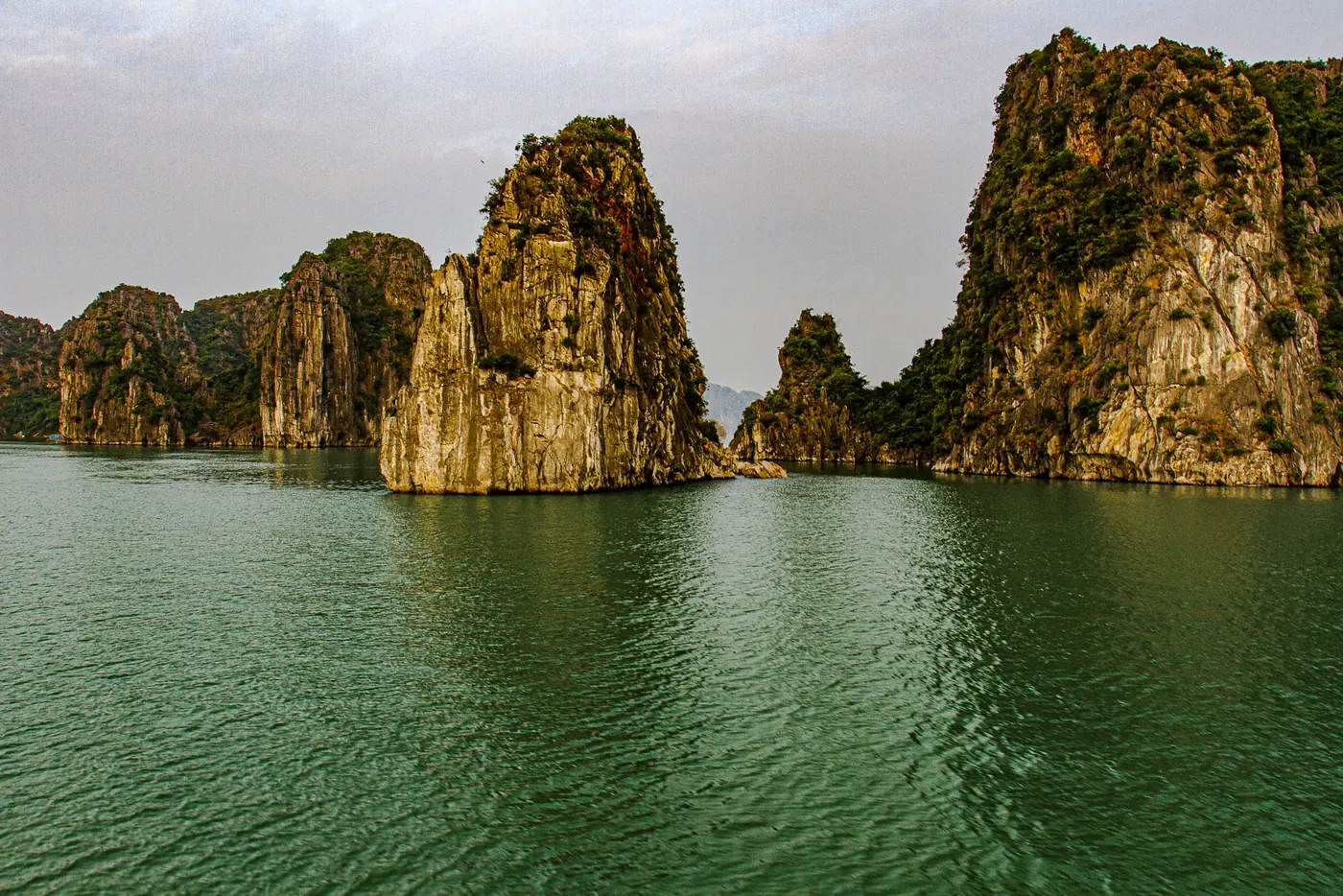
Limestone karsts of Ha Long Bay
Hanoi
The capital is the gateway to the north. Travelers come for the Old Quarter and its streets historically devoted to a single trade, Hoan Kiem Lake, the Ho Chi Minh Mausoleum, the Temple of Literature and renowned street food (pho, bun cha). Allow two to three days, leaving time simply to walk and watch the scooter traffic. Temple of Literature, pho and scooters: our Hanoi travel guide covers these two or three days in the capital.
Ha Long Bay and Lan Ha Bay
A UNESCO World Heritage Site, Ha Long Bay has nearly 2,000 limestone islets. Most visitors take a one- or two-night cruise from Ha Long or Cat Ba. Neighboring Lan Ha Bay is often less crowded. In winter, frequent mist reduces visibility; in summer, cruises may be canceled during typhoons. One or two nights, quieter Lan Ha: knowing what to do in Ha Long Bay helps you choose the right option.
Ninh Binh
About two hours south of Hanoi, the Trang An and Tam Coc area has limestone karsts surrounded by rice fields, explored by rowing boat along the rivers. The Trang An site is a World Heritage Site. One or two nights there let you visit early in the morning, before the groups.
Sapa and the northern mountains
Perched at about 1,600 m (5,250 ft), Sapa is the starting point for hikes through terraced rice fields and ethnic minority villages. Further northeast, the Ha Giang loop, by motorbike or by car with a driver, crosses spectacular mountain scenery. It is cool all year and cold in winter.
Hue
The former imperial capital of the Nguyen dynasty, Hue preserves its citadel, the Purple Forbidden City, and the imperial tombs scattered along the Perfume River. The site is a UNESCO World Heritage Site. The Hai Van Pass road links Hue with Da Nang, with fine coastal views.
Hoi An and Da Nang
Hoi An is a former trading port whose World Heritage old town is lined with merchants’ houses, a Japanese covered bridge and silk lanterns. Tailor shops are everywhere. Da Nang, 30 km (19 mi) away, is a large beach city with a well-served airport and long beaches. Avoid the area in October and November: according to the UK FCDO (GOV.UK, updated 21 September 2026), seasonal flooding occurs in central Vietnam then. Tailors, old town and Da Nang beaches: plan a stay in Hoi An outside October and November to avoid the floods.
Ho Chi Minh City (Saigon)
The country’s largest city is also its most dynamic. On the program: the War Remnants Museum, the colonial-era Central Post Office and Notre-Dame Cathedral, Ben Thanh Market and the Cholon Chinatown. The Cu Chi tunnels can be visited on a half-day trip from the city.
The Mekong Delta and Phu Quoc
In the south, the Mekong splits into many channels among orchards and rice fields. Can Tho and Ben Tre are good bases for floating markets and boat rides, ideally with at least one night there. To finish at the beach, Phu Quoc island is reached by plane from Ho Chi Minh City and Hanoi.
Itinerary ideas for Vietnam
7 to 10 days: the north or the center and south
Days 1–3: Hanoi
Days 4–5: overnight cruise in Ha Long Bay or Lan Ha Bay
Days 6–7: Ninh Binh (Trang An, Tam Coc)
Days 8–10: Sapa for hiking, or back to Hanoi
Center-south variant: 3 days in Hoi An with a day in Hue, then 3 days in Ho Chi Minh City and 1 to 2 days in the Mekong Delta
2 weeks: north to south
Days 1–3: Hanoi
Days 4–5: Ha Long Bay or Lan Ha Bay
Days 6–7: Ninh Binh
Days 8–9: Hue (flight or night train from Hanoi)
Days 10–11: Hoi An, via the Hai Van Pass
Days 12–13: Ho Chi Minh City (flight from Da Nang)
Day 14: Mekong Delta, then back to Ho Chi Minh City for your international flight
With three weeks, add Sapa or Ha Giang in the north and a few beach days on Phu Quoc in the south. Make sure it fits the season: a full tour works best from February to April (see best time to visit Vietnam).
Budget for a trip to Vietnam
Vietnam remains an affordable destination, especially for meals and transport. The amounts below are orders of magnitude per person per day, excluding international flights; they vary by city (Hanoi and Ho Chi Minh City are a little more expensive) and season. They are converted from our euro estimates at the ECB rate of 23 October 2026 (€1 = US$1.12).
Indicative estimates, to be checked according to the season and booking date.
A Ha Long Bay cruise quickly weighs on the budget: prices vary a lot with the standard of the boat. To convert prices into dong, use our currency converter.
Getting around Vietnam
The country is long and narrow: on a two-week tour, domestic flights save a lot of time. Hanoi, Hue, Da Nang, Ho Chi Minh City and Phu Quoc are linked by several airlines.
Train: the Reunification Line links Hanoi and Ho Chi Minh City via Hue and Da Nang. The full journey takes more than a day; the coastal Hue to Da Nang section is the most popular. Sleeper berths let you travel overnight.
Buses: sleeper buses serve most towns cheaply, but berths are narrow and night journeys tiring. The UK FCDO (GOV.UK, updated 21 September 2026) notes that bus crashes are not uncommon and more likely at night.
Car with driver: convenient for Ninh Binh, Ha Giang or the Hai Van Pass. Driving yourself is not advisable: according to the U.S. Department of State (travel.state.gov, last updated July 2, 2026), international driving permits and US licences are not valid in Vietnam, and it strongly discourages riding motorbikes or scooters. UK visitors need the 1968 International Driving Permit plus their UK licence, and third-party insurance (GOV.UK).
In town: ride-hailing apps (car or motorbike taxi) show the price in advance; the FCDO recommends pre-arranged transport or apps such as Grab or XanhSM. For regular taxis, choose large metered firms.
Where to stay in Vietnam
Hanoi: the Old Quarter, to do everything on foot; around West Lake (Tay Ho) for more peace and quiet
Ha Long Bay: a night on board a cruise boat, or a base on Cat Ba to explore Lan Ha
Ninh Binh: homestays and small hotels in Tam Coc, among the rice fields
Hue: the south bank of the Perfume River, close to the restaurants, or near the citadel
Hoi An: near the old town, or toward An Bang beach to combine sightseeing and swimming
Ho Chi Minh City: central District 1; more residential District 3
Mekong Delta: a homestay in Ben Tre or Can Tho
There is plenty of choice at every price, from family guesthouses to large hotels. Hotels register your stay with the police and will ask for your passport at check-in (U.S. Department of State). In high season and around Tet, book ahead.
Entry requirements for Vietnam
US citizens
According to the U.S. Department of State (travel.state.gov, last updated July 2, 2026), you need a valid passport and a visa (or a pre-approval letter for a visa on arrival). Your passport must be valid for six months beyond your planned stay, with at least one blank visa page. You can apply online for a single- or multiple-entry e-visa on the Vietnam Immigration website; it cannot be extended from within the country. Check every detail carefully: an error, even a typo in your name, can lead to refusal of entry.
UK citizens
According to the UK FCDO (GOV.UK foreign travel advice, updated 21 September 2026), you can visit without a visa for up to 45 days for tourism or business; check that the exit date stamped in your passport is 45 days from arrival. For a longer stay, you can apply for an e-visa allowing 90 days and multiple entries. Your passport must have an expiry date at least 6 months after the date you arrive and no damage: British nationals have been refused entry because of damaged passports.
Overstaying: you may be prevented from leaving until you pay a fine, and could be deported (GOV.UK). You must enter and exit on the same passport.
Digital arrival card: since 15 April 2026, travelers arriving at Tan Son Nhat airport (Ho Chi Minh City) are encouraged to complete a digital arrival card online; it is not mandatory at the time of writing (GOV.UK).
Customs: cash above 15 million dong must be declared, and vapes are banned (GOV.UK).
Entry requirements checked on 24 October 2026; check them again before you travel.
Health and safety
Health: mosquito-borne diseases include dengue, Zika, malaria and Japanese encephalitis (GOV.UK); see a travel health clinic at least 8 weeks before you leave. Medical facilities often do not meet international standards, and hospitals expect immediate cash payment (U.S. Department of State): take out insurance covering medical costs and evacuation.
Methanol: deaths and serious illness have been caused by drinks containing methanol, including in licensed bars in tourist areas (GOV.UK).
Crime: violent crime against foreigners is rare, but bag-snatching by thieves on motorbikes is common: hold your bag on the side away from the road (GOV.UK and U.S. Department of State). Do not leave your passport as a deposit for a rental.
Road safety: traffic accidents are the leading cause of death and serious injury among foreigners (U.S. Department of State). Look both ways before crossing, even at a green light.
Laws: drug penalties are severe and can include the death penalty; always carry photo ID (a printed copy of your passport photo page and visa is accepted); do not take photos near military bases (GOV.UK).
Weather and emergencies: follow official bulletins during the typhoon and flood season. Police 113, fire 114, ambulance 115 (GOV.UK).
Good-quality care is found mainly in international clinics in the big cities and can be expensive: travel insurance covering medical costs and repatriation is strongly recommended.
Practical tips for Vietnam
Money: the dong has lots of zeros; check your notes carefully when paying. ATMs are plentiful in cities, and cards are accepted in mid-range and upscale hotels and restaurants. Keep cash for the street, markets and rural areas.
Bargaining: at markets and with street vendors, prices are often negotiable, always with a smile.
Internet: Wi-Fi is very widespread in accommodation and cafés. A local SIM card or an eSIM gives you affordable mobile data, useful for ride-hailing and maps.
Etiquette: cover your shoulders and knees in pagodas and temples (GOV.UK), take off your shoes when asked and avoid showing irritation in public. Ask before photographing people, especially in mountain villages.
Tipping: not compulsory, but appreciated by guides, drivers and in restaurants.
Mistakes to avoid on a trip to Vietnam
Arriving without the right visa: US citizens need a visa or e-visa; British citizens are visa-free for up to 45 days only.
Planning a north-to-south tour in the wrong season: a full tour works best from February to April (see best time to visit Vietnam).
Driving yourself: US licences and IDPs are not valid; prefer a car with a driver.
Mixing up dong notes: they have lots of zeros, so check them when paying.
Carrying your bag on the road side: bag-snatching from motorbikes is common in the big cities.
Taking an unmetered taxi: use a ride-hailing app or a well-known company.
Visiting pagodas with bare shoulders or knees: covering clothing is expected.
Who is Vietnam for?
Our verdict by traveler profile, based on the information in this guide:
First trip to Asia: yes: the country is easy to travel from north to south, with trains, domestic flights and ride-hailing apps; violent crime against foreigners is rare.
Budget travelers: yes: roughly US$40–56 a day, with street food, guesthouses and sleeper buses.
Couples: yes: a cruise in Ha Long or Lan Ha Bay, Hoi An’s old town, the beach on Phu Quoc.
Families: yes, limiting night journeys and taking domestic flights; watch out for heavy city traffic.
Culture: yes: Hanoi, the Hue citadel, Hoi An, Trang An, the War Remnants Museum.
Hiking: yes: Sapa’s rice terraces, the Ha Giang loop with a driver.
US citizens need a visa, usually an e-visa applied for online, and a passport valid six months beyond the stay (travel.state.gov, last updated July 2, 2026). British citizens can visit visa-free for up to 45 days, or apply for a 90-day e-visa, with an undamaged passport valid 6 months after arrival (GOV.UK, updated 21 September 2026). Checked on 24 October 2026.
How long do you need to visit Vietnam?
Two weeks lets you tour from north to south using domestic flights. With 7 to 10 days, it is better to focus on the north or on the center and south.
How much does a trip to Vietnam cost?
Excluding international flights, allow roughly US$40–56 per person per day on a budget and US$90–170 in comfort.
What is the best time to visit Vietnam?
For a full tour, February to April is the best window. Otherwise the best month depends on the region: autumn in the north, spring and summer in the center, December to April in the south.
Is Vietnam safe for tourists?
Violent crime against foreigners is rare, according to GOV.UK and the U.S. Department of State. The main risks are road traffic, bag-snatching in the big cities and methanol in drinks. Check the latest official travel advice before you leave.
Which airports serve Vietnam?
The main international airports are Hanoi (Noi Bai), Ho Chi Minh City (Tan Son Nhat) and Da Nang. Flight times depend on your departure city and connections: check current routes with the airlines. Vietnam is on UTC+7.
What budget for 15 days in Vietnam?
Based on our ranges, allow roughly US$590–840 per person on a budget and US$1,340–2,520 in comfort for 15 days on the ground, excluding international flights. A Ha Long Bay cruise can push up the bill depending on the standard of the boat.
Our sources
Entry, health and safety information read on 24 October 2026: U.S. Department of State, Vietnam country information (travel.state.gov, last updated July 2, 2026), and UK FCDO, foreign travel advice for Vietnam (GOV.UK, updated 21 September 2026)
Vietnam Institute for Building Science and Technology (IBST): climate normals
European Central Bank, euro foreign exchange reference rates of 23 October 2026 (budget conversion)
Transparency: this page contains affiliate links, labelled as such. If you book through them we may earn a commission at no extra cost to you; it does not influence our content or recommendations. How we fund the site.