For a trip to Indonesia, allow 10 days for Bali and a neighboring island, and two to three weeks to combine Java, Bali and Komodo or Lombok, on a budget of roughly IDR 600,000–1,200,000 per person per day when traveling cheaply (excluding flights). Indonesia is the world’s largest archipelago: more than 17,000 islands spread over more than 5,000 km (3,107 mi) from west to east. Bali is its best-known gateway, but Java, Lombok, Flores, Sulawesi and Raja Ampat offer very different landscapes and cultures. This Indonesia travel guide helps you choose your islands and plan your trip.
Time zonethree time zones: UTC+7 on Java (Jakarta), no daylight saving · detailsBali, Lombok, Flores and Sulawesi: UTC+8; Papua and Raja Ampat: UTC+9. Jakarta is 7 h ahead of London and 12 h ahead of New York in winter
AirportsJakarta Soekarno-Hatta (CGK), Bali Ngurah Rai/Denpasar (DPS)Check current routes with the airlines
EntryUS and UK: visa required, 30-day visa on arrival (or e-VOA) · travel.state.gov · GOV.UK
Electricitycheck the voltage and plug type before you travel · plugs
For most tourist destinations (Java, Bali, Lombok, Flores, Komodo), the best time is the dry season, from April–May to October. The rainy season, from November to March, stays hot but very wet: Denpasar gets 345 mm (13.6 in) of rain in January, against 25 mm (1.0 in) in August. The archipelago is huge, and some regions follow a different pattern, especially in the east (Maluku, Raja Ampat): check island by island. For Bali, all the month-by-month details are in our article best time to visit Bali.
Where to go in Indonesia: the highlights
Bali
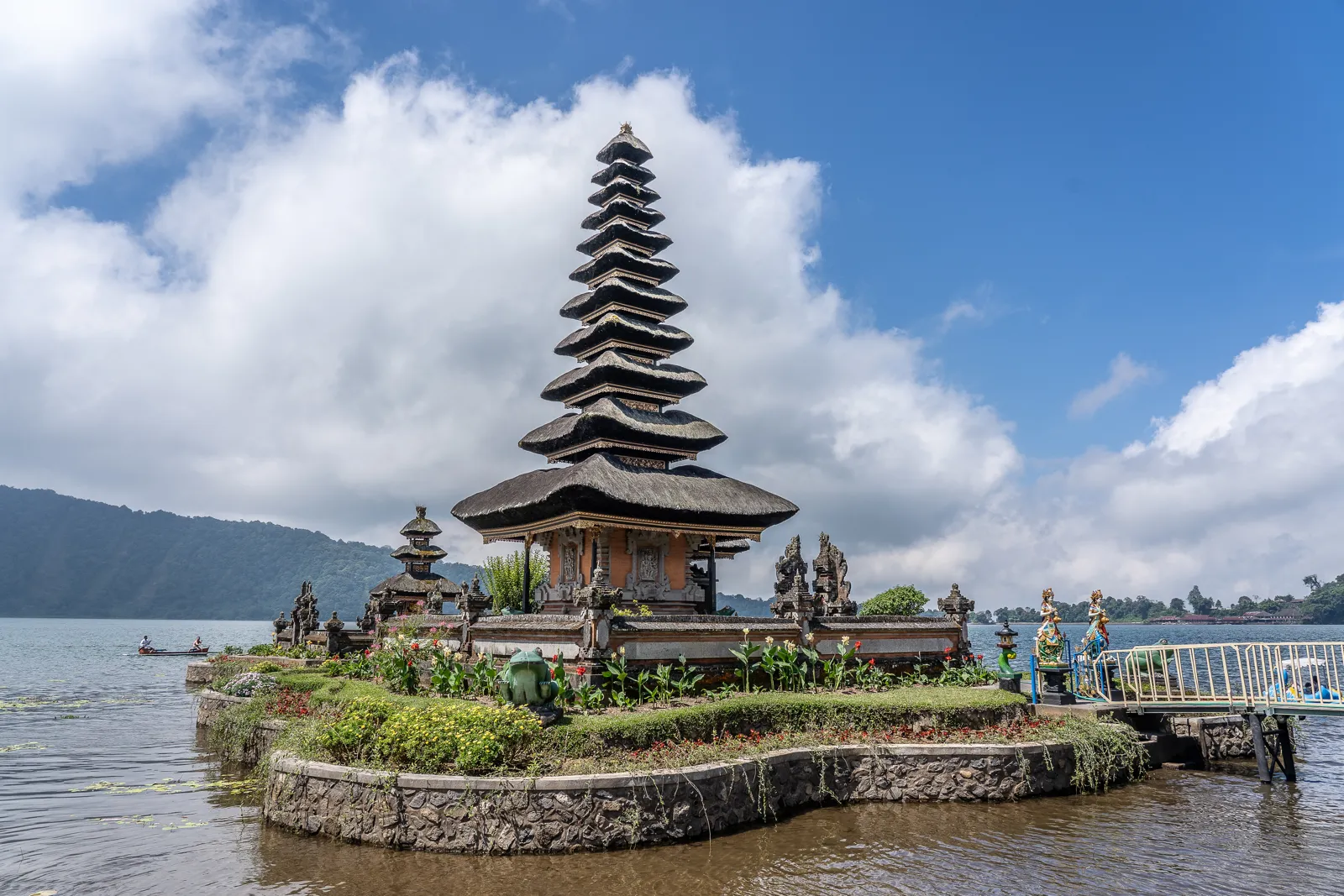
Pura Ulun Danu Bratan temple on the shore of Lake Bratan, Bali
The archipelago’s Hindu island, and the most visited. People come for the rice terraces of Ubud and Jatiluwih, the temples (Uluwatu, Tanah Lot, Besakih, Ulun Danu Beratan), the sunrise climb of Mount Batur, the beaches and surf of the south, and diving at Amed. The south is very busy; the east and north are quieter. Our Bali travel guide covers each area.
Java: Yogyakarta, Borobudur and Prambanan
Yogyakarta is Java’s cultural capital: the sultan’s palace (kraton), batik workshops, traditional performances. It is the base for visiting Borobudur, the world’s largest Buddhist temple, and Prambanan, a complex of Hindu temples; both are UNESCO World Heritage Sites. Access to the top of Borobudur is now supervised and limited: book your ticket in advance.
From Yogyakarta, our guide to visiting Borobudur temple explains the official tickets (grounds or climb), opening hours and sunrise options.
East Java: Bromo and Ijen
Mount Bromo seen from Mount Penanjakan, in Bromo Tengger Semeru National Park, Java
In eastern Java, Mount Bromo is seen at sunrise from the viewpoints above its caldera and its « sea of sand ». Further east, near the Bali Strait, the Ijen volcano is known for its turquoise acid lake and its sulfur miners. The climb is done at night; the sulfur fumes mean wearing a mask provided by the guides. Both sites can be closed during volcanic activity.
Lombok and the Gili Islands
Bali’s neighbor, Lombok is quieter and more rural. Its south has wide sandy bays and surf breaks around Kuta Lombok. Mount Rinjani, Indonesia’s second-highest volcano, is climbed in two or three days with a guide. In the northwest, the three Gili Islands (Trawangan, Meno, Air) have no cars or scooters: you get around by bike or horse cart, and often swim with turtles. Rinjani in two or three days, car-free Gilis: the best time to visit Lombok matters a lot for these activities.
Flores and Komodo National Park
Labuan Bajo, in western Flores, is the departure point for Komodo National Park, a World Heritage Site and home of the Komodo dragons. Day or multi-day boat trips combine seeing the monitor lizards (always with rangers), hiking on Padar Island and diving with manta rays. The park’s fees and entry rules change regularly: check them before you leave. The interior of Flores, with Kelimutu volcano and its colored lakes, deserves several days.
Sulawesi: Toraja country
On the island of Sulawesi, the Tana Toraja region is known for its traditional houses with boat-shaped roofs (tongkonan) and its very distinctive funeral rites. The region is remote (flight to Makassar, then a long drive or a domestic flight) and is best visited with a local guide, respecting the ceremonies.
Raja Ampat
At the western tip of Papua, the Raja Ampat archipelago is renowned among divers for its rich coral reefs. Getting there is long and expensive (flight to Sorong, then ferry), accommodation is mostly in local homestays or on liveaboard dive cruises, and visitors pay an entry fee. Best kept for travelers with time and a substantial budget.
Sumatra
Less visited, the large western island is home to Gunung Leuser National Park, where you can see orangutans around Bukit Lawang, and Lake Toba, the world’s largest volcanic lake, with Samosir Island and Batak culture. Distances are long: allow at least a week.
Things to do in Indonesia: 10 experiences
To sum up what to see and do in Indonesia, here are the experiences described above:
Walk through the rice terraces of Ubud and Jatiluwih, in Bali
Climb Mount Batur at sunrise
Visit Borobudur and Prambanan from Yogyakarta, with a ticket booked in advance
Watch the sunrise over the Bromo caldera
Climb Ijen volcano at night, with a mask provided by the guides
Swim with turtles around the Gili Islands
See the Komodo dragons with rangers and hike on Padar Island
Discover the colored lakes of Kelimutu, on Flores
Watch orangutans around Bukit Lawang, in Sumatra
Dive the reefs of Raja Ampat, if you have the time and budget
Itinerary ideas: how many days in Indonesia?
10 days: Bali and a neighboring island
Days 1 and 2: southern Bali (Uluwatu or Sanur)
Days 3 to 5: Ubud, rice terraces and Mount Batur
Days 6 and 7: eastern Bali (Sidemen, Amed)
Days 8 to 10: Gili Islands or Nusa Penida, back to Bali for the flight
2 weeks: Java and Bali
Days 1 to 3: Yogyakarta, Borobudur and Prambanan
Days 4 and 5: train or flight to eastern Java, sunrise at Bromo
Day 6: Ijen volcano at night, then ferry to Bali
Days 7 to 9: Ubud and central Bali
Days 10 to 14: flight to Labuan Bajo for Komodo, or a beach stay in Bali and Nusa Penida
Distances between islands are long: for a first trip, stick to two or three islands and take domestic flights for long journeys.
Who is Indonesia for?
Our verdict by traveler profile, based on the places, budget and conditions presented in this guide to Indonesia.
Profile
Our verdict
First trip
✅ Bali and a neighboring island in 10 days, without too many stops.
Culture
✅ Bali’s temples, Borobudur and Prambanan from Yogyakarta, Toraja country.
Nature and volcanoes
✅ Bromo, Ijen, Rinjani, the Kelimutu lakes, Sumatra’s orangutans.
Diving
✅ Komodo and its manta rays, Amed, Raja Ampat for divers with time and budget.
Beach
✅ Gili Islands, southern Lombok, Nusa Penida, southern Bali.
Budget travelers
✅ Roughly IDR 600,000–1,200,000 a day, especially on Java and Lombok; Bali, Komodo and Raja Ampat cost more.
Budget for a trip to Indonesia
Indonesia remains affordable once there, especially on Java and Lombok. Bali, Komodo and Raja Ampat are more expensive. Indicative amounts per person per day, excluding international flights (converted from our euro estimates at the ECB rate of 23 October 2026, roughly €1 = IDR 20,270):
Item
Budget
Comfort
Accommodation (based on a shared double room)
roughly IDR 200,000–500,000
roughly IDR 1,000,000–3,000,000
Meals
roughly IDR 120,000–300,000 (warungs)
roughly IDR 400,000–1,000,000
Local transport
roughly IDR 100,000–300,000
roughly IDR 400,000–800,000
Activities and sightseeing
roughly IDR 100,000–300,000
roughly IDR 400,000–1,200,000
Total per day
roughly IDR 600,000–1,200,000
roughly IDR 2,000,000–5,100,000
Indicative estimates, excluding domestic flights, Komodo cruises and diving, which can weigh heavily on the budget.
Add the visa, the Bali tourist levy and national park fees (Komodo, Raja Ampat), which have risen sharply in recent years. The visa on arrival and the Bali levy are covered in our guide Bali visa.
Getting around Indonesia
Plane: essential to link distant islands (Bali – Labuan Bajo, Jakarta – Makassar, Sorong). There are many domestic airlines; delays are frequent, so leave a margin before an international flight.
Train: on Java, the rail network is practical and comfortable between Jakarta, Yogyakarta, Surabaya and the east of the island. A high-speed train links Jakarta and Bandung.
Ferries and fast boats: between Java and Bali (Ketapang – Gilimanuk), between Bali, Lombok and the Gilis, or to Nusa Penida. Crossings may be canceled in rough seas.
Private driver: the most common option in Bali, Lombok and Flores for day trips and transfers. The UK FCDO also suggests a private driver or a car with driver given the poor traffic discipline (GOV.UK, updated 18 September 2026).
Ride-hailing apps: Grab and Gojek are widely used in big cities and in Bali.
Scooter and car: according to the UK FCDO (GOV.UK, updated 18 September 2026), you cannot drive on a UK licence alone: you need a UK-issued International Driving Permit, and you must hold the appropriate licence for the vehicle you hire. Moped and motorbike accidents, some fatal, have risen sharply in Bali: wear a helmet. The U.S. Department of State (travel.state.gov, last updated July 9, 2026) describes traffic as hazardous, congested and undisciplined.
Where to stay in Indonesia
There is a wide range: family guesthouses (homestays and losmen), guesthouses, private pool villas in Bali, chain hotels in big cities and Nusa Dua, ecolodges on Lombok or Flores. In Yogyakarta, stay near the center (Prawirotaman or around Malioboro Street); in Bali, combine a base in Ubud with another on the coast; in Labuan Bajo, hotels are concentrated on the hills above the port. In remote areas (Raja Ampat, inland Flores, Toraja), accommodation is simpler and sometimes limited: book ahead.
Mistakes to avoid on a trip to Indonesia
Trying to see too many islands: for a first trip, stick to two or three islands and fly for long journeys.
Forgetting the All Indonesia form: the free online customs and health declaration must be completed within 72 hours of arrival (GOV.UK). Avoid look-alike websites that ask for payment.
Ignoring the Bali tourist levy: IDR 150,000 for all foreign tourists arriving in Bali (GOV.UK).
Booking an international flight right after a domestic flight or ferry: delays and cancellations in rough seas are frequent.
Riding a scooter without the right licence: UK travelers need a UK-issued IDP (GOV.UK), and traffic is dangerous in cities.
Neglecting dress away from the beaches: cover shoulders and knees in mosques and temples.
Underestimating the drug laws: penalties include long prison sentences or the death penalty (GOV.UK).
Using an unofficial visa agent: the UK FCDO warns of visa scams; overstaying costs IDR 1 million a day. Use the Indonesian immigration website.
Entry requirements for Indonesia, health and safety
US citizens
According to the U.S. Department of State (travel.state.gov, last updated July 9, 2026), your passport must be valid for at least six months beyond your arrival date and have at least two blank pages. Tourists can get a visa on arrival, or apply in advance for an electronic visa on arrival (e-VOA): it costs IDR 500,000, is valid for 30 days and can be extended once for 30 days. You need a return or onward flight booking. For stays over 30 days, apply for a visa online. Overstaying is fined IDR 1 million per day and can lead to detention or deportation.
UK citizens
According to the UK FCDO (GOV.UK foreign travel advice, updated 18 September 2026), you must have a visa. A 30-day, single-entry visa on arrival (VOA) is available for tourism; it costs IDR 500,000 (cash or card) and can be extended once for 30 days. Your passport must be valid for at least 6 months after arrival with at least 2 blank pages, and you need proof of an onward or return journey. You can also apply online before travel (at least one week ahead). Complete the free All Indonesia arrival card within 72 hours of arrival. A tourist levy of IDR 150,000 (about £8) applies to all foreign tourists arriving in Bali, payable online or on arrival.
Health: according to the UK FCDO (GOV.UK, updated 18 September 2026), check vaccine recommendations at least 8 weeks before your trip; health risks include malaria, dengue, Zika and poor air quality, and rabies is present in Bali and elsewhere (street dogs, monkeys around temples). A yellow fever certificate is required only if you arrive from a country with a transmission risk. The U.S. Department of State recommends malaria prevention medicine for some areas of Indonesia, even for short stays. Tap water is not safe to drink (GOV.UK). See a doctor or travel health clinic before you go.
Natural hazards: volcanic eruptions occur frequently, and the country is exposed to earthquakes, tsunamis and flooding (GOV.UK). Follow the local authorities’ advice on exclusion zones around volcanoes.
Safety: the UK FCDO has specific regional advice for Aceh, Central Sulawesi, the Maluku Islands and the Papua region, where armed clashes occur (GOV.UK, updated 18 September 2026); U.S. government personnel travel to Central Papua and Highland Papua is restricted (travel.state.gov). Drug offences carry long prison sentences or the death penalty, and cannabis products, including CBD, are illegal (GOV.UK).
Emergencies: ambulance 118, police 110 (GOV.UK).
Entry requirements checked on 24 October 2026; they change often, so check them again before you travel.
Practical tips for Indonesia
Money: withdraw rupiah from bank ATMs (fees apply to each withdrawal) and prefer licensed exchange offices. Banknotes have many zeros: check amounts carefully. Our currency converter helps you find your way.
Internet: good mobile coverage in cities and in Bali, much patchier on remote islands. A local SIM card or an eSIM is useful for transport apps.
Religion and dress: Indonesia is mostly Muslim (Bali is Hindu). Away from the beaches, wear clothes covering shoulders and knees, especially in mosques and temples.
Ramadan: during this month, avoid eating and drinking conspicuously in public in Muslim areas. The end of Ramadan brings major travel across the country: transport is crowded and expensive.
Etiquette: give and receive with your right hand, avoid touching people’s heads and stay calm in all circumstances.
Yes. US and UK citizens can get a 30-day visa on arrival (IDR 500,000), extendable once for 30 days, with a passport valid at least six months after arrival, two blank pages and proof of onward travel; it can also be applied for online in advance (travel.state.gov, last updated July 9, 2026; GOV.UK, updated 18 September 2026). A tourist levy of IDR 150,000 applies in Bali. Checked on 24 October 2026; check the latest rules before you leave.
What is the best time to visit Indonesia?
For Java, Bali, Lombok and Komodo, the dry season, from April–May to October. Some regions in the east of the archipelago follow a different calendar: check for each island.
How many days do you need in Indonesia?
Ten days lets you discover Bali and a neighboring island. Two to three weeks are needed to combine Java, Bali and Komodo or Lombok without spending too much time in transit.
How much does a trip to Indonesia cost?
Excluding international flights, allow roughly IDR 600,000–1,200,000 per person per day on a budget, and IDR 2,000,000–5,100,000 in comfort. Komodo cruises, diving and Raja Ampat raise the budget considerably.
Is Indonesia safe to visit?
Mostly, yes. The main risks are road accidents, natural hazards (volcanoes, earthquakes) and scams. Drug laws are extremely strict, and the UK FCDO has specific advice for Aceh, Central Sulawesi, the Maluku Islands and Papua (GOV.UK, updated 18 September 2026). Read the US and UK advice before you leave.
What budget for 15 days in Indonesia?
Excluding international flights, allow roughly IDR 9,000,000–18,000,000 per person for 15 days on a budget (IDR 600,000–1,200,000 a day), and roughly IDR 30,000,000–76,000,000 in comfort (IDR 2,000,000–5,100,000 a day). Add domestic flights, a Komodo cruise or diving.
What itinerary for 15 days in Indonesia?
A classic route combines Yogyakarta (Borobudur, Prambanan), Bromo and Ijen in eastern Java, Ubud and central Bali, then Komodo from Labuan Bajo or a few beach days in Bali and Nusa Penida.
Our sources
Climate normals: 1961–1990 normals for the Denpasar station published by Indonesia’s Agency for Meteorology, Climatology and Geophysics (BMKG) on the WMO World Weather Information Service; 1991–2020 normals for the Jakarta-Kemayoran station, published by the World Meteorological Organization (NOAA archive)
Entry, health, safety and driving information read on 24 October 2026: U.S. Department of State, Indonesia country information (travel.state.gov, last updated July 9, 2026), and UK FCDO, foreign travel advice for Indonesia (GOV.UK, updated 18 September 2026)
European Central Bank: euro reference rates of 23 October 2026 (budget conversions)
Transparency: this page contains affiliate links, labelled as such. If you book through them we may earn a commission at no extra cost to you; it does not influence our content or recommendations. How we fund the site.