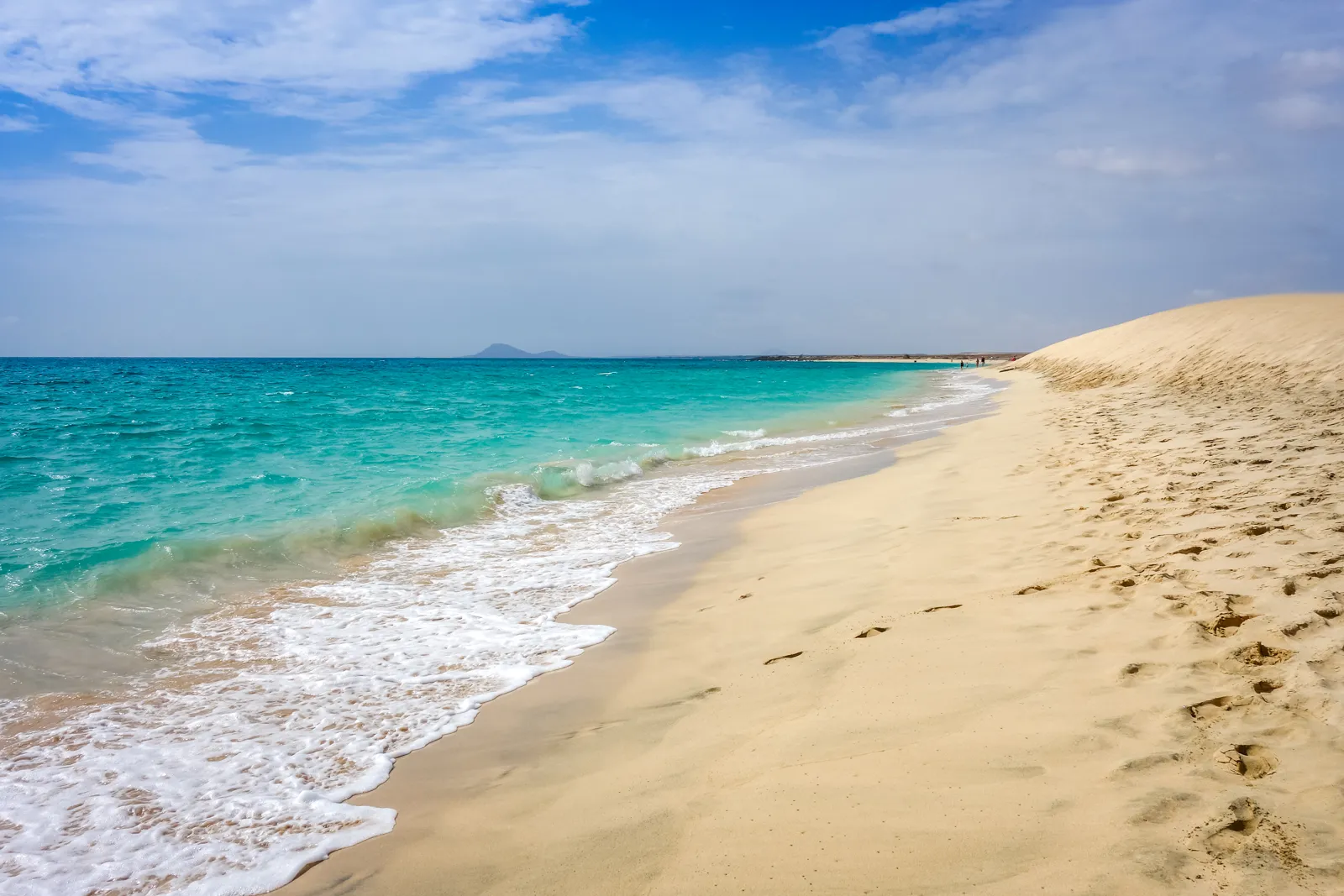
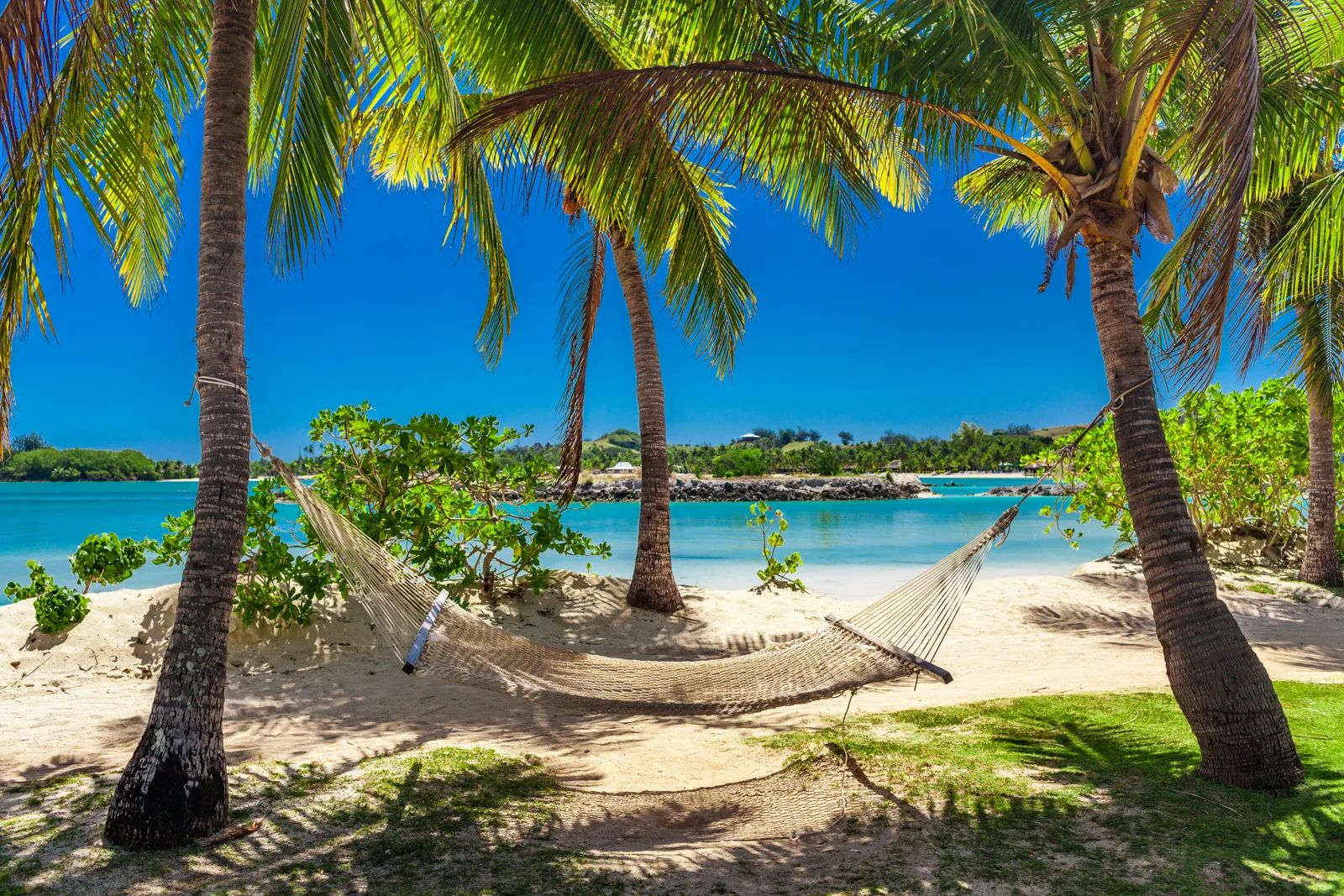
The Seychelles are an archipelago of 115 islands in the Indian Ocean, about 1,500 km (930 mi) off the coast of Kenya. Most travelers stay on the three main granite islands: Mahé, Praslin and La Digue, known for their granite boulders, forests and clear water. For a trip to the Seychelles, allow at least 7 to 10 days to combine these three islands, and aim for April–May or October–November for the calmest sea. This Seychelles travel guide brings together the essentials: what to see, what to do, itineraries, budget and getting between the islands.
To locate towns, regions, terrain, national parks and airports, see our map of the Seychelles.
Seychelles at a glance
CapitalVictoria (Mahé)
LanguagesSeychellois Creole, English and French (official languages)
CurrencySeychellois rupee (SCR)
Time zoneUTC+4, no daylight saving (4 h ahead of London and 9 h ahead of New York in winter)
AirportsSeychelles International Airport (SEZ), on Mahé; check current routes with the airlines
Entryno visa for US and UK citizens, but a paid Travel Authorization must be obtained online before departure (travel.state.gov · GOV.UK)
Electricitycheck voltage and plug types before you go (plugs)
Indicative budgetroughly US$135–225 per person per day on a budget (based on two people), US$335 and up in comfort
When to go to the Seychelles
It is hot all year (about 29 to 31 °C (84 to 88 °F) in the afternoon) and the main islands lie outside the cyclone belt. The best periods are the shoulder seasons, April–May and October–November, when the sea is calm and ideal for diving. From December to March, the northwest monsoon brings more rain; from June to September, the southeast trade wind makes the sea rougher on some coasts. All the details, month by month, are in our article best time to visit the Seychelles.
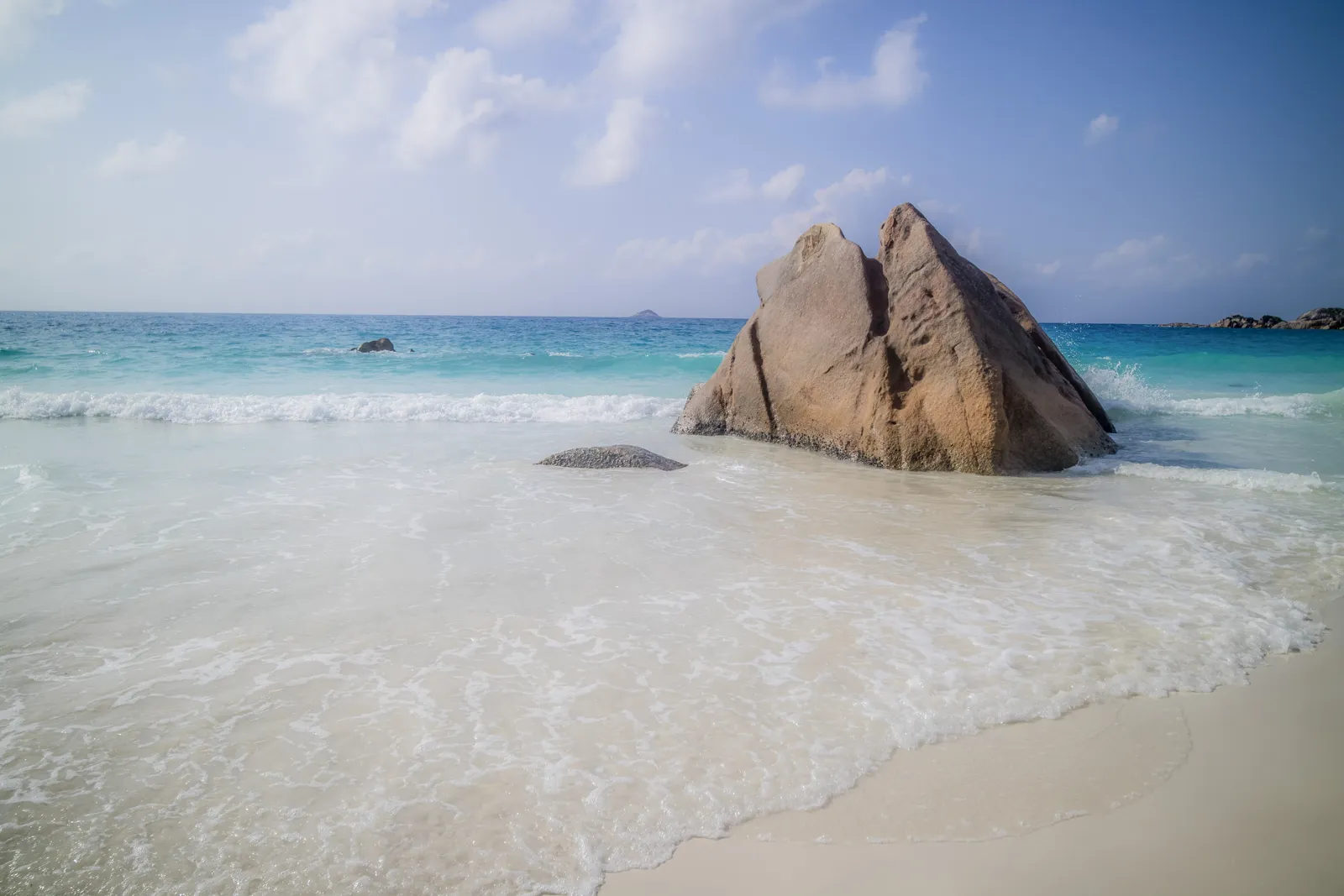
Granite boulder on Anse Lazio beach, Praslin
Where to go in the Seychelles: the highlights
Mahé and Victoria
The largest island has the international airport and the vast majority of the population. Victoria, one of the world’s smallest capitals, can be seen in half a day: the Sir Selwyn Selwyn-Clarke Market, the Clock Tower, the Hindu temple and the botanical garden with its giant tortoises. The rest of the island alternates between beaches (Beau Vallon, Anse Takamaka, Anse Intendance) and mountain roads. The west coast, around Port Glaud and Baie Ternay, is the most unspoiled; the more built-up east coast runs past the airport and Victoria.
Morne Seychellois National Park
It covers about a fifth of Mahé and rises to 905 m (2,969 ft). Several marked trails cross it, including the short and easy Copolia trail, with views over Victoria and the islets of the marine park. The Trois Frères and Morne Blanc trails are steeper. Set off early in the morning, before the heat and the clouds. The UK FCDO (GOV.UK, updated 23 October 2026) notes that hiking is generally safe but that visitors have sometimes got lost: plan your route and tell your accommodation where you are going.
Sainte Anne Marine Park
Just opposite Victoria, this marine park groups several islets surrounded by reefs. It is explored on a day trip, by glass-bottom boat or with mask and snorkel. It is a good option for seeing fish and turtles without leaving Mahé.
Praslin and the Vallée de Mai
The country’s second island, Praslin is home to the Vallée de Mai, a UNESCO World Heritage forest. It shelters the coco de mer, an endemic palm with the heaviest seeds in the plant kingdom, and with a little luck the Seychelles black parrot. The island also has several famous beaches, including Anse Lazio and Côte d’Or.
La Digue
About fifteen minutes by boat from Praslin, La Digue is explored by bike: cars are very rare. Anse Source d’Argent, reached through the L’Union estate (entry fee), is famous for its granite boulders sculpted by erosion. The east coast beaches, such as Grand Anse and Anse Cocos, are spectacular but often dangerous for swimming: the UK FCDO notes that east coasts are unsafe during the southeast wind season (around May to September).
Curieuse and Cousin Island
Reached on day trips from Praslin, these two small islands are nature reserves. Curieuse is home to Aldabra giant tortoises and a mangrove crossed by a trail. Cousin is a bird reserve, with guided visits on certain days of the week.
The outer islands
Further out, the coral islands (Bird Island, Denis, Desroches, Alphonse) can only be reached by small plane or boat and often have just one hotel. Aldabra Atoll, a UNESCO site, has the world’s largest population of giant tortoises; access is very restricted. The U.S. Department of State (travel.state.gov, last updated December 9, 2025) notes that pirate attacks have occurred in waters around the outer islands and that medical care is mainly available on Mahé, Praslin and La Digue.
Things to do in the Seychelles
Activities revolve around the sea, granite beaches and the islands’ unspoiled nature. The main ones, to combine according to season and island:
Snorkeling and diving: in Sainte Anne Marine Park or at Baie Ternay (Mahé), around Coco Island and Félicité from La Digue; best conditions in April–May and October–November. Never swim or snorkel alone (U.S. Department of State).
Hiking: the Copolia, Trois Frères or Morne Blanc trails in Morne Seychellois National Park, early in the morning.
Vallée de Mai: Praslin’s UNESCO-listed coco de mer forest, explored on its trails.
La Digue by bike: a loop of the island and Anse Source d’Argent, best seen at low tide.
Boat trips: Curieuse (giant tortoises, mangrove) and Cousin (bird reserve) from Praslin.
Sailing and kitesurfing: from June to September, when the southeast trade wind blows steadily.
Victoria: the Sir Selwyn Selwyn-Clarke Market, the Hindu temple and the botanical garden, in half a day.
Creole food: fish or octopus curries and grilled fish, at take-aways or restaurants.
Days 1 to 3: Mahé (Victoria, Morne Seychellois, southern beaches, Sainte Anne Marine Park)
Days 4 to 6: Praslin (Vallée de Mai, Anse Lazio, trip to Curieuse and Cousin)
Days 7 to 9: La Digue by bike (Anse Source d’Argent, Grand Anse), then back to Mahé
2 weeks: the main islands and a quieter island
Days 1 to 4: Mahé, with a hike and a boat trip
Days 5 to 8: Praslin and its islets (Curieuse, Cousin, Saint-Pierre)
Days 9 to 11: La Digue, with a snorkeling trip to Félicité, the Sisters or Coco Island
Days 12 to 14: a quieter island (Silhouette, Bird Island or Denis) or a final stay on Mahé’s west coast
Budget for a trip to the Seychelles
The Seychelles are an expensive destination: much is imported and the hotel supply is limited. Guesthouses and self-catering apartments do, however, bring the bill down considerably. Indicative amounts per person per day, based on two people, excluding international flights (converted from our euro estimates at the ECB rate of 23 October 2026, €1 = US$1.12):
Item
Budget
Comfort
Accommodation
Roughly US$55–100 (guesthouse, self-catering)
Roughly US$170–335 (boutique or 4-star hotel)
Meals
Roughly US$20–40 (take-away, groceries, small restaurants)
Roughly US$11–35 (hikes, beaches, site entry fees)
Roughly US$55–135 (boat trips, diving)
Indicative amounts, which can vary widely by season and island: check when booking.
Add the cost of ferries between Mahé, Praslin and La Digue, and entry fees for some sites (Vallée de Mai, the L’Union estate on La Digue), which add up.
How much do 10 days or 2 weeks for two cost?
Length (2 people)
Budget
Comfort
10 days
Roughly US$2,685–4,475
Roughly US$6,715 and up
2 weeks
Roughly US$3,805–6,270
Roughly US$9,400 and up
Calculated from our indicative ranges per person per day (US$135–225 on a budget, US$335 and up in comfort), excluding international flights and ferries.
Add your international flights, whose price varies widely by season and school holidays. Traveling outside peak holiday periods remains the simplest way to cut the bill.
Getting around the Seychelles
Between islands: fast ferries link Mahé with Praslin (about 1 hour) and Praslin with La Digue (about 15 to 20 minutes). Short domestic flights also link Mahé and Praslin. The sea can be rough from June to September. On boat trips, check that life jackets are provided (UK FCDO).
Bus: a cheap public bus network serves Mahé and Praslin. Services are infrequent on some routes and most buses do not run after 8 pm (UK FCDO, GOV.UK, updated 23 October 2026).
Car rental: handy on Mahé and Praslin. Cars drive on the left and you need an international driving permit according to the U.S. Department of State; UK photocard licence holders can drive for 3 months (UK FCDO), though rental companies may require an IDP. Roads are narrow and winding, with sheer drops, hairpin bends and deep storm drains, and drink-driving is a problem.
Bike: the main means of transport on La Digue, where bikes are easy to rent.
Taxis: available on Mahé and Praslin, but expensive: some are not metered, so agree the fare before setting off (U.S. Department of State, UK FCDO).
Where to stay in the Seychelles
Accommodation is the biggest expense. There are three main types: guesthouses and apartments run by Seychellois, mid-sized hotels, and upscale resorts, some of which occupy an entire island.
Mahé: Beau Vallon for its beach, restaurants and evening atmosphere; the south and west coasts (Anse Royale, Takamaka) for more peace and quiet
Praslin: Côte d’Or (Anse Volbert) for the sheltered beach and services; Grand Anse for proximity to the airport
La Digue: around La Passe, near the port, to do everything by bike
Private islands: for a honeymoon or a very quiet stay, with a budget to match
Entry requirements for the Seychelles
US citizens
According to the U.S. Department of State (travel.state.gov, last updated December 9, 2025), the Seychelles are visa-free, but all travelers must apply for a Travel Authorization before traveling (standard fee EUR 10.90, application up to 30 days before your flight, online or via the Seychelles E-Border app). You need a passport, an onward or return ticket, sufficient funds and confirmed accommodation; the application asks for your flight and accommodation bookings and a selfie.
UK citizens
According to the UK FCDO (GOV.UK foreign travel advice, updated 23 October 2026), you do not need a visa, but you must apply and pay for a travel authorization online before you travel (up to 30 days before arrival), showing a return or onward ticket, confirmed accommodation and sufficient funds. On arrival you get a free 3-month visitor’s permit, extendable for a fee. Your passport must be valid for the duration of your stay. You may be asked to show proof of travel insurance at the border. A yellow fever certificate is required if you arrive from a country with a risk of transmission.
Customs and health screening: travelers who have been in or transited through the DRC in the last 21 days may be refused entry (Ebola measures), and cash worth 50,000 rupees or more must be declared in the travel authorization application (UK FCDO). Fruit, vegetables, pharmaceuticals, tobacco and alcohol are prohibited or need permits (U.S. Department of State). Entry requirements checked on 24 October 2026.
Health and safety
The U.S. Department of State lists chikungunya, dengue, hepatitis A and B, rabies and typhoid among prevalent diseases: protect yourself from mosquitoes and the sun, very strong at this latitude, and check vaccine recommendations at least 8 weeks before travel (UK FCDO). As a tourist, you must pay for medical treatment; the main hospital, with an emergency department, is in Victoria (UK FCDO). Medical facilities are limited on isolated islands: travel insurance covering evacuation is strongly recommended.
Crime is generally non-violent, but there are break-ins, bag-snatching and thefts from cars, beaches and walking trails; be particularly alert in Beau Vallon, the back streets of Victoria and isolated areas at night (UK FCDO). The main danger is the sea: the west coast is unsafe during the northwest monsoon (around December to March), the east coast during the southeast winds (around May to September), and beaches at the southern tip are never suitable for swimming (UK FCDO). Lifeguards are few: ask for local advice and follow warning signs. In an emergency, dial 999.
Practical tips for the Seychelles
Money: the Seychellois rupee is the official currency, and some purchases can be paid in US dollars or other hard currencies. ATMs at the airport and in the main tourist areas of Mahé, Praslin and La Digue dispense only rupees; credit cards are not necessarily widely accepted outside resorts, and gas stations and small shops usually take cash only (U.S. Department of State). Our currency converter helps you work out your spending.
Internet: Wi-Fi is common in accommodation but sometimes slow. Local SIM cards can be bought for a compatible phone (U.S. Department of State); an eSIM is also handy for GPS navigation.
Etiquette: nudism is not permitted, and topless sunbathing is uncommon (UK FCDO; acceptable on certain beaches according to the U.S. Department of State). Cover up to go into shops and around Victoria. Tipping is not compulsory; some establishments already include a service charge.
Environment: do not collect coral or shells.
Food: Seychellois Creole cooking is based on grilled fish, curries (fish, octopus or coconut milk), rice and tropical fruit. Take-aways serve Creole dishes at moderate prices, a good lunch option.
Opening hours: shops close early and many are closed on Sundays. Night falls around 6 to 6:30 pm all year: plan your days accordingly.
Groceries: if self-catering, shop at the supermarkets on Mahé or Praslin, which are better stocked than the small shops.
Who are the Seychelles for?
Couples and honeymooners: yes: private islands and resorts for a very quiet stay, the granite beaches of Anse Lazio or Anse Source d’Argent, with a budget to match.
Diving and snorkeling: yes: Sainte Anne Marine Park, Baie Ternay, Coco Island and Félicité, with the best conditions in April–May and October–November.
Hiking and nature: yes: the Morne Seychellois trails, the Vallée de Mai, the giant tortoises of Curieuse, the Cousin bird reserve.
Budget travelers: no: roughly US$135–225 per person per day even in guesthouses or self-catering, excluding flights and ferries.
Sailing and kitesurfing: yes from June to September, when the southeast trade wind blows steadily.
Easy swimming: choose carefully: some beaches, such as Grand Anse or Anse Cocos on La Digue, are often dangerous, especially from June to September.
No visa is needed for US or British citizens, but you must apply and pay online for a Travel Authorization before you travel, up to 30 days ahead (travel.state.gov, last updated December 9, 2025; GOV.UK, updated 23 October 2026). You need a return ticket, confirmed accommodation and sufficient funds. Checked on 24 October 2026.
How many days do you need in the Seychelles?
Allow at least 7 to 10 days to discover Mahé, Praslin and La Digue without rushing. Two weeks let you add boat trips or a more remote island.
Are the Seychelles expensive?
Yes, it is one of the most expensive destinations in the Indian Ocean. By staying in guesthouses or self-catering apartments and using buses, you can still keep the budget to roughly US$135–225 per person per day.
Which island should I choose in the Seychelles?
For a first trip, combine the three main islands: Mahé for hiking and services, Praslin for the Vallée de Mai and its beaches, La Digue for its relaxed pace and Anse Source d’Argent.
What is the best time to visit the Seychelles?
The shoulder seasons, April to May and October to November, offer a calm sea and good diving conditions. It is hot all year round.
Can I drive in the Seychelles?
Yes, on Mahé and Praslin. Cars drive on the left. The U.S. Department of State says you need an international driving permit; UK photocard licence holders can drive for 3 months, though rental companies may ask for an IDP (UK FCDO). Roads are narrow, steep and poorly lit: avoid remote roads at night.
How much do 10 days in the Seychelles cost for two?
Excluding international flights, allow roughly US$2,685–4,475 for two on a budget (guesthouse, take-away, buses) and roughly US$6,715 and up in comfort, based on our indicative daily ranges.
Seychelles or Maldives: which should I choose?
The Seychelles suit you if you want to move around: hiking, forests, several islands to combine by ferry, varied accommodation. The Maldives focus on the island resort, the lagoon and overwater villas. Seasonally, the Seychelles are at their best in April–May and October–November, the Maldives from January to April. See our guide travel to the Maldives, or Mauritius for another Indian Ocean island.
Transparency: this page contains affiliate links, labelled as such. If you book through them we may earn a commission at no extra cost to you; it does not influence our content or recommendations. How we fund the site.