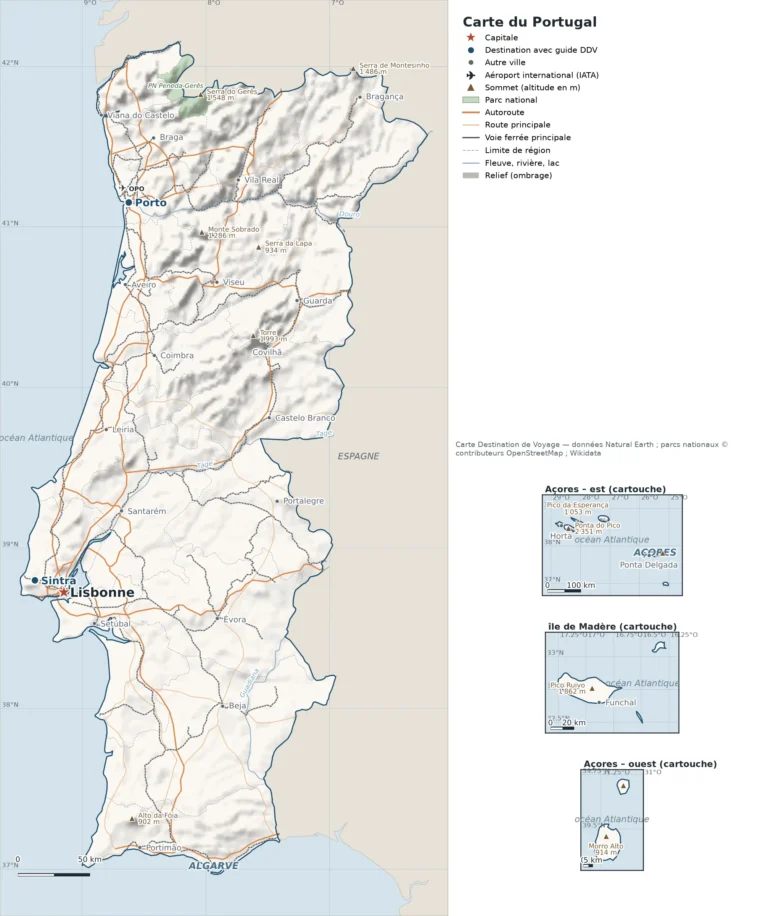
An Azores trip means nine volcanic islands in the middle of the Atlantic: crater lakes, hot springs, fields of hydrangeas, vines growing on lava and boat trips to watch whales and dolphins. This Azores travel guide covers the archipelago, an autonomous region of Portugal, which falls into three groups: São Miguel and Santa Maria in the east, five islands in the centre (Terceira, Graciosa, São Jorge, Pico, Faial), and Flores and Corvo in the west. It helps you choose your islands, your itinerary and your budget.
The Azores at a glance
Main townPonta Delgada, on São Miguel island
LanguagePortuguese; English is widely spoken in tourism
Time zoneUTC−1 (UTC+0 in summer), 1 hour behind London and Lisbon all year · detailsLocal time now: –:–
AirportsPonta Delgada (São Miguel) is the main gateway; Terceira and Horta (Faial) also have airports; many travellers connect via Lisbon or Porto · details
EntryPortugal (Schengen area): US and UK citizens can stay up to 90 days without a visa (UK: in any 180-day period); passport valid at least 3 months beyond your stay · US: travel.state.gov · UK: GOV.UK
Electricity230 V, type C/F plugs; US and UK travellers need an adapter · plugs
✓ Ideal~ Good, with caveats✕ AvoidAverage max. temperature · click a month to see where to go
Jan18°C/64°F
Feb17°C/63°F
Mar18°C/64°F
Apr19°C/66°F
May20°C/68°F
Jun22°C/72°F
Jul25°C/76°F
Aug26°C/79°F
Sep25°C/77°F
Oct23°C/73°F
Nov20°C/68°F
Dec18°C/65°F
✅ Best months: may, June, July, August, September
❌ Period to avoid: January, December
The best period runs from June to September: it is the driest and sunniest season, with afternoon temperatures of 22 to 26 °C (72 to 79 °F) in Ponta Delgada according to IPMA normals. May and October suit hiking well, with more changeable weather. Winter stays mild (17 to 18 °C / 63 to 64 °F) but rainy, and inter-island connections can be disrupted. All the details, month by month: the best time to visit the Azores. Those winter disruptions also feature in our Madeira or the Azores comparison, which sets the two archipelagos side by side.
Things to do in the Azores: the highlights
Sete Cidades (São Miguel)
In the northwest of São Miguel, a vast caldera holds two connected lakes, one blue-looking, the other green. The Vista do Rei viewpoint offers the best-known view, and a trail runs around the rim. Morning is often the clearest time; if clouds cover the crater, come back later. Nearby, Ponta da Ferraria has a natural pool where a hot spring mixes with the ocean, usable depending on sea conditions.
Furnas and Lagoa do Fogo (São Miguel)
The Furnas valley is the volcanic heart of the island: fumaroles, bubbling springs and cozido das Furnas, a stew cooked for several hours in the hot ground by the lake. Terra Nostra Park has a large pool of iron-rich thermal water and a botanical garden; the pools of Poça da Dona Beija are another option. Between Ponta Delgada and Furnas, Lagoa do Fogo, an undeveloped crater lake, can be seen from the road or on foot. In the north, the Gorreana and Porto Formoso tea plantations are open to visitors.
Ponta Delgada
The archipelago’s main town has kept a centre built of black volcanic stone and white lime: the city gates, churches, the Graça market and the waterfront. It is the starting point for most whale- and dolphin-watching trips on São Miguel.
Pico
Pico island is dominated by the volcano of the same name, Portugal’s highest summit (2351 m (7,713 ft)). The long, steep climb is regulated: check access conditions with Casa da Montanha, the mountain house at the start of the trail, before you set off; a guide is recommended. On the coast, the Landscape of the Pico Island Vineyard Culture, a UNESCO World Heritage Site, is a grid of lava-stone walls that shelter the vines from the ocean. Lajes do Pico, a former whaling port, is now a whale-watching centre.
Faial and Horta
Horta is a famous stopover for transatlantic sailors: on the marina walls, crews paint a record of their passage, and Peter Café Sport is an institution. In the west of the island, the Capelinhos volcano, born of an eruption in 1957–1958, left a landscape of ash around an old lighthouse, with an interpretation centre. The caldera, in the centre of Faial, can be explored on foot in clear weather.
Terceira and Angra do Heroísmo
Angra do Heroísmo, a UNESCO World Heritage Site, is one of the most attractive towns in the archipelago, with its colourful streets, churches and Monte Brasil. Inland, Algar do Carvão lets you descend into a volcanic vent; its opening hours are limited, so check them. Terceira is also known for its popular festivals and its bullfights « on a rope » (touradas à corda).
São Jorge and its fajãs
Long and narrow, São Jorge is lined with cliffs at whose foot lie fajãs, small coastal plains formed by landslides or lava flows. Trails lead down to them, such as the one to Fajã da Caldeira de Santo Cristo. The island produces a renowned cheese.
Santa Maria and Graciosa
Santa Maria, the southernmost island, is said to be the driest and sunniest in the archipelago, with light-sand beaches that are rare in the Azores. Graciosa, small and little visited, is a UNESCO Biosphere Reserve; you can descend into Furna do Enxofre, a volcanic cave beneath the caldera. Two quiet islands for those who have already seen São Miguel.
Flores and Corvo
At the western end, Flores is the island of waterfalls and lakes, the wildest in the archipelago; tiny Corvo amounts to one village and a crater. Connections are less frequent and weather-dependent: allow spare days.
Itinerary ideas for the Azores
7 days: São Miguel
Day 1: arrival in Ponta Delgada, historic centre
Day 2: Sete Cidades, viewpoints and Ferraria
Day 3: whale- and dolphin-watching trip, afternoon in Ponta Delgada
Day 4: Lagoa do Fogo and Caldeira Velha
Days 5–6: Furnas (cozido, Terra Nostra), tea plantations, Nordeste
Day 7: hike or beach, departure
10 days to 2 weeks: São Miguel and the central group
Days 1–5: São Miguel
Days 6–8: Pico (vineyards, Lajes, the climb if the weather allows)
Days 9–10: Faial (Horta, Capelinhos, the caldera) by ferry from Pico
Days 11–12: São Jorge and its fajãs, or Terceira and Angra do Heroísmo
Days 13–14: back to Ponta Delgada or Terceira, departure
Keep a spare day at the end: flights and ferries between the islands are sometimes cancelled because of bad weather.
How much does a trip to the Azores cost?
Indicative amounts per person per day, excluding flights:
Item
Tight budget
Comfort
Accommodation (based on a shared double room)
about €30–50
about €70–140
Meals
about €20–30
about €40–70
Transport (shared rental car, fuel)
about €15–25
about €25–40
Activities (whale watching, hot springs, guides)
about €5–15
about €20–50
Total per day
about €70–120
about €155–300
Indicative estimates, varying by season: prices peak in July and August.
The rental car is the first cost to watch in summer: book it at the same time as your flights. To visit several islands, add inter-island flights and ferries.
Who are the Azores for?
Our verdicts by traveller type, based on the places, conditions and budget ranges in this guide:
Hiking and nature: ideal: the Sete Cidades caldera rim, Lagoa do Fogo, the fajã trails on São Jorge, the regulated climb of Pico, the waterfalls of Flores.
Whale watching: a very good choice: boat trips from Ponta Delgada and from Lajes do Pico, a former whaling port.
Couples: yes: the thermal pools of Terra Nostra and Poça da Dona Beija, rural houses on the north coast, the UNESCO-listed town of Angra do Heroísmo.
Families: yes, with a car: thermal pools, boat trips, the descent into Algar do Carvão. Keep a spare day for flights and ferries cancelled by bad weather.
Tight budgets: so-so: about €70–120 a day, with car rental weighing heavily in summer. Book it at the same time as your flights.
Beach: no: the sea is cool and the weather changeable, even in summer. Santa Maria, the driest island, has a few light-sand beaches, rare in the archipelago.
Getting there and getting around the Azores
Getting there: Ponta Delgada Airport on São Miguel is the main gateway; Terceira and Horta (Faial) also receive flights from the mainland. Many international travellers connect via Lisbon or Porto; check current routes from your home airport.
Car: essential for exploring an island at your own pace. Roads are good but winding, and fog can be thick at altitude. UK photocard licences can be used in Portugal (GOV.UK, updated 11 August 2026); US licences are valid for up to six months, and for an International Driving Permit the State Department refers you to AAA or the National Auto Club (travel.state.gov, last updated December 11, 2025). In the Azores, the State Department warns of narrow cobblestone streets, blind curves and livestock on country roads. Licence, insurance and pick-up in Ponta Delgada: see our guide to car rental in the Azores.
Bus: buses link the main towns on São Miguel and the other islands, with limited timetables, especially at weekends.
Plane: SATA Air Açores links Ponta Delgada with Santa Maria, Terceira, Faial (Horta), Pico, São Jorge and Flores.
Ferry: routes link Faial, Pico and São Jorge; other lines run mainly in summer. Crossings can be cancelled in rough seas.
Taxis and tours: useful for one-way hikes or 4×4 trips.
Where to stay in the Azores
Base
Best for
Good to know
Ponta Delgada
First visit, boat trips, restaurants
Central, 20–40 minutes from the main sights
Furnas
Hot springs, nature
Damper, village atmosphere
North coast of São Miguel
Peace and quiet, rural houses
Car essential
Horta (Faial)
Seafaring atmosphere, ferry to Pico
Small town, lively in summer
Madalena or Lajes (Pico)
Vineyards, the climb, whale watching
More limited choice
Angra do Heroísmo (Terceira)
UNESCO-listed town, festivals
Good base for the island
On São Miguel, a base in Ponta Delgada plus one or two nights in Furnas saves long drives.
Options range from hotels to rural houses and homestays. Choice is limited on the smaller islands: in summer, book several months ahead.
Entry requirements, health and safety
US citizens (travel.state.gov, page updated December 11, 2025): you may enter Portugal, including the Azores, for up to 90 days for tourism or business without a visa; your passport must be valid for at least three months beyond your stay; you need sufficient proof of funds and a return ticket.
UK citizens (GOV.UK, updated 11 August 2026): Schengen rules apply, up to 90 days in any 180-day period without a visa; your passport must have been issued less than 10 years before you arrive and be valid for at least 3 months after you leave the Schengen area. The EU Entry/Exit System (EES) is now in place: fingerprints and a photo are taken at your first entry (free).
Health: for vaccines, GOV.UK refers to TravelHealthPro’s Portugal guide and travel.state.gov advises being up to date on all CDC-recommended vaccinations. Take out travel insurance that covers medical costs and repatriation, especially if you plan to hike; UK residents can also use a GHIC or a valid EHIC.
Safety: the U.S. Department of State says pickpocketing is common at popular tourist sites; GOV.UK notes that hiking in the Azores can be challenging, so choose paths that suit your fitness.
Natural hazards: GOV.UK lists earthquakes as a risk in Portugal and, for the Azores, refers to the Earthquake Information and Surveillance Centre.
Sea and hiking: respect the flags: according to the UK FCDO (GOV.UK, updated 11 August 2026), a red flag means you must not enter the water and a yellow flag means it is only safe to paddle at the water’s edge; beware of rip currents. In the mountains, be properly equipped, stay on marked trails and don’t hike alone.
Weather: always pack a waterproof windbreaker and a warm layer, even in August; check the webcams before driving up to the viewpoints.
Money: cards are widely accepted; keep a little cash for small cafés and markets.
Internet: check your home carrier’s roaming charges before you leave, or use a local or eSIM data plan.
Whale watching: choose an operator that follows Portuguese regulations on approaching the animals.
Hot springs: the iron-rich water at Furnas stains light-coloured swimwear: bring an old swimsuit.
Food and drink: try cozido das Furnas, São Jorge cheese, São Miguel pineapple, grown in greenhouses, and Pico wine.
Further reading
The weather changes quickly from one island to the next: before setting your dates, read the best time to visit the Azores, with month-by-month weather in Ponta Delgada. The Azores are one hour behind Lisbon: our page on time differences in Portugal explains the offset for each region. To combine the archipelago with the mainland during a stopover, see our Portugal travel guide and our Lisbon guide.
Frequently asked questions
Which is the most beautiful island in the Azores?
It depends on what you are looking for. São Miguel is the most varied (crater lakes, hot springs, tea) and the easiest to reach. Pico is the most spectacular for its volcano and vineyards, Flores the wildest.
How many days do you need in the Azores?
A week lets you see São Miguel properly. Allow 10 days to 2 weeks to add Pico and Faial, or Terceira, keeping a spare day for bad weather.
How much does a week in the Azores cost?
Excluding flights, allow about €70–120 per person per day on a tight budget and €155–300 for a comfortable trip, or roughly €500–850 or €1,100–2,100 for 7 days.
Do you need to rent a car in the Azores?
Yes, it is strongly recommended: buses exist but their timetables are limited, and most viewpoints and trailheads are outside the towns.
Are the Azores worth visiting?
Yes, if you enjoy nature, hiking and volcanic landscapes. It is not a guaranteed beach destination: the weather is changeable and the sea cool, even in summer.
Transparency: this page contains affiliate links, labelled as such. If you book through them we may earn a commission at no extra cost to you; it does not influence our content or recommendations. How we fund the site.