This Madeira travel guide covers a Portuguese volcanic island in the Atlantic, known for its trails along the levadas, its cliffs and its mild weather all year round. With the small island of Porto Santo and its sandy beach, it forms an archipelago that is easy to organise: the euro, no visa needed for short stays by US or UK citizens, and the same time as London. Allow a week for the essentials (Funchal, the peaks, a few levadas and the north coast) and ten days to two weeks to add Porto Santo, with a budget of roughly €70–100 per person per day on a tight budget. This guide brings together what to see and do, itineraries and practical information.
To locate the towns, regions, relief, national parks and airports, see our map of Madeira.
Madeira at a glance
CapitalFunchal (autonomous region of Portugal)
LanguagePortugueseEnglish is common in tourist areas
Time zoneUTC+0, UTC+1 in summer; same time as London, 5 hours ahead of New York · details
AirportsMadeira (FNC), near Santa Cruz; Porto Santo (PXO) · details
EntryPortugal, Schengen area: no visa for stays of up to 90 days for US and UK citizens · travel.state.gov · GOV.UKPassport valid at least 3 months beyond your stay (US) or after leaving the Schengen area (UK)
Electricitycheck plug types and voltage before you go · plugs
The best time is from April to September: there is very little rain in Funchal, temperatures stay pleasant (21 to 27 °C, or 70 to 81 °F, in the afternoon) and the high-altitude trails are more often open. May, with the Flower Festival, and September, with warmer sea temperatures, are the best compromises. From October to March it is always mild on the south coast (about 20 °C (68 °F) in the afternoon in winter), but rain is more frequent and so are trail closures. The New Year’s Eve fireworks attract many visitors. All the details, month by month and region by region, are in our article on the best time to visit Madeira. For the very popular 31 December fireworks, Madeira weather in December covers rain, temperatures and bookings.
Where to go in Madeira: the highlights
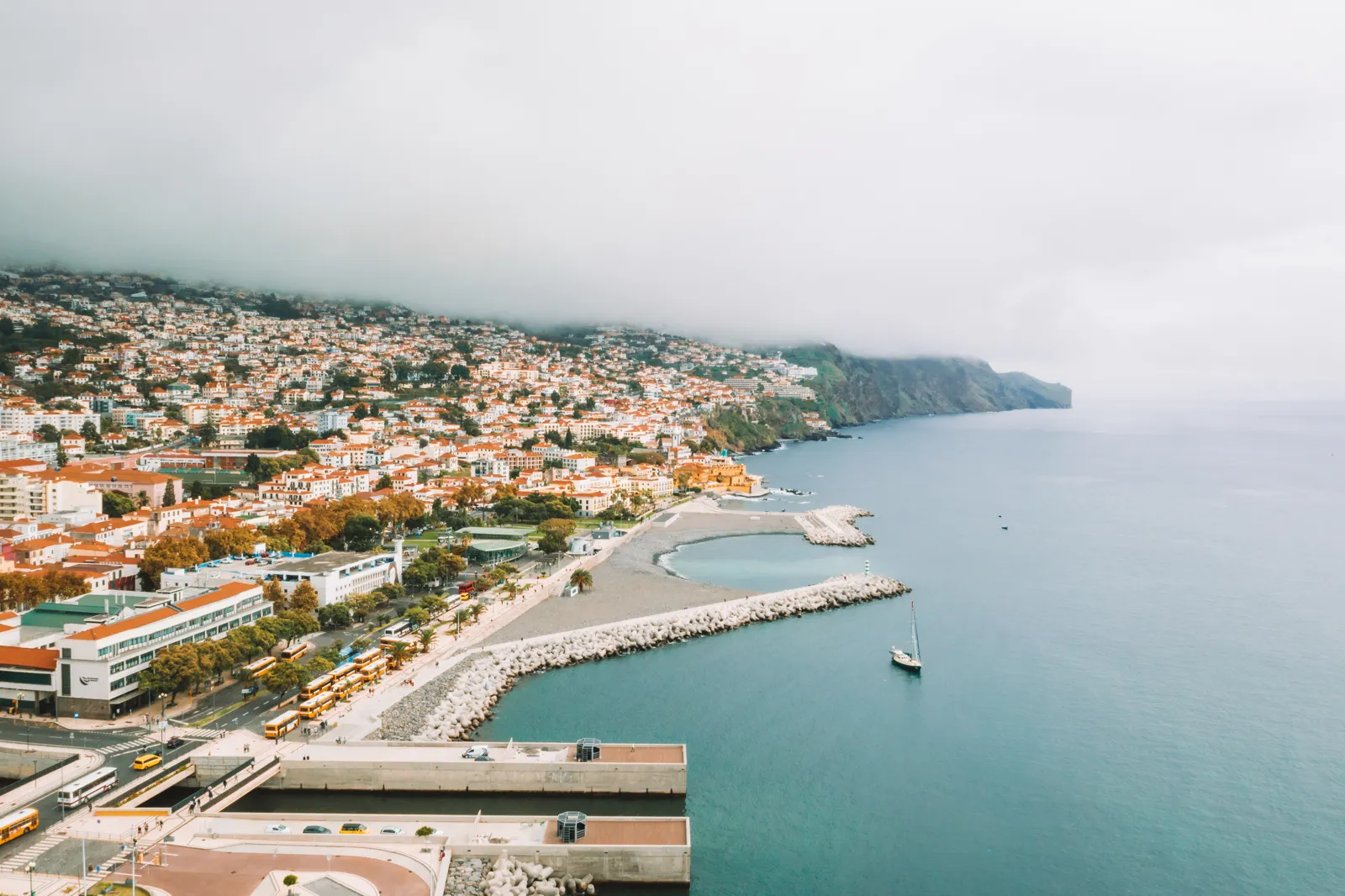
The old town of Funchal on the Atlantic, in Madeira
Funchal
The capital rises like an amphitheatre above its bay. Allow at least two days for the old town (Zona Velha) and its painted doors, the Lavradores market, the cathedral, the Madeira wine lodges and the seafront. The cable car climbs to the Monte district, from where you can ride back down in the traditional wicker toboggans steered by « carreiros ». The botanical garden and the Monte gardens round off the visit. Funchal is also the most practical base for exploring the island.
Pico do Arieiro and Pico Ruivo
The island’s two highest peaks exceed 1,800 m (5,900 ft). A road climbs to Pico do Arieiro, often above a sea of clouds at sunrise. The trail linking it to Pico Ruivo, Madeira’s highest point, is one of the most spectacular hikes on the island, but also one of the most exposed: steps cut into the rock, tunnels, airy sections. It is regularly closed, in whole or in part, after storms or fires: check its status on the official website before you set off.
The levadas: Rabaçal, Caldeirão Verde, Levada do Rei
The levadas are irrigation channels that run across the island for more than two thousand kilometres (over 1,200 mi). The maintenance paths alongside them form hiking trails that are often almost flat, deep in the forest. Among the best known: the Rabaçal trails (25 Fontes waterfall, Risco), Caldeirão Verde from Queimadas, and the Levada do Rei. Some sections are narrow and vertiginous: the UK FCDO advises choosing paths that suit your fitness and experience and reducing the risk by walking with a group or following a guide (GOV.UK, updated 11 August 2026). Classified trails charge a fee and must be booked (see below).
Fanal forest and the Paul da Serra plateau
In the north-west, the laurel forest (laurisilva), a UNESCO World Heritage Site, takes on a very particular look at Fanal: old laurels standing alone in meadows, often shrouded in fog. The neighbouring Paul da Serra plateau, vast and bare, contrasts with the deep valleys around it. The area is cool and windy: bring a warm layer.
The north coast: Porto Moniz, Seixal, São Vicente and Santana
The north coast road runs along cliffs covered with vegetation and waterfalls. In Porto Moniz, natural pools have been built into the volcanic rock; Seixal has a black-sand beach. São Vicente has volcanic caves that can be visited. To the east, Santana is known for its small traditional houses with triangular thatched roofs.
Ponta de São Lourenço
At the eastern tip of the island, this dry, almost treeless peninsula contrasts with the rest of Madeira: colourful cliffs and ocean views on both sides. The trail along it is one of the busiest on the island; set off early, as there is no shade.
Câmara de Lobos and Cabo Girão
A few kilometres west of Funchal, the small fishing port of Câmara de Lobos, with its colourful boats, is a pleasant stop. A little further on, Cabo Girão, one of the highest cliffs in Europe, has a glass-floored viewing platform suspended above terraced fields and the ocean.
Porto Santo
About two and a half hours by ferry from Funchal, or a few minutes by plane, Porto Santo is the opposite of Madeira: a dry, flat island fringed by a long golden sandy beach of almost 9 km (6 mi). It is the archipelago’s beach destination, especially from July to September. Allow two or three days to enjoy it, or a day trip in summer.
Things to do in Madeira: 10 experiences not to miss
To sum up what to see and do in Madeira on a first trip, here are the experiences described above, to tick off according to your interests:
Stroll through Funchal’s old town and the Lavradores market, then taste Madeira wine
Ride the cable car up to Monte and come back down by wicker toboggan
Watch the sunrise from Pico do Arieiro, above the sea of clouds
Hike from Pico do Arieiro to Pico Ruivo, if the trail is open
Walk along a levada: 25 Fontes at Rabaçal, Caldeirão Verde or the Levada do Rei
Get lost in the Fanal laurel forest, often in the fog
Swim in the natural pools of Porto Moniz
See the traditional thatched houses of Santana
Walk Ponta de São Lourenço early in the morning
Step onto the glass platform at Cabo Girão, then stop at Câmara de Lobos
Itinerary ideas: how many days in Madeira?
7 to 10 days: the essentials of Madeira
Days 1 and 2: Funchal (old town, market, Monte cable car, gardens)
Day 3: Câmara de Lobos, Cabo Girão, then the south-west coast to Calheta
Day 4: sunrise at Pico do Arieiro, then the hike towards Pico Ruivo if the trail is open
Day 5: Rabaçal (25 Fontes) and Fanal, returning via Paul da Serra
Day 6: the north coast: Porto Moniz, Seixal, São Vicente
Day 7: Santana and the Caldeirão Verde levada
Days 8 to 10: Ponta de São Lourenço, another levada, or a rest day in Funchal
2 weeks: Madeira and Porto Santo
Days 1 to 3: Funchal and around
Days 4 to 6: a base on the north coast (Santana or São Vicente) for mountain hikes and northern levadas
Days 7 to 9: a base in the west (Calheta or Porto Moniz): Rabaçal, Fanal, Paul da Serra
Day 10: Ponta de São Lourenço and Machico
Days 11 to 13: ferry or flight to Porto Santo, beach and a tour of the island
Day 14: back to Funchal and flight home
Budget for a trip to Madeira
Meals in Madeira are reasonably priced by Western European standards, but accommodation prices rise sharply over the festive season, during the Flower Festival and in summer. Car hire is a significant expense if you want to explore the island freely. Approximate amounts per person per day, excluding flights:
Item
Tight budget
Comfortable
Accommodation (based on a shared double room)
about €30–50
about €80–150
Meals
about €20–30
about €40–60
Transport (bus, share of a rental car)
about €10–20
about €20–30
Activities and sightseeing
about €5–15
about €15–40
Total per day
about €70–100
about €150–250
Rough estimates that vary with the season. Expect to pay considerably more around 31 December.
Allow for the access fee on classified trails: €4.50 per trail for the general public since 1 January 2026, according to the official tourism website (visitmadeira.com, checked on 24 October 2026). Guided excursions (guided hikes, boat trips, canyoning) quickly push up the activities budget.
Madeira: who is it for?
Our verdict depending on how you like to travel, based on the places, conditions and budget ranges in this guide:
Hiking: ideal: the Rabaçal and Caldeirão Verde levadas, the Pico do Arieiro to Pico Ruivo trail, Ponta de São Lourenço. Classified trails charge a fee and must be booked.
Winter sun: a very good choice: about 20 °C (68 °F) in the afternoon in winter on the south coast, with more frequent rain and some trails closed.
Couples: yes: quintas surrounded by gardens, sunsets from Cabo Girão, Madeira wine lodges in Funchal.
Families: yes: the Monte cable car and wicker toboggans, the natural pools of Porto Moniz, the Porto Santo beach in summer. Keep the vertiginous trails for children used to walking.
Tight budget: moderately: roughly €70–100 per person per day, with a rental car weighing on the budget. Avoid New Year and the Flower Festival, which are more expensive.
Beach: not on Madeira itself; yes on Porto Santo, with its golden sandy beach of almost 9 km (6 mi), especially from July to September.
Getting around Madeira
Rental car: the most flexible way to reach trailheads and the north coast. The network of expressways and tunnels is good, but secondary roads are narrow and very steep: a reasonably powerful car is preferable, and caution is needed in rain or fog at altitude. UK photocard licences can be used in Portugal (GOV.UK, updated 11 August 2026); US licences are valid for up to six months, and for an International Driving Permit the State Department refers you to AAA or the National Auto Club (travel.state.gov, last updated December 11, 2025).
Bus: a city network serves Funchal, and several bus companies link the capital with the island’s villages. Practical for simple journeys, but services to isolated trailheads are infrequent.
Taxis and excursions: taxis can be booked by the day, and many agencies offer transfers to levada trailheads, useful for one-way hikes.
To Porto Santo: a ferry links Funchal and Porto Santo (a crossing of about two and a half hours), and short flights connect the two airports. Crossings can be disrupted by rough seas.
From the airport: Madeira airport is at Santa Cruz, east of Funchal, about twenty minutes from the centre by car. Buses, taxis and car rental companies operate there.
Where to stay in Madeira
Funchal is the most practical base for a first stay: plenty of hotels and restaurants, bus connections and the sunniest climate on the island. The old town and the centre let you do everything on foot; the hotel zone west of the centre (Lido) has most of the large hotels with pools. On the south-west coast, Calheta and Ponta do Sol are quieter and sunny. For hiking, one or two nights on the north coast (Santana, São Vicente, Porto Moniz) save long drives.
Options range from guesthouses and apartments to upscale hotels, including quintas, old manor houses surrounded by gardens and converted into hotels. For New Year and the Flower Festival, book several months ahead.
Mistakes to avoid on a trip to Madeira
Hiking without a booking: according to visitmadeira.com, reservations on the SIMplifica portal are mandatory for classified trails, and hiking without one may result in a fine.
Setting off on a closed trail: each trail is listed as open, restricted or closed on visitmadeira.com; check on the day.
Judging the weather from Funchal: conditions change quickly and can be very different on the peaks and the north coast; bring a warm layer and a windproof jacket.
Forgetting a head torch: several trails go through tunnels.
Renting an underpowered car: secondary roads are narrow and very steep.
Booking too late for New Year or the Flower Festival: hotels in Funchal fill up several months ahead.
Entry requirements for Madeira
Madeira is part of Portugal: the US and UK advice for Portugal applies (GOV.UK states that its Portugal advice also covers Madeira and Porto Santo).
US citizens: you may enter for up to 90 days for tourism or business without a visa. Your passport must be valid at least three months beyond the period of stay, and you need sufficient proof of funds and a return ticket. If you are not staying in a hotel or similar tourist accommodation, the State Department says you must register your presence with the immigration authorities within three working days of arrival (U.S. Department of State, travel.state.gov, last updated December 11, 2025).
UK citizens: Schengen rules apply, up to 90 days in any 180-day period without a visa. Your passport must have been issued less than 10 years before the day you arrive and be valid at least 3 months after the day you plan to leave the Schengen area. The EU Entry/Exit System (EES) is being implemented: fingerprints and a photo may be taken, free of charge (GOV.UK, updated 11 August 2026).
Health and safety
Health: for vaccines, GOV.UK refers to TravelHealthPro’s Madeira and Porto Santo guide, and travel.state.gov advises being up to date on all CDC-recommended vaccinations. UK travellers need a GHIC or EHIC for medically necessary state healthcare; whatever your nationality, take out travel insurance covering medical costs.
Hiking: according to the UK FCDO (GOV.UK, updated 11 August 2026), hiking in Madeira can be challenging: expect narrow, uneven paths and heights, take extra care after rain, leave details of your route with your hotel, take a phone and consider walking with a group or a guide. Never walk on a closed trail; bring a head torch (tunnels), a windproof jacket and water.
Cliffs and swimming: GOV.UK warns that falling rocks are a hazard near cliffs and that the authorities can fine people who ignore warning signs. On supervised beaches, a red flag means you must not enter the water and a yellow flag means it is only safe to paddle at the water’s edge. In rough seas, stay away from the shore.
Wildfires: the UK FCDO warns of an increased wildfire risk from April to October; starting a fire, even by accident, is illegal and can lead to a fine or a prison sentence. Call 112 if you see a fire. Emergency number: 112.
Practical tips for Madeira
Money: the euro. Cards are accepted almost everywhere; ATMs are plentiful in Funchal and the main villages.
Mobile data: check your home carrier’s roaming charges before you leave. Coverage can be weak in some valleys and in the mountains. An eSIM is a simple way to get local data.
Weather: conditions change quickly and vary a lot from one side of the island to the other. Check the forecasts and warnings of the Portuguese Met Office (IPMA), and the trail status, every morning.
Hiking: book your slot on the SIMplifica portal for each classified trail, and set off early to avoid crowds and clouds on the peaks.
Food: try espada (black scabbardfish), bolo do caco (local garlic bread), espetada (beef skewers), poncha (a drink made with sugar-cane spirit) and, of course, Madeira wine.
Etiquette: tipping is not compulsory, but rounding up the bill in restaurants is customary. A few words of Portuguese (obrigado, obrigada) are always appreciated.
Not for short stays as a US or UK citizen. Madeira is part of Portugal, in the European Union and the Schengen area: you can stay up to 90 days (in any 180-day period for UK citizens) without a visa, with a passport valid at least 3 months beyond your stay. Check travel.state.gov or GOV.UK before you leave.
When is the best time to visit Madeira?
From April to September, when there is very little rain in Funchal and the trails are more often open. May and September are the best compromises. The island stays mild all year, but winter is wetter.
How many days do you need to visit Madeira?
A week lets you discover Funchal, the main peaks, a few levadas and the north coast. With ten days to two weeks, you can do more hikes and add Porto Santo.
Do you need to rent a car in Madeira?
It is strongly recommended to reach trailheads and the north coast freely. Secondary roads are narrow and steep: drive carefully. Without a car, buses, taxis by the day and organised excursions are alternatives.
Do you have to pay to hike in Madeira?
Yes, on classified trails (PR): since 1 January 2026, access costs €4.50 for the general public and requires booking a slot on the SIMplifica portal, according to the official website visitmadeira.com. Also check the trail status (open, restricted or closed) before you set off.
Is Madeira worth visiting?
Yes if you love hiking and scenery: levadas, peaks above 1,800 m (5,900 ft), a UNESCO-listed laurel forest and cliffs, with the euro and no visa for short stays. It is less suited to a pure beach holiday: for a long sandy beach, go to Porto Santo.
How much does a trip to Madeira cost?
Excluding flights, allow roughly €70–100 per person per day on a tight budget and €150–250 for a comfortable trip, more around 31 December. Add €4.50 per classified trail for hiking.
Transparency: this page contains affiliate links, labelled as such. If you book through them we may earn a commission at no extra cost to you; it does not influence our content or recommendations. How we fund the site.