What is there to do in Lisbon? Wander through Alfama up to São Jorge Castle, walk down through the Baixa to Praça do Comércio, visit Belém (Jerónimos Monastery, Belém Tower), ride tram 28, enjoy the viewpoints and spend a day in Sintra. This Lisbon travel guide covers a city that rises in tiers over hills facing the Tagus estuary. You move from the medieval lanes of Alfama to the avenues of the Baixa, rebuilt after the 1755 earthquake, and on to the monuments of Belém, linked to the age of maritime exploration. The city is best explored on foot and by tram, in good shoes. This guide helps you choose what to see in Lisbon, where to stay and which itinerary to follow, for a weekend or a 3- to 5-day stay. If Porto tempts you too, our Porto or Lisbon comparison helps you choose according to budget, length of stay and atmosphere.
Flights London → Lisbon
“From” fare provided by Kiwi.com (affiliate link), seen in recent searches; it varies with dates.

Our travel deals for Lisbon
Affiliate links: we earn a commission, at no extra cost to you.
 Learn the languageTargumiLearn a few words of Portuguese before you go — 30% off via our link.See the course
- Airport transferKiwitaxiPrivate driver booked in advance at a fixed price.Book a transfer
- Tickets and toursTiqetsEntry tickets and guided tours to book online; compare with the official price.See tickets



Lisbon at a glance
- Airport Humberto Delgado (LIS), linked to the centre by metro
- Ideal length of stay 3 to 4 days, plus a day for Sintra
- Best time to go April to June and September
- Time zone same time as London all year; 5 hours ahead of New York most of the year (details)
- Entry Schengen area; US and UK citizens can stay up to 90 days without a visa (see travel.state.gov and GOV.UK)
- Currency the euro
- Electricity 230 V, type C/F plugs (two round pins); US and UK travellers need an adapter
- Budget roughly €70–120 per person per day on a tight budget, €160–300 for a comfortable trip
Things to do in Lisbon: the highlights
Alfama and São Jorge Castle
Lisbon’s oldest neighbourhood largely survived the 1755 earthquake. Its stepped lanes lead to the cathedral (Sé), the Santa Luzia and Portas do Sol viewpoints, and São Jorge Castle at the top of the hill, with views over the city and the Tagus. In the evening, several fado houses put on performances. The Feira da Ladra flea market is held near the Monastery of São Vicente de Fora. To bundle transport and museums, see our Lisboa Card page, with its official prices.
Baixa, Praça do Comércio and Chiado
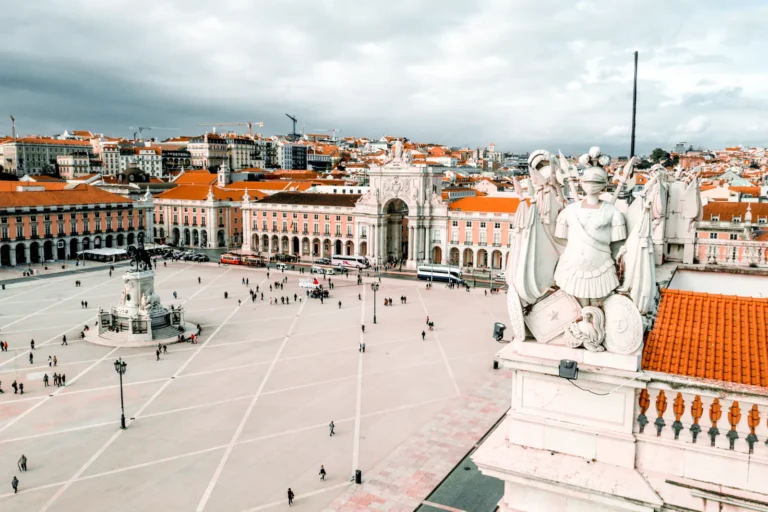
Rebuilt on a grid after the earthquake, the Baixa links Rossio square to Praça do Comércio, which opens onto the Tagus. Pedestrianised Rua Augusta passes under a triumphal arch. The Santa Justa Lift, an early 20th-century iron structure, climbs towards Chiado, an elegant district of historic cafés, bookshops and theatres, and to the ruins of the Carmo Convent.
Belém: the tower and Jerónimos Monastery
West of the centre, Belém gathers the monuments linked to the maritime discoveries: Jerónimos Monastery and Belém Tower, jointly listed as a UNESCO World Heritage Site, and the Monument to the Discoveries. This is where you taste the famous pastéis de Belém, and the district is also home to MAAT (Museum of Art, Architecture and Technology) and the Belém Cultural Centre. Come early: queues are long in high season.
Tram 28 and the viewpoints
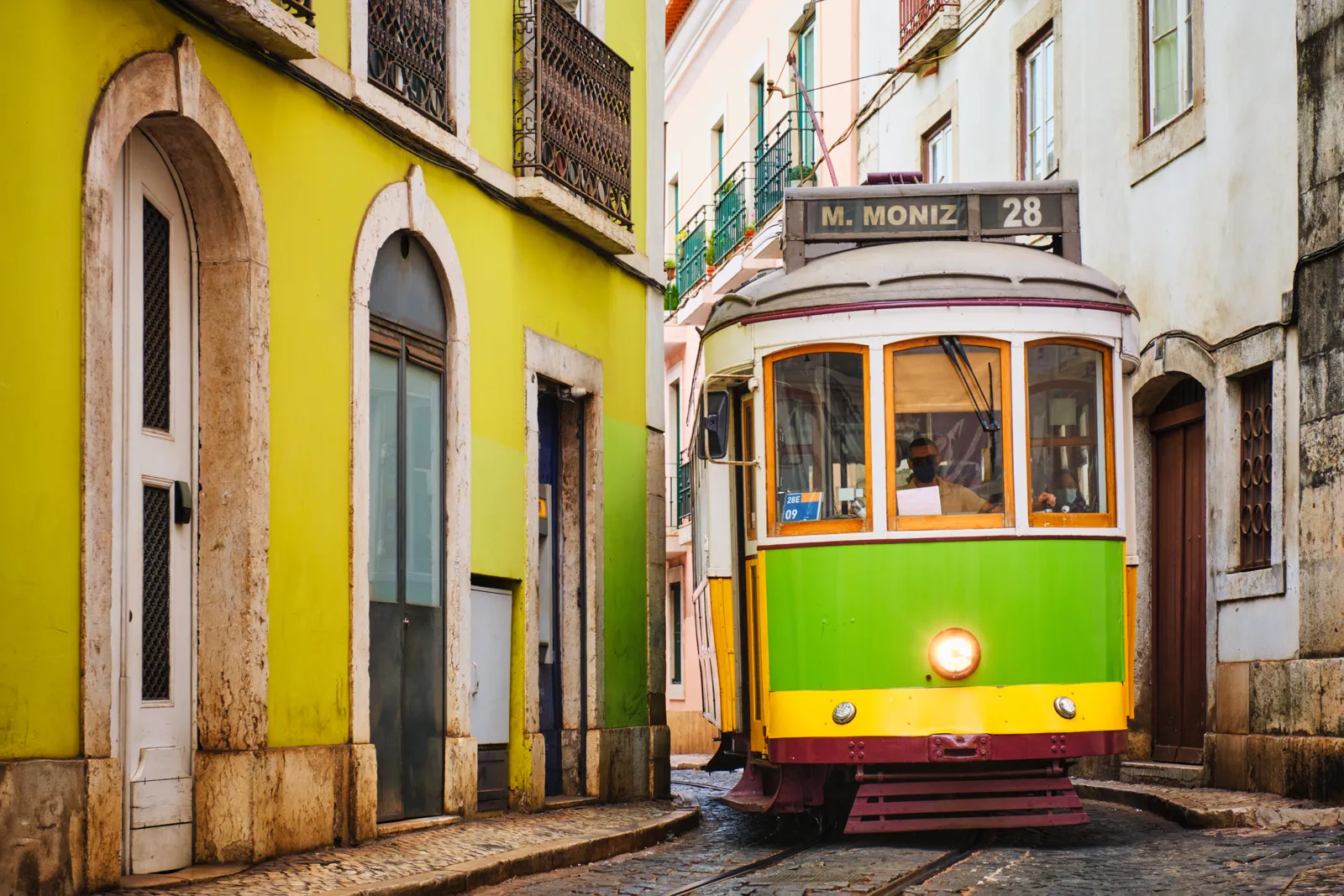
Tram 28 runs from Martim Moniz to Campo de Ourique through Graça, Alfama, the Baixa and Estrela, in vintage cars. It is often packed: board at the terminus early in the morning and keep an eye on your belongings. The viewpoints (miradouros) are another way to discover the city: Senhora do Monte and Graça for the view of the castle, São Pedro de Alcântara facing Alfama.
Bairro Alto and Príncipe Real
Quiet by day, Bairro Alto becomes one of the liveliest districts in the city at night, with bars and restaurants packed into narrow streets. Just above it, Príncipe Real is a residential area with gardens, designer shops and quieter cafés.
Museums: Gulbenkian, azulejos and ancient art
The Calouste Gulbenkian Museum, in a modern park north of the centre, holds a collection ranging from ancient Egypt to 20th-century art. The National Azulejo Museum, housed in a former convent, traces the history of the glazed tiles that cover so many of the city’s façades. The National Museum of Ancient Art displays Portuguese and European painting.
Parque das Nações and the Oceanário
Built for the 1998 World Expo, this modern district on the banks of the Tagus is home to the Oceanário, one of the largest aquariums in Europe, a riverside promenade and a cable car. It is especially popular with families.
Sintra and Cascais
Less than an hour by train from Rossio station, Sintra is a collection of romantic palaces and gardens on a wooded hill: Pena Palace, Quinta da Regaleira, the Moorish Castle and the National Palace. It gets very crowded: come early, on a weekday, and book tickets for the most popular sites. Cascais, a seaside resort reached by train from Cais do Sodré, can be combined with Cabo da Roca, the westernmost point of mainland Europe.

What to see in Lisbon: summary of visits
| Sight | Area | Time needed | Who is it for? |
|---|---|---|---|
| São Jorge Castle and viewpoints | Alfama | Half a day with the neighbourhood | First-time visitors, lovers of views |
| Rua Augusta, Praça do Comércio, Santa Justa Lift | Baixa, Chiado | Half a day | Everyone |
| Jerónimos Monastery, Belém Tower | Belém | Half a day to a full day | History, architecture |
| Tram 28 | From Martim Moniz to Campo de Ourique | One ride, early in the morning | Everyone, watching their belongings |
| Gulbenkian, Azulejo and Ancient Art museums | Outside the historic centre | 2 to 3 hours each | Rainy days, art lovers |
| Oceanário | Parque das Nações | Half a day | Families |
| Sintra palaces | Sintra, by train from Rossio | A full day | Stays of 4 days or more |
Lisbon neighbourhoods
- Baixa and Chiado: central, flat (in the Baixa), ideal for a first visit
- Alfama and Graça: charm and viewpoints, but steep lanes and sometimes noisy
- Bairro Alto: nightlife; avoid it if you want peace and quiet
- Príncipe Real and Estrela: residential and quiet, within walking distance of the centre
- Avenida da Liberdade: large hotels, well served by the metro
- Belém: quiet in the evening, but out of the way
Itinerary: Lisbon in 3 to 5 days
- Day 1: Baixa, Praça do Comércio, Santa Justa Lift and Chiado; in the evening, Bairro Alto
- Day 2: Alfama, the cathedral, São Jorge Castle, the Graça viewpoints; in the evening, a fado performance
- Day 3: Belém (Jerónimos Monastery, the tower, the Monument to the Discoveries), then LX Factory or MAAT
- Day 4: day trip to Sintra, returning via Cascais or Cabo da Roca if you have a car or are on an organised tour
- Day 5: Gulbenkian Museum or Azulejo Museum, then Parque das Nações and the Oceanário
With only two days, focus on the Baixa, Chiado, Alfama and Belém, and save Sintra for another visit.
A weekend in Lisbon: 2-day itinerary
For a weekend in Lisbon, stay central and group your visits by neighbourhood to limit travel time:
- Day 1, morning: Baixa, Rua Augusta and Praça do Comércio, then the Santa Justa Lift up to Chiado
- Day 1, afternoon: Alfama, the cathedral, the Santa Luzia and Portas do Sol viewpoints, São Jorge Castle
- Day 1, evening: dinner and fado in Alfama, or the buzz of Bairro Alto
- Day 2, morning: Belém early (Jerónimos Monastery, Belém Tower, Monument to the Discoveries) and pastéis de Belém
- Day 2, afternoon: LX Factory or MAAT, then sunset from a viewpoint (São Pedro de Alcântara, Senhora do Monte)
Tram 15 links the centre to Belém. Save tram 28 for a morning, boarding at the terminus.
Airport transfer in Lisbon: metro, bus, taxi and private transfer
Humberto Delgado Airport is very close to the city: according to its operator ANA, it is 20 minutes from the centre. The metro is the simplest and cheapest option; taxis are still affordable.
Metro
The airport has its own metro station, with a direct line to the centre; ANA gives about 20 minutes to central Lisbon. You first need to buy the rechargeable navegante occasional card (€0.50). According to the Metropolitano de Lisboa fare table in force since 1 January 2026, a single Carris/Metro ticket costs €1.90 (valid for 1 hour on the Carris/Metro network), a metro trip paid with « zapping » credit loaded on the card €1.72, a trip paid with a contactless bank card €1.92, and a 24-hour Carris/Metro ticket €7.25.
Bus
Carris city buses and intercity coaches (Flixbus) stop near the arrivals terminal. ANA states that only luggage of up to 50 x 40 x 20 cm (20 x 16 x 8 in) is allowed on city buses: with a suitcase, take the metro.
Taxi and ride-hailing
Taxis wait outside the terminals. According to ANA, a ride to the centre costs between €10 and €15, luggage included, depending on traffic; check that the meter is running and ask for a receipt. ANA points out that a taxi or ride-hailing car should be booked at the official rank or through an app, never with someone who approaches you in the terminal. Ride-hailing services (Bolt, Uber) have a pick-up area in car park P2, level 2, on the arrivals side.
| Option | Where to catch it | Official fare | Source |
|---|---|---|---|
| Metro | Aeroporto station | €1.90 (+ €0.50 card) | metrolisboa.pt; lisbonairport.pt |
| Carris bus | Stops near arrivals | Carris/Metro ticket €1.90 | metrolisboa.pt; lisbonairport.pt |
| Taxi | Outside the terminals | €10 to €15 to the centre, luggage included | lisbonairport.pt |
| Ride-hailing (Bolt, Uber) | Car park P2, level 2 | Set by the app | lisbonairport.pt |
Booking a transfer in Lisbon
A private transfer booked in advance (a driver waiting on arrival, price fixed at booking) mainly makes sense for late arrivals, bulky luggage, families with young children or groups, when the cost is shared. It can also take you straight to Cascais, Sintra or the coast. Before booking, check what the price includes (tolls, luggage, waiting time if your flight is delayed), the exact meeting point in the terminal, the cancellation terms and the name of the company that actually operates the ride.
Sources: ANA Aeroportos de Portugal, Lisbon Airport, « Public transportation » page (lisbonairport.pt); Metropolitano de Lisboa, 2026 fare table (metrolisboa.pt), checked on 24 October 2026.
Where to stay in Lisbon
For a first visit, the Baixa and Chiado let you do everything on foot and are well connected by metro. Alfama is full of atmosphere, but getting there by taxi and with luggage is difficult. Príncipe Real and Estrela are quieter, and Avenida da Liberdade suits upscale hotels.
Options range from the many hostels to guesthouses, apartments and boutique hotels in old buildings. Check for a lift and air conditioning, often useful in summer. In June and in summer, book several months ahead.
Getting around Lisbon
- Metro: four lines, handy for the airport, the Baixa, Avenida da Liberdade and Parque das Nações.
- Trams and funiculars: lines 28 and 15 (to Belém) are the most used; the funiculars (Glória, Bica, Lavra) climb the steepest slopes.
- Bus: a dense network, useful for areas the metro does not reach.
- Train: suburban lines to Sintra (from Rossio) and to Cascais (from Cais do Sodré).
- Boat: ferries cross the Tagus to Cacilhas, with a fine view of the city.
- Car: pointless in the city, where driving and parking are difficult; only useful for exploring the region.
A rechargeable card works on the metro, buses, trams and some trains. A city tourist pass combining transport and admissions can be worthwhile if you plan many visits: according to the Visit Lisboa tourist board, the Lisboa Card includes city transport and free admission to 51 museums and monuments, including São Jorge Castle, Jerónimos Monastery and Belém Tower. Compare its price on the official website with the admissions you actually plan to use.
When to go to Lisbon
✅ Best months: April, may, June, September, October
❌ Period to avoid: November
The best periods are April to June and September: 20 to 27 °C (68 to 81 °F) in the afternoon and little rain, according to the IPMA normals. July and August are hot (nearly 29 °C (84 °F)) and very busy; November is the wettest month. Winter is mild and quiet, ideal for museums. Weather month by month and festivals: see our article on the best time to visit Lisbon.
Budget for a trip to Lisbon
Meals and transport in Lisbon are generally reasonably priced by Western European standards, but accommodation costs have risen sharply. Approximate amounts per person per day, excluding flights:
| Item | Tight budget | Comfortable |
|---|---|---|
| Accommodation (based on a shared double room) | about €30–55 | about €80–160 |
| Meals | about €25–35 | about €45–80 |
| Transport (metro, tram, train) | about €5–10 | about €10–25 |
| Sightseeing | about €10–20 | about €25–40 |
| Total per day | about €70–120 | about €160–300 |
To cut costs: have the « prato do dia » (dish of the day) for lunch in neighbourhood cafés, enjoy the free viewpoints and gardens, and drink your coffee at the counter.
Who is Lisbon for?
Our verdicts by traveller profile, based on the places, conditions and budget ranges in this guide:
- City weekend: ideal, especially if you are already in Europe: in two days you can see the Baixa, Chiado, Alfama and Belém.
- Culture and history: a very good choice: Jerónimos Monastery and Belém Tower on the UNESCO list, the Gulbenkian, Azulejo and Ancient Art museums, fado in Alfama.
- Couples: yes: sunsets from the viewpoints, fado, the romantic palaces of Sintra.
- Families: yes, with good shoes and a light stroller: the Oceanário in Parque das Nações, the ferry to Cacilhas, the beaches of Cascais by train. The steep lanes of Alfama are tiring.
- Nightlife: yes: Bairro Alto bars in the evening, the June festivals and grilled sardines.
- Tight budget: so-so: about €70–120 a day, as accommodation has risen sharply. The dish of the day, the viewpoints and free gardens keep spending down.
- Beach: as a day trip: Cascais is reached by train from Cais do Sodré.
What to eat in Lisbon
- Pastéis de nata: custard tarts in puff pastry, best tasted in Belém, where they are called pastéis de Belém
- Salt cod (bacalhau): as fritters (pastéis de bacalhau) or in slow-cooked dishes
- Grilled sardines: the signature dish of the June festivals
- Prato do dia: the dish of the day in neighbourhood cafés, the cheapest option at lunchtime
- Ginjinha: the sour cherry liqueur served by the glass at small counters around Rossio
To estimate your spending if you are coming from outside the eurozone, use our currency converter.
Entry requirements, health and safety
- US citizens: Portugal is in the Schengen area; you may enter for up to 90 days for tourism or business without a visa. Your passport must be valid at least three months beyond the period of stay, and you need sufficient proof of funds and a return ticket (U.S. Department of State, travel.state.gov, page updated December 11, 2025).
- UK citizens: Schengen rules apply, up to 90 days in any 180-day period without a visa. Your passport must have been issued less than 10 years before arrival and be valid at least 3 months after you leave the Schengen area. The EU Entry/Exit System (EES) is now in place: fingerprints and a photo are taken at your first entry, free of charge (GOV.UK, updated 11 August 2026).
- Minors: according to the UK FCDO (GOV.UK, updated 11 August 2026), children aged 17 and under travelling alone or with an adult who is not their parent or legal guardian must carry a certified letter of authorisation to travel.
- Health: UK travellers can use a valid GHIC or EHIC for state healthcare; whatever your nationality, take out travel insurance that covers medical costs.
- Pickpocketing: according to the U.S. Department of State (travel.state.gov, last updated December 11, 2025), it is common at tourist sites and on public transport, including the popular tram 28, and thieves often strike as the doors open. Keep your bag in front of you and beware of jostling and requests for photos meant to distract you.
- Earthquakes: earthquakes are a risk in Portugal according to the UK FCDO (GOV.UK, updated 11 August 2026); learn the basic safety steps (drop, cover, hold on) before you go.
- Wildfires: the UK FCDO notes a high wildfire risk from April to October, and that starting a fire, even by accident, is illegal; take particular care in forest areas such as the Serra de Sintra.
- Emergencies: dial 112.
Practical tips for Lisbon
- Shoes: the « calçada » cobblestones are slippery, especially in the rain or on the way down: wear shoes with grippy soles.
- Money: bank cards are accepted almost everywhere; keep a little cash for small cafés.
- Restaurants: the small starters placed on the table (bread, olives, cheese) are charged if you touch them; you can send them back.
- Mobile data: check your home carrier’s roaming charges before you leave, or buy a local or eSIM data plan.
- Etiquette: a few words of Portuguese (« obrigado » or « obrigada », « bom dia ») are appreciated; avoid speaking Spanish to Portuguese people.
- Language: A few words go a long way here: start learning Portuguese on Targumi before your trip, with 30% off via our link.
Read also
To pick your dates, see the best time to visit Lisbon, with the weather month by month and the June festivals, then the best time to visit Portugal if you continue to the Algarve or the north. Lisbon is on the same time as London: our page on the time difference in Portugal details the gap by region and with New York. For a second city break, our Porto travel guide is easy to combine by train, and the Azores are a short flight from Lisbon.
Frequently asked questions
What can you do in Lisbon in 2 days?
Spend the first day in the Baixa, Chiado and Alfama, and the second in Belém. Save Sintra for a longer stay.
Is the Lisboa Card worth it?
According to Visit Lisboa, it includes city transport and free admission to 51 museums and monuments. It pays off if you string together several paid visits, for example in Belém, within its period of validity.
How many days do you need in Lisbon?
Three days are enough to see the essentials: the Baixa, Chiado, Alfama and Belém. Allow four to five days to add Sintra, the museums and Parque das Nações without rushing.
How do you get from the airport to central Lisbon?
The metro (red line) links the airport to the centre, with a change for the Baixa. Buses and taxis also make the trip.
Is tram 28 worth it?
Yes, for the ride through the historic neighbourhoods, but it is often packed and pickpockets are active on it. Board at the terminus early in the morning, or cover the same area on foot.
How do you get to Sintra from Lisbon?
By train from Rossio station, in under an hour. Allow a full day, arrive early and book tickets in advance for the most popular palaces, especially Pena Palace.
Is Lisbon safe?
Pickpocketing is common at tourist sites and on public transport, including tram 28, according to the U.S. Department of State. Watch your belongings in crowds.
Our sources
- Entry requirements, health and safety checked on 24 October 2026: U.S. Department of State, Portugal country information (last updated December 11, 2025) and UK FCDO, GOV.UK foreign travel advice for Portugal (updated 11 August 2026).
- Visit Lisboa (Lisbon tourist board): official Lisboa Card page, checked on 5 October 2026
- ANA Aeroportos de Portugal (lisbonairport.pt) and Metropolitano de Lisboa (metrolisboa.pt): airport transport and 2026 fares, checked on 24 October 2026
- Lisbon climate normals: 1991-2020 normals for the Lisbon station (Instituto Geofísico), Instituto Português do Mar e da Atmosfera (IPMA)
- Our methodology
Updated October 2026.
To combine Lisbon with Porto or the Algarve, see our Portugal travel guide, our Porto guide, the page on the best time to visit Portugal, our Madeira guide and our other destinations in Europe.