An Algarve travel guide starts with the coast: roughly 150 km (93 mi) of ochre cliffs, coves and long beaches in southern Portugal, between Cape St. Vincent and the Spanish border. What is there to do in the Algarve? See Ponta da Piedade in Lagos and Benagil Cave by boat, walk the Seven Hanging Valleys Trail, then explore the quieter east, the Ria Formosa lagoon and Tavira. This guide brings together the highlights, itineraries, the best time to visit the Algarve based on official climate normals, a budget and our practical tips.

Our travel deals for Algarve
Affiliate links: we earn a commission, at no extra cost to you.
 Learn the languageTargumiLearn a few words of Portuguese before you go — 30% off via our link.See the course
- FlightsKiwi.comCompare flights and airline combinations to Algarve.Compare flights


The Algarve at a glance
- Airport Faro, about 7 km (4 mi) from the centre of Faro · details
- Airports Faro (FAO) for the Algarve; Lisbon, about 3 hours’ drive away, has more long-haul connections(check current routes with the airport)
- Time zone Same time as London all year (UTC+0, UTC+1 in summer) · detailsLocal time now: –:–
- Entry US and UK citizens: no visa for stays up to 90 days (Schengen rules); passport valid at least 3 months beyond your stay · US: travel.state.gov · UK: GOV.UK
- Language and currency Portuguese; euro (€). To learn a few words before you go, try Targumi’s online Portuguese lessons with native teachers (30% off via our link).
- Electricity 230 V, type C/F plugs (two round pins); US and UK travellers need an adapter · plugs
- Best time May to June and September to mid-October
- Budget see our budget section
Things to do in the Algarve: the highlights
Lagos and Ponta da Piedade
Lagos is the most pleasant town in the western Algarve: city walls, a pedestrian old town, a marina and beaches below the cliffs (Praia do Camilo, Praia dos Estudantes, Dona Ana). 2 km (1 mi) to the south, Ponta da Piedade is a cluster of arches, caves and rock stacks that you can see from the lighthouse and its walkways, or from below, by boat or kayak from the marina. The steps down to Praia do Camilo and the cliff path between the two can be done on foot; keep away from the edges, which are unstable.
Benagil Cave and Praia da Marinha
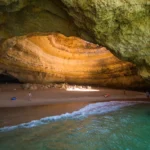
Benagil sea cave, with its dome open to the sky, is the most photographed spot in the Algarve. You see it by boat, kayak or paddleboard from Benagil beach, Portimão or Armação de Pêra; access rules, especially for landing inside the cave, are set by the maritime authorities, so ask your tour operator. Nearby, Praia da Marinha, one of the finest beaches in the region, is framed by cliffs and sea-carved rocks.
The Seven Hanging Valleys Trail
This waymarked coastal trail (Percurso dos Sete Vales Suspensos) links Praia da Marinha with Praia de Vale Centeanes, passing above Benagil and its caves: about 6 km (4 mi) one way, with constant views of the cliffs. Set off early in summer with water and sun protection: there is almost no shade. Spring and autumn are the best seasons to walk it.
Sagres and Cape St. Vincent
At the southwestern tip of mainland Europe, Sagres is a small surf-oriented port. Its fortress stands on a windswept headland, and Cape St. Vincent, 6 km (4 mi) away, offers one of the most popular sunsets in Portugal, below its lighthouse. The beaches of Tonel, Beliche and Martinhal feel very different depending on the wind: some are sheltered while others take the swell.
The Costa Vicentina
The west coast, facing the Atlantic, is protected as a natural park (Sudoeste Alentejano e Costa Vicentina). Its beaches are vast and wild (Arrifana, Amado, Bordeira, Odeceixe), popular with surfers, and the water is cooler than on the south coast. The villages of Aljezur and Carrapateira make good bases. The Rota Vicentina hiking network, including the Fishermen’s Trail along the cliffs, runs through the area.
Carvoeiro, Algar Seco and Ferragudo
Carvoeiro is a former fishing village of white houses huddled around a small beach. To the east, a boardwalk follows the cliffs to Algar Seco, a group of rocks hollowed out into pools and windows onto the sea. Ferragudo, across the estuary from Portimão, has kept more of its character, with cobbled lanes and grilled-fish restaurants.
Silves and the Serra de Monchique
Silves, the capital of the Algarve in the Moorish period, is dominated by a red sandstone castle, one of the best preserved in the region, and its cathedral. Further north, the Serra de Monchique is a completely different landscape: forests, the hot springs of Caldas de Monchique and, at the top of Fóia, the highest point in the Algarve (about 900 m, or 2,950 ft), with views to the sea. The area has been hit by large wildfires, so check the condition of the trails.
Faro, Olhão and the Ria Formosa
Faro deserves more than an airport stopover: its walled old town, cathedral and chapel of bones can be seen in half a day. The city borders the Ria Formosa, a lagoon sheltered by a chain of sandy islands. From Faro and Olhão, boats run to the islands of Culatra, Armona and Ilha Deserta, with huge, barely developed beaches. Olhão, a fishing town with flat-roofed houses, is known for its waterfront market halls.
Tavira and Cacela Velha
Tavira, crossed by the Gilão river and its old bridge, is often called the prettiest town in the Algarve: churches, castle ruins and houses with four-sided hipped roofs. Its beach is on Ilha de Tavira, reached by boat. Further east, the white village of Cacela Velha overlooks the lagoon from its small fort; at low tide, you can walk across to the beach opposite. The eastern Algarve has flatter beaches and a sea that is generally a little less cold than in the west.
Albufeira and the central coast
Albufeira is the busiest resort: an old town on the cliff, a large beach and lively nightlife on « The Strip ». If you are looking for peace and quiet, choose the beaches nearby, such as Praia da Falésia, several kilometres long below red and white cliffs, or the villages along the coast towards Armação de Pêra. Inland, Loulé has a neo-Moorish covered market and a large Saturday market.
Itinerary: how many days in the Algarve?
The Algarve in 7 days
- Days 1-2: Faro, the Ria Formosa (islands by boat), Olhão
- Day 3: Tavira and Cacela Velha
- Day 4: Loulé, then Praia da Falésia and Albufeira
- Day 5: Benagil Cave by boat, Praia da Marinha and the Seven Hanging Valleys Trail
- Day 6: Carvoeiro, Algar Seco, Silves
- Day 7: Lagos and Ponta da Piedade, sunset at Cape St. Vincent
The Algarve in 10 to 15 days
- Add two or three days on the Costa Vicentina (Aljezur, Arrifana, Carrapateira, Odeceixe) and its trails
- A day in the Serra de Monchique
- Combine with Lisbon, about 3 hours’ drive away: see our Lisbon travel guide
- Or cross the border to Seville and Andalusia: see our Andalusia travel guide
Change base at least once: the east (Tavira or Olhão) and the west (Lagos or Carvoeiro) are about 1 hour 30 minutes apart by road, which means a lot of back and forth from a single base.
When to go to the Algarve
The best time to visit the Algarve is May to June and September to mid-October: afternoons reach 23 to 27 °C (73 to 81 °F), rain is rare and the beaches are less crowded than in midsummer. July and August are hot (an average high of about 29 °C, or 84 °F, in Faro), dry and very busy. Winter is mild, around 16-17 °C (61-63 °F) in the afternoon, but it is the rainy season, especially from November to January.
The Algarve has a Mediterranean climate, sheltered from northerly winds by the hills inland, and is among the sunniest places in Europe: about 3,000 hours of sunshine a year in Faro according to IPMA (1971-1995 records). The sea, which is the Atlantic, stays cool, especially on the west coast. The table uses the official normals for the Faro weather station, at the airport.
| Month | Avg max | Avg min | Rain | Rainy days | Crowds | Prices | Verdict |
|---|---|---|---|---|---|---|---|
| January | 16.3 °C (61 °F) | 8.3 °C (47 °F) | 49 mm (1.9 in) | 6 | Low | Low | ⚠️ Mild by day, cool in the evening |
| February | 17.0 °C (63 °F) | 8.8 °C (48 °F) | 42 mm (1.7 in) | 5 | Low (carnival) | Low | ⚠️ Almond blossom, cold sea |
| March | 18.9 °C (66 °F) | 10.8 °C (51 °F) | 47 mm (1.9 in) | 6 | Low to moderate | Low | ⚠️ Mild spring, ideal for hiking |
| April | 20.7 °C (69 °F) | 12.4 °C (54 °F) | 39 mm (1.5 in) | 5 | Moderate (Easter) | Moderate | ✅ Hiking and villages, cool sea |
| May | 23.5 °C (74 °F) | 15.0 °C (59 °F) | 26 mm (1.0 in) | 4 | Moderate | Moderate | ✅ Dry and sunny, few crowds |
| June | 26.8 °C (80 °F) | 17.8 °C (64 °F) | 5 mm (0.2 in) | 1 | High | High | ✅ Beach, long days |
| July | 29.4 °C (85 °F) | 19.6 °C (67 °F) | 1 mm (0.0 in) | 0 | Very high | Very high | ⚠️ Hot, peak crowds and prices |
| August | 29.2 °C (85 °F) | 19.9 °C (68 °F) | 3 mm (0.1 in) | 0 | Very high | Very high | ⚠️ Busiest month |
| September | 26.4 °C (80 °F) | 18.3 °C (65 °F) | 22 mm (0.9 in) | 2 | Moderate to high | High → moderate | ✅ Best month for the beach |
| October | 23.3 °C (74 °F) | 15.8 °C (60 °F) | 56 mm (2.2 in) | 6 | Moderate | Moderate | ✅ Still mild, first rains |
| November | 19.6 °C (67 °F) | 11.9 °C (53 °F) | 76 mm (3.0 in) | 7 | Low | Low | ⚠️ More frequent rain |
| December | 17.1 °C (63 °F) | 9.7 °C (49 °F) | 90 mm (3.5 in) | 7 | Low (holidays) | Low | ❌ Wettest month |
According to IPMA (sunshine 1971-1995), July gets about 360 hours of sunshine, compared with 160 to 180 in December and January. The west coast (Sagres, Costa Vicentina) is windier and cooler in summer than Faro; the Serra de Monchique gets more rain in winter.
Spring (March to May): hiking season
Highs rise from 19 to 23 °C (66 to 73 °F), the countryside is green and in flower, and you can walk the cliffs without excessive heat. It is the best season for the Seven Hanging Valleys Trail and the Rota Vicentina. The sea is still cool for swimming, and a few showers are possible in March and April.
Summer (June to August): guaranteed sun, and crowds
It hardly rains, and it reaches 27 to 29 °C (81 to 84 °F) in Faro, more inland. Beaches, Benagil boat trips and restaurants are full in July and August, and accommodation prices peak. The UK FCDO notes a high wildfire risk from April to October and says that starting a fire, even by accident, is illegal and can lead to a fine or a prison sentence.
Autumn (September and October): the best compromise
September keeps highs of 26 °C (79 °F) and the warmest sea of the year, with fewer families once schools are back. October stays mild (23 °C, or 73 °F) but sees the first rains return. It is also the ideal season for golf and hiking.
Winter (November to February): mild but wetter
Afternoons hover around 16-17 °C (61-63 °F), nights around 8-10 °C (46-50 °F). December is the wettest month (90 mm, or 3.5 in), but sunny days are still frequent. Many hotels and restaurants in the beach resorts scale back; towns such as Faro, Tavira and Lagos stay lively. In February, almond trees blossom inland.
The Algarve month by month
January: 16 °C (61 °F) in the afternoon, 49 mm (1.9 in) of rain. Quiet, low prices, ideal for towns and hiking.
February: 17 °C (63 °F), almond blossom. The Loulé carnival is one of the best known in Portugal.
March: 19 °C (66 °F), less rain. A good month for the coastal trails.
April: 21 °C (70 °F). Easter brings more visitors; the sea is still cold.
May: 23.5 °C (74 °F), 4 rainy days on average: one of the best months for a road trip.
June: 27 °C (81 °F) and almost dry. Start of the beach season, with the popular feasts of St. John and St. Anthony.
July: 29 °C (84 °F), the sunniest month. High season, so book early.
August: 29 °C (84 °F), peak crowds. Plenty of summer festivals (seafood in Olhão, the medieval fair in Silves, sardines in Portimão): check the dates.
September: 26 °C (79 °F), the sea at its warmest: the best month for the beach.
October: 23 °C (73 °F), rain gradually returns (56 mm, or 2.2 in). Still very pleasant, with prices falling.
November: 20 °C (68 °F), 7 rainy days. Low season.
December: 17 °C (63 °F), the wettest month. Low prices outside the Christmas and New Year holidays.
To compare with the rest of the country, see our page on the best time to visit Portugal. For July and August, book accommodation and a rental car 3 to 5 months ahead; 1 to 2 months is enough the rest of the year.
Budget for a trip to the Algarve
Prices in the Algarve vary a lot with the season: the same accommodation can cost two to three times more in August than in March. Indicative amounts per person per day, excluding flights:
| Item | Budget | Comfort |
|---|---|---|
| Accommodation (shared double room) | about €30 to €50 | about €70 to €130 |
| Meals | about €20 to €35 | about €40 to €70 |
| Transport (shared car, fuel, tolls) | about €15 to €20 | about €20 to €35 |
| Activities (boat, kayak, sightseeing) | about €5 to €15 | about €15 to €40 |
| Total per day | about €70 to €110 | about €140 to €250 |
Who is the Algarve for?
Our verdict by travel style, based on the information in this guide:
- Beach: ideal: coves below the cliffs in the west (Lagos, Praia da Marinha), long beaches in the east (Falésia, the Ria Formosa islands).
- Families: yes: the eastern Algarve has flatter beaches and a sea that is generally a little less cold, and Albufeira has most of the family resorts. Keep away from cliff edges, which are unstable.
- Couples: yes: Tavira and Ferragudo for peace and quiet, sunset at Cape St. Vincent, a kayak trip to Ponta da Piedade.
- Hiking and surfing: yes: the Seven Hanging Valleys Trail, the Rota Vicentina and the surf beaches of the Costa Vicentina and Sagres.
- Tight budget: fine outside summer: about €70 to €110 per person per day, but the same accommodation can cost two to three times more in August than in March.
- Culture: as a complement: Faro’s walled old town, Silves castle, the lanes of Tavira.
Getting around the Algarve
- Car: the most practical option for beaches and villages. Some Portuguese motorways have electronic-only tolls with no booths (Portugal Tolls portal, pttolls.com): ask your rental company how tolls are paid.
- Train: a regional line links Lagos with Vila Real de Santo António via Silves, Albufeira (the station is far from the centre), Faro, Olhão and Tavira. Trains also run from Faro to Lisbon.
- Bus: the regional network serves the towns and some of the beaches; services are less frequent out of season.
- Boats: shuttles to the Ria Formosa islands from Faro, Olhão and Tavira; cave trips from Lagos, Portimão and Albufeira.
- Parking: car parks at well-known beaches (Marinha, Benagil, Camilo) fill up in summer: arrive early.
Where to stay in the Algarve
- Lagos: the best base for the west, with real town life; ideal without a car
- Carvoeiro or Ferragudo: in the middle of the cliff coast, near Benagil and Marinha
- Albufeira: a wide choice of hotels and resorts, lively; stay nearby if you want peace and quiet
- Tavira: the prettiest base in the east, quiet and authentic
- Faro or Olhão: convenient for the airport and the Ria Formosa
- Aljezur or Sagres: for the Costa Vicentina, surfing and nature; more limited choice
Entry requirements, health and safety
- Entry requirements: Portugal is in the Schengen area. US citizens may enter for up to 90 days for tourism or business without a visa; the passport must be valid at least three months beyond the period of stay, and you need sufficient proof of funds and a return ticket (U.S. Department of State, travel.state.gov, page updated December 11, 2025). British citizens can stay up to 90 days in any 180-day period without a visa; the passport must have been issued less than 10 years before arrival and be valid at least 3 months after you leave the Schengen area. The EU Entry/Exit System (EES) is now in place: fingerprints and a photo are taken at your first entry, free of charge (UK FCDO, GOV.UK, updated 11 August 2026).
- Health: for vaccines, GOV.UK refers to TravelHealthPro’s Portugal guide and travel.state.gov advises being up to date on all CDC-recommended vaccinations. UK travellers can use a GHIC (or a valid UK EHIC) for state healthcare; whatever your nationality, take out travel insurance that covers medical care. Protect yourself from the heat and the sun.
- Safety: the U.S. Department of State says petty crime is common at tourist sites, that car break-ins target tourists and that valuables should not be left unattended at the beach: leave nothing in the car.
- Swimming: some beaches are dangerous because of currents and waves, and the water is cold. Respect the flags: according to the UK FCDO (GOV.UK, updated 11 August 2026), a red flag means you must not enter the water and a yellow flag means it is only safe to paddle at the water’s edge.
- Cliffs and wildfires: GOV.UK warns of falling rocks, particularly in the Algarve, and the authorities can fine people who ignore warning signs; starting a fire, even by accident, is illegal. Earthquakes are a risk in Portugal (GOV.UK).
- Emergencies: 112.
Practical tips for the Algarve
- Internet: check your home carrier’s roaming charges before you go; a local SIM or an eSIM is often cheaper.
- Restaurants: the starters placed on the table (bread, olives, cheese) are charged if you eat them; tipping is not compulsory.
- Beaches: check the tide before you go: some coves and passages between beaches are only accessible at low tide.
- Sun and wind: sunscreen in every season and a jacket for the evenings and the west coast.
- Local food: grilled sardines and fish, cataplana (a slow-cooked seafood dish), almond and fig sweets.
Further reading
To compare the Algarve with the rest of the country, see the best time to visit Portugal and our Portugal travel guide. The time is the same as in Lisbon (and London): details on our time in Portugal page.
Frequently asked questions
How many days do you need in the Algarve?
A week lets you see the essentials, from the Ria Formosa to Lagos and Cape St. Vincent. Allow 10 to 15 days to add the Costa Vicentina and the Serra de Monchique.
What is the best time to visit the Algarve?
May to June and September to mid-October: 23 to 27 °C (73 to 81 °F) in the afternoon in Faro according to IPMA normals, very little rain and fewer people than in July and August. September is the best month for the beach.
Is the weather good in the Algarve in October?
Generally, yes: an average high of about 23 °C (73 °F) in Faro. The rain returns (56 mm, or 2.2 in, on average over 6 rainy days), but the sea is still pleasant early in the month.
Do you need a car in the Algarve?
It is strongly recommended for beaches and villages. Without a car, stay in Lagos, Faro or Tavira and combine trains, buses and boat trips. Ask your rental company how electronic tolls are paid.
Can you swim in the Algarve all year round?
The Atlantic stays cool: swimming is most pleasant from June to October, and a little less cold in the east (Tavira) than in the west. Always follow the beach flags.
How do you visit Benagil Cave?
By boat, kayak or paddleboard with a tour operator, from Benagil, Portimão or Armação de Pêra. Access is regulated: check the rules before booking.
Our sources
- Entry requirements, health and safety checked on 24 October 2026: U.S. Department of State, Portugal country information (last updated December 11, 2025) and UK FCDO, GOV.UK foreign travel advice for Portugal (updated 11 August 2026).
- Portugal Tolls portal (pttolls.com): electronic-only tolls, checked on 24 October 2026
- Climate normals: IPMA (Instituto Português do Mar e da Atmosfera) 1991-2020 normals, Faro station (airport); sunshine 1971-1995 (IPMA)
- Our methodology
Updated October 2026.
To extend your trip, see our Portugal travel guide, our guides to Lisbon (and the best time to visit Lisbon), Porto and the Azores, our guide to neighbouring Andalusia and our other destinations in Europe. Not sure when to go? See our ideas for travelling in May or in September.