Looking for things to do in Faro? The capital of the Algarve is often seen as little more than an airport gateway, but its walled old town, cathedral, chapel of bones and, above all, the Ria Formosa lagoon are worth a stop. To visit Faro, one day is enough for the city; 2 to 3 days let you add the barrier islands and their beaches, Olhão or Tavira.
This guide brings together the highlights, a suggested plan, the budget and the official climate, with a figure rarely given elsewhere: the gap between the air temperature and the ocean temperature, which stays cool even in summer.
Flights London → Faro
“From” fare provided by Kiwi.com (affiliate link), seen in recent searches; it varies with dates.

Our travel deals for Faro
Affiliate links: we earn a commission, at no extra cost to you.
 Learn the languageTargumiLearn a few words of Portuguese before you go — 30% off via our link.See the course

Faro at a glance
- Region Algarve, southern Portugal
- Language Portuguese; English widely spoken in tourism. To learn a few words before you go, try Targumi’s online Portuguese lessons with native teachers (30% off via our link).
- Currency euro (€) · currencies
- Time zone Same time as London all year (UTC+0, UTC+1 in summer) · detailsLocal time now: –:–
- Airport Faro, close to the centre
- Airports Faro (FAO)(some routes are seasonal; from further afield, many travellers connect via Lisbon or another European hub)
- Entry US and UK citizens: no visa for stays up to 90 days (Schengen rules); passport valid at least 3 months beyond your stay · US: travel.state.gov · UK: GOV.UK
- Electricity 230 V, type C/F plugs (two round pins); US and UK travellers need an adapter · plugs
- Budget see our budget section
Things to do in Faro: the highlights
The Cidade Velha and the Arco da Vila
The walled old town is entered through the Arco da Vila, an early 19th-century neoclassical gate built after the earthquakes; beneath the arch, a gate from the Moorish period survives. Cobbled lanes, white houses and storks nesting on the rooftops: this is the nicest area to wander, a few steps from the marina.
The cathedral (Sé)
Completed in the 13th century and remodelled after the 1755 earthquake, the cathedral blends Gothic, Renaissance and Baroque styles. Climb the bell tower: the view takes in the old town, the salt marshes and the lagoon out to the islands.
Carmo church and the chapel of bones
The Baroque Carmo church, with its twin bell towers and gilded altarpieces, hides the Capela dos Ossos behind it, a small chapel lined with skulls and bones from the city’s old cemeteries. A short but striking visit.
The municipal museum
Housed in a former convent in the old town, it displays archaeological collections, including Roman mosaics from Ossonoba, the ancient city from which Faro grew.
The Ria Formosa
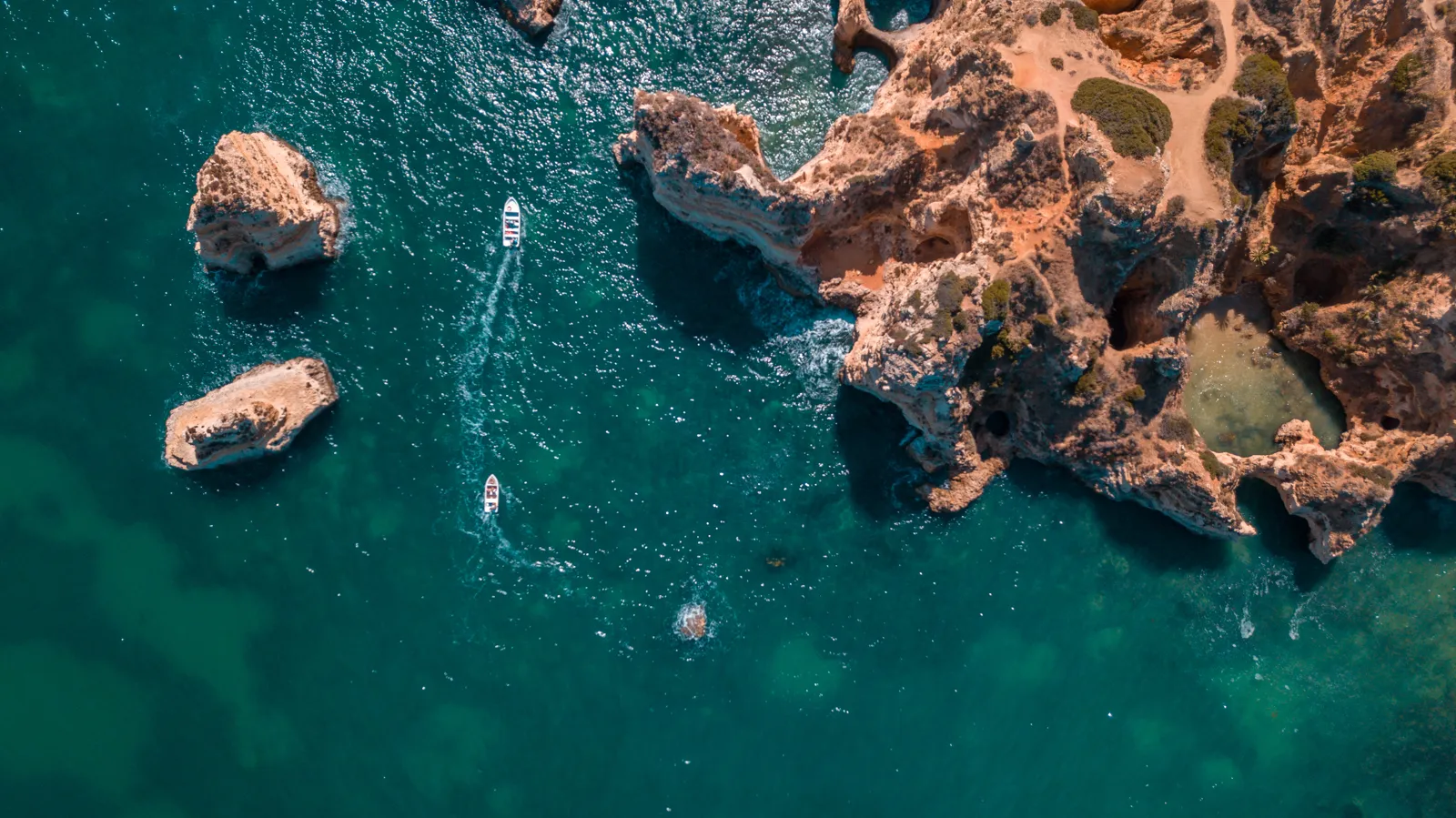
This protected lagoon, a natural park since 1987, stretches along the coast, sheltered from the ocean by a chain of barrier islands. Explore it by boat or kayak from Faro and Olhão: marshes, salt pans, birds (including flamingos) and shellfish beds.
Islands and beaches
Faro has no beach in the city centre. Praia de Faro, a long sandy beach on Faro Island, can be reached by bus or car. From the harbour, boats run in season to Ilha Deserta (Barreta) and Culatra Island, with the hamlet of Farol: big, wild, barely developed beaches. Check the return times before boarding.
Around Faro
A few kilometres to the north, Estoi Palace and the Roman ruins of Milreu can be visited together. Olhão, to the east, is known for its waterfront market; Tavira, a little further on, for its old centre and bridge. The rest of the region is covered in our Algarve travel guide.
Itinerary: Faro in 2 or 3 days
- Day 1: Cidade Velha, the cathedral and its bell tower, the municipal museum, then Carmo church and the chapel of bones; evening at the marina
- Day 2: boat to Ilha Deserta or Culatra, a swim and back in the late afternoon
- Day 3: Estoi and Milreu in the morning, Olhão market or central Tavira in the afternoon
Faro pairs well with Lisbon on a first trip to Portugal; for the north, see also Porto.
When to go to Faro: air, sea and sunshine
The best times are May-June and September: 23 to 27 °C (73 to 81 °F) in the afternoon, almost no rain and a less crowded city than in summer. July and August are hot (about 29 °C, or 84 °F) and dry, but the ocean stays cool: 19 to 20 °C (66 to 68 °F) on average. Winter is mild (about 16 to 17 °C, or 61 to 63 °F, in the afternoon), with most of the rain from November to January.
| Month | Avg max | Avg min | Rain | Sunshine (h/day) | Sea | Air − sea gap | Sunset | Verdict |
|---|---|---|---|---|---|---|---|---|
| January | 16.3 °C (61 °F) | 8.3 °C (47 °F) | 49 mm (1.9 in) | 5.9 | 15 °C (59 °F) | +1.3 °C (+2 °F) | 17:38 | ⚠️ Mild, rain possible |
| February | 17.0 °C (63 °F) | 8.8 °C (48 °F) | 42 mm (1.7 in) | 6.1 | 15 °C (59 °F) | +2.0 °C (+4 °F) | 18:11 | ⚠️ Mild |
| March | 18.9 °C (66 °F) | 10.8 °C (51 °F) | 47 mm (1.9 in) | 7.8 | 15 °C (59 °F) | +3.9 °C (+7 °F) | 18:38 | ✅ Mild spring |
| April | 20.7 °C (69 °F) | 12.4 °C (54 °F) | 39 mm (1.5 in) | 8.5 | 16 °C (61 °F) | +4.7 °C (+8 °F) | 20:06 | ✅ Pleasant |
| May | 23.5 °C (74 °F) | 15.0 °C (59 °F) | 26 mm (1.0 in) | 9.8 | 17 °C (63 °F) | +6.5 °C (+12 °F) | 20:32 | ✅ Ideal |
| June | 26.8 °C (80 °F) | 17.8 °C (64 °F) | 5 mm (0.2 in) | 10.9 | 18 °C (64 °F) | +8.8 °C (+16 °F) | 20:52 | ✅ Ideal, beach |
| July | 29.4 °C (85 °F) | 19.6 °C (67 °F) | 1 mm (0.0 in) | 11.6 | 19 °C (66 °F) | +10.4 °C (+19 °F) | 20:51 | ⚠️ Hot, crowded |
| August | 29.2 °C (85 °F) | 19.9 °C (68 °F) | 3 mm (0.1 in) | 11.1 | 20 °C (68 °F) | +9.2 °C (+17 °F) | 20:23 | ⚠️ Hot, crowded |
| September | 26.4 °C (80 °F) | 18.3 °C (65 °F) | 22 mm (0.9 in) | 9.3 | 20 °C (68 °F) | +6.4 °C (+12 °F) | 19:39 | ✅ Warmest sea, fewer people |
| October | 23.3 °C (74 °F) | 15.8 °C (60 °F) | 56 mm (2.2 in) | 7.3 | 19 °C (66 °F) | +4.3 °C (+8 °F) | 18:55 | ✅ Mild, rain returning |
| November | 19.6 °C (67 °F) | 11.9 °C (53 °F) | 76 mm (3.0 in) | 6.4 | 17 °C (63 °F) | +2.6 °C (+5 °F) | 17:22 | ⚠️ Rainy |
| December | 17.1 °C (63 °F) | 9.7 °C (49 °F) | 90 mm (3.5 in) | 5.1 | 16 °C (61 °F) | +1.1 °C (+2 °F) | 17:15 | ⚠️ Wettest month |
What the figures show
- The water never averages 21 °C (70 °F): 20 °C (68 °F) at best in August and September, according to the DWD series.
- In July, the air is 10.4 °C (19 °F) warmer than the water: the biggest gap of the year. A swim is properly refreshing.
- In September and October, the gap drops to 6.4 and 4.3 °C (12 and 8 °F): the water is almost as warm as in August and the air is more bearable.
- More than 11 hours of sunshine a day in July, about 5 in December.
- Destination de Voyage calculation based on IPMA and DWD data; the two series do not cover the same period, so the gap is an order of magnitude.
To compare with other beaches, see our page on sea temperatures month by month and the best time to visit Portugal.
Budget for visiting Faro
We do not publish unverified budget figures. The main costs are accommodation, meals, boats to the islands and excursions; prices rise sharply in July and August. Compare rates for your dates.
Getting around Faro
- On foot: the old town, the marina and the shopping streets are close to one another.
- From the airport: bus to the centre or taxi; the journey is short.
- Boats: to the Ria Formosa islands from the harbour, with fewer departures out of season.
- Train and bus: to Olhão, Tavira and Lisbon.
- Car: useful for exploring the western Algarve (Lagos, Sagres) or the hinterland.
Where to stay in Faro
| Area | Best for | Highlights |
|---|---|---|
| Centre and marina | First visit, no car | Everything on foot, restaurants, boat departures |
| Old town | Couples, peace and quiet | Lanes, charm; few hotels |
| Praia de Faro | Beach stay | Direct ocean access; close to the airport |
| Olhão | Base for the islands | Market, boats to Culatra and Armona |
Entry requirements, health and safety
- Entry requirements: Portugal is in the Schengen area. US citizens may enter for up to 90 days for tourism or business without a visa; the passport must be valid at least three months beyond the period of stay, and you need sufficient proof of funds and a return ticket (U.S. Department of State, travel.state.gov, page updated December 11, 2025). British citizens can stay up to 90 days in any 180-day period without a visa; the passport must have been issued less than 10 years before arrival and be valid at least 3 months after you leave the Schengen area. The EU Entry/Exit System (EES) is now in place: fingerprints and a photo are taken at your first entry, free of charge (UK FCDO, GOV.UK, updated 11 August 2026).
- Health: UK travellers can use a GHIC (or a valid UK EHIC); everyone should have travel insurance that covers medical care.
- Swimming: respect the flags: according to the UK FCDO (GOV.UK, updated 11 August 2026), a red flag means you must not enter the water and a yellow flag means it is only safe to paddle at the water’s edge.
- Wildfires: the UK FCDO notes a high wildfire risk from April to October and says that starting a fire, even by accident, is illegal.
- See our travel insurance guide.
Practical tips for Faro
- Storks: they nest on the rooftops of the old town; look up.
- Food: cataplana (a seafood stew cooked in a copper pot), grilled fish, shellfish from the Ria Formosa.
- Sun: the sun is strong from spring onwards; protect yourself on the islands, where there is no shade.
- Islands: take water and check the time of the last boat.
- Mobile data: check your home carrier’s roaming charges before you go.
Frequently asked questions
How many days do you need in Faro?
One day for the old town, the cathedral and the chapel of bones; two to three days with the Ria Formosa islands, Olhão or Tavira.
Is Faro worth visiting?
Yes, for at least a day: the walled old town and the Ria Formosa lagoon are often skipped by travellers heading straight for the beaches of the western Algarve.
Can you swim in Faro?
Not in the city centre, but you can at Praia de Faro (bus or car) and on the islands reached by boat. The water stays cool: 19 to 20 °C (66 to 68 °F) on average in summer, according to the DWD.
How do you fly to Faro?
Routes to Faro Airport (FAO) change with the seasons; check current routes with the airport and the airlines.
What is the best time to visit Faro?
May, June and September: warm without being too hot, almost no rain, and in September a sea at 20 °C (68 °F).
Our sources
- IPMA (Instituto Português do Mar e da Atmosfera): 1991-2020 normals for the Faro station (airport); sunshine 1971-1995, via the Wikipedia article « Faro, Portugal » (accessed 15 October 2026)
- Deutscher Wetterdienst: Faro Klimatafel (water temperature, 1931-1960), also used on our best time to visit Portugal page
- Entry requirements, health and safety checked on 24 October 2026: U.S. Department of State, Portugal country information (last updated December 11, 2025) and UK FCDO, GOV.UK foreign travel advice for Portugal (updated 11 August 2026).
- Destination de Voyage calculation: air − sea gap, sunset times (NOAA solar algorithm)
- Our methodology
Updated October 2026.
To extend your trip, see our Portugal travel guide and our other destinations in Europe.