If you want to visit Luxembourg, you will find a grand duchy of 2,586 km² (998 sq mi) wedged between France, Belgium and Germany. Its capital, perched above the gorges of the Alzette, preserves the remains of a former fortress listed as a UNESCO World Heritage Site; to the north lie the hills of the Ösling (Oesling), to the east the Moselle valley and its vineyards. This guide brings together the essentials for a trip to Luxembourg: what to see, how to make the most of free public transport, entry requirements for US and UK citizens, and the climate according to Meteolux.
The country is small, but there is more to it than its capital. In a few days you can go from the upper town and the casemates to the castles of the Eisch valley, the rocks of the Mullerthal and the wine villages of the Moselle, almost always by train or bus, without buying a ticket.
Luxembourg at a glance
CapitalLuxembourg (Luxembourg City)
Languagethree official languages (Luxembourgish, French, German)
Time zoneUTC+1, UTC+2 in summer; 1 hour ahead of London, 6 hours ahead of New York
AirportsLuxembourg-Findel (LUX)
EntrySchengen area: no visa for short stays for US and UK citizens · travel.state.gov · GOV.UKPassport valid at least 3 months beyond your stay (US) or after leaving the Schengen area (UK)
Electricitycheck plug types and voltage before you go · plugs
Ideal length2 days for the capital, 4 to 5 days for the country
What to see in Luxembourg: the highlights
The upper town and the fortifications
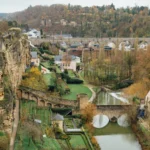
The city grew out of a castle built in 963 on the Bock rock by Count Siegfried. The remains of the old fortress and the old town are UNESCO-listed. In the upper town you can visit the Grand Ducal Palace, whose oldest part dates back to the 16th century, and Notre-Dame Cathedral. The Chemin de la Corniche runs along the ramparts and gives the best view of the valley.
The Bock casemates
Carved into the rock, the casemates are defensive galleries of the former fortress, open to visitors. They give an idea of how important the city was militarily for centuries. Check the opening periods, which vary with the season.
Grund, Clausen and Pfaffenthal
Three districts lie at the bottom of the valleys: Grund, Clausen and Pfaffenthal. Grund, on the banks of the Alzette, is home to the former Neumünster Abbey, now a cultural centre. To get back up without effort, the city has two public lifts: the Grund lift and the Pfaffenthal–upper town panoramic lift.
Kirchberg and the Mudam
On the Kirchberg plateau, the district of the European institutions, the Mudam (Grand Duke Jean Museum of Modern Art) occupies a building by the architect I. M. Pei, built on the remains of a Vauban fort. The Pfaffenthal-Kirchberg funicular links Pfaffenthal station to the plateau.
The Valley of the Seven Castles
West of the capital, the Valley of the Seven Castles brings together, over 24 km (15 mi), the castles of Mersch, Schoenfels, Hollenfels, the two castles of Ansembourg, Septfontaines and Koerich, in a landscape of meadows and old villages. It is an excursion to do on foot or by bike in stages, or by car in a day. Not all the castles can be visited inside: check before you go.
Vianden
In the north, in the Ösling, Vianden is dominated by a large castle whose origins go back to late Antiquity. Victor Hugo stayed there several times, notably from 8 June to 22 August 1871; a literary museum is devoted to him. A chairlift climbs above the town.
The Mullerthal and Echternach
Nicknamed « Luxembourg’s Little Switzerland », the Mullerthal is a region of rocks and forests north of the Moselle, along the German border. Its main town, Echternach, is one of the oldest in the country. This is the hiking region.
The Moselle valley
In the east, the Moselle marks the border with Germany. Its vineyard slopes make it one of the country’s main tourist attractions. Travel from village to village for the wine cellars and riverside walks.
Itinerary ideas for Luxembourg
Length
Programme
2 days
Upper town, casemates, Chemin de la Corniche, Grund; day 2: Kirchberg and the Mudam, Pfaffenthal lift
4 days
2 days in the capital, 1 day in the Valley of the Seven Castles, 1 day in Vianden
5 days
The 4-day programme + the Mullerthal and Echternach, or a day in the Moselle wine country
Suggested itineraries, all doable by public transport. Check timetables on the official Luxembourg public transport website (mobiliteit.lu).
Getting around Luxembourg: free public transport
This is what sets a trip to Luxembourg apart: according to the national public transport website (mobiliteit.lu, checked on 24 October 2026), public transport has been free throughout the country since 1 March 2020. Trains, trams and buses can be used without a ticket, except first class on trains; free travel ends at the border, so you need a cross-border ticket for the part of a journey beyond the Grand Duchy.
Tram: the tram line crosses the capital, serving Kirchberg, the upper town and the central station.
Bus: the capital has a dense city network, complemented by national routes and night buses.
Train: Luxembourg central station is the hub of the national network; Pfaffenthal-Kirchberg station is linked to the plateau by funicular.
From neighbouring countries: you still need a ticket for the part of a cross-border train journey outside Luxembourg.
Car: the State Department notes that roads are congested during morning and evening rush hours, as the capital more than doubles its population on weekdays with cross-border workers; cars must have all-weather or snow tyres from October to April, and a warning triangle and high-visibility vest are compulsory (travel.state.gov, last updated April 16, 2026). UK photocard licences can be used for one year, and the blood alcohol limit is 0.05% (GOV.UK, updated 11 August 2026).
When to go to Luxembourg
From May to September, with the most pleasant weather in June, July and August: 21.7 to 23.9 °C (71 to 75 °F) in the afternoon and more than 7 hours of sunshine a day on average. Rain is spread throughout the year (49.0 to 89.4 mm, or 1.9 to 3.5 in, per month): it rains often but rarely heavily. Winter is cold and grey, with lows around 0 °C (32 °F) from December to February and less than 2 hours of sunshine a day in December.
Month
Max °C (°F)
Min °C (°F)
Rain mm (in)
Rainy days
Sunshine per day
Verdict
January
3.8 (39)
−1.0 (30)
72 (2.8)
11.7
1.7 h
❌ Cold, very grey
February
5.2 (41)
−0.7 (31)
59 (2.3)
10.3
2.8 h
❌ Cold, grey
March
9.8 (50)
2.0 (36)
57 (2.2)
10.3
4.4 h
⚠️ Cool, sunny spells
April
14.4 (58)
5.1 (41)
49 (1.9)
8.7
6.6 h
✅ Mild, driest month
May
18.4 (65)
8.7 (48)
71.2 (2.8)
10.0
7.3 h
✅ Mild, green
June
21.7 (71)
11.8 (53)
75.6 (3.0)
9.9
8.0 h
✅ Pleasant, long sunshine
July
23.9 (75)
13.8 (57)
71.5 (2.8)
9.9
8.3 h
✅ Warmest and sunniest
August
23.5 (74)
13.6 (56)
71.9 (2.8)
9.2
7.6 h
✅ Warm, sunny
September
19.0 (66)
10.3 (51)
66.2 (2.6)
8.6
5.8 h
✅ Mild, still bright
October
13.5 (56)
6.6 (44)
76.6 (3.0)
10.4
3.4 h
⚠️ Cool, autumn colours
November
7.7 (46)
2.8 (37)
72.1 (2.8)
12.2
1.7 h
❌ Grey, rainy
December
4.5 (40)
0.0 (32)
89.4 (3.5)
13.1
1.4 h
⚠️ Cold, Christmas markets
Meteolux (Air Navigation Administration), Luxembourg-Findel station (368 m / 1,207 ft), 1991-2020 normals, via the Wikipedia climate box (article « Luxembourg City »). Rainy days ≥ 1 mm. Sunshine per day: Destination de Voyage calculation (monthly sunshine divided by the number of days).
Is Luxembourg really grey?
Only in autumn and winter: from November to February, Luxembourg-Findel gets less than 3 hours of sunshine a day, but from May to August it gets 7.3 to 8.3 hours. When it rains, it is usually moderate: 5.5 to 7.8 mm (0.2 to 0.3 in) per rainy day on average. Destination de Voyage calculation: monthly sunshine and rainfall divided by the number of days, Meteolux data.
Month
Sunshine per day (Luxembourg)
Rain per rainy day
January
1.7 h
6.2 mm (0.2 in)
February
2.8 h
5.7 mm (0.2 in)
March
4.4 h
5.5 mm (0.2 in)
April
6.6 h
5.6 mm (0.2 in)
May
7.3 h
7.1 mm (0.3 in)
June
8.0 h
7.6 mm (0.3 in)
July
8.3 h
7.2 mm (0.3 in)
August
7.6 h
7.8 mm (0.3 in)
September
5.8 h
7.7 mm (0.3 in)
October
3.4 h
7.4 mm (0.3 in)
November
1.7 h
5.9 mm (0.2 in)
December
1.4 h
6.8 mm (0.3 in)
Destination de Voyage calculation based on Meteolux (Luxembourg-Findel, 1991-2020).
Where to stay in Luxembourg
In the capital, the upper town puts you within walking distance of the main sights; the Gare district is convenient for day trips by train; Kirchberg suits a stay linked to the European institutions. Thanks to free public transport, staying in the capital and taking day trips is the simplest option. For hiking, one or two nights in the Mullerthal or in Vianden save you the return journeys.
Entry requirements for Luxembourg
US citizens: Luxembourg applies Schengen rules. Your passport should be valid for at least three months beyond the period of stay, and you will need sufficient proof of funds and a return ticket (U.S. Department of State, travel.state.gov, last updated April 16, 2026).
UK citizens: no visa for up to 90 days in any 180-day period for tourism. Your passport must have been issued less than 10 years before the day you arrive and be valid at least 3 months after the day you plan to leave the Schengen area. At the border you may be asked for proof of accommodation, travel insurance, a return or onward ticket and enough money for your stay. The EU Entry/Exit System (EES) is being implemented: fingerprints and a photo may be taken, free of charge (GOV.UK, updated 11 August 2026).
Health and safety
Health: the State Department describes medical facilities as excellent and widely available, with most professional staff speaking English (travel.state.gov, last updated April 16, 2026). UK travellers need a GHIC or EHIC for medically necessary state healthcare (GOV.UK, updated 11 August 2026). In all cases, take out travel insurance covering medical costs.
Safety: according to GOV.UK, pickpockets operate on buses and in train stations, particularly the main station (Gare de Luxembourg), and hotel lobbies in the Findel area are reported hotspots for theft. The State Department reports thefts of bags and laptops on trains, especially to and from Brussels, and a spike in petty crime during the Schueberfouer, a three-week summer fair in Luxembourg City.
Local laws: bladed weapons of any kind are strictly prohibited (travel.state.gov).
Emergencies: 112 for an ambulance or the fire service, 113 for the police (GOV.UK).
Practical tips for Luxembourg
Languages: French is understood everywhere and used in administration and on signs, alongside German and Luxembourgish; English is widely spoken.
Money: the euro; cards are widely accepted. Our currency converter helps if you continue to a country outside the eurozone.
Mobile data: check your home carrier’s roaming charges before you leave.
Car: avoid rush hours on the motorways coming from France, Belgium and Germany.
Frequently asked questions
Is public transport really free in Luxembourg?
Yes. According to mobiliteit.lu, public transport has been free throughout the country since 1 March 2020. Free travel excludes first class on trains and ends at the border for cross-border journeys.
What can you see in Luxembourg in 2 days?
The upper town, the Bock casemates, the Chemin de la Corniche and Grund on the first day; Kirchberg, the Mudam and the Pfaffenthal lift on the second.
Do I need a visa to visit Luxembourg?
Not for short stays as a US or UK citizen. Luxembourg is in the Schengen area: UK citizens can stay up to 90 days in any 180-day period, and US citizens need a passport valid at least three months beyond their stay. Check travel.state.gov or GOV.UK before you leave.
When is the best time to visit Luxembourg?
From May to September. July is the warmest month (23.9 °C / 75 °F) and the sunniest according to the Meteolux 1991-2020 normals; April is the driest month.
What is the Valley of the Seven Castles?
A 24 km (15 mi) route west of the capital linking the castles of Mersch, Schoenfels, Hollenfels, Ansembourg (two castles), Septfontaines and Koerich.
Our sources
Meteolux (Air Navigation Administration), 1991-2020 normals for Luxembourg-Findel, via the Wikipedia climate box (article « Luxembourg City »), checked on 23 October 2026
Wikipedia: « Luxembourg », « Luxembourg City », « Vianden », « Mudam », checked on 23 October 2026
Destination de Voyage calculations: sunshine per day, rain per rainy day
Transparency: this page contains affiliate links, labelled as such. If you book through them we may earn a commission at no extra cost to you; it does not influence our content or recommendations. How we fund the site.