Planning to visit Malta? Allow 4 to 5 days for the essentials (Valletta, Mdina, Comino, a day on Gozo) and a week to ten days to see everything, with a budget of roughly €60–90 per person per day on a tight budget. Malta is the smallest country in the European Union: an archipelago of three inhabited islands, Malta, Gozo and Comino, south of Sicily. People come for Valletta and the heritage of the Knights of St John, megalithic temples that are among the oldest in the world, clear waters renowned for diving, and sunshine almost all year round. In the eurozone, with English as an official language, it is an easy destination to organise, even for a few days. If you are hesitating with another Mediterranean island, our Malta or Cyprus comparison looks at sunshine and the sea.
To locate the towns, regions, relief, national parks and airports, see our map of Malta.
Malta at a glance
CapitalValletta
LanguageMaltese and English (both official)Italian is often understood
Time zoneUTC+1, UTC+2 in summer; 1 hour ahead of London, 6 hours ahead of New York
AirportsMalta International Airport (MLA), at Luqa · details
EntrySchengen area: no visa for stays of up to 90 days for US and UK citizens · travel.state.gov · GOV.UKPassport valid at least 3 months beyond your departure (US) or after leaving the Schengen area (UK)
Electricitycheck plug types and voltage before you go · plugs
The best times are April to June and September to October: 19 to 28 °C (66 to 82 °F) in the afternoon, little rain and fewer people than in midsummer. July and August are dry and very hot (an average high of 31 °C (88 °F) at Luqa), with big crowds, especially on Comino, and the highest prices. From November to March it is mild (15 to 20 °C, or 59 to 68 °F), but this is the season of rain and wind: perfect for a cultural trip, less so for the beach. All the details, with month-by-month normals, are in our article on the best time to visit Malta. For an ideal spring between sightseeing and the first swims, see our page on Malta weather in April.
Where to go in Malta: the highlights
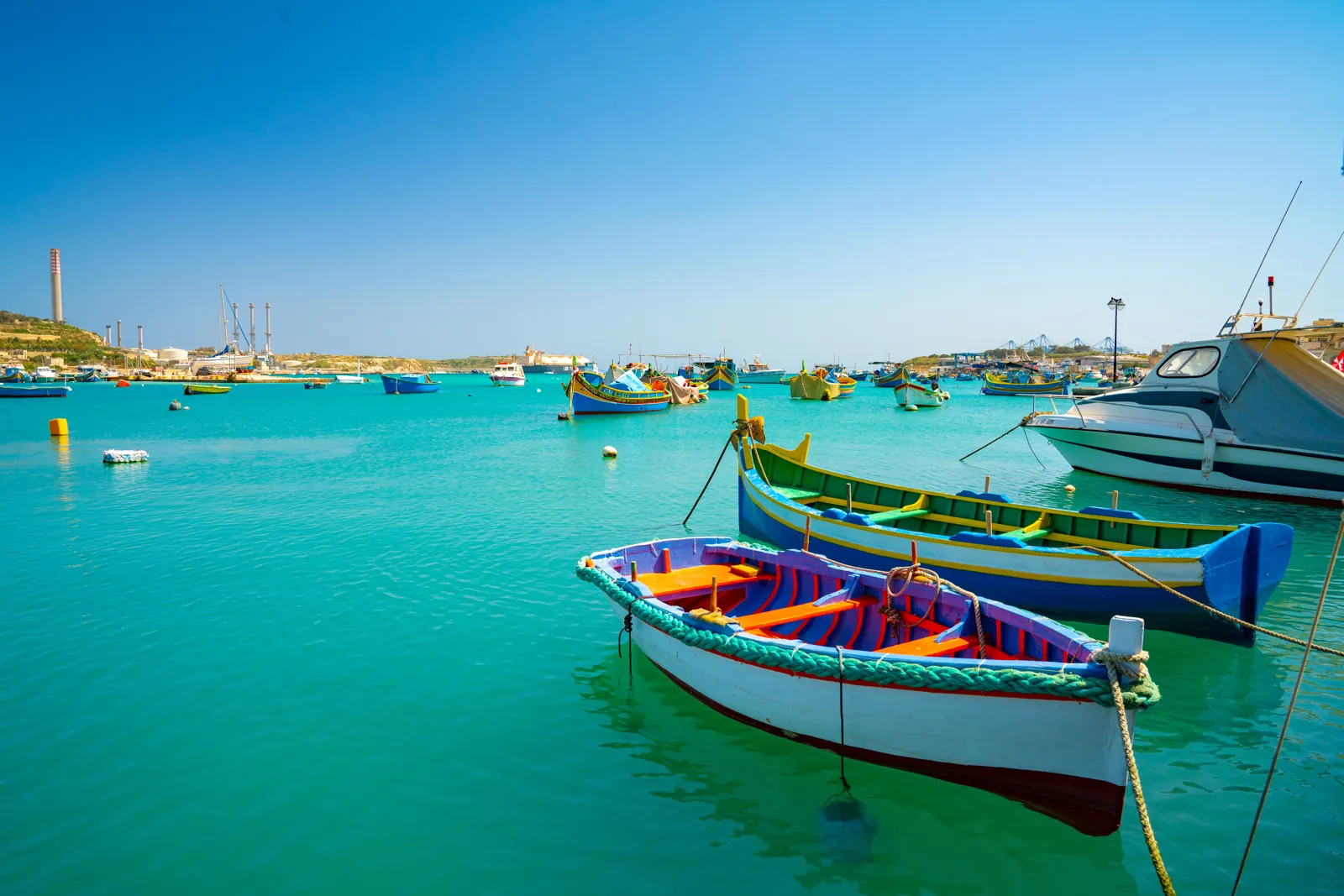
Luzzu fishing boats in Marsaxlokk harbour, Malta
Valletta
A fortified capital built by the Knights of St John in the 16th century, Valletta is a UNESCO World Heritage Site. Its grid of streets can be explored on foot in one or two days: St John’s Co-Cathedral and its Caravaggios, the Grandmaster’s Palace, the Upper Barrakka Gardens with their view over the Grand Harbour and the noon gun salute, Fort St Elmo. In the evening, the city is quieter than Sliema or St Julian’s.
The Three Cities
Across the Grand Harbour, Birgu (Vittoriosa), Senglea and Cospicua were the Knights’ first strongholds, before Valletta was built. Less visited, they are best discovered by wandering along the quays and alleys. Get there by a small ferry from Valletta or by crossing the harbour in a dgħajsa, the traditional boat.
Mdina and Rabat
A former capital perched in the centre of the island, Mdina is a small fortified city of narrow, silent streets, nicknamed the « Silent City ». Neighbouring Rabat has early Christian catacombs. Not far away, the Dingli Cliffs offer one of the finest views on the island, especially at sunset.
The megalithic temples and the Hypogeum
Malta has UNESCO-listed prehistoric temples older than the pyramids of Egypt: Ħaġar Qim and Mnajdra on the south coast, and Tarxien near Valletta. The Ħal Saflieni Hypogeum, an underground necropolis carved into the rock, is visited in very small groups: places are limited and must be booked well in advance.
Marsaxlokk and the Blue Grotto
The fishing village of Marsaxlokk, in the south-east, is known for its luzzu, colourful boats painted with an eye, and for its Sunday morning market. A little further west, the Blue Grotto can be visited by small boat from Wied iż-Żurrieq when the sea allows.
Gozo
About thirty minutes by ferry from the main island, Gozo is greener, more rural and quieter. Highlights include the Citadel in Victoria (Rabat), the Ġgantija temples, among the oldest in the archipelago, Dwejra Bay and its Inland Sea, the red-sand beach of Ramla and the Xwejni salt pans. The famous Azure Window, a natural arch, collapsed in 2017, but Dwejra remains one of the great dive sites of the Mediterranean.
Comino and the Blue Lagoon
Between Malta and Gozo, Comino is a small, almost uninhabited island. Its Blue Lagoon, with turquoise water, is one of Malta’s best-known images, but it is packed in summer. Go early in the morning or out of season, and enjoy the island’s quieter trails. According to the UK FCDO, people drown in the sea in Malta every year and some beaches have strong undercurrents (GOV.UK, updated 11 August 2026): swim within designated zones.
Diving in Malta
The archipelago is one of the most renowned diving destinations in the Mediterranean: very clear water, drop-offs, caves and many wrecks, some deliberately scuttled for divers. Dive centres are plentiful on Malta and Gozo, for beginners and experienced divers alike. The State Department notes that the tourism industry is unevenly regulated and that safety inspections of equipment do not occur regularly (travel.state.gov, last updated July 9, 2026): choose your centre carefully.
Things to do in Malta: 10 experiences not to miss
To sum up what to see and do in Malta on a first trip, here are the experiences described above, to tick off according to your interests:
Visit St John’s Co-Cathedral and its Caravaggios, then watch the noon gun salute at the Upper Barrakka Gardens
Cross the Grand Harbour by dgħajsa to the Three Cities
Wander the alleys of Mdina, then watch the sunset from the Dingli Cliffs
Discover the megalithic temples of Ħaġar Qim and Mnajdra
Book a visit to the Ħal Saflieni Hypogeum well in advance
See the colourful luzzu and the Sunday market in Marsaxlokk
Take a boat into the Blue Grotto when the sea allows
Swim in Comino’s Blue Lagoon early in the morning, within designated zones
Spend at least a day on Gozo: the Citadel in Victoria, Ġgantija, Dwejra, Ramla
Dive the wrecks and drop-offs of Malta and Gozo with a reputable centre
Itinerary ideas: how many days in Malta?
4 to 5 days: the essentials of Malta
Day 1: Valletta (St John’s Co-Cathedral, Grandmaster’s Palace, Upper Barrakka)
Day 2: the Three Cities, then Marsaxlokk and the Blue Grotto
Day 3: Mdina, Rabat and the Dingli Cliffs at sunset
Day 4: Comino and the Blue Lagoon (early in the morning), then the north of the island
Day 5: day trip to Gozo (Citadel in Victoria, Ġgantija, Dwejra)
7 to 10 days: Malta, Gozo and Comino
Days 1 to 3: Valletta, the Three Cities, the southern temples (Ħaġar Qim, Mnajdra) and Marsaxlokk
Day 4: Mdina, Rabat and Dingli
Days 5 and 6: the north (Mellieħa, Golden Bay) and a day on Comino
Days 7 to 9: a stay on Gozo (coastal hiking, Ramla, Dwejra, diving)
Day 10: back to Malta and flight home
Malta: who is it for?
Our verdict depending on how you like to travel, based on the information in this guide:
Profile
Our verdict
Why
Culture and history
✅ Ideal
UNESCO-listed megalithic temples, St John’s Co-Cathedral and its Caravaggios, Mdina, the Three Cities.
Diving
✅ Ideal
Very clear water, drop-offs, caves and wrecks around Malta and Gozo.
Couples
✅ Yes
The alleys of Mdina, sunset at the Dingli Cliffs, Gozo more rural and quieter.
Families
✅ Yes
A small archipelago, a ferry of about thirty minutes to Gozo, the Blue Lagoon early in the morning; swim only in designated zones.
Tight budget
✅ Yes
Roughly €60–90 per person per day on a budget, more in July–August; pastizzi and buses keep the bill down.
Winter beach
❌ Not ideal
The best times are April to June and September to October; winter suits sightseeing, not the beach.
Budget for a trip to Malta
Prices on the ground are typical of Western Europe for meals and a little lower for transport. Accommodation varies a lot with the season. Approximate amounts per person per day, excluding international flights:
Item
Tight budget
Comfortable
Accommodation (based on a shared double room)
about €25–45
about €70–140
Meals
about €20–30 (pastizzi, ftira, snacks)
about €45–70
Transport (bus, ferries, boats)
about €5–10
about €15–35 (taxi, car hire)
Activities and sightseeing
about €10–15
about €20–50 (diving, excursions)
Total per day
about €60–90
about €140–230
Rough estimates that vary with the season. Expect to pay considerably more in July–August and for diving.
Pastizzi, flaky pastries sold for well under a euro at kiosks, are the classic cheap meal.
Getting around Malta
Bus: buses are the main means of public transport (travel.state.gov). The Malta Public Transport network serves the whole main island and Gozo at moderate prices, with Valletta as its hub. Buses are practical but often crowded and slow at rush hour in summer; GOV.UK reports pickpocketing on bus routes between Valletta and St Julian’s in summer.
Ferries to Gozo: ferries link Ċirkewwa, in the north of Malta, with Mġarr on Gozo in about thirty minutes; a fast ferry also links Valletta and Gozo. In bad weather, crossings can be disrupted.
Boats to Comino: shuttles leave from Ċirkewwa, Marfa and Gozo, mainly from May to October.
Harbour ferries: they link Valletta with Sliema and the Three Cities in a few minutes.
Car: traffic drives on the left. According to the State Department (travel.state.gov, last updated July 9, 2026), Maltese drivers may drive more aggressively than visitors expect, and roads are often narrow, winding and congested and flood easily. UK photocard licences can be used in Malta; GOV.UK also warns that some roads are in poor condition (updated 11 August 2026). A car is useful on Gozo and for remote spots, but parking is difficult around Valletta and Sliema.
Taxis and ride-hailing: the State Department says taxis are safe but expensive and not metered: agree on the fare in advance. Ride-hailing apps are handy in the evening, when buses thin out.
Where to stay in Malta
Valletta is ideal for heritage and quiet evenings, in renovated palazzos and old houses. Sliema and St Julian’s, on the north-east coast, have the widest choice of hotels, restaurants and bars, with a ferry to Valletta. Mellieħa, in the north, suits families and beach lovers, close to the boats for Comino and Gozo. On Gozo, country houses with pools (farmhouses) are a popular option for a quiet stay.
The Paceville district in St Julian’s is the centre of nightlife: very noisy in the evening, it is singled out by both the UK FCDO and the State Department (drink spiking, assaults, heavy-handed bouncers). In July–August, book several months ahead.
Mistakes to avoid on a trip to Malta
Booking too late for July–August: the archipelago is small, and well-located accommodation in Valletta, Sliema or Gozo goes several months ahead.
Underestimating the driving: traffic drives on the left and is heavy around Valletta and Sliema; a car is mainly useful on Gozo.
Arriving at the Blue Lagoon at midday in summer: it is the busiest time; take the first boat.
Swimming outside designated zones: GOV.UK reports drownings every year; follow the lifeguards’ flags (a red flag indicates dangerous conditions).
Booking the Hypogeum at the last minute: places are very limited.
Entering churches with bare shoulders or knees.
Relying on your UK prescription: GOV.UK states that UK prescriptions are not recognised in Malta; bring enough medication.
Entry requirements for Malta
US citizens: Malta is a party to the Schengen Agreement: you may enter for up to 90 days for tourism or business without a visa. Your passport should be valid for at least three months beyond your planned departure date, and you need proof of sufficient funds and a return ticket (U.S. Department of State, travel.state.gov, last updated July 9, 2026).
UK citizens: no visa for up to 90 days in any 180-day period for tourism. Your passport must have been issued less than 10 years before the day you arrive and be valid at least 3 months after the day you plan to leave the Schengen area. At the border you may need to show a return or onward ticket and prove you have enough money for your stay. The EU Entry/Exit System (EES) is being implemented: fingerprints and a photo may be taken, free of charge. A yellow fever certificate is required only if you arrive from a country with a transmission risk (GOV.UK, updated 11 August 2026).
Health and safety
Health: travel.state.gov advises being up to date on all CDC-recommended vaccinations and strongly recommends insurance covering medical evacuation. UK travellers need a GHIC or EHIC for medically necessary state healthcare. Take out travel insurance, and protect yourself from the heat and sun in summer.
Swimming: according to GOV.UK (updated 11 August 2026), people drown in the sea every year, some beaches have strong undercurrents, and hidden rocks make diving into unknown water dangerous. In summer, lifeguards patrol most beaches with a flag system: red flags indicate dangerous conditions. Follow local advice if jellyfish are present.
Crime: crime against tourists is rare, but GOV.UK reports pickpocketing and bag snatching, and drink spiking in some bars in Paceville. The State Department advises caution in the Paceville nightclub area.
Hunting season: GOV.UK notes that bird hunting with firearms takes place in spring and autumn, often from 2 hours before sunrise to 2 hours after sunset, in areas that are rarely marked: be aware of your surroundings in the countryside.
Emergencies: 112 (ambulance, fire, police).
Practical tips for Malta
Money: the euro. Cards are widely accepted and ATMs are plentiful; keep a little cash for pastizzi kiosks, the boats to Comino and small shops. GOV.UK advises caution when using ATMs.
Mobile data: check your home carrier’s roaming charges before you leave; an eSIM is a simple way to get local data. Wi-Fi is widespread.
Language: English being an official language, it is easy to make yourself understood everywhere.
Churches: cover your shoulders and knees to enter churches, including St John’s Co-Cathedral.
Etiquette and laws: Maltese society is attached to the Catholic faith; be discreet in public. According to GOV.UK, smoking cannabis in public is illegal and attracts a fine.
Sun: shade is rare at the sites and on the cliffs. A hat, water and sunscreen are essential from May to October.
For another Mediterranean island, see our guides to Sicily and Cyprus.
Frequently asked questions
Do I need a visa to visit Malta?
Not for short stays as a US or UK citizen. Malta is in the Schengen area: you can stay up to 90 days (in any 180-day period for UK citizens) without a visa, with a passport valid at least 3 months beyond your departure. Check travel.state.gov or GOV.UK before you leave.
When is the best time to visit Malta?
April to June and September–October: pleasant warmth, little rain and fewer people than in July–August. June and September are the best months to combine sightseeing and swimming.
How many days do you need to visit Malta?
Four to five days are enough for Valletta, Mdina, Comino and a day on Gozo. Allow a week to ten days to add the temples, hiking, diving or a stay on Gozo.
How much does a week in Malta cost?
Excluding flights, allow roughly €60–90 per person per day on a tight budget, and €140–230 for a comfortable trip. Accommodation prices rise sharply in July–August.
Do you need to rent a car in Malta?
It is not essential: buses and ferries serve most sights. A car is useful on Gozo and for remote spots, but traffic drives on the left and is heavy around Valletta.
What are the downsides of Malta?
The main ones: big crowds and high prices in July–August, strong summer heat with little shade at the sites, heavy traffic and driving on the left, and a very built-up north-east coast (Sliema, St Julian’s). In winter, rain and wind can disrupt the ferries to Gozo.
Is Malta worth visiting?
Yes if you want a compact destination, in euros and with English widely spoken, that brings together heritage (Valletta, Mdina, megalithic temples), clear sea and diving in a small area. It is less suitable if you are looking for peace and quiet in midsummer.
Transparency: this page contains affiliate links, labelled as such. If you book through them we may earn a commission at no extra cost to you; it does not influence our content or recommendations. How we fund the site.