This Croatia travel guide focuses on the Dalmatian coast (Split, Dubrovnik and the islands), the Plitvice Lakes and Istria: allow 7 to 10 days for the coast, two weeks from Zagreb to Dubrovnik, and roughly €70–100 per person per day on a budget. Croatia combines an Adriatic coast with more than a thousand islands, historic towns listed as World Heritage and national parks known for their lakes and waterfalls. In the eurozone and the Schengen area, it is easy to plan. Here is what to see, what to do, which itinerary to follow and what budget to plan.
To locate cities, regions, terrain, national parks and airports, see our map of Croatia.
Croatia at a glance
CapitalZagreb
LanguageCroatianEnglish is common in tourist areas, and German and Italian on the coast
Currencythe euro (EUR), since January 2023 · currencies
Time zoneUTC+1 (Central European Time)1 h ahead of London and 6 h ahead of New York
AirportsZagreb, Split, Dubrovnik and ZadarCheck current routes with the airlines
EntryUS and UK: visa-free up to 90 days in any 180 (Schengen) · travel.state.gov · GOV.UK
The best period is May to June, plus September: it is warm on the coast, the sea becomes pleasant, ferries to the islands run regularly and crowds remain reasonable. July and August are the peak beach season, very sunny but packed in Dubrovnik, Split and Hvar, with prices at their highest and a risk of wildfires on the coast. From November to March, the coast is mild but rainy and the islands slow down, while Zagreb, with its continental climate, gets cold. All the details, region by region and month by month, are in our article best time to visit Croatia.
What to see in Croatia: the highlights
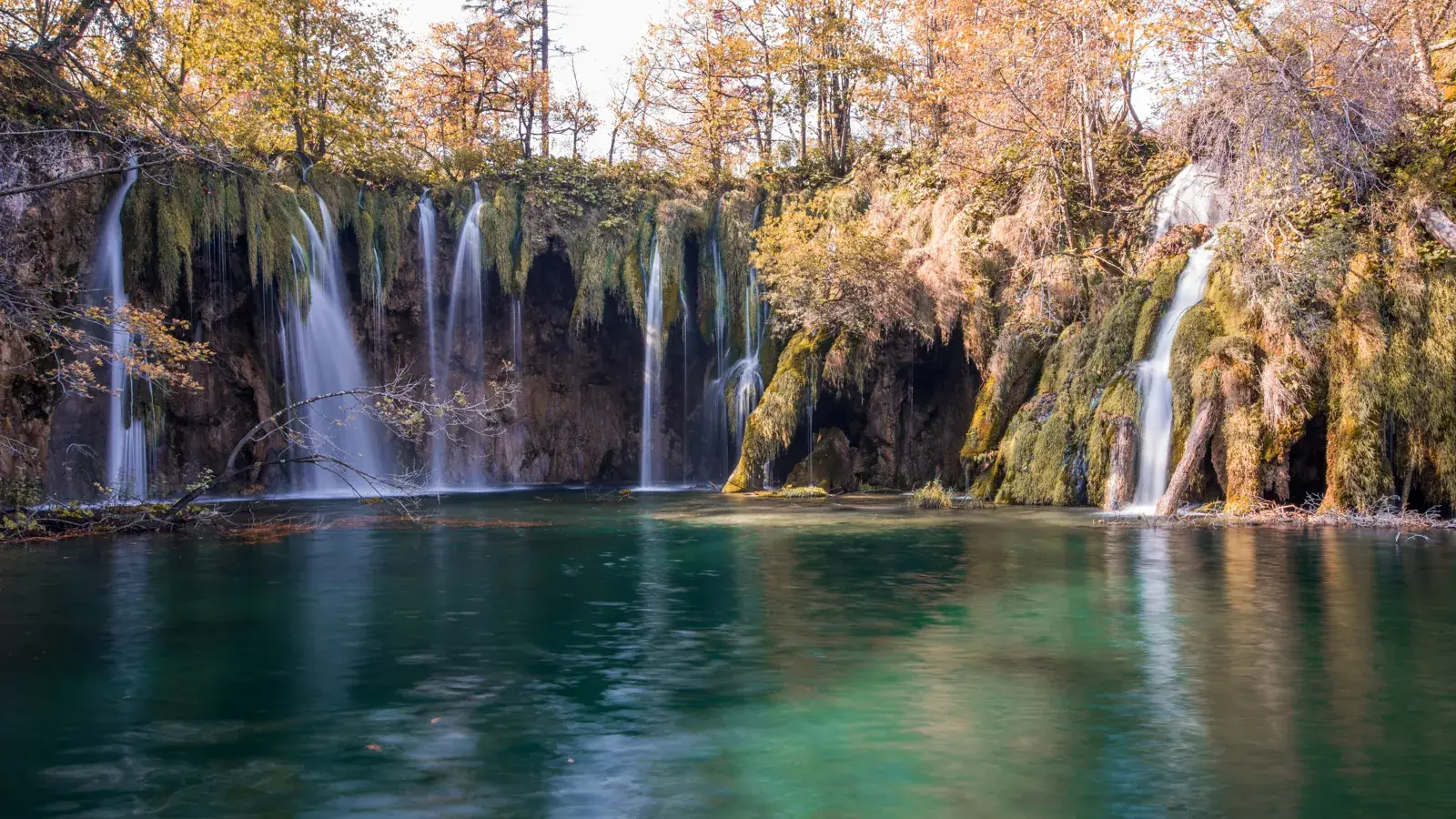
Lakes and waterfalls in Plitvice Lakes National Park, Croatia
Dubrovnik
At the far south of the country, the former Republic of Ragusa is surrounded by walls you can walk for nearly two kilometers (just over a mile), with views over the tiled roofs and the sea. The UNESCO-listed old town can be seen in a day, but two or three days let you add Lokrum island, the Mount Srđ cable car and the village of Cavtat. In summer, the city is very busy: walk the walls at opening time or late in the day.
Split and Diocletian’s Palace
The country’s second city, Split grew up in and around the palace that the Roman emperor Diocletian had built in the early 4th century. Its lanes, its peristyle and the Cathedral of Saint Domnius, set in the former imperial mausoleum, form a lively, UNESCO-listed historic center. Split is also the main port for the Dalmatian islands. A few kilometers away, the small town of Trogir, also a World Heritage Site, deserves half a day.
Hvar, Brač, Vis and Korčula
The Dalmatian islands are one of the main reasons to visit Croatia. Hvar is the busiest, with its lively town in summer and the UNESCO-listed Stari Grad Plain. Brač is known for Zlatni Rat beach, near Bol. Vis, more remote and long closed to foreigners, is quieter. Korčula, further south, has a walled old town and combines easily with Dubrovnik and the Pelješac peninsula, renowned for its wines.
Plitvice Lakes National Park
Between Zagreb and the coast, Plitvice is a set of sixteen terraced lakes linked by waterfalls, explored on wooden boardwalks. It is the country’s most visited national park and a World Heritage Site. Swimming is prohibited. In summer, arrive at opening time or late in the afternoon to avoid lines, and buy your ticket online in advance.
Šibenik and Krka National Park
Šibenik has the Cathedral of St. James, built entirely of stone and listed as World Heritage. Nearby, Krka National Park is known for its waterfalls, including Skradinski Buk, reached by trails and boardwalks. Swimming is now prohibited there. The park is easy to reach from Split or Zadar.
Zadar
Zadar is a port city with a compact historic center, a Roman forum, the Church of St. Donatus and, on the waterfront, the Sea Organ, which plays sounds to the rhythm of the waves, and the « Greeting to the Sun » light installation. It is a good base for the islands of the Zadar archipelago, Kornati National Park and Paklenica for hiking.
Istria: Rovinj, Pula and the hill villages
The northwestern peninsula was long Venetian and then Italian, which shows in its architecture and food. Rovinj is a colorful little town on the sea; Pula has one of the best-preserved Roman amphitheaters; Poreč is home to the UNESCO-listed Euphrasian Basilica. Inland, the hilltop villages of Motovun and Grožnjan, truffles and olive oil justify a few days by car.
Zagreb
The capital is often overlooked by travelers rushing to the coast. Its Upper Town (Gornji Grad), St. Mark’s Church with its colorful tiled roof, its markets and its many museums, including the Museum of Broken Relationships, are worth one or two days. In December, Advent turns the center into a big Christmas market.
Itinerary ideas for Croatia
7 to 10 days: the Dalmatian coast
Days 1 to 3: Split and Trogir
Days 4 and 5: Hvar or Brač by catamaran or ferry
Day 6: Korčula
Days 7 to 9: Dubrovnik, Lokrum and Cavtat
Day 10: fly home from Dubrovnik, or a trip to the Bay of Kotor (Montenegro) if your flight allows
2 weeks: from Zagreb to Dubrovnik
Days 1 and 2: Zagreb
Day 3: Plitvice Lakes (overnight in or near the park)
Days 4 and 5: Zadar
Day 6: Šibenik and Krka National Park
Days 7 to 9: Split, Trogir and an island (Hvar or Brač)
Days 10 and 11: Korčula or the Pelješac peninsula
Days 12 to 14: Dubrovnik
With three weeks, add Istria (Rovinj, Pula, Motovun) at the start of the trip, or the island of Vis. For a one-way route, fly into Zagreb and out of Dubrovnik, or the other way round.
Budget for a trip to Croatia
Croatia is no longer a cheap destination on the coast in summer: accommodation in Dubrovnik, Split and Hvar often costs as much as in Western Europe. Meals and transport remain more affordable, especially inland. Indicative amounts per person per day, excluding international flights:
Item
Budget
Comfort
Accommodation (based on a shared double room)
roughly €30–50
roughly €80–150
Meals
roughly €25–35 (bakeries, snacks, simple konobas)
roughly €50–70
Transport (buses, ferries, car rental)
roughly €10–20
roughly €25–40
Activities and sightseeing
roughly €5–15
roughly €15–40
Total per day
roughly €70–100
roughly €160–260
Indicative estimates, varying with the season and the city. Allow considerably more in July–August in Dubrovnik and Hvar.
Entrance fees for the national parks (Plitvice, Krka) and the Dubrovnik city walls are a significant expense and vary with the season. Fast catamarans to the islands cost more than standard ferries.
Getting around Croatia
Ferries and catamarans: the main way to reach the islands, from Split, Zadar, Rijeka, Dubrovnik or Makarska. The state operator Jadrolinija and private companies run the routes, with many more sailings in summer. Catamarans only take foot passengers; to take a car in July–August, arrive early or book where possible. The bora wind can cause cancellations in winter.
Bus: the intercity bus network is dense and links all the coastal towns, Zagreb and Plitvice. It is the easiest option without a car.
Car: handy for Istria, Plitvice and small coastal roads. Highway tolls are higher than in the United States and can be paid in cash or by card; beware of aggressive drivers overtaking on curves (U.S. Department of State, travel.state.gov, last updated December 11, 2025). Since the Pelješac Bridge opened in 2022, you can drive from Split to Dubrovnik without crossing the Neum corridor in Bosnia and Herzegovina. Parking is difficult and paid in the old towns in summer.
Driving rules: a UK photocard licence is valid for up to one year; the alcohol limit is 0.05%, and zero for drivers under 24 (UK FCDO, GOV.UK, updated 11 August 2026). Speed limits range from 110 to 130 km/h (68 to 80 mph) on motorways (U.S. Department of State).
Train: the network is limited and slow; it links Zagreb with Split, but the bus is often faster.
Plane: domestic flights link Zagreb with Split, Dubrovnik and other coastal cities: useful to save time.
Sailing: chartering a sailboat, with or without a skipper, is a popular way to explore the Dalmatian islands; Croatia recognizes certain foreign certificates, including some issued by US Sailing (U.S. Department of State).
Where to stay in Croatia
Croatia has many private rentals: rooms (sobe) and apartments (apartmani), often signposted outside the house, alongside hotels, youth hostels and many campsites, especially in Istria and Dalmatia. In Dubrovnik, the old town is the most expensive; the Lapad and Gruž districts, linked by bus, are more affordable. In Split, stay in the historic center or the Varoš district to do everything on foot. On Hvar, Hvar town is lively and noisy in summer; Stari Grad and Jelsa are quieter.
For Plitvice, staying in the neighboring villages lets you enter the park at opening time. On the islands, many places only open from about May to October. For July–August, book several months ahead. Your accommodation must register your arrival with the police within 48 hours; hotels normally do it for you (UK FCDO).
Entry requirements for Croatia
Croatia is in the Schengen area. Entry requirements checked on 24 October 2026; check them again before you travel.
US citizens
According to the U.S. Department of State (travel.state.gov, last updated December 11, 2025), you do not need a visa for tourism or business stays of less than 90 days within a 180-day period.
Your passport must have at least three months’ validity when you leave Croatia, or you may be denied entry.
You must register with the local police within three days of arrival; hotels, hostels and vacation rentals do it for you.
UK citizens
According to the UK FCDO (GOV.UK, updated 11 August 2026), you can travel without a visa to the Schengen area, including Croatia, for up to 90 days in any 180-day period.
Your passport must have been issued less than 10 years before you arrive and be valid for at least 3 months after you plan to leave the Schengen area. You may need to show a return or onward ticket.
The EU Entry/Exit System (EES) is being rolled out: you may have to register your fingerprints and photo at the border. Your accommodation provider must register you with the police within 48 hours.
The land borders with Serbia, Bosnia and Herzegovina and Montenegro, outside the Schengen area, still have police and customs checks (U.S. Department of State).
Health and safety
Health: health risks include dengue and biting insects and ticks (UK FCDO). UK travelers need a GHIC or EHIC for medically necessary state healthcare, but there is always a charge for treatment in Croatia, up to €530: take out travel insurance.
Wildfires: they are common in the hot, dry summers. Causing a fire, even unintentionally, can be fined, and intentionally causing one can mean €2,000 to €20,000 or prison. Call 112 if you see a fire (UK FCDO).
Crime: crime levels are low and violent crime is rare, but pickpockets operate in tourist areas; always carry your passport (UK FCDO).
Mines: outside the tourist resorts, beware of unexploded mines in former war-affected areas (UK FCDO); known minefields are marked with signs showing a skull and crossbones (U.S. Department of State). Stay on marked paths.
Earthquakes: they can be strong, as in Zagreb and Petrinja in recent years, and small tremors occur several times a month (UK FCDO).
Emergencies: 112 (ambulance, fire, police).
Practical tips for Croatia
Money: the euro. ATMs are common and credit cards are generally accepted; traveler’s checks are no longer accepted (U.S. Department of State). Keep some cash for markets, small restaurants, some private rentals and the smallest islands.
Internet: check your provider’s roaming rates before you leave, including for day trips to Bosnia and Herzegovina or Montenegro; an eSIM can be a cheaper option.
Dress in town: in some town centers, including Split and Dubrovnik, you can get on-the-spot fines for walking around shirtless or in swimwear (UK FCDO). In churches, cover shoulders and knees.
Beaches: the coast is mostly pebbles and rocks: water shoes are useful. Sandy beaches are rare.
Water and sun: in summer, the glare off the white stone of the old towns is strong: a hat, sunscreen and water are essential.
Etiquette: a few words of Croatian are appreciated: dobar dan (hello), hvala (thank you). Respect the quiet of residential areas in the evening.
Mistakes to avoid on a trip to Croatia
Booking too late for July–August: in Dubrovnik, Split and Hvar, accommodation goes months in advance and prices soar.
Walking around town in swimwear: Split and Dubrovnik, among others, can fine people in swimwear or shirtless away from the beach.
Backtracking needlessly: for a one-way route, fly into Zagreb and out of Dubrovnik (or the other way round).
Forgetting water shoes: the coast is mostly pebbles and rocks.
Arriving on small islands without cash: ATMs are rare there, and some markets and private rentals do not take cards.
Forgetting roaming outside the EU: on a trip to Bosnia and Herzegovina or Montenegro, check your plan’s coverage.
Ignoring the fire risk: never light a fire in summer and call 112 in an emergency.
Who is Croatia for?
Our verdicts by traveler profile, based on the information in this guide:
Couples: yes: the Dubrovnik walls at sunset, the islands of Vis or Korčula, Pelješac wines, sailing between the Dalmatian islands.
Families: yes, avoiding July–August on the coast: the Plitvice boardwalks, campsites in Istria and Dalmatia; the coast is mostly pebbles and rocks.
Budget travelers: average: roughly €70–100 a day; accommodation in Dubrovnik, Split and Hvar is expensive in summer.
Culture: yes: Dubrovnik old town, Diocletian’s Palace, Trogir, Šibenik Cathedral, the Pula amphitheater.
Nature: yes: Plitvice, Krka, Kornati, Paklenica for hiking.
Nightlife: yes, in Hvar in summer, lively and noisy.
Not for a short stay if you are a US or British citizen: Croatia is in the Schengen area, and you can stay up to 90 days in any 180-day period without a visa (travel.state.gov, December 11, 2025; GOV.UK, 11 August 2026). Your passport must be valid at least three months after you leave. Checked on 24 October 2026.
What is the best time to visit Croatia?
May to June and September: pleasant warmth, the sea warm enough to swim from June, regular island connections and fewer crowds than in July–August.
How much does a week in Croatia cost?
Excluding flights, allow roughly €70–100 per person per day on a budget, and €160–260 in comfort. Prices rise sharply in July–August on the coast, especially in Dubrovnik and Hvar.
How many days do you need in Croatia?
A week to ten days lets you explore the Dalmatian coast between Split and Dubrovnik with one or two islands. Two weeks leaves time to add Zagreb, Plitvice, Zadar and Krka; three weeks, Istria.
Can you visit Croatia without a car?
Yes. Buses link all the coastal towns, Zagreb and Plitvice, and ferries and catamarans serve the islands. A car is still more practical for Istria and small villages.
How much do 10 days in Croatia cost?
Based on our daily ranges, allow roughly €700–1,000 per person on a budget and €1,600–2,600 in comfort, excluding international flights. Plan considerably more in July–August in Dubrovnik and Hvar.
Where to go in Croatia for a first trip?
The Dalmatian coast is the simplest option: Split and Trogir, an island (Hvar or Brač), Korčula, then Dubrovnik, in 7 to 10 days. With two weeks, start in Zagreb and add the Plitvice Lakes, Zadar and Krka National Park.
Our sources
Entry, health, safety and driving information read on 24 October 2026: U.S. Department of State, Croatia country information (travel.state.gov, last updated December 11, 2025), and UK FCDO, foreign travel advice for Croatia (GOV.UK, updated 11 August 2026)
Croatian Meteorological and Hydrological Service (DHMZ), climate normals for the Zagreb, Zadar, Split and Dubrovnik stations
Transparency: this page contains affiliate links, labelled as such. If you book through them we may earn a commission at no extra cost to you; it does not influence our content or recommendations. How we fund the site.