Italy packs some of the world’s most visited art cities, Alpine lakes, rocky coastlines and two large islands into a territory not much larger than Arizona. In the eurozone and the Schengen area, with no visa needed for short tourist stays by US or UK citizens, it is an easy destination to organise. This Italy travel guide answers the questions you ask before leaving: where to go, what to see, which itinerary to follow depending on how long you have, what budget to plan and how to get around.
To locate the cities, regions, relief, national parks and airports, see our map of Italy.
Italy at a glance
CapitalRome
LanguageItalianEnglish is common in tourist areas, less so in villages
Time zoneUTC+1, UTC+2 in summer: 1 hour ahead of London, 6 hours ahead of New York
AirportsRome Fiumicino (FCO), Milan Malpensa (MXP), Venice (VCE), Naples (NAP), Catania (CTA) · details
EntrySchengen area: no visa for up to 90 days for US citizens (tourism or business) and UK citizens (in any 180-day period) · travel.state.gov · GOV.UKPassport valid at least 3 months beyond your stay (US) or after leaving the Schengen area (UK)
Electricity220-volt system, according to the U.S. Department of State · plugsCheck that your devices accept it and check plug types on IEC World Plugs
The best time runs from April to June and from September to October: pleasant temperatures, little rain and fewer people than in midsummer. July and August are beach season, with more than 30 °C (86 °F) in Rome, Naples and Palermo, prices at their highest and very crowded coasts around 15 August. From November to March it is cool and rainier, but it is a good season to visit museums without queues or to ski in the Dolomites. All the details, region by region and month by month, are in our article on the best time to visit Italy.
What to see in Italy: the highlights
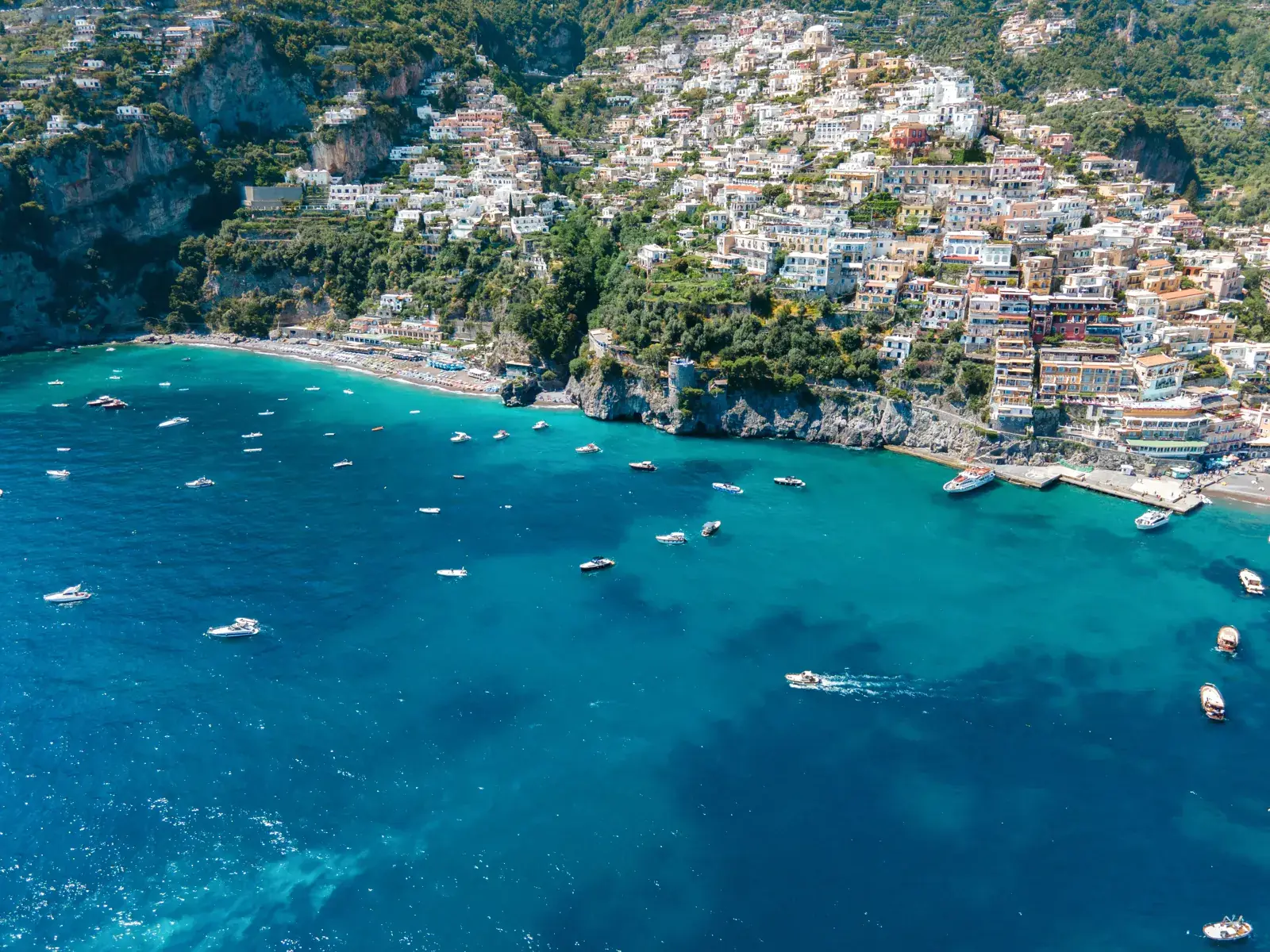
Aerial view of Positano and the Amalfi Coast
What should you see in Italy on a first trip? The Rome, Florence, Venice trio remains the easiest to link by train. For a second trip, or if you prefer nature and the sea, the south, the islands, the lakes and the Dolomites offer a completely different feel. The table below helps you choose. For a second trip that is more about food than monuments, our guide to things to do in Bologna presents a city that is easy to reach by train.
What you want
Where to go in Italy
Suggested length
First trip, art cities
Rome, Florence, Venice
7 to 10 days
Countryside and villages
Tuscany (Chianti, Val d’Orcia), Puglia
5 to 7 days
Sea and coastline
Amalfi Coast, Cinque Terre, Sardinia, Sicily
5 days to 2 weeks
Lakes and mountains
Lakes Como, Maggiore and Garda, the Dolomites
4 to 7 days
Archaeology
Rome, Pompeii and Herculaneum, Agrigento, Syracuse
3 to 7 days
Road trip
Tuscany, the Dolomites, Puglia, Sicily
1 to 2 weeks
Where to go in Italy depending on what you want: rough guidelines, to adapt to the season.
Rome and the Vatican
The capital needs at least three days: the Colosseum, the Roman Forum and the Palatine, the Pantheon, the Trevi Fountain, Piazza Navona, and in the Vatican, St Peter’s Basilica, the Vatican Museums and the Sistine Chapel. Trastevere is the liveliest district in the evening. Book Colosseum and Vatican Museums tickets online, especially in high season. All the details are in our Rome guide.
Florence and Tuscany
The cradle of the Renaissance, Florence is explored on foot: the Duomo and its dome, the Uffizi Gallery, Michelangelo’s David at the Galleria dell’Accademia, the Ponte Vecchio and the Boboli Gardens. Around it, Tuscany offers Siena and its shell-shaped square, Pisa, San Gimignano and its towers, and the hills of Chianti and the Val d’Orcia, ideal to explore by car. See our Tuscany travel guide. Before heading to Siena or Chianti, a two- or three-day stay in Florence lets you see the city and the Boboli Gardens.
Venice
Built on a lagoon and car-free, Venice is discovered on foot and by vaporetto: St Mark’s Square and Basilica, the Doge’s Palace, the Rialto Bridge, the Grand Canal, then the islands of Murano and Burano. To enjoy the city more peacefully, stay overnight and go out early in the morning or in the evening. GOV.UK notes that visitors to Venice may need to pay an access fee: check when it applies on the city’s official website before you go (GOV.UK, updated 21 October 2026). More tips in our Venice guide.
Milan and the Italian lakes
Italy’s business capital is worth one or two days for its cathedral (Milan’s Duomo), the Galleria Vittorio Emanuele II, La Scala and Leonardo da Vinci’s Last Supper, which must be booked well in advance. About an hour away, Lakes Como, Maggiore and Garda line up lakeside villages, villas and gardens against an Alpine backdrop. Duomo, Last Supper and districts: our Milan travel guide covers the city before you head to Lakes Como, Maggiore or Garda. Further west, the former capital of the Dukes of Savoy is covered in our guide to visiting Turin, between the Egyptian Museum and the arcades.
Naples, Pompeii and the Amalfi Coast
Naples is the liveliest city in the south: its UNESCO-listed historic centre, National Archaeological Museum and Neapolitan pizza justify two days. Nearby are the sites of Pompeii and Herculaneum, buried by Vesuvius in AD 79, and the climb up the volcano. Further south, the Amalfi Coast (Positano, Amalfi, Ravello) and the island of Capri are superb but very crowded and expensive in summer (see our Amalfi Coast guide). Pompeii, Vesuvius and the Amalfi Coast are easy day trips during a stay in Naples.
The Cinque Terre
On the Ligurian coast, these five colourful cliffside villages are linked by train and hiking trails. They are very crowded in summer: spring and early autumn are more pleasant for walking. Some trails charge a fee or are temporarily closed after landslides: ask locally. Trails sometimes closed, crowded summers: a stay in the Cinque Terre is more enjoyable in spring or early autumn.
The Dolomites
In the north-east, these World Heritage-listed limestone mountains are explored on foot in summer (Tre Cime di Lavaredo, Lake Braies, Val Gardena) and on skis in winter. The mountain pass roads also make a fine road trip from late June to September. Hiking in summer, skiing in winter, passes from late June to September: our Dolomites travel guide helps you choose your season.
Sicily
The largest island in the Mediterranean can fill a whole trip: Palermo and its markets, the Valley of the Temples in Agrigento, Syracuse and the island of Ortigia, baroque Noto, Taormina, and Mount Etna, an active volcano you can approach with a guide when activity allows. It is also where the swimming season lasts longest. Details in our Sicily travel guide.
Puglia and Sardinia
The heel of the boot appeals with its white villages, the trulli of Alberobello, baroque Lecce and coastlines on two seas. Wilder Sardinia is famous for its beaches and clear waters, from the Costa Smeralda to the south of the island. A car is essential in both regions. See also our Sardinia guide. Since a car is essential, planning a trip to Puglia starts with choosing your bases between the two seas.
Itinerary ideas for Italy
Three itineraries depending on time and transport: the first two are mainly by train, the third is an Italy road trip designed for the car. The road trip can include the northern lakes: our Lake Garda travel guide helps you choose villages, activities and timing.
7 to 10 days: Rome, Florence and Venice
Days 1 to 3: Rome (Colosseum, Forum, Vatican, historic centre)
Days 4 to 6: fast train to Florence (about 1 h 30), with a day in Siena or Chianti
Days 7 and 8: Venice (about 2 hours by train from Florence)
Days 9 and 10: extend to the lakes or Milan, or fly home from Venice
2 weeks: Rome, Naples and Sicily
Days 1 to 3: Rome
Days 4 to 6: Naples, Pompeii and Vesuvius
Days 7 and 8: the Amalfi Coast or Capri
Day 9: flight or overnight ferry to Sicily
Days 10 to 14: Sicily by car (Palermo, Agrigento, Syracuse, Taormina and Etna)
Italy road trip (10 days): Tuscany and Umbria by car
Days 1 and 2: Florence on foot (pick up the car as you leave: the centre is a ZTL)
Days 3 and 4: Chianti, San Gimignano and Volterra
Days 5 and 6: Siena, then the Val d’Orcia (Pienza, Montalcino)
Days 7 and 8: Montepulciano, then Assisi and Perugia in Umbria
Days 9 and 10: Lucca and Pisa, back to Florence or fly home from Pisa
Other possible road trips: the Dolomites pass route (late June to September), Puglia from Bari to Lecce, or a loop around Sicily. Park outside historic centres and look out for ZTL signs at town entrances. Before the Dolomites passes, a lakeside stop can be planned too: our Lake Como travel guide presents villages and villas.
Budget for a trip to Italy
Prices in Italy are in line with Western Europe, with big differences between north and south and between high and low season. Approximate amounts per person per day, excluding international flights:
Item
Tight budget
Comfortable
Accommodation (based on a shared double room)
about €30–50
about €80–150
Meals
about €25–35 (pizzerias, simple trattorias)
about €50–80
Transport (regional trains, bus, metro)
about €10–20
about €20–40
Activities and sightseeing
about €10–20
about €20–40
Total per day
about €70–100
about €160–260
Rough estimates that vary with the season and region. Expect to pay considerably more in Venice and on the Amalfi Coast in summer.
Many major cities charge a tourist tax, usually paid at your hotel and often in cash; the rate varies by city and hotel category (GOV.UK). In restaurants, the « coperto » (cover charge) is often added to the bill. The major museums and archaeological sites charge admission; some offer free entry on certain days, to be checked on their websites.
Getting around Italy
Train: the most practical way between major cities. Fast trains link Milan, Venice, Florence, Rome and Naples; cheaper regional trains serve smaller towns. Validate tickets bought from a kiosk or machine before your journey: inspectors issue on-the-spot fines (GOV.UK; travel.state.gov, last updated August 11, 2025). Strikes often affect transport: reconfirm your bookings.
Car: essential for rural Tuscany, the Dolomites, Puglia, Sicily and Sardinia. Motorways are tolled. You need a pass to drive into the historic centre of many cities; the limited traffic zones are marked ZTL in black on a yellow background (GOV.UK, updated 21 October 2026). UK photocard licences can be used; rental companies may require a year of driving experience, a higher minimum age or an International Driving Permit. Thefts from parked cars are common: GOV.UK advises not leaving luggage in the vehicle, even in the boot, and the State Department notes that break-ins of rented vehicles are common.
Plane: domestic flights link the north with Sicily, Sardinia and Puglia: a time-saver over long distances. During periods of heightened activity at Etna, check with your airline or Catania airport.
Ferries: they serve Sicily, Sardinia, Capri, the Aeolian Islands and the lakes.
In town: metro in Rome, Milan and Naples, vaporetto in Venice; historic centres are best explored on foot. Only use licensed taxis (GOV.UK).
Getting there
Italy’s main international airports are Rome Fiumicino (FCO) and Milan Malpensa (MXP), followed by Venice (VCE), Naples (NAP), Bologna (BLQ), Pisa (PSA), Catania (CTA) and Palermo (PMO). Check current routes from your home airport with the airlines and the airports.
Where to stay in Italy
In Rome, the historic centre (around the Pantheon and Piazza Navona) and Trastevere let you do everything on foot; the Termini station area is practical but less charming. In Florence, stay in the centre, inside the old walls. In Venice, staying in the city itself costs more than on the mainland (Mestre), but lets you enjoy the quieter evenings and mornings. On the Amalfi Coast, Sorrento is often a cheaper base than Positano. Staying in Sorrento is easier outside peak season: see the best time to visit the Amalfi Coast.
Options range from B&Bs and apartments to hotels of every category. In the countryside, agriturismi (farm stays) are a good option in Tuscany, Umbria and Puglia. In summer and during major events, book several months ahead. As farm stays there are in high demand in summer, check the best time to visit Puglia to book at the right moment. Hotels are legally required to register your passport details with the police: wait until they have done so rather than leaving your passport at reception (GOV.UK).
Entry requirements for Italy, health and safety
US citizens: you may enter Italy for up to 90 days for tourism or business without a visa. Your passport must be valid at least 3 months beyond your stay, and you need proof of sufficient funds and a return ticket. A passport that has ever been reported lost or stolen, or is expired, may be refused (U.S. Department of State, travel.state.gov, last updated August 11, 2025).
UK citizens: no visa for up to 90 days in any 180-day period as a tourist. Your passport must have been issued less than 10 years before the day you arrive and be valid at least 3 months after the day you plan to leave the Schengen area; you may be asked for proof of accommodation. The EU Entry/Exit System (EES) is being implemented: fingerprints and a photo may be taken at your first entry, free of charge. If your passport is lost or stolen, a police report is not enough to leave Italy (GOV.UK, updated 21 October 2026).
ID: under Italian law, police can stop you at any time for an identity check: carry photo ID at all times (GOV.UK).
Health: GOV.UK lists dengue, biting insects and ticks, and West Nile disease among health risks, plus altitude sickness in the Alps and Dolomites; travel.state.gov advises being up to date on CDC-recommended vaccinations. UK travellers can use a GHIC or EHIC for state healthcare; whatever your nationality, take out travel insurance covering medical costs. Protect yourself from mosquitoes and the summer heat.
Theft: crime levels are generally low, but bag-snatching and pickpocketing are higher in city centres and at major tourist attractions (GOV.UK); the State Department adds that organised groups operate in train stations, bars and cafés. Keep your documents at the hotel and carry copies, while keeping photo ID on you.
Earthquakes and volcanoes: many parts of Italy lie on a major fault line and minor tremors happen regularly; there are several active volcanoes in southern Italy, with national emergency planning for the Phlegraean Fields (GOV.UK). Follow the instructions of the local authorities.
Venice: high waters are common and can flood parts of the city, especially in autumn and winter: check the tide forecasts (GOV.UK).
Emergencies: dial 112.
Practical tips for Italy
Money: the euro. Keep some cash for small shops, villages and tourist taxes. To avoid skimming devices, use ATMs in well-lit public areas or inside a bank (travel.state.gov).
Mobile data: check your home carrier’s roaming charges before you leave; an eSIM is a simple way to get local data. Avoid entering bank details on public Wi-Fi.
At cafés and restaurants: a coffee drunk standing at the bar costs less than at a table. Tipping is not compulsory, as the cover charge is often billed; leave a few euros if you enjoyed the service.
Opening hours: many shops close in the early afternoon, especially in the south, and some museums close one day a week: check before you go.
In churches: cover shoulders and knees, a rule strictly enforced at St Peter’s in Rome and in the major basilicas.
Public spaces: GOV.UK notes that entering or bathing in public fountains is an offence in many towns, including Florence and Rome, as is buying from unlicensed street traders.
At the beach: follow the flag system (a red flag means you must not enter the water) and take extra care where there are no lifeguards (GOV.UK).
Mistakes to avoid in Italy
Driving into a historic centre in a limited traffic zone (ZTL) without a pass.
Arriving without booking the Colosseum, the Vatican Museums or the Last Supper in Milan in high season.
Forgetting to validate a public transport ticket before your journey.
Visiting a major basilica with bare shoulders or knees.
Leaving belongings in a rental car.
Being surprised by the cover charge (« coperto ») on the bill: it is often added.
Planning a visit on a museum’s weekly closing day.
Italy: who is it for?
Our verdict, profile by profile, based on the information in this guide:
Profile
Our verdict
First trip, art cities
Ideal: Rome, Florence and Venice link by train in 7 to 10 days.
Couples
Ideal: Venice early in the morning, the Amalfi Coast, Lakes Como and Garda, the Val d’Orcia.
Road trip
Ideal: Tuscany and Umbria, the Dolomites passes, Puglia or a loop around Sicily.
Nature and hiking
Yes: the Dolomites in summer, the Cinque Terre trails in spring and early autumn.
Families
Yes: short train journeys between cities, supervised beaches (lidos).
Tight budget
Possible: roughly €70–100 per person per day, more in Venice, on the Amalfi Coast and in August.
Not for short stays if you are a US or UK citizen: up to 90 days for tourism without a visa (in any 180-day period for UK citizens), with a passport valid at least 3 months beyond your stay. Check travel.state.gov or GOV.UK before you leave.
When is the best time to visit Italy?
April to June and September to October: pleasant temperatures, little rain and fewer people than in July–August. For the beach, aim for June to September, and until October in Sicily.
How much does a week in Italy cost?
Excluding flights, allow roughly €70–100 per person per day on a budget trip and €160–260 for a comfortable one. Prices rise in summer, especially in Venice and on the Amalfi Coast.
How many days do you need to visit Italy?
One week lets you see Rome, Florence and Venice by train. Two weeks give you time to add rural Tuscany, or to head south to Naples, the Amalfi Coast and Sicily.
Do you need to rent a car in Italy?
Not for the big cities, which are well linked by train and where traffic is restricted in historic centres (ZTL). A car becomes useful for the Tuscan countryside, the Dolomites, Puglia, Sicily and Sardinia.
Where to go in Italy on a first trip?
Rome, Florence and Venice: the three cities are linked by fast train and hold many of the country’s best-known sights. Allow 7 to 10 days.
Which itinerary for an Italy road trip?
Tuscany is the easiest for a first road trip: Florence, Chianti, Siena, the Val d’Orcia, then Umbria, in about 10 days. The Dolomites, Puglia and Sicily also suit a car. Avoid driving in historic centres (ZTL).
Transparency: this page contains affiliate links, labelled as such. If you book through them we may earn a commission at no extra cost to you; it does not influence our content or recommendations. How we fund the site.