This Montenegro travel guide covers a small country that packs in the Bay of Kotor, an Adriatic coast of beaches and fortified old towns, and wild mountains such as Durmitor and the Tara Canyon. With the euro as its currency and no visa needed for short stays by US or UK citizens, it is easy to organise. This guide brings together the essentials for planning your trip to Montenegro.
To locate the towns, regions, relief, national parks and airports, see our map of Montenegro.
Montenegro at a glance
CapitalPodgorica (Cetinje is the historic capital)
LanguageMontenegrinEnglish is fairly widely spoken in tourist areas
Currencythe euro (€) · currenciesused although the country is not an EU member
Time zoneUTC+1, UTC+2 in summer; 1 hour ahead of London, 6 hours ahead of New York
AirportsPodgorica (TGD), Tivat (TIV)Dubrovnik (DBV), in Croatia, is another gateway
Entryno visa for up to 90 days in 180 for US and UK citizens; registration within 24 hours · travel.state.gov · GOV.UK
Electricitycheck plug types and voltage before you go · plugs
The best time runs from mid-May to the end of June and through September: pleasant warmth, a sea warm enough for swimming, accessible mountains and fewer people than in midsummer. July and August are peak season on the coast, with intense heat, crowded beaches and the highest prices; it is, however, the right time for Durmitor. From October to April it rains a lot on the coast, and snow covers the north. All the details, region by region and month by month, are in our article on the best time to visit Montenegro.
Where to go in Montenegro: the highlights
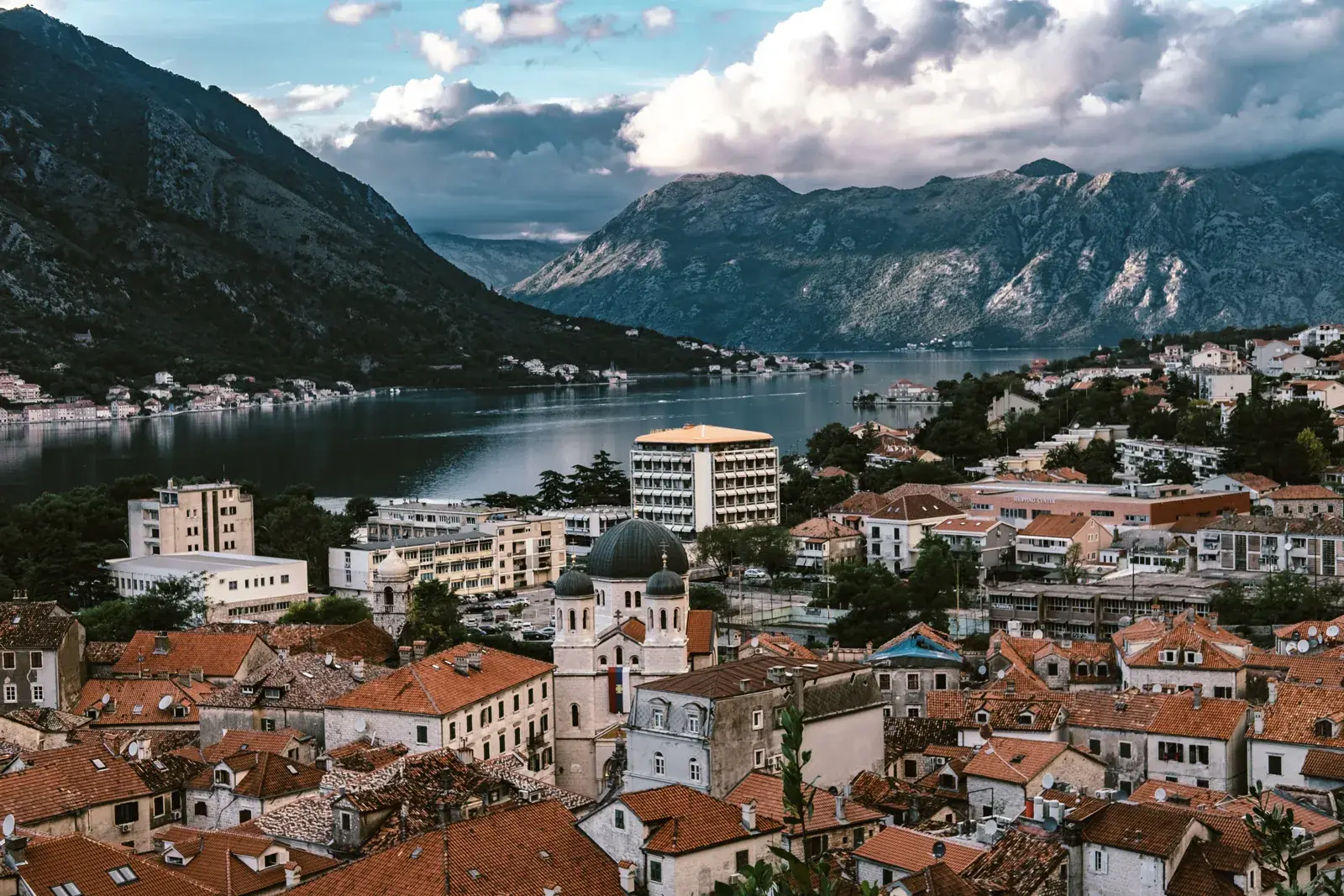
The Bay of Kotor and its old town seen from Mount Lovćen
Kotor
At the far end of the Bay of Kotor, the fortified old town, a UNESCO World Heritage Site, is a maze of alleys, squares and churches. Its walls climb the mountainside up to St John’s Fortress: the climb up the steps gives the country’s best-known view, best done early in the morning in summer. The town receives many cruise calls; evenings are quieter.
Perast and the Bay of Kotor
A small baroque town on the water’s edge, Perast faces two islets, including Our Lady of the Rocks, reachable by boat. A tour of the bay by car or boat also takes in Risan, Tivat and its marina, and the Luštica peninsula. Herceg Novi, at the entrance to the bay, is a town of steps, pleasant out of season.
Budva and Sveti Stefan
Budva is the country’s liveliest seaside resort, with a small fortified old town and beaches that are very busy in summer. Further south, the islet of Sveti Stefan, linked to the coast by a sandbar, is one of Montenegro’s iconic images; the islet itself is occupied by a hotel complex with restricted access, but it can be photographed from the neighbouring beaches. Petrovac, quieter, suits families well.
Cetinje and Mount Lovćen
The former royal capital, Cetinje has monasteries, museums and former embassies. The winding road up from Kotor offers spectacular views over the bay. Lovćen National Park is home to the Njegoš Mausoleum, reached by a long staircase, with a view over much of the country.
Lake Skadar
Shared with Albania, it is the largest lake in the Balkans and a national park renowned for its birds. Virpazar is the starting point for boat trips among water lilies, islets and monasteries. The surrounding vineyards produce vranac, the local red wine.
Durmitor and the Tara Canyon
In the north, Durmitor National Park, a World Heritage Site, has limestone peaks, glacial lakes (including the Black Lake near Žabljak) and forests. The Tara Canyon, one of the deepest in Europe, can be descended by raft; the Đurđevića Tara Bridge offers an impressive viewpoint. The Durmitor panoramic road is closed in winter.
Biogradska Gora and Kolašin
Near Kolašin, Biogradska Gora National Park protects a primeval forest around a lake. Kolašin is a base for hiking in summer and skiing in winter. Further east, the Prokletije range, on the borders of Albania and Kosovo, attracts experienced hikers.
Ulcinj and the south
Near the Albanian border, Ulcinj combines a hilltop old town and Ottoman influences. To the south, Velika Plaža is the country’s longest sandy beach, popular with kitesurfers. Ostrog Monastery, carved into a cliff between Podgorica and Nikšić, is the country’s main Orthodox pilgrimage site: modest dress required.
Things to do in Montenegro: experiences not to miss
Tour the Bay of Kotor by car or boat, with a stop at Perast and Our Lady of the Rocks
Climb Kotor’s walls for the view over the bay
Head up to Cetinje and Mount Lovćen, the former capital and the Njegoš Mausoleum
Take a boat on Lake Skadar from Virpazar
Go rafting in the Tara Canyon and hike in Durmitor (in season)
Visit Ostrog Monastery, carved into a cliff between Podgorica and Nikšić
The best beaches in Montenegro
Area
Type
Atmosphere
Budva and Sveti Stefan
Town beaches and bays
Very lively in July–August
Petrovac
Sheltered bay
More family-friendly
Velika Plaža (Ulcinj)
Long sandy beach
Kitesurfing, wide open spaces
Selection based on the stops described in this guide. For swimming, aim for June or September (see the best time to visit Montenegro).
Itinerary ideas for Montenegro
7 to 10 days: the coast and the interior
Days 1 to 3: Kotor, Perast and the Bay of Kotor
Day 4: the switchback road to Cetinje, Mount Lovćen
Days 5 and 6: Budva, Sveti Stefan and Petrovac
Day 7: Lake Skadar from Virpazar
Days 8 to 10: Ostrog, then Žabljak and Durmitor (in season) before returning to Podgorica
2 weeks: the full tour
Days 1 and 2: Herceg Novi and the Luštica peninsula
Days 3 to 5: Kotor, Perast, Tivat
Day 6: Cetinje and Lovćen
Days 7 and 8: Budva, Sveti Stefan, Petrovac
Days 9 and 10: Ulcinj, Velika Plaža and Lake Skadar
Day 11: Ostrog Monastery
Days 12 and 13: Durmitor, the Tara Canyon, Biogradska Gora
Day 14: return via Podgorica
Budget for a trip to Montenegro
Montenegro is cheaper than Western Europe for meals and transport, but accommodation prices climb sharply in summer around the Bay of Kotor and Budva. Approximate amounts per person per day, excluding flights:
Item
Tight budget
Comfortable
Accommodation (based on a shared double room)
about €20–35
about €50–100
Meals
about €15–25
about €35–55
Transport
about €5–10 (bus)
about €20–30 (rental car)
Activities and sightseeing
about €5–10
about €15–30 (boat, rafting)
Total per day
about €50–80
about €120–200
Rough estimates that vary with the season and region. Expect to pay considerably more in August in Kotor, Budva or Sveti Stefan.
Boat trips in the bay, rafting on the Tara and national park fees are the main extra costs. Private rooms and apartments are often the cheapest option. Outside hotels, you also pay a local tourist tax when you register (travel.state.gov).
Getting around Montenegro
Rental car: the most flexible way to combine coast and mountains. According to the State Department (travel.state.gov, last updated September 17, 2026), drivers can be reckless and aggressive and accidents are frequent; the Morača Canyon road north of Podgorica is particularly dangerous. Seat belts are mandatory, phone use while driving is prohibited, lights must always be on, the blood alcohol limit is 0.03%, and snow tyres and chains are required from 15 November to 30 March. Mountain roads are narrow and winding; avoid driving at night.
Bus: buses link the main towns on the coast and inland at moderate prices, with more services in summer. The State Department notes that trains, buses and ferries often use ageing equipment.
Train: a line runs from Bar to Podgorica, then on to the north of the country (Kolašin), through mountain scenery.
Boats: shuttles and excursions in the Bay of Kotor and on Lake Skadar; a car ferry crosses the bay between Kamenari and Lepetane, saving the drive around.
Taxis: GOV.UK advises using only officially licensed taxis and checking the price per kilometre or agreeing the fare in advance; at Podgorica airport, take one of the licensed taxis in front of the terminal (GOV.UK, updated 13 August 2026).
Where to stay in Montenegro
Around the Bay of Kotor, Kotor has the advantage of the old town, but Perast, Dobrota or Prčanj are quieter and have lovely water views. Budva concentrates the beach resorts and nightlife; Petrovac and Ulcinj are better for a quiet stay. In the north, Žabljak and Kolašin have hotels, chalets and guesthouses, many of which open only in season.
Apartments and private rooms are very common. All visitors must be registered within 24 hours of arrival: hotels do it automatically, but if you stay with private hosts, check that they register you or go to the local tourism office yourself. In July–August, book several months ahead on the coast.
Entry requirements for Montenegro
US citizens: no visa for stays of up to 90 days in total in a 180-day period, counted from the first entry. Visitors must register their stay in each municipality where they stay more than 24 hours: hotels do it automatically; otherwise, go to the local tourism office and pay the local tourist tax. Failing to register can lead to a fine, incarceration, deportation or difficulties leaving the country. Cash over €10,000 and valuable goods must be declared (U.S. Department of State, travel.state.gov, last updated September 17, 2026).
UK citizens: no visa for up to 90 days in any 180-day period; Montenegro is not in the Schengen area, so days there do not count towards your Schengen limit, and vice versa. Your passport must have been issued less than 10 years before you enter and be valid at least 3 months after the day you plan to leave. Make sure it is stamped on entry and exit, and register with the local tourism office or police within 24 hours of arrival if your accommodation does not do it (GOV.UK, updated 13 August 2026).
Medication: according to GOV.UK, prescription medication containing narcotics must be declared on arrival and is limited to 30 days’ supply, with a prescription or doctor’s certificate less than 90 days old.
Health and safety
Health: Montenegro recognises the GHIC (GOV.UK). The State Department says ambulance services have limited availability and many providers accept only cash, and strongly recommends insurance covering medical evacuation. Be up to date on CDC-recommended vaccinations; GOV.UK refers to TravelHealthPro. Insurance covering medical costs and repatriation is essential.
ID: you must always carry ID such as your passport, or the police can fine you (GOV.UK).
Crime: violent crime is rare (travel.state.gov), but watch out for pickpockets in tourist hotspots, on beaches and on public transport. Use ATMs inside banks where possible: GOV.UK warns of bank card fraud, and the State Department reports more robberies at ATMs from May to September.
Natural hazards: according to GOV.UK, wildfires are common from April to October, flooding can occur with heavy rain and snowmelt, and Montenegro lies in a seismically active zone.
Mountains: hikers have got lost after leaving marked paths (GOV.UK): do not hike alone off waymarked trails. Emergencies: 112; police 122, fire 123, ambulance 124 (travel.state.gov).
Practical tips for Montenegro
Money: the euro. Cards are accepted in many hotels and restaurants on the coast, but cash is essential in villages, small restaurants, buses and some car parks. ATMs are plentiful in towns.
Mobile data: Montenegro is not in the European Union: check your carrier’s roaming charges before you leave; an eSIM or local SIM card is often cheaper.
Etiquette: in Orthodox monasteries and churches, cover your shoulders and knees. Life moves at a relaxed pace: service can take its time.
Tipping: not compulsory, but rounding up the bill or leaving about 10% in restaurants is appreciated.
Cruises: check the cruise ship schedule in Kotor to plan your visit to the old town away from peak crowds.
Montenegro combines easily with Dubrovnik, a gateway via the Bay of Kotor, and with Albania to the south, via Ulcinj and Shkodër. See also our Croatia guide.
Montenegro: who is it for?
Beach: yes, from June to September: the coast from Budva to Petrovac, Velika Plaža near Ulcinj. In July–August, beaches are crowded and prices at their highest.
Families: yes: Petrovac, quieter than Budva, suits families well.
Hiking and adventure: yes: Durmitor, rafting in the Tara Canyon, Biogradska Gora and, for experienced hikers, the Prokletije.
Culture: yes: Kotor old town, Perast, Cetinje, Ostrog Monastery.
Tight budget: fairly, outside summer: roughly €50–80 per person per day, with private rooms often cheap; accommodation climbs sharply in August on the coast.
Road trip: yes: a car is the most flexible way to combine coast and mountains, on narrow mountain roads best avoided at night.
Not for short stays as a US or UK citizen: you can stay up to 90 days in any 180-day period without a visa. You must register within 24 hours of arrival (hotels do it for you). Check travel.state.gov or GOV.UK before you leave.
When is the best time to visit Montenegro?
From mid-May to the end of June and in September: pleasant warmth, a sea warm enough for swimming, accessible mountains and fewer people than in July–August.
How much does a trip to Montenegro cost?
Excluding flights, allow roughly €50–80 per person per day on a tight budget, and €120–200 for a comfortable trip. Prices rise sharply in July–August on the coast.
How many days do you need to visit Montenegro?
A week lets you see the Bay of Kotor, Budva, Cetinje and Lake Skadar. With ten days to two weeks, you can add Durmitor, the Tara Canyon, Ostrog and the south around Ulcinj.
Is Montenegro safe?
The State Department says violent crime is rare. The main risks are on the roads and petty theft: drive carefully, watch your belongings and use ATMs inside banks.
What can you see in Montenegro in a week?
In a week, focus on the Bay of Kotor (Kotor, Perast), Cetinje and Mount Lovćen, the coast from Budva to Petrovac, and Lake Skadar. Add Ostrog and Durmitor if you have ten days.
Do you need to rent a car in Montenegro?
It is the most flexible option for the road from Kotor to Cetinje, Lake Skadar, Ostrog or Durmitor. On the coast, buses link the main towns, but they serve inland sights poorly.
Discover our other destinations in Europe, including our guides to neighbouring Croatia and Albania.
Transparency: this page contains affiliate links, labelled as such. If you book through them we may earn a commission at no extra cost to you; it does not influence our content or recommendations. How we fund the site.