This Albania travel guide covers a Mediterranean coastline still largely undeveloped in places, Ottoman towns on the World Heritage list and some of the wildest mountains in Europe. With no visa needed for US or UK visitors and local prices well below those of Western Europe, it is an easy destination to organise. Here is everything you need to plan your trip to Albania.
To locate the towns, regions, relief, national parks and airports, see our map of Albania.
Albania at a glance
CapitalTirana
LanguageAlbanianItalian and English are fairly common in tourist areas
EntryUS: no visa, stays of up to one year; UK: no visa for up to 90 days in 180 · travel.state.gov · GOV.UK
Electricitycheck voltage and plug type before you travel · plugs
Budgetroughly US$45–75 per person per day on a budget, US$110–200 for comfort · details
When to go to Albania
The best time runs from mid-May to the end of June and covers all of September: pleasant heat, warm enough sea for swimming, open mountain trails and fewer people than in midsummer. July and August are the Riviera’s high season, with intense heat inland, crowded beaches and peak prices; it is, however, the best season for hiking in the Albanian Alps. From November to March, it rains a lot and the coast slows down. All the details, region by region and month by month, are in our article on when to go to Albania.
What to see in Albania: the highlights
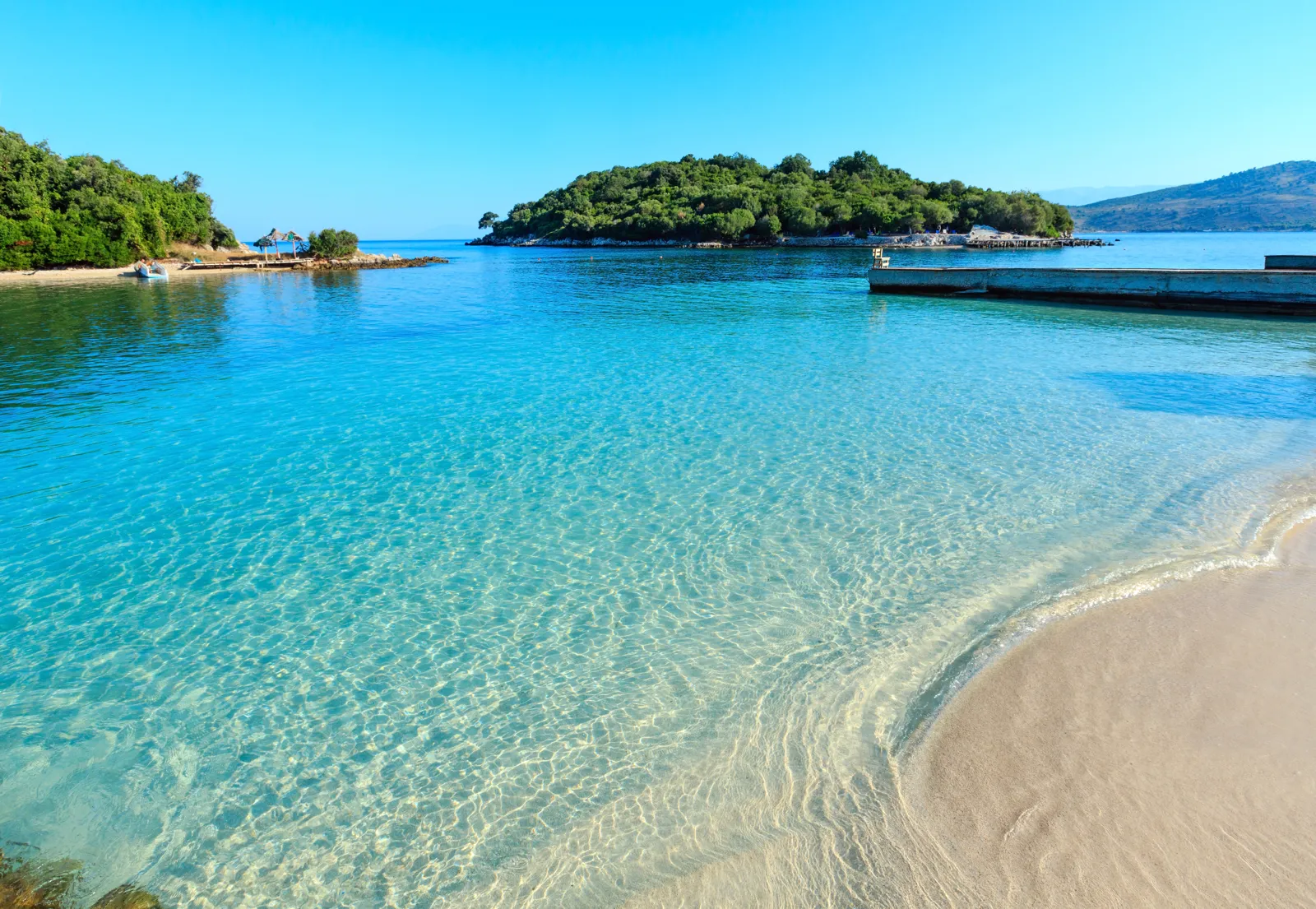
Turquoise waters of the Ionian Sea at Ksamil, on the Albanian Riviera
Tirana
The capital deserves one or two days. Skanderbeg Square, the Et’hem Bey Mosque, the National History Museum and the former nuclear bunkers turned into museums (Bunk’Art 1 and 2) tell the country’s turbulent history, especially the communist period. The Blloku district is full of cafés and restaurants. The Dajti Ekspres cable car climbs Mount Dajti, above the city.
Berat
Nicknamed « the city of a thousand windows », Berat is a World Heritage Site together with Gjirokastër. Its white Ottoman houses rise in tiers above the Osum river, facing the Gorica district. Climb up to the citadel, still inhabited, which has Byzantine churches and the Onufri Museum. The Osum canyons, further south, are good for rafting in spring.
Gjirokastër
Further south, Gjirokastër is a stone town clinging to a mountainside, dominated by a vast fortress. Its tower houses with stone-slab roofs and its bazaar are explored on foot, in good shoes: the cobbled streets are steep. It combines easily with the Blue Eye spring (Syri i Kaltër) and Sarandë.
The Albanian Riviera: Himarë, Dhërmi, Jale, Ksamil
Between Vlorë and Sarandë, the coast road crosses the Llogara Pass and then runs past a string of pebble beaches and clear-water coves. Dhërmi and Jale draw a livelier, party crowd; Himarë and the nearby villages (Qeparo, Borsh) are quieter. In the south, Ksamil is known for the small islands off its shore, but it is overcrowded in July and August. Sarandë is a practical base for the area.
Butrint
Near the Greek border, Butrint National Park protects a World Heritage archaeological site occupied from Greek antiquity to the Venetian era: theatre, baptistery, basilica and walls, set among a lagoon and forest. Allow half a day, preferably early in the morning in summer.
Shkodër and the Albanian Alps (Theth, Valbona)
Shkodër, on the shore of the largest lake in the Balkans, is the gateway to the Albanian Alps. From the town you can reach Theth, a mountain village with its church and lock-in tower, and Valbona, on the other side of the pass. The hike between the two valleys takes a day. It is often combined with the Lake Komani ferry, which mostly runs in the warmer months. The hiking season generally runs from June to September; hiking with a local guide is advisable. GOV.UK (updated 15 October 2026) warns that unexploded landmines remain in some remote areas around hill towns on the northern border with Kosovo: do not step off marked paths.
Korçë and Lake Ohrid
In the east, Korçë is a lively mountain town known for its Orthodox cathedral, its restored old bazaar and its beer. About 40 km (25 mi) away, Pogradec lies on Lake Ohrid, shared with North Macedonia and a World Heritage Site. A cool stop in summer, to combine with a tour of the south-east.
The Vjosa and Përmet
Declared a national park in 2023, the Vjosa is one of the last great wild rivers in Europe. Around Përmet, you can bathe in the Benjë hot springs, go rafting and try local specialities. A good stop between Gjirokastër and Korçë.
Things to do in Albania: experiences not to miss
Stroll through the World Heritage Ottoman towns of Berat and Gjirokastër
Swim on the Riviera between Vlorë and Sarandë, from Dhërmi to Ksamil
Step back in time at Butrint, an archaeological site by a lagoon
Take the Lake Komani ferry then hike from Valbona to Theth in the Albanian Alps (June to September)
Go rafting on the Vjosa around Përmet
Try the local food: byrek, grilled meats and simple, inexpensive taverns
The best beaches in Albania
Albania’s coast is split between the Adriatic, north of Vlorë, and the Ionian Sea, to the south. The most sought-after beaches are on the Ionian Riviera:
Beach or area
Type
Atmosphere
Dhërmi and Jale
Pebbles, clear water
Lively, party crowd
Himarë, Qeparo, Borsh
Pebbles, long bays
Quieter, family-friendly
Ksamil
Small coves facing islets
Very busy in July and August
Selection based on the stops described in this guide. Go in June or September to avoid the crowds (see when to go to Albania).
Itinerary ideas for Albania
7 to 10 days: historic towns and the Riviera
Days 1 and 2: Tirana
Days 3 and 4: Berat
Days 5 and 6: Gjirokastër and the Blue Eye
Days 7 and 8: Ksamil and Butrint, from Sarandë
Days 9 and 10: Himarë or Dhërmi, then back to Tirana via the Llogara Pass and Vlorë (for an Albania road trip, a hire car is the most flexible option: see « Getting around » below)
2 weeks: north to south (June to September)
Days 1 and 2: Tirana
Day 3: Shkodër and its lake
Days 4 to 6: Lake Komani ferry, Valbona, hike to Theth, back to Shkodër
Days 7 and 8: Berat
Days 9 and 10: Përmet and Gjirokastër
Days 11 to 13: Sarandë, Butrint, Ksamil and then the Riviera (Himarë, Dhërmi)
Day 14: back to Tirana via Vlorë
Albania: who is it for?
Here is our view by traveller profile, based on the stops, budget and conditions described in this Albania guide.
Profile
Our view
Budget travellers
✅ One of the cheapest countries in Europe: roughly US$45–75 a day, more in August on the Riviera.
Beaches
✅ The Riviera between Vlorë and Sarandë; Ksamil is overcrowded in July and August.
Families
✅ Quieter pebble bays at Himarë, Qeparo and Borsh.
Culture and history
✅ UNESCO-listed Berat and Gjirokastër, Butrint, Bunk’Art in Tirana.
Hiking and adventure
✅ Theth and Valbona from June to September, with a local guide, rafting on the Vjosa.
Nightlife
⚠️ Dhërmi and Jale draw a party crowd in summer.
Road trips
✅ A hire car for a full tour; avoid driving at night in the mountains.
Budget for a trip to Albania
Albania remains one of the cheapest countries in Europe for food, transport and accommodation, although prices rise sharply on the Riviera in summer. Indicative amounts per person per day, excluding international flights:
Indicative estimates, varying by season and region. Allow considerably more in August in Ksamil, Dhërmi or Himarë.
Entry fees for sites (citadels, Butrint, museums) are modest. Boat trips on the Riviera, rafting and mountain guides are the main extra costs.
Getting around Albania
Getting there: Tirana International Airport is the country’s main international gateway. The U.S. Department of State (travel.state.gov, last updated August 27, 2026) notes that there are no commercial domestic flights and no direct commercial air service to the United States.
Hire car: the most flexible way to do a full tour. Traffic drives on the right. GOV.UK (updated 15 October 2026) describes driving as very hazardous and often aggressive, with road deaths among the highest in Europe, poor road surfaces and no street lighting even on major routes; it recommends a 1968 international driving permit alongside a UK licence (the 1949 IDP is no longer accepted). The U.S. Department of State says US travellers can drive on a US or international licence as non-residents, advises not travelling at night and notes a zero-tolerance drink-driving law. After an accident, even a minor one, do not move your car and wait for the police.
Buses and furgons: buses and minibuses (furgons) link the main towns cheaply. The U.S. Department of State notes that buses are regulated and generally considered safe, and recommends travelling between cities in daylight. Timetables are rarely posted: ask at your accommodation.
Komani ferry: the lake crossing links the Shkodër area with the Valbona valley, mainly in the warmer months.
Taxis: handy in towns and for short trips. According to the U.S. Department of State, Uber and other ride-hailing services do not operate in Albania, but marked taxis are considered safe; agree on the fare before setting off if there is no meter.
Train: the U.S. Department of State describes rail services as poor, limited and unreliable; not a practical option for a tourist trip.
Where to stay in Albania
In Tirana, the centre (around Skanderbeg Square) and the Blloku district let you do everything on foot. In Berat and Gjirokastër, stay in the old town, often in traditional houses restored as guesthouses. On the Riviera, Sarandë and Himarë offer the widest choice all season; Ksamil and Dhërmi are more expensive in summer.
In the Albanian Alps, accommodation is mostly in family-run guesthouses, often with half board. Many open only in season. In July and August, book several months ahead on the coast.
Entry requirements for Albania
US citizens: according to the U.S. Department of State (travel.state.gov, last updated August 27, 2026), you can enter Albania as a tourist without a visa and stay up to one year without applying for a residence permit. Your passport should be valid for at least three months from the date of arrival.
UK citizens: according to the UK FCDO (GOV.UK, updated 15 October 2026), you can visit without a visa for up to 90 days in any 180-day period, for tourism or business. Your passport must have an expiry date at least 3 months after the day you plan to leave Albania; a passport reported lost or stolen leads to refusal of entry. A yellow fever certificate is required only if you arrive from a country listed as a transmission risk.
Passport validity: the two sources word it differently (3 months from arrival for the US page, 3 months after departure for GOV.UK): to be safe, travel with a passport valid at least 3 months beyond your return date, and check with the Albanian embassy if in doubt.
Customs: GOV.UK states that you must declare anything that may be prohibited or subject to tax or duty; the U.S. Department of State mentions strict rules on weapons, endangered species and narcotics, including narcotic and psychotropic medicines. For what you can bring home, check your home country’s customs allowances (e.g. CBP in the US, HMRC in the UK).
Health and safety
Health: check recommended vaccinations at least 8 weeks before travel (GOV.UK). Do not drink tap water; drink bottled water and only UHT or pasteurised milk (GOV.UK, updated 15 October 2026). GOV.UK describes medical facilities as very poor, particularly outside Tirana; the U.S. Department of State notes that hospitals often require payment up front and that Medicare and Medicaid do not apply overseas. Take out insurance covering medical costs and air evacuation.
Safety: according to GOV.UK, reports of crime targeting foreigners are rare, but take sensible precautions against street crime in larger cities and late at night, and watch out for pickpockets in tourist areas, on public transport and at airports. Avoid demonstrations, which have occasionally turned violent in central Tirana. The U.S. Department of State notes that anti-American sentiment is rare.
Outdoors: GOV.UK advises renting jet skis and boats only through licensed water sports centres, observing beach flags, and taking care in wildfire season (April to October); causing a wildfire is a criminal offence. Landmines remain in some remote areas near the border with Kosovo.
Earthquakes and weather: tremors are common and serious earthquakes occasionally happen; from December to February, severe weather can cause flooding, particularly in the north (GOV.UK).
Drugs: according to GOV.UK, possession of illegal drugs can lead to 5 to 10 years in prison and supply to up to 15 years; airports scan baggage, including that of transiting passengers, for cannabis.
Emergency numbers: police 112, ambulance 127, fire 128 (GOV.UK).
Practical tips for Albania
Money: the currency is the lek. According to the U.S. Department of State (last updated August 27, 2026), Albania is primarily a cash economy and most businesses do not accept credit cards, but ATMs are widely available in cities. Euros are sometimes accepted in tourist areas, often at a less favourable rate.
Internet: check your carrier’s roaming charges before you leave; an eSIM or a local SIM card is often cheaper. Wifi is common in accommodation and cafés.
Raki: the local spirit is often offered as a sign of hospitality, sometimes served in recycled water bottles: check what you are drinking.
Etiquette: Albanians often shake their head from side to side to say yes, and nod for no, which can be confusing: ask for a spoken confirmation. In mosques and churches, cover shoulders and knees.
Tipping: not compulsory, but rounding up the bill in restaurants is appreciated.
Power cuts: the U.S. Department of State mentions sporadic blackouts across the country; GOV.UK notes that they can affect street lighting.
Albania combines easily with its neighbours: Montenegro to the north, Corfu opposite Sarandë, and Greece to the south. To go further along the Adriatic coast, see also Dubrovnik.
No. According to the U.S. Department of State (last updated August 27, 2026), US citizens can enter as tourists without a visa and stay up to one year, with a passport valid at least three months from arrival. According to GOV.UK (updated 15 October 2026), UK citizens can stay up to 90 days in any 180-day period, with a passport valid at least 3 months after departure.
When is the best time to visit Albania?
From mid-May to the end of June and in September: pleasant heat, warm enough sea, open mountain trails and fewer people than in July and August. April and October suit towns and historic sites well.
How much does a trip to Albania cost?
Excluding flights, allow roughly US$45–75 per person per day on a budget and US$110–200 for comfort. Prices rise in July and August on the Riviera.
How many days do you need in Albania?
A week to ten days lets you see Tirana, Berat, Gjirokastër, Butrint and part of the Riviera. Two weeks leave time to add Shkodër and the Theth – Valbona hike, or the Korçë and Lake Ohrid area.
Is Albania safe for tourists?
According to GOV.UK (updated 15 October 2026), reports of crime targeting foreigners are rare; take usual precautions against pickpockets. The main risk is the road: GOV.UK notes that road deaths are among the highest in Europe, so drive in daylight and carefully.
What budget should I plan for a week in Albania?
Based on our estimates per person per day (roughly US$45–75 on a budget, US$110–200 for comfort), a week on the ground costs roughly US$315–525 on a budget and US$770–1,400 for comfort, excluding international flights. Allow more in August on the Riviera.
Is Albania worth visiting?
Yes, if you want to combine historic towns, beaches and mountains at prices below those of Western Europe. The country is less set up for tourism than its neighbours: slow mountain roads, bus timetables to check, and a very busy Riviera in midsummer.
Our sources
Tirana International Airport: list of flights and destinations (consulted on 5 October 2026)
German Weather Service (DWD) and WMO 1961-1990 normals published by NOAA, for climate data
Transparency: this page contains affiliate links, labelled as such. If you book through them we may earn a commission at no extra cost to you; it does not influence our content or recommendations. How we fund the site.