If you want to visit the Netherlands, you can string together Amsterdam’s canals, tulip fields, windmills, art cities and North Sea beaches: the country packs a lot into a small, flat area that is easy to get around by train and bike. It is ideal for a weekend as well as a one- to two-week tour. This guide brings together the essentials for planning your trip: what to see, itineraries, budget and transport.
To locate the cities, regions, relief, national parks and airports, see our map of the Netherlands.
Netherlands at a glance
CapitalAmsterdamThe government and parliament sit in The Hague
LanguageDutch; English is very widely spoken
Currencythe euro (€) · currenciesCards are often the only accepted means of payment
Time zoneUTC+1, UTC+2 in summer; 1 hour ahead of London, 6 hours ahead of New York
AirportsAmsterdam Schiphol (AMS), Rotterdam The Hague (RTM), Eindhoven (EIN)
EntrySchengen area: no visa for short stays for US and UK citizens · travel.state.gov · GOV.UKPassport valid at least 3 months beyond your stay (US) or after leaving the Schengen area (UK)
Electricitycheck plug types and voltage before you go · plugs
The best time is from April to September. April and early May are tulip season, with King’s Day on 27 April. June to August are the warmest months (about 20 to 22 °C, or 68 to 72 °F, in the afternoon in Amsterdam), ideal for cycling and beaches, but also the busiest. September is a good compromise. Winter, cool and grey, suits a museum-focused city break, with Christmas markets in December. All the details, month by month and region by region, are in our article on the best time to visit the Netherlands.
What to see in the Netherlands: the highlights
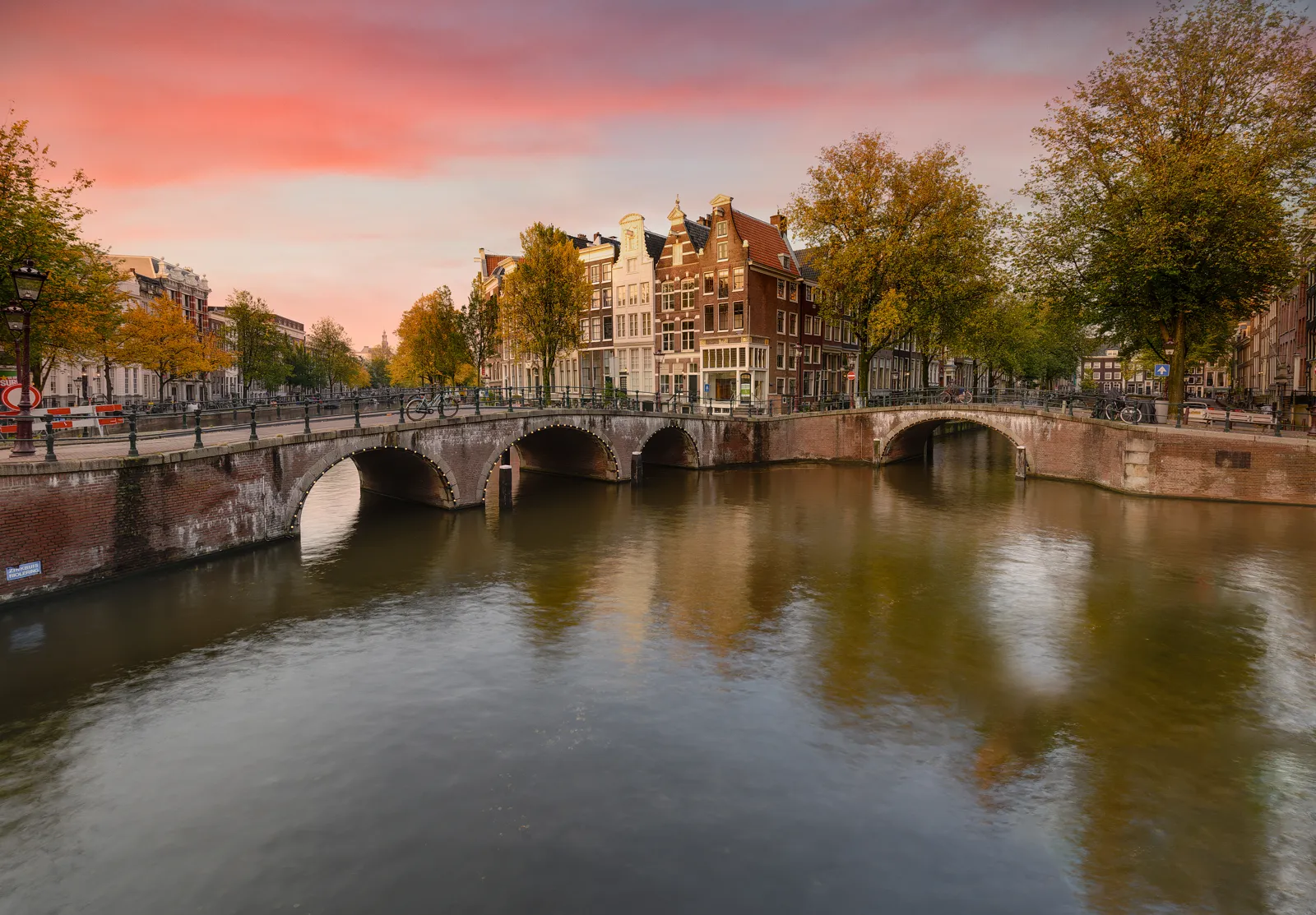
The Keizersgracht canal in Amsterdam
Amsterdam
The capital is best explored on foot or by bike, along the 17th-century ring of canals, a UNESCO World Heritage Site. The must-sees: the Rijksmuseum (Rembrandt, Vermeer), the Van Gogh Museum, the Anne Frank House, the Jordaan district, the flower market and the Vondelpark. A canal boat trip lets you see the façades of the merchants’ houses. North of the IJ, reached by free ferry from Central Station, the Amsterdam-Noord district is more modern. Tickets for the big museums are booked online for a time slot.
Haarlem and the bulb region
About fifteen minutes by train from Amsterdam, Haarlem is a quieter historic town, with its Grote Markt, the great St Bavo’s Church and the Frans Hals Museum. To the south, between Lisse and Noordwijkerhout, lie the bulb fields, in bloom from late March to May. Keukenhof gardens in Lisse display millions of bulbs, in spring only. Zandvoort beach is also close by.
The Hague and Delft
The Hague, seat of the government, the International Court of Justice and parliament, is home to the Mauritshuis, a small museum where you can see Vermeer’s Girl with a Pearl Earring. Its seaside district of Scheveningen faces the North Sea. Nearby Delft, Vermeer’s birthplace, is known for its canals, market square and blue earthenware. Leiden, a university town, is easy to combine.
Rotterdam and Kinderdijk
Destroyed in 1940, Rotterdam was rebuilt as a city of contemporary architecture: the Cube Houses, the Markthal (covered market), the Erasmus Bridge and one of the largest ports in Europe. The Boijmans Van Beuningen museum has opened a depot accessible to the public. East of the city, Kinderdijk lines up 19 18th-century windmills, a UNESCO World Heritage Site, reached by waterbus from Rotterdam. Our guide to Rotterdam: things to do and where to stay covers the city, its port and its districts of contemporary architecture.
Utrecht
In the centre of the country, Utrecht is a lively student city built around the Dom Tower, the country’s tallest church tower, and two-level canals whose lower wharves are lined with cellars turned into terraces. It is a good alternative base to Amsterdam, often cheaper, less than half an hour away by train.
Zaanse Schans, Giethoorn and the countryside
For windmills and wooden houses, Zaanse Schans, north of Amsterdam, is the easiest site to reach, but very busy. Giethoorn, in the east, is a village with no roads in its historic centre, where you get around by boat on the canals; go early or out of season. Hoge Veluwe National Park, in the east, combines forests, heaths and dunes with the Kröller-Müller Museum, rich in works by Van Gogh, and free white bicycles in the park.
Gouda and Marken: traditional Holland
Between Rotterdam, The Hague and Utrecht, and linked to them by Intercity trains, Gouda is known for its cheese: the traditional cheese market is held on Thursday mornings, from 10 am to 1 pm, from April to August. Its town hall, built between 1448 and 1450, is among the oldest Gothic town halls in the country. North-east of Amsterdam, Marken, a former island in the Markermeer linked to the mainland by a dyke since 1957, is known for its wooden houses.
Maastricht and Limburg
In the far south, Maastricht has a different feel from the rest of the country: squares with terraces, medieval lanes, ramparts, a bookshop in a former Dominican church and the St Pietersberg caves. The hills of Limburg, rare in the Netherlands, can be explored on foot or by bike. Belgium and Germany (Aachen) are a few kilometres away: check the best time to visit Belgium if you continue to Liège or Brussels.
The Wadden Islands
In the north, the Wadden archipelago borders a shallow sea listed as a UNESCO World Heritage Site. Texel, the largest island, is reached by ferry from Den Helder: beaches, dunes, seals and cycle paths. The other islands (Vlieland, Terschelling, Ameland, Schiermonnikoog) are more remote. Best kept for May to September.
Itinerary ideas for the Netherlands
7 to 10 days: Amsterdam and Holland
Days 1 to 3: Amsterdam (canals, museums, Jordaan), with half a day at Zaanse Schans
Day 4: Haarlem, plus Keukenhof in spring or Zandvoort beach in summer
Day 5: Leiden then The Hague (Mauritshuis, Scheveningen)
Day 6: Delft
Days 7 and 8: Rotterdam and the Kinderdijk windmills
Days 9 and 10: Utrecht, then back via Amsterdam
2 weeks: a tour of the Netherlands
Days 1 to 4: Amsterdam and around (Zaanse Schans, Haarlem)
Days 5 and 6: Texel island, by bike
Day 7: Giethoorn
Days 8 and 9: Hoge Veluwe National Park and the Kröller-Müller Museum
Days 10 and 11: Maastricht and Limburg
Days 12 and 13: Rotterdam, Kinderdijk and Delft
Day 14: The Hague, then home
Distances are short: most of these stops are less than two and a half hours apart by train. A bike makes it easy to link nearby villages and sights.
Road trip by car: a car is useful for Zeeland, the Veluwe or Giethoorn, much less so in cities. In Amsterdam, rather than looking for parking in the centre, use the Park and Ride (P+R) car parks on the outskirts, linked to the centre by public transport; check the conditions and rates on the city’s official website before you go.
Budget for a trip to the Netherlands
The Netherlands is a fairly expensive country, especially for accommodation in Amsterdam, where a high tourist tax is added to room rates. Other cities are more affordable. Approximate amounts per person per day, excluding international travel:
Item
Tight budget
Comfortable
Accommodation (based on a shared double room)
about €35–60 (hostel, simple room outside Amsterdam)
about €90–160
Meals
about €20–30 (supermarkets, snacks, fries, herring)
about €50–80
Transport (train, tram, bike)
about €10–15
about €15–30
Museums and activities
about €5–15
about €25–40
Total per day
about €70–110
about €180–300
Rough estimates that vary with the season and the city. Amsterdam is considerably more expensive than Rotterdam, Utrecht or Maastricht.
To cut costs: stay outside Amsterdam (Haarlem, Utrecht, Leiden or even Rotterdam) and travel into the capital by train, avoid peak periods (tulips, King’s Day), shop in supermarkets and get around by bike. Compare museum cards and visitor transport passes with single tickets according to your plans.
Getting around the Netherlands
Train: the Dutch railways (NS) network is dense and frequent, with several trains an hour between major cities. Check the ticket and payment options before you travel.
City transport: trams, buses and metros in Amsterdam, Rotterdam and The Hague. Remember to check in and out with your ticket or card when boarding and leaving. GOV.UK warns that thieves often operate in gangs on trains and trams to and from Schiphol airport and Central Station (updated 11 August 2026).
Bike: the most common means of transport. Rental shops are plentiful and there are cycle paths everywhere. Follow the rules: lights, dedicated lanes, parking only in designated places. According to the State Department (travel.state.gov, last updated August 13, 2026), serious accidents involving cyclists and trams occur every year, and pedestrians should not walk on bicycle paths, usually marked with red paving.
Boat: free ferries across the IJ in Amsterdam, waterbuses to Kinderdijk, ferries to the Wadden Islands.
Car: of little use in cities, where parking is scarce and expensive, but practical for the countryside, Zeeland or the Veluwe. A valid US licence can be used while in tourist status, and UK licences are accepted; the blood alcohol limit is 0.05%, speed cameras are common, and motorists must yield to cyclists (travel.state.gov; GOV.UK).
Where to stay in the Netherlands
In Amsterdam, accommodation is expensive and should be booked well ahead. The historic centre and the canal ring are the most convenient but the priciest; De Pijp, Oud-West or Amsterdam-Noord offer a good compromise, well served by tram or ferry. Staying in Haarlem, Utrecht or Leiden and commuting by train is often cheaper. Whether you stay in De Pijp or Haarlem, choosing the best time to visit Amsterdam affects the price as much as the neighbourhood.
Elsewhere, options include city hotels, B&Bs, hostels, campsites and, on the islands and in the countryside, holiday homes. There are also some unusual options, such as converted houseboats in Amsterdam. For tulip season, King’s Day and summer, book several months ahead.
Entry requirements for the Netherlands
US citizens: the Netherlands applies Schengen rules. Your passport should be valid for at least three months beyond the period of stay, and you need sufficient proof of funds and a return ticket. Dutch immigration does not accept the 12-page US emergency passport for visa-free entry (U.S. Department of State, travel.state.gov, last updated August 13, 2026).
UK citizens: no visa for up to 90 days in any 180-day period. Your passport must have been issued less than 10 years before the day you arrive and be valid at least 3 months after the day you plan to leave the Schengen area. The EU Entry/Exit System (EES) is being implemented: fingerprints and a photo may be taken, free of charge (GOV.UK, updated 11 August 2026).
ID: according to GOV.UK, anyone aged 14 or over must always be able to show identification; British nationals should use their passport, and the fine for not complying is €100 for those aged 16 or over.
Dutch Caribbean: Aruba, Curaçao, Sint Maarten, Bonaire, Saba and Sint Eustatius have their own travel advice pages: check them separately (see our Aruba guide).
Health and safety
Health: UK travellers need a GHIC or EHIC for medically necessary state healthcare; GOV.UK lists biting insects and ticks among the health risks. The State Department describes medical facilities as good and widely available. Take out travel insurance covering medical costs. Emergencies: 112.
Theft and scams: pickpocketing and bag snatching are common in central Amsterdam, around Central Station and on public transport to and from Schiphol. GOV.UK also warns of criminals posing as police officers to get cash and cards from tourists.
Terrorism: GOV.UK states that terrorists are likely to try to carry out attacks in the Netherlands: stay aware of your surroundings.
Drugs: the State Department points out that cannabis is a controlled substance and possession can result in a fine; GOV.UK adds that drug use is only tolerated in designated premises, that smoking soft drugs in public is illegal, and that street sellers should be avoided. Watch out for drink spiking.
Canals: according to GOV.UK, people drown in the canals every year, mostly after heavy drinking or cannabis use: take care when walking along them.
Practical tips for the Netherlands
Money: the euro. Many places accept cards only, and according to the State Department most retailers accept only chip-and-PIN cards, not magnetic-strip US credit cards: carry a backup card and a little cash.
Mobile data: check your home carrier’s roaming charges before you leave. Wi-Fi is available in most accommodation, cafés and trains.
Language: English is spoken almost everywhere; a few words of Dutch (« dank u wel » for thank you) are appreciated.
Etiquette: the Dutch are direct and punctual. In Amsterdam, the city regulates visitor behaviour in the centre (drinking in public, noise): follow the signs and respect residents’ peace.
Tipping: service is included; rounding up or leaving about 5 to 10% in restaurants is common but optional.
Weather: bring a waterproof, windproof jacket, even in summer. Tap water is safe to drink.
The Netherlands: who is it for?
Our verdict by type of traveller, based on the information in this guide (places, budget, seasons).
The Wadden Islands, Hoge Veluwe National Park, the bulb region in spring.
Frequently asked questions
Do I need a visa to visit the Netherlands?
Not for short stays as a US or UK citizen. The Netherlands is in the Schengen area: UK citizens can stay up to 90 days in any 180-day period, and US citizens need a passport valid at least three months beyond their stay. Carry your passport: ID must be shown on request from age 14.
How many days do you need to visit the Netherlands?
Three to four days are enough for Amsterdam and around. Allow a week to ten days to add Haarlem, The Hague, Delft, Rotterdam and Utrecht, and two weeks to include the Wadden Islands, the Veluwe and Maastricht.
How much does a week in the Netherlands cost?
Excluding international travel, allow about €70–110 per person per day on a tight budget and €180–300 for a comfortable trip. Amsterdam is the most expensive city, especially for accommodation.
Is cannabis legal in the Netherlands?
Not as such: the State Department notes that cannabis is a controlled substance, and GOV.UK says its use is only tolerated in designated premises in major cities, while smoking soft drugs in public is illegal.
What are the must-sees in the Netherlands?
Amsterdam and its canals, the tulip fields and Keukenhof in spring, Haarlem, The Hague and Delft, Rotterdam, the windmills of Kinderdijk and Zaanse Schans, Utrecht, Giethoorn, Hoge Veluwe National Park, Maastricht and Texel island.
Do you need a car to visit the Netherlands?
Not for the cities: trains quickly link Amsterdam, Haarlem, The Hague, Delft, Rotterdam and Utrecht, and bikes fill the gaps. A car becomes practical for Zeeland, the Veluwe or Giethoorn. In Amsterdam, use the Park and Ride (P+R) car parks on the outskirts.
When is the best time to visit the Netherlands?
From April to September. April and early May for the tulips, June to August for warmth, September for a good compromise with fewer tourists.
Transparency: this page contains affiliate links, labelled as such. If you book through them we may earn a commission at no extra cost to you; it does not influence our content or recommendations. How we fund the site.