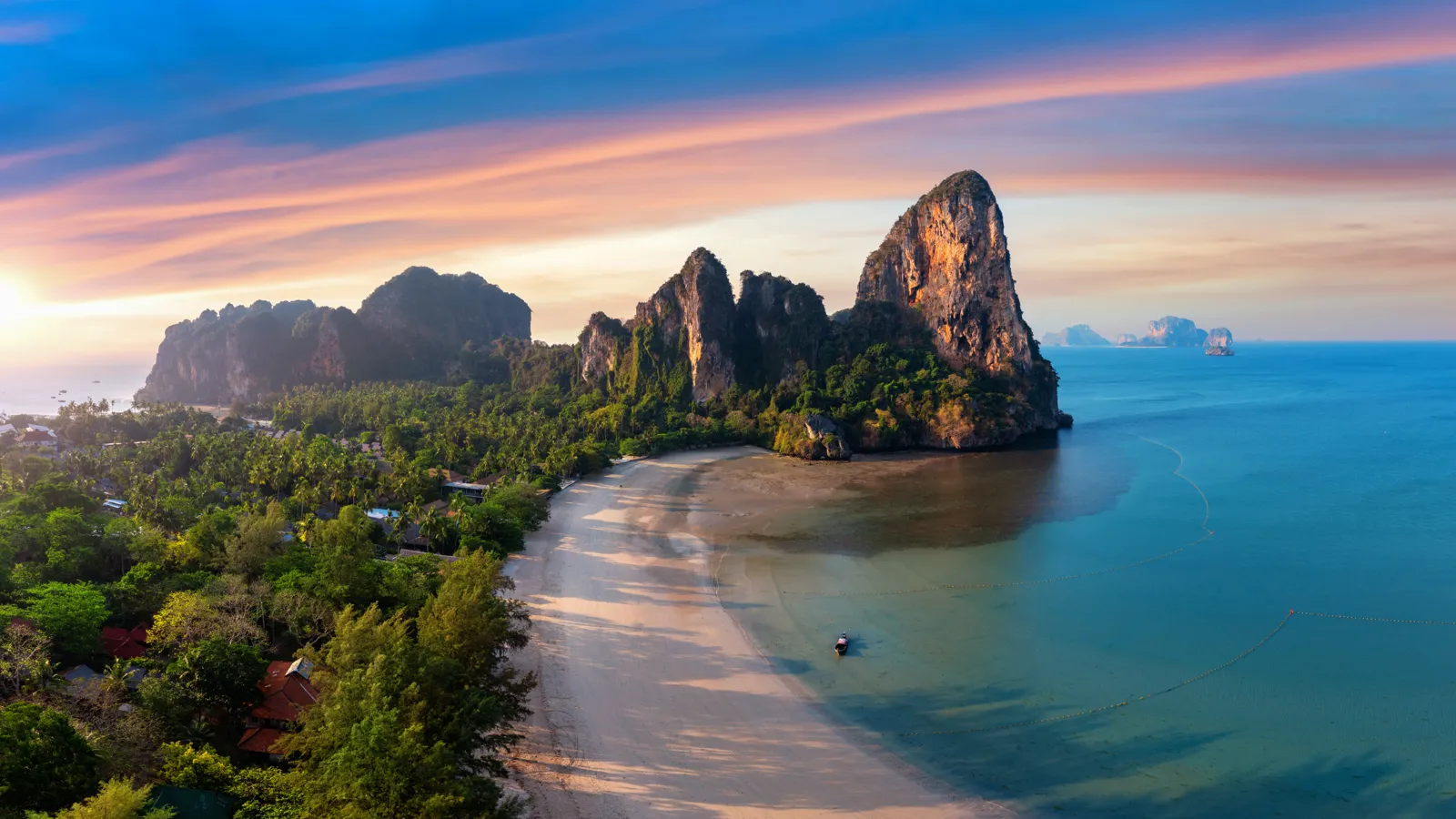
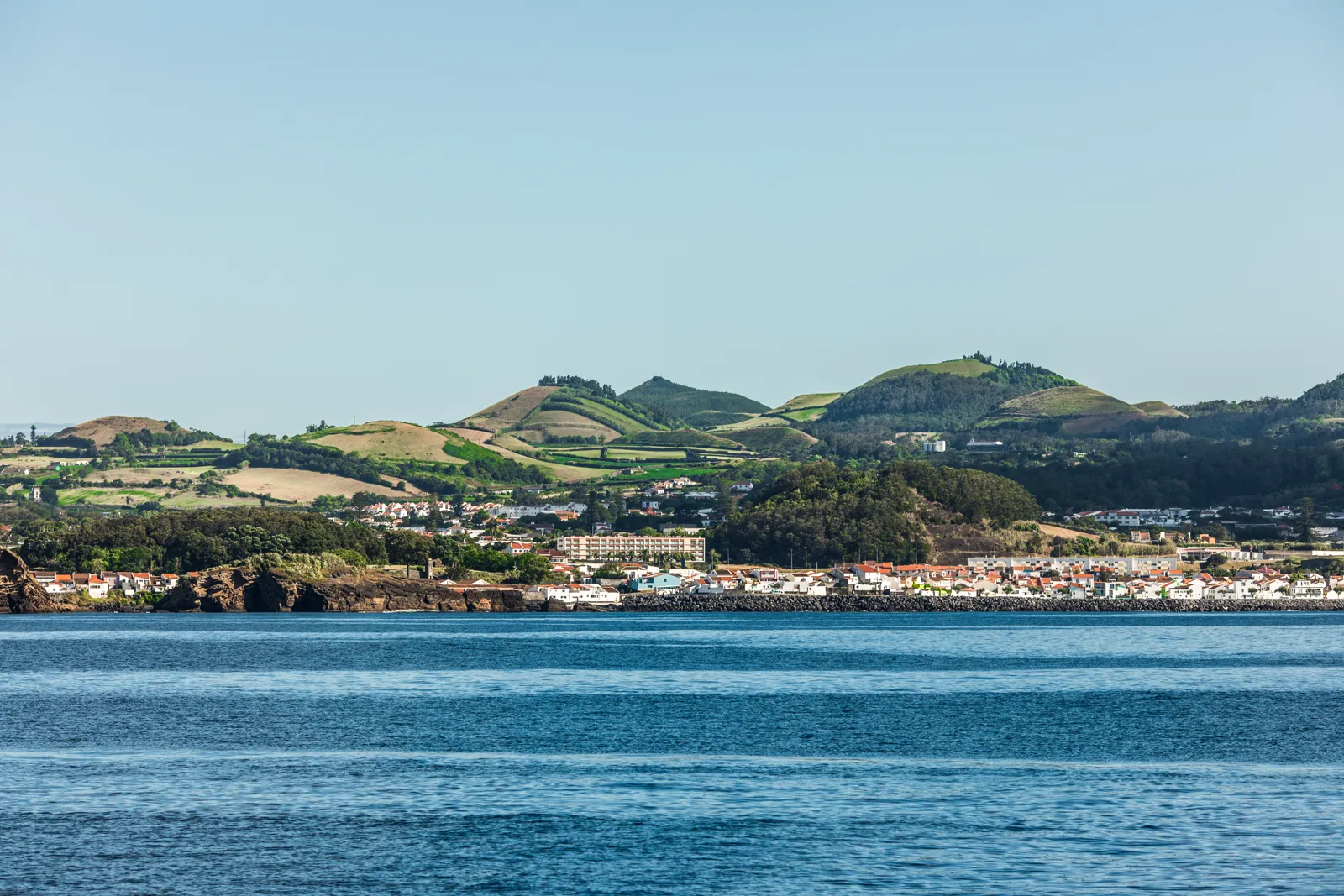
An Aruba travel guide starts with the basics: a dry, windy island off the coast of Venezuela, with long white-sand beaches on the west coast and a landscape of cacti, rocks and coves on the north coast. This Dutch Caribbean island, about 30 km (19 mi) long, is rarely hit by hurricanes, which makes it a year-round destination. This guide answers the practical questions: things to do in Aruba, when to go, how to get there, what budget to plan and where to stay.
To locate towns, regions, terrain, the national park and the airport, see our map of Aruba.
Aruba at a glance
CapitalOranjestadAn autonomous country within the Kingdom of the Netherlands
LanguageDutch and PapiamentoEnglish and Spanish are widely spoken
The best time to visit Aruba is from February to September: it rarely rains (less than 45 mm, or 1.8 in, per month, and fewer than 3 rainy days from March to June), with afternoon highs of 30 to 33 °C (86 to 91 °F). From October to January, showers are more frequent but remain modest: 87 mm (3.4 in) in November, the wettest month. For your budget, late summer and autumn are cheaper than winter, the high season for North American visitors.
The Departamento Meteorologico Aruba places the dry season roughly from February to June and the rainy season from September to January, with showers often early in the morning. The easterly trade wind blows almost constantly and makes the heat bearable; it is stronger in spring and early summer, a plus for kitesurfing and windsurfing. The island lies on the southern edge of the hurricane belt: according to the DMA, serious damage occurs only about once a century, although storms passing to the north can make the sea rough and erode beaches. The UK FCDO (GOV.UK, updated 7 July 2026) notes that the Caribbean hurricane season normally runs from June to November and that most hurricanes pass to the north of Aruba.
Month
High °C (°F)
Low °C (°F)
Rain mm (in)
Rainy days
Crowds
Prices
Verdict
January
30.3 (87)
24.8 (77)
44 (1.7)
10.8
High
Very high
✅ Pleasant, a few showers
February
30.6 (87)
24.8 (77)
20 (0.8)
4.5
High (Carnival)
Very high
✅ Dry and sunny
March
31.1 (88)
25.3 (78)
10 (0.4)
2.0
High
High
✅ The driest
April
31.9 (89)
26.0 (79)
9 (0.4)
1.5
High (Easter)
High
✅ Dry, steady wind
May
32.0 (90)
26.7 (80)
14 (0.6)
1.7
Moderate
Medium
✅ Dry, fewer people
June
32.5 (90)
26.9 (80)
17 (0.7)
2.8
Moderate
Medium
✅ Dry, strong wind
July
32.4 (90)
26.7 (80)
20 (0.8)
4.1
High (holidays)
High
✅ Hot and dry, holidays
August
33.2 (92)
27.2 (81)
31 (1.2)
3.1
High (holidays)
High
✅ The hottest, little rain
September
33.2 (92)
27.3 (81)
43 (1.7)
3.3
Low
Low
✅ Hot, lower prices
October
32.4 (90)
26.7 (80)
76 (3.0)
7.3
Low
Low
⚠️ More frequent showers
November
31.5 (89)
26.0 (79)
87 (3.4)
9.6
Moderate
Medium
⚠️ The wettest (moderate)
December
30.7 (87)
25.3 (78)
80 (3.1)
11.0
Very high
Very high
⚠️ Showers, high holiday prices
Temperatures, rainfall and rainy days: 1991–2020 normals from the Departamento Meteorologico Aruba (DMA), Oranjestad station. Crowds and prices: our estimate based on the tourist seasons.
When to go to Aruba: the essentials
Best time: February to September, with March and April the driest months
Best value for weather and price: May, June and September
Hottest months: August and September (average high of 33.2 °C, 92 °F)
Wettest month: November (87 mm, 3.4 in), then December (80 mm, 3.1 in) and October (76 mm, 3.0 in)
Hurricanes: the island is on the edge of the hurricane belt; the risk is not zero, especially from August to November
Sea: warm all year round
What to do by season: in winter and at Carnival the island is lively but expensive; from April to July the wind is ideal for board sports; from September to November prices drop, with a few harmless showers. If you are weighing up another island, compare with the more pronounced rainy and hurricane seasons of Cuba or the Dominican Republic.
Things to do in Aruba: the highlights
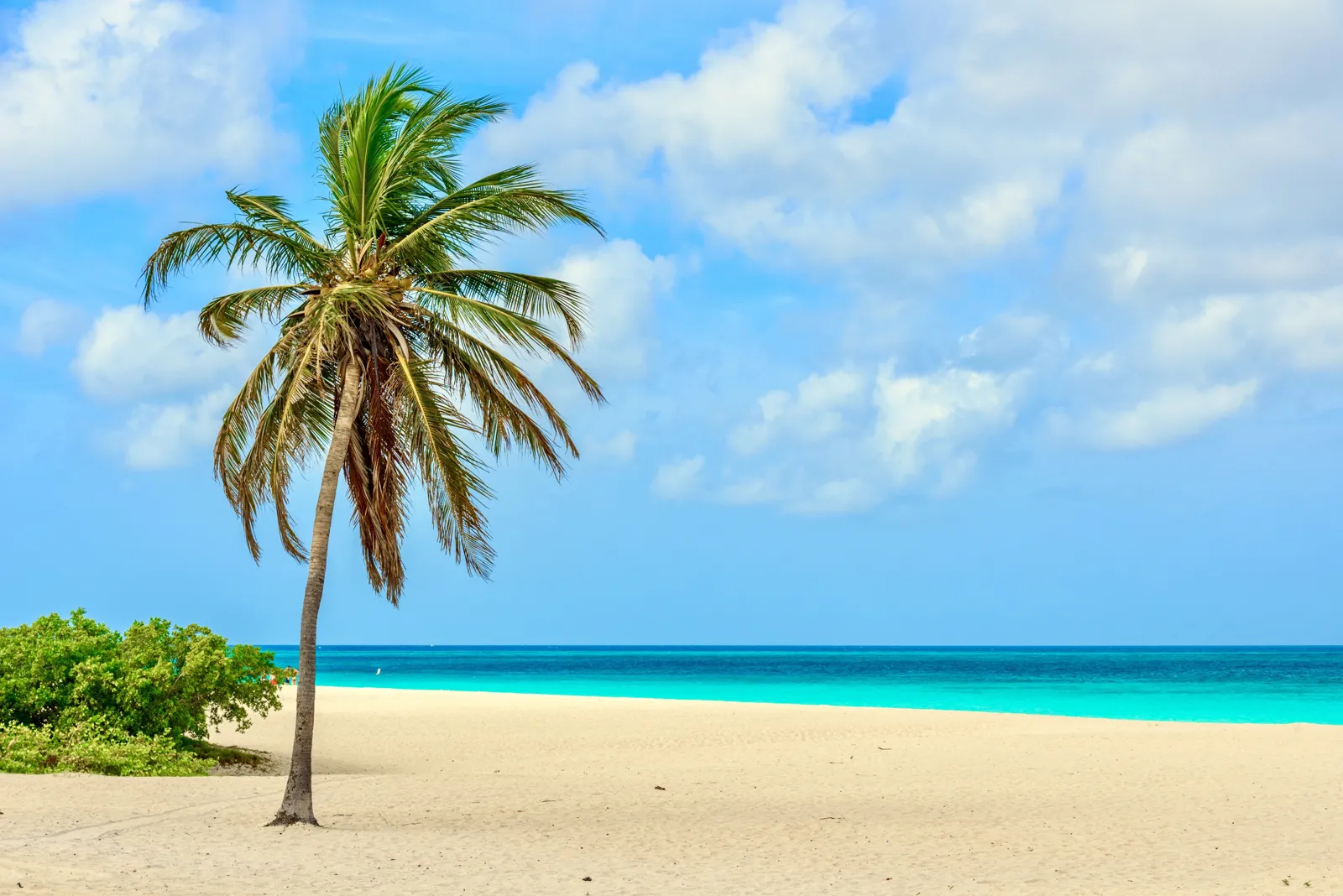
Palm tree on the white sand of Eagle Beach, Aruba
Eagle Beach
The widest beach on the island, with very fine white sand, calm water and, in places, the famous fofoti trees bent by the wind. It is lined with low-rise hotels rather than towers, which keeps the atmosphere quiet. Sea turtles nest here in season: respect the protected areas.
Palm Beach
North of Eagle Beach, Palm Beach has most of the large hotels, restaurants, bars and water sports (catamaran trips, parasailing, jet skis). The sea is calm and the atmosphere lively, especially in the evening.
Arashi, Malmok and the northern tip
Further north, Arashi and Boca Catalina beaches and the Malmok shoreline are among the best spots for snorkeling from the shore, with fish and coral close in. The wreck of the Antilla, sunk during the Second World War, can be reached on a diving or snorkeling boat trip.
California Lighthouse and Alto Vista Chapel
At the northwestern tip, the California Lighthouse overlooks the dunes and the sea; it is a popular sunset viewpoint. Nearby, the small yellow Alto Vista Chapel stands alone among the cacti, reached by a road lined with the Stations of the Cross.
Arikok National Park
This national park covers a large part of the east of the island: arid hills, cacti, goats and a wild, wave-battered coast. You can visit the Fontein and Quadirikiri caves, decorated with Amerindian drawings, and the Natural Pool (Conchi), sheltered by rocks and reached by 4×4, ATV or on foot. There is an entrance fee that goes towards the park’s conservation (Aruba Tourism Authority, aruba.com, read 24 October 2026). Swimming on the north coast is dangerous outside the Natural Pool.
Oranjestad
The capital has colorful Dutch-style facades, shops and a small streetcar along the main street. Fort Zoutman, the oldest building on the island, houses a small history museum. Cruise ships call regularly at the port: the town is quieter on days without a ship.
Baby Beach and San Nicolas
At the southeastern tip, Baby Beach is a shallow lagoon with very calm water, popular with families; the snorkeling area near the lagoon entrance can have currents. On the way, the town of San Nicolas has become known for its street-art murals, painted over the years during an urban art festival. The U.S. Department of State (travel.state.gov, last updated August 13, 2026) notes an increased risk of crime in the San Nicolas district, especially at night: visit during the day.
Mangel Halto and board sports
On the southwest coast, Mangel Halto is a small beach surrounded by mangroves, known for snorkeling and kayaking. North of Palm Beach, the Hadicurari area (Fisherman’s Huts) is the island’s kitesurfing and windsurfing spot, thanks to the steady trade wind.
Itinerary ideas for Aruba
4 to 5 days: day 1, Eagle Beach and sunset at the California Lighthouse; day 2, snorkeling at Arashi and Boca Catalina; day 3, Arikok by 4×4 (caves and Natural Pool); day 4, Oranjestad, San Nicolas and Baby Beach; day 5, Mangel Halto or a catamaran trip.
7 to 10 days: the same program at a slower pace, with a dive on the Antilla wreck, a day of kitesurfing or a beginner lesson, and a few beach days.
Combined trip: Aruba can be combined with neighboring Curaçao and Bonaire (regional flights); Colombia is also close, see our Colombia travel guide.
Budget for a trip to Aruba
Aruba is an expensive destination: most goods are imported and the hotel offer targets North American visitors. Indicative amounts per person per day, excluding flights (converted from our euro estimates at roughly €1 = US$1.12, ECB rate of 23 October 2026):
Item
Budget
Comfort
Accommodation (based on a shared double room)
roughly US$55–100 (apartment, small hotel)
roughly US$170–335 (beachfront hotel)
Meals
roughly US$34–50
roughly US$67–112
Transport (Arubus bus, shared car)
roughly US$11–28
roughly US$34–56 (car rental)
Activities
roughly US$22–34
roughly US$45–90
Total per day
roughly US$135–200
roughly US$280–505
Indicative estimates, varying with the season and exchange rate. All-inclusive packages can reduce the cost of meals.
To save money: choose an apartment with a kitchen and shop at the supermarket, travel between May and November, and compare flight + hotel packages, which are often better value.
Getting around Aruba
Car: the most convenient way to tour the island. Traffic drives on the right; right turns on red are prohibited, drivers entering a roundabout must yield to traffic already in it, and seat belts are compulsory. US citizens can drive with a valid U.S. driver’s license; watch for scooters, ATVs and goats, and note that most roads are less well lit than in the US (U.S. Department of State, travel.state.gov, last updated August 13, 2026). UK drivers need both the correct international driving permit (IDP), obtained in the UK before travel, and their UK licence; drink-driving is a serious offence (UK FCDO, GOV.UK, updated 7 July 2026). A 4×4 is needed for the Arikok tracks and the Natural Pool.
Arubus bus: the public network links the airport, Oranjestad, Eagle Beach, Palm Beach and San Nicolas at moderate prices. According to the U.S. Department of State, buses run every 15 minutes between 5:45 am and 6 pm, and every 40 minutes between 6 pm and 11:30 pm.
Taxis: taxis are not metered and fares depend on the destination: agree the price before you set off and use only licensed taxis (GOV.UK; travel.state.gov).
Bikes and scooters: handy along the west-coast beaches, where a path follows the shoreline.
Excursions: 4×4, ATV, catamaran or snorkeling boat trips, to book with local operators.
Getting there: international flights land at Queen Beatrix International Airport, near Oranjestad. Check current routes with the airlines and, if you connect in another country, its transit rules.
Where to stay in Aruba
Palm Beach has the high-rise hotels, restaurants and activities: convenient and lively. Eagle Beach has lower, quieter hotels on the island’s finest beach. Noord, set back from the beaches, offers cheaper apartments and villas a few minutes’ drive away. Oranjestad suits a short stay near the airport. Further away, Savaneta and the south of the island appeal to those looking for peace and quiet.
Entry requirements, health and safety
Entry requirements for Aruba. Aruba is an autonomous country within the Kingdom of the Netherlands and sets and enforces its own entry rules (GOV.UK).
US citizens: according to the U.S. Department of State (travel.state.gov, last updated August 13, 2026), on arrival you must have a U.S. passport valid for the duration of your stay, a completed Embarkation and Disembarkation Card (ED card), a return or onward ticket and proof of sufficient funds for accommodation and food. For stays longer than 30 days, see Aruba’s extension-of-stay requirements. Since March 1, 2018, passengers from certain countries must show proof of yellow fever vaccination.
UK citizens: according to the UK FCDO (GOV.UK foreign travel advice, updated 7 July 2026), you can visit Aruba for up to 3 months without a visa, and your passport must be valid for the duration of your stay. You must complete an embarkation card up to 7 days before you arrive and show proof of approval to your airline before you can fly. For medical entry requirements, the FCDO refers to TravelHealthPro.
Connections: if your journey involves a stopover in another country, check that country’s transit rules with your airline. Entry requirements checked on 24 October 2026; check them again before you travel.
Health: the U.S. Department of State (last updated August 13, 2026) lists Zika, dengue and chikungunya as prevalent: use repellent and cover up, and be up to date on routine vaccinations. Access to quality medical care is limited, critically ill patients may be transferred to neighboring countries at their own expense, and there is no decompression chamber on the island, so divers with decompression sickness must be evacuated. The EHIC and GHIC are not valid in Aruba (GOV.UK, updated 7 July 2026): take out travel insurance covering medical costs and evacuation.
Safety: there is a risk of petty theft and occasional street crime: do not take valuables or cash to the beach, do not leave bags in your vehicle and avoid walking in remote areas at night (GOV.UK). Rental cars can be stolen; check your insurance cover (travel.state.gov).
Swimming: the west coast is calm; the north and east coasts, battered by waves and currents, are dangerous for swimming.
Sun: the sun is very strong and the wind makes you forget it: sunscreen, a hat and plenty of water.
Emergencies: ambulance and fire 911, police 100, coastguard 913 (GOV.UK).
Practical tips for Aruba
Money: the official currency is the Aruban florin, but US dollars are widely accepted (Aruba Tourism Authority, aruba.com, read 24 October 2026). Keep some cash for small shops. Our currency converter helps you estimate your budget.
Local laws: carrying ID is a legal requirement, so keep a copy of your passport with you, and there are severe penalties for all drug offences (GOV.UK, updated 7 July 2026). Laws against possession of controlled substances, including marijuana for personal use, are rigorously enforced (travel.state.gov).
Internet: Wi-Fi is common in hotels; check roaming charges with your provider, or use an eSIM for navigation by car.
Environment: Aruba protects its reefs: choose reef-safe sunscreen and do not touch coral or turtles.
Customs: there are strict rules on goods you can take into or out of Aruba, and you must declare anything that may be prohibited or taxed (GOV.UK); check your home country’s allowances for the return (e.g. CBP in the US, HMRC in the UK).
Packing: swimsuit, UV-protection T-shirt and water shoes for the rocky beaches; see our packing list.
Who is Aruba for?
Our view by traveler profile, based on the information in this guide (places, budget, seasons).
Profile
Our view
Why
Couples
Very well suited
Sunsets at the California Lighthouse, Eagle Beach and its low-rise hotels, quieter than the Palm Beach towers.
Families
Well suited
Baby Beach is a shallow lagoon with very calm water; the sea is calm on the west coast. Swimming is dangerous on the north coast, outside the Natural Pool.
Budget travelers
With reservations
An expensive destination: roughly US$135–200 per person per day on a budget. An apartment with a kitchen and a stay between May and November reduce the cost.
Beach and sun
Very well suited
Long white-sand beaches on the west coast and little rain from February to September.
Water sports
Very well suited
Steady trade wind for kitesurfing and windsurfing at Hadicurari; shore snorkeling at Arashi, Boca Catalina and Mangel Halto.
Culture
Less suited
Oranjestad, Fort Zoutman, the San Nicolas murals and the Arikok caves fill one or two days.
Frequently asked questions
What is the best time to visit Aruba?
February to September, when it rarely rains: March and April are the driest months (10 mm and 9 mm, or 0.4 in, according to the DMA climate normals). May, June and September offer the best balance between weather and prices.
Does Aruba get hurricanes?
Rarely. According to Aruba’s meteorological service, the island lies on the southern edge of the hurricane belt and serious damage occurs only about once a century. The UK FCDO (GOV.UK, updated 7 July 2026) notes that most hurricanes pass to the north, although there are occasional tropical storms, and storms passing to the north can still make the sea rough.
Do I need a passport to go to Aruba?
Yes. US citizens need a passport valid for the duration of their stay, a completed ED card, a return or onward ticket and proof of sufficient funds (travel.state.gov, last updated August 13, 2026). British citizens can visit for up to 3 months without a visa, with a passport valid for the duration of the stay, and must complete the embarkation card up to 7 days before arrival (GOV.UK, updated 7 July 2026).
How do you get to Aruba?
International flights land at Queen Beatrix International Airport, near Oranjestad. Depending on where you start, the journey may involve a connection: check current routes with the airlines and the transit rules of any country you change planes in.
How many days do you need in Aruba?
Four to five days are enough to tour the island, including Arikok. A week lets you alternate beaches, snorkeling and excursions without rushing.
How much does a trip to Aruba cost?
Excluding flights, allow roughly US$135–200 per person per day on a budget and roughly US$280–505 in comfort. An apartment with a kitchen and a trip between May and November bring the cost down.
Entry, health, safety, driving and local-law information read on 24 October 2026: U.S. Department of State, Aruba country information (travel.state.gov, last updated August 13, 2026), and UK FCDO, foreign travel advice for Aruba (GOV.UK, updated 7 July 2026)
European Central Bank: euro reference rates of 23 October 2026 (budget conversion)
Climate data: 1991–2020 normals from the Departamento Meteorologico Aruba (DMA), Oranjestad station, as reproduced in the climate box of the Wikipedia article « Geography of Aruba »; climate overview on the Departamento Meteorologico Aruba website (meteo.aw), consulted on 13 October 2026
Transparency: this page contains affiliate links, labelled as such. If you book through them we may earn a commission at no extra cost to you; it does not influence our content or recommendations. How we fund the site.