Planning a trip to Krabi means choosing a base on the Andaman coast of southern Thailand, among limestone cliffs, mangroves and islands. Krabi province includes Ao Nang beach, the Railay peninsula (reachable only by boat), the small town of Krabi and, offshore, the Phi Phi and Hong islands and Ko Lanta. What to do in Krabi, when to go, where to stay and how much to budget: this Krabi travel guide covers the essentials, with the official climate normals of the Thai Meteorological Department.
Krabi at a glance
Locationprovince in southern ThailandOn the Andaman Sea, east of Phuket
Time zoneUTC+7, no daylight saving · detailsLocal time now: –:–
AirportsKrabi International Airport (KBV) · detailsDomestic flights from Bangkok (Suvarnabhumi and Don Mueang) and some regional international flights; Phuket airport is another option
EntryUS and UK: visa-exempt up to 30 days per entry, tourism only, since 15 September 2026; TDAC arrival card required; passport valid 6 months · tatnews.org · travel.state.gov · GOV.UK
Electricity220 V, type A, B, C and O plugs; US plugs usually fit, UK travellers need an adapter · plugs
Ideal length4 to 5 days7 to 10 days with Ko Lanta or a night on Phi Phi
When to go to Krabi
The best time to visit Krabi is from December to March: this is the dry season, with afternoon highs of 32 to 34 °C (90 to 93 °F), under 100 mm (3.9 in) of rain a month and a generally calm sea for boat trips. November and April are good shoulder months. From May to October, the southwest monsoon brings heavy rain (up to 324 mm / 12.8 in in October) and rougher seas: prices drop, but some sea trips are cancelled on stormy days.
When to go to Krabi: key facts
Best time: December to March
Driest months: January (32 mm / 1.3 in) and February (43 mm / 1.7 in)
Wettest month: October, 324 mm (12.8 in) and 22 rainy days on average
Hottest month: March, average high of 34.3 °C (94 °F)
Lowest prices: May to October, if you accept showers and sometimes rough seas
High season: late December to February, book early
Month
Avg max
Avg min
Rain
Rainy days
Crowds
Prices
Verdict
January
32.9 °C (91 °F)
21.6 °C (71 °F)
32 mm (1.3 in)
5
Very high
High
✅ Dry and sunny, calm sea
February
34.2 °C (94 °F)
22.0 °C (72 °F)
43 mm (1.7 in)
5
High
High
✅ One of the driest months
March
34.3 °C (94 °F)
23.0 °C (73 °F)
98 mm (3.9 in)
9
High
High
✅ Very hot, still dry
April
34.1 °C (93 °F)
23.6 °C (74 °F)
147 mm (5.8 in)
12
Moderate
Moderate
⚠️ Heat and first storms; Songkran in mid-April
May
32.9 °C (91 °F)
23.7 °C (75 °F)
172 mm (6.8 in)
16
Low
Low
⚠️ Start of the monsoon
June
31.9 °C (89 °F)
23.3 °C (74 °F)
193 mm (7.6 in)
16
Low
Low
⚠️ Frequent showers, rough sea on some days
July
31.5 °C (89 °F)
23.0 °C (73 °F)
201 mm (7.9 in)
18
Moderate
Moderate
⚠️ Monsoon; summer holiday crowds
August
31.4 °C (89 °F)
22.9 °C (73 °F)
266 mm (10.5 in)
18
Moderate
Moderate
⚠️ Rainy, sea trips sometimes cancelled
September
31.2 °C (88 °F)
22.9 °C (73 °F)
275 mm (10.8 in)
19
Low
Low
❌ Very rainy
October
31.3 °C (88 °F)
22.4 °C (72 °F)
324 mm (12.8 in)
22
Low
Low
❌ The wettest month
November
31.1 °C (88 °F)
22.5 °C (73 °F)
180 mm (7.1 in)
18
Moderate
Moderate
⚠️ End of the monsoon, weather improving
December
31.4 °C (89 °F)
21.7 °C (71 °F)
68 mm (2.7 in)
10
Very high
Very high
✅ Dry weather returns; year-end holidays in high demand
Temperatures, rainfall and rainy days (rounded): 1981-2010 normals for the Krabi station published by the Thai Meteorological Department. Crowds and prices: estimates based on the tourist seasons.
The heat varies little: highs stay between 31 and 34 °C (88 and 93 °F) all year and lows around 22-24 °C (72-75 °F). What changes is the rain and the state of the sea. In the rainy season, showers are often heavy but not constant, with sunny spells. Speedboat trips to Phi Phi or the Hong islands then depend on the day’s weather. The Thai Meteorological Department issues warnings for heavy rain or rough seas.
Krabi seasons
Dry season (December to March): often clear skies and a calm, clear sea, ideal for the islands, diving and climbing. This is high season: hotels and boats are in heavy demand, especially from Christmas to February.
Shoulder season (April, November): April is very hot with the first storms; November marks the end of the monsoon. A good balance of weather, crowds and prices.
Monsoon (May to October): heavy rain, especially from August to October, rougher seas and sometimes less clear water. Rates drop sharply and beaches are quieter; stay flexible for sea trips.
Krabi month by month
January: The driest month (32 mm / 1.3 in): ideal for the islands, very busy.
February: Still dry, 34 °C (93 °F); one of the best months.
March: The hottest (34.3 °C / 94 °F), still little rain: a good month for diving.
April: First storms; Songkran, Thai New Year, is celebrated in mid-April across the country.
May: Start of the monsoon, prices falling.
June: Frequent showers, quiet beaches.
July: Monsoon, but busy with summer holidaymakers.
August: Heavier rain (266 mm / 10.5 in); stay flexible for sea trips.
September: Very rainy, low prices.
October: The wettest month (324 mm / 12.8 in), best avoided for a beach-focused trip.
November: End of the monsoon, weather improving as the month goes on.
December: The dry season returns; book early for the holidays.
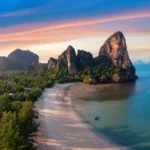
Railay is a peninsula cut off from the road by cliffs: you get there by longtail boat from Ao Nang or Krabi. Railay West has the best beach for swimming; Railay East, lined with mangroves, is mainly a landing point. A path leads to Phra Nang beach, at the foot of the cliffs, with its offerings cave. Railay and neighbouring Tonsai beach are renowned climbing spots, with schools for beginners. The Railay viewpoint and lagoon are reached on a steep, slippery trail with rope sections: avoid it after rain or in flip-flops.
The Phi Phi Islands
About 1.5 to 2 hours away by boat depending on the type of vessel, the Phi Phi archipelago is the most popular day trip. Phi Phi Don, the inhabited island, has most of the accommodation; uninhabited Phi Phi Leh is home to Maya Bay, made famous by the film The Beach. The islands are part of a national park: an entrance fee is charged, and swimming and access to some bays are regulated to protect the coral. Maya Bay has already been closed temporarily to let the site recover: check that it is open before booking. To enjoy Phi Phi without the midday crowds, spend a night there.
The Hong Islands and the 4 Islands tour
North of Ao Nang, the Hong Islands hide an inner lagoon surrounded by cliffs, explored by kayak or at a suitable tide. The « 4 Islands tour » combines, in half a day or a full day, Ko Poda, Chicken Island (recognisable by its rock shaped like a chicken’s head), Ko Tup, linked to Ko Kai by a sandbar visible at low tide, and Phra Nang beach. These trips run by longtail or speedboat; choose an operator that provides life jackets and respects the boat’s capacity.
Ao Nang
Ao Nang is the province’s main beach resort, with the widest choice of hotels, restaurants and tour agencies. The beach itself is decent, but its main appeal is as the departure point for boats to Railay and the islands. To the west, Noppharat Thara beach, longer and quieter, is lined with casuarina trees. Ao Nang is the most convenient base for a first visit.
Krabi Town
Krabi Town, on the estuary, is the provincial capital. It has few beaches, but a genuinely Thai feel: markets, temples, local restaurants and cheaper accommodation. The weekend night market and the evening food markets are a chance to taste southern cuisine. From the pier, boats run along the mangroves and the two limestone peaks of Khao Khanab Nam, which hold caves.
Wat Tham Suea, the Tiger Cave Temple
A few kilometres north of Krabi Town, this Buddhist monastery is known for its staircase of more than 1,200 steps climbing to a Buddha statue on a hilltop, with sweeping views over the province. Go early in the morning and take water: it is a real effort in the heat. As the temple is a place of worship, cover your shoulders and knees, and watch out for the monkeys, which snatch food and belongings.
Emerald Pool and the hot springs
In Khlong Thom district, to the southeast, the Thung Teao forest is home to the Emerald Pool (Sa Morakot), a clear, green-tinted pool where you can swim, and a second pool further along the trail. Nearby, hot springs flow into a stream in warm cascades. The two sites are often combined in a day trip; arrive early to avoid the groups.
Hikes: Dragon Crest and Khao Phanom Bencha
The Tab Kak Hang Nak trail, north of Ao Nang, climbs to the « Dragon Crest », a rocky ridge with views over the coast and islands; the climb is steady, so allow half a day. Further north, Khao Phanom Bencha National Park protects a tropical forest with waterfalls, including Huai To. Set off early with water and good shoes, and avoid these trails in heavy rain.
Kayaking, diving and climbing
The mangroves of Ao Thalane or Klong Root can be explored by kayak, at the tide and time recommended by the rental operators. Diving takes place around Phi Phi and the nearby islands, with many dive centres in Ao Nang and on Phi Phi; visibility is better in the dry season. Railay and Tonsai are well-known climbing destinations, with routes for all levels and half-day courses.
Ko Lanta and Ko Jum
Further south, still in Krabi province, Ko Lanta has long beaches, a quieter atmosphere and an old fishing town on the east coast. It is reached by boat from Ao Nang in high season, or by minibus and car ferries from Krabi. In between, little-developed Ko Jum suits those looking for peace and quiet.
Itinerary ideas for Krabi
5 days: the essentials
Day 1: arrival, Ao Nang, sunset at Noppharat Thara
Day 2: Railay, Phra Nang, viewpoint (in dry weather)
Day 3: day trip to the Phi Phi Islands
Day 4: 4 Islands tour or Hong Islands
Day 5: Wat Tham Suea and Krabi Town, evening market
7 to 10 days: the whole province
Days 1-3: Ao Nang, Railay, 4 Islands tour
Day 4: Hong Islands by kayak
Day 5: Emerald Pool, hot springs and Wat Tham Suea
Days 6-7: a night on Phi Phi
Days 8-10: Ko Lanta (beaches, old town, national park at the southern tip)
Krabi remains affordable, especially in Krabi Town. Indicative amounts per person per day, excluding flights:
Item
Budget
Comfort
Accommodation (based on a shared double room)
roughly 450–1,150 THB
roughly 1,900–4,600 THB
Meals
roughly 400–600 THB
roughly 950–1,700 THB
Transport (longtail, songthaew, scooter)
roughly 200–400 THB
roughly 400–950 THB
Tours and activities
roughly 400–800 THB
roughly 950–2,300 THB
Total per day
roughly 1,500–2,900 THB
roughly 4,200–9,500 THB
Indicative estimates, national park entrance fees extra; prices rise sharply from Christmas to February.
A trip to Phi Phi or the 4 Islands is the main expense: prices vary with the boat (longtail or speedboat), the number of passengers and what is included. Compare what is covered (meals, mask, park entrance fee) before booking. To convert prices from baht, use our currency converter.
Who is Krabi for?
Our verdict by traveller type, based on the places, conditions and budget ranges in this guide:
Beaches and islands: ideal: Railay West, Phra Nang, the Phi Phi Islands, the 4 Islands tour and Ko Lanta, from December to March when the sea is calm.
Nature and adventure: an excellent choice: climbing at Railay and Tonsai, kayaking in the mangroves and the Hong Islands lagoon, diving around Phi Phi, hikes to Dragon Crest and Khao Phanom Bencha.
Families: yes: Ao Nang, Noppharat Thara and Klong Muang work well. Avoid steep trails with young children and choose boats with life jackets in their size.
Couples: yes: the quiet beach of Noppharat Thara, the resorts of Klong Muang and Tubkaek, and a night on Phi Phi to enjoy the island without the midday crowds.
Tight budget: yes: roughly 1,500–2,900 THB per person per day, especially if you stay in Krabi Town and travel from May to October. Boat trips are the main expense.
Culture: as an extra: Wat Tham Suea and its 1,200 steps, the markets and temples of Krabi Town. For a more cultural trip, see Bangkok or Chiang Mai.
Parties and nightlife: only moderately: Ao Nang is lively, but Phuket has much more nightlife.
Getting around Krabi
From the airport: Krabi airport is about 15 km (9 mi) from Krabi Town and about 30 to 40 minutes from Ao Nang; buses, shared minibuses and taxis provide transfers.
Songthaews: these converted pick-up trucks link Krabi Town, Ao Nang and Noppharat Thara at fixed fares.
Longtails: essential for Railay; boats leave when they are full. The last departure is in the late afternoon, and you sometimes have to wade ashore.
Ferries and speedboats: services to Phi Phi, Ko Lanta and Phuket, more frequent in high season.
Scooter and car: handy for the Emerald Pool or Khao Phanom Bencha, but the UK FCDO (GOV.UK, updated 12 October 2026) notes a high number of road accidents in Thailand, particularly with motorcycles. A helmet is compulsory by law; UK drivers need the 1968 International Driving Permit plus their UK licence, and riding without a valid licence could invalidate your travel insurance.
Where to stay in Krabi
Base
Best for
Good to know
Ao Nang
First visit, families
The most convenient for tours, very lively
Noppharat Thara
Peace and quiet, couples
Long beach, next to Ao Nang
Railay
Climbing, natural setting
Boat access only, higher prices
Krabi Town
Tight budget, local life
No beach, a good starting point for buses
Klong Muang, Tubkaek
Resorts, rest
More isolated, transport needed
Ko Lanta, Phi Phi Don
Beaches, islands
Plan the boat and at least one night
In Railay, expect to carry your luggage from the boat: choose a bag that is easy to carry.
From December to February, book several weeks ahead. During the monsoon, prices drop sharply, but some places close or carry out renovation work: check before booking.
Entry requirements, health and safety
US citizens (U.S. Department of State, travel.state.gov, page updated August 20, 2026): pre-arrival online registration is required; a passport valid at least six months beyond arrival is strongly recommended; you may be asked for an onward or return ticket or proof of funds.
British citizens (FCDO, GOV.UK, updated 12 October 2026): passport valid at least 6 months after arrival with 1 blank page; from 15 September 2026, visa-exempt entry is up to 30 days for tourism only; land-border visa-exempt entries are normally limited to 2 per calendar year; you may need proof of funds (10,000 THB per person / 20,000 THB per family) and onward travel; overstay fine of 500 THB a day, up to 20,000 THB.
Thailand Digital Arrival Card (TDAC): mandatory for all foreign nationals since 1 May 2025; it can be completed within the 3 days before arrival.
30 days for US citizens too: The U.S. State Department page (last updated August 20, 2026) still mentions 60 days, but it predates the change: under the Thai rules in force since 15 September 2026, US citizens are also limited to 30 days (Tourism Authority of Thailand, 1 September 2026). Check with the Royal Thai Embassy in Washington before you travel.
On arrival: check the exit date stamped in your passport by immigration.
Health: make sure routine vaccinations are up to date; others may be recommended depending on your trip: see your doctor or a travel clinic. Dengue is present: protect yourself against mosquitoes day and night. Carry prescription medication in its original packaging with your doctor’s prescription (U.S. Department of State).
Safety: The FCDO advises against all but essential travel to Pattani, Yala, Narathiwat and parts of southern Songkhla (Thailand–Malaysia border) and to areas within 20 km (12 mi) of the Cambodian land border (land crossings with Cambodia are suspended). Krabi province is not among these areas.
Sea: the UK FCDO warns that people have drowned in strong riptides; respect beach flags, especially red flags, and skip boat trips when the sea is rough.
Drugs: according to the UK FCDO (GOV.UK, updated 12 October 2026), recreational cannabis use is illegal, cannabis is restricted to medical use with a Thai prescription, and taking it out of Thailand is illegal.
Insurance that covers medical evacuation and repatriation is strongly recommended: see our travel insurance guide.
Practical tips
Money: ATMs are plentiful in Ao Nang and Krabi Town, but charge a fee on each withdrawal. Keep cash for longtails, markets and park entrance fees.
Internet: Wi-Fi is widespread; a local SIM card or an eSIM helps you avoid your home carrier’s roaming charges.
Etiquette: the province has a large Muslim population: dress respectfully away from the beach, with shoulders and knees covered in temples and mosques. Never criticise the monarchy, which is a criminal offence.
Boats: insist on a life jacket, do not board an overloaded boat and protect your belongings in a dry bag.
Environment: do not touch coral, use a reef-safe sunscreen and do not feed the fish or the monkeys.
Food: try the southern curries, often spicier, massaman curry, grilled seafood and the roti at the evening markets.
From December to March, during the dry season: 32 to 34 °C (90 to 93 °F), under 100 mm (3.9 in) of rain a month and a calm sea, according to Thai Meteorological Department normals. November and April are good compromises.
How many days do you need in Krabi?
Four to five days are enough for Ao Nang, Railay, Phi Phi and the 4 Islands tour. With a week to ten days, you can add the Hong Islands, the Emerald Pool, Wat Tham Suea and Ko Lanta.
Should you stay in Ao Nang or Krabi Town?
Ao Nang is more convenient for the beaches and boats. Krabi Town is cheaper and more authentic, but has no beach. For a first visit, Ao Nang is the simplest choice.
Can you visit Krabi during the monsoon?
Yes, if you accept frequent showers and sometimes rough seas. Prices are lower, but some boat trips may be cancelled, especially from August to October.
Krabi or Phuket?
Krabi is more about nature: cliffs, mangroves, climbing, islands. Phuket is bigger and more built-up, with more nightlife and more flights. Many travellers combine the two, linked by boat or by road.
Is Krabi good for families?
Yes: Ao Nang, Noppharat Thara and Klong Muang suit families well. Avoid steep hikes with young children and choose boats with life jackets in their size.
Transparency: this page contains affiliate links, labelled as such. If you book through them we may earn a commission at no extra cost to you; it does not influence our content or recommendations. How we fund the site.