Phuket is Thailand’s largest island, linked to the mainland by a bridge, on the Andaman Sea. It has very lively beaches such as Patong, quieter bays to the south and north, an old town of Sino-Portuguese houses and many temples. The island is also a base for exploring Phang Nga Bay and the Phi Phi Islands. What to do in Phuket? This Phuket travel guide helps you choose your beach, sights, day trips and when to go.
Phuket: key facts
Airport: Phuket International Airport, in the north of the island
Getting there: Phuket International Airport (HKT) receives international flights; check the routing and any connection when you book
From Bangkok: frequent domestic flights, or overnight bus
Ideal length of stay: 5 to 7 days, including day trips
Best time: December to March
Time difference: Thailand is on UTC+7 with no daylight saving: 7 hours ahead of London in winter (GMT) and 6 hours in summer (BST); 12 hours ahead of New York in winter (EST) and 11 hours in summer (EDT). Details.
Entry: US and UK citizens: visa-exempt entry of up to 30 days per entry, for tourism only, since 15 September 2026 (Tourism Authority of Thailand, 1 September 2026; GOV.UK, 12 October 2026); pre-arrival online registration for US citizens (travel.state.gov); passport valid 6 months, Thailand Digital Arrival Card (TDAC). Check tatnews.org, travel.state.gov and GOV.UK
Currency: the Thai baht (THB)
Typical budget: roughly ฿1,500–2,700 per person per day on a tight budget, ฿4,600–9,500 for a comfortable trip
Things to do in Phuket: the highlights
Phuket Old Town (Phuket Town)
The island’s main town, on the east side, has kept an old quarter built on the wealth of the tin trade: colourful Sino-Portuguese shophouses on Thalang, Dibuk and Krabi roads and Soi Romanee, Chinese shrines, cafés and small museums. On Sunday evenings, Thalang Road becomes a walking street market. It is the best place to try the local cuisine, influenced by Hokkien Chinese and Malay cooking.
Big Buddha and Wat Chalong
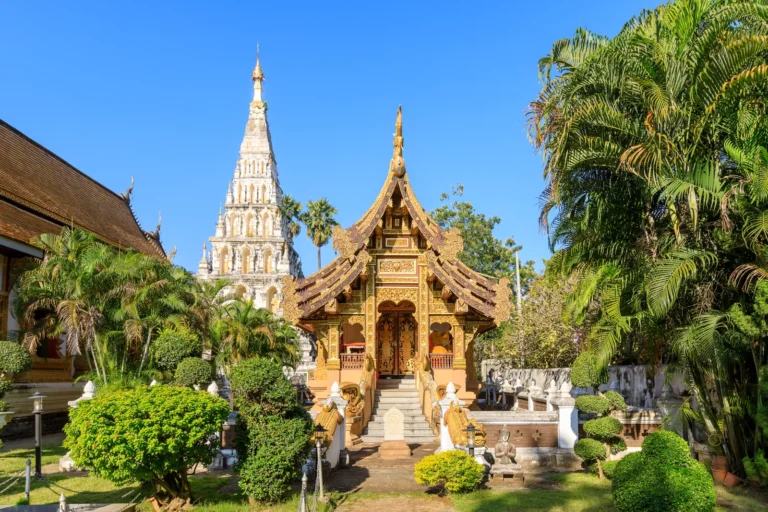
On Nakkerd Hill, in the south-centre of the island, a huge seated Buddha in white marble overlooks the coast, with wide views over Chalong Bay. Modest dress required (shoulders and knees covered). Below, Wat Chalong is the most visited temple on the island, with a large chedi that, according to tradition, holds a relic of the Buddha.
West coast beaches
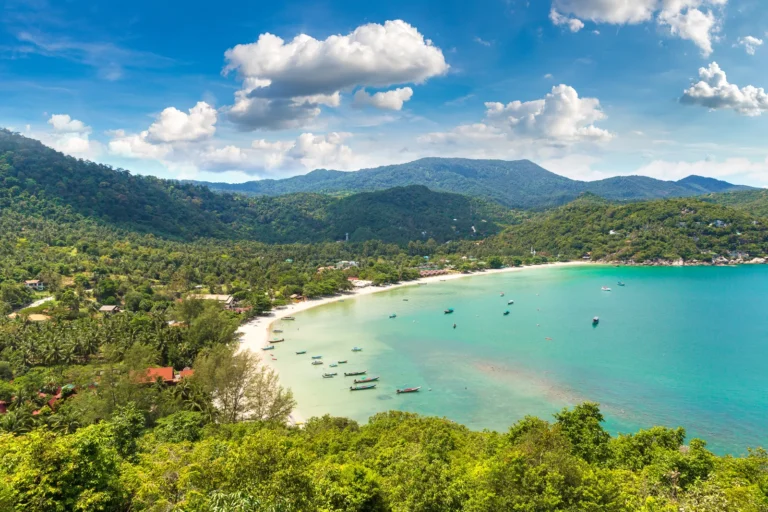
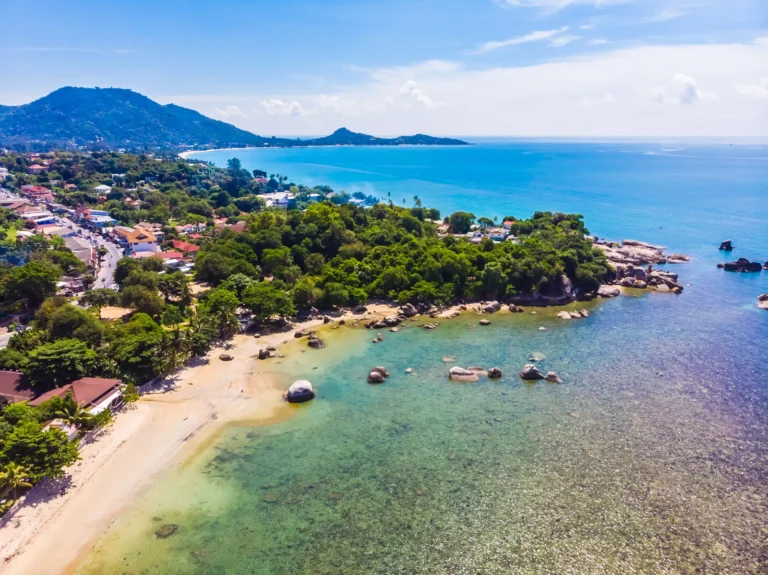
Patong is the most built-up and liveliest beach, with Bangla Road and its nightlife. Further south, Karon and Kata are more family-friendly, and Kata Noi is smaller and quieter. Kamala, Surin and Bang Tao, north of Patong, have more resorts. All are exposed to swell during the southwest monsoon.
The south: Nai Harn, Rawai and Promthep Cape
Nai Harn is a beautiful bay backed by a lake, quieter than Patong. Rawai is mainly a pier for boats to the small neighbouring islands. Promthep Cape, at the southern tip, is a very popular sunset viewpoint.
The north: Mai Khao, Nai Yang and Sirinat National Park
Near the airport, Mai Khao and Nai Yang beaches are part of Sirinat National Park. They are long, lightly developed and calmer. You can watch planes land at low altitude over Mai Khao beach.
Patong and nightlife
Patong, on the west coast, is the island’s busiest resort: a big beach, shopping malls, restaurants and, in the evening, pedestrianised Bangla Road with its bars and clubs. You can spend an evening there even if you stay on a quieter beach. If you are looking for peace, choose Kata, Karon or the south of the island.
Muay Thai, food and activities
Several stadiums and training camps host evening Muay Thai fights and beginner classes. Thai cooking classes are plentiful, as are spas and massages. At sea, the dry season is best for diving, snorkelling and kayaking into the caves of Phang Nga Bay.
Phang Nga Bay
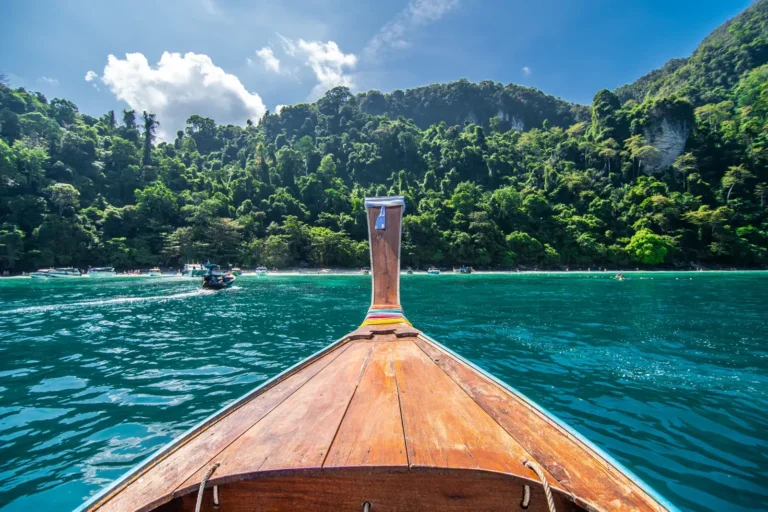
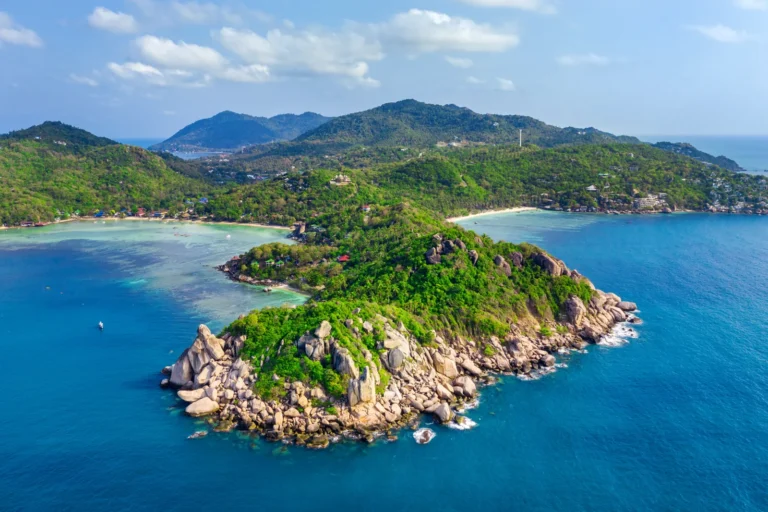
Northeast of Phuket, Phang Nga Bay is dotted with limestone karsts rising out of the green water. Speedboat or canoe trips let you explore sea caves and get close to the islet of Khao Phing Kan, known as « James Bond Island ». It is a long day and very busy in high season: leave early.
The Phi Phi Islands and the Similan Islands
The Phi Phi Islands, between Phuket and Krabi, can be reached by speedboat or ferry for the day or for several nights. Further northwest, the Similan Islands National Park is famous for diving, but it closes for part of the monsoon: check the opening dates with the Department of National Parks before booking a trip.
Itinerary: 5 to 7 days in Phuket
Day 1: arrival, check-in and sunset at Promthep Cape
Day 2: Phuket Old Town, Wat Chalong and the Big Buddha
Day 3: a day trip to Phang Nga Bay
Day 4: a beach day (Kata, Karon or Nai Harn)
Day 5: a day trip to the Phi Phi Islands, or take the ferry to spend one or two nights there
Days 6 and 7: beach, snorkelling, or an extension to Krabi and Ko Lanta
With two weeks, combine Phuket with Bangkok and the north of the country, or with Krabi and Ko Lanta in the dry season. From May to October, pair Bangkok with the Gulf islands instead. For the Bangkok leg, pick the best time to visit Bangkok to match the Andaman dry season.
Airport transfer in Phuket: Smart Bus, bus, taxi and private transfer
Phuket International Airport is in the north of the island, far from Patong, Kata or Rawai. There is no train: your options are buses, taxis, ride-hailing apps and pre-booked transfers.
Phuket Smart Bus
According to the airport, the Smart Bus serves Ban Khian, Cherngtalay, Surin, Kamala, Patong, Karon, Kata and Rawai, for 100 THB. It leaves from Exit 3 of the main terminal (Level 1). It runs to a timetable: check it on the operator’s website before you land, especially in the evening.
Bus 8411 to Phuket Town
The orange bus on route 8411 runs to Phuket Town. The fare depends on distance; tickets are sold on board (QR code or cash) or on the operator’s website.
Taxis and ride-hailing
The airport lists metered taxis and electric VIP taxis. For the EVme VIP taxi, the meter starts at 150 THB for the first two kilometres, plus a 100 THB airport fee set by the Ministry of Transport. Ask for the fare at the counter before getting in. Grab and AOT Limousine are also available.
Option
Where to catch it
Official fare
Source
Smart Bus
Exit 3, Level 1
100 THB
phuket.airportthai.co.th
Bus 8411 (Phuket Town)
In front of the terminal
Depends on distance
phuket.airportthai.co.th
EVme VIP taxi
Arrivals, domestic terminal
150 THB (first 2 km) + meter + 100 THB
phuket.airportthai.co.th
Private transfer
Arrivals hall
Fixed when booking
Your chosen provider
The right choice for your beach (Destination de Voyage summary): Mai Khao and Nai Yang are close to the airport, so a taxi is fine; for Patong, Karon, Kata or Rawai, the Smart Bus goes straight to these beaches if its timetable fits your arrival; for Phuket Town, take bus 8411; for a night arrival or a hotel away from the bus route, book a transfer.
Booking your Phuket transfer
A private transfer booked in advance (driver waiting on arrival, price fixed at booking) makes most sense for a late arrival, bulky luggage, travelling with young children, or in a group when the cost is shared. Before booking, check what the price includes (tolls, luggage, waiting time if your flight is late), the exact meeting point in the terminal, the cancellation terms and the name of the company actually doing the drive.
Sources: Phuket International Airport, « Smart Bus », « Airport Bus » and « EVme VIP Taxi » pages (phuket.airportthai.co.th), checked on 24 October 2026.
Where to stay in Phuket
Patong: lively, every service, nightlife; noisy and heavily built up
Kata and Karon: a good compromise for families, pleasant beaches, restaurants
Kamala, Surin and Bang Tao: quieter, lots of resorts
Nai Harn and Rawai: a more relaxed feel in the south, close to the piers
Mai Khao and Nai Yang: very quiet, close to the airport, but far from the rest of the island
Phuket Town: for culture and food, cheaper accommodation, but no beach
Options range from hostels to large resorts. Distances are longer than they look on the map and traffic is heavy: choose your beach based on what you want to do. For the year-end holidays and February, book several months ahead.
Getting around Phuket
From the airport: licensed taxis, minibuses and buses to town and the beaches. The U.S. Department of State advises using only transport from the airport’s official pick-up area or the limousine counters.
Buses: a bus links the airport to the west-coast beaches and the south of the island; songthaews (shared pick-up trucks) run from Phuket Town to the main beaches.
Ride-hailing apps: Grab and Bolt work on the island and save you haggling.
Taxis and tuk-tuks: agree the fare before getting in; prices are high by Thai standards.
Scooters: very common but dangerous: the WHO ranks Thailand among the deadliest countries for motorcycle fatalities, and UK drivers need the 1968 International Driving Permit alongside their licence (UK FCDO, GOV.UK, updated 12 October 2026). Check that your travel insurance covers you.
Boats: ferries and speedboats to the Phi Phi Islands, Krabi and Ko Lanta, depending on the season.
When to go to Phuket
✓ Ideal~ Good, with caveats✕ AvoidAverage max. temperature · click a month to see where to go
Jan33°C/91°F
Feb34°C/93°F
Mar34°C/94°F
Apr34°C/94°F
May33°C/92°F
Jun33°C/91°F
Jul32°C/90°F
Aug32°C/90°F
Sep32°C/89°F
Oct32°C/89°F
Nov32°C/90°F
Dec32°C/90°F
✅ Best months: January, February, March, December
❌ Period to avoid: September, October
The best time is December to March: the dry season, with less than 85 mm (3.3 in) of rain a month and a calm sea, according to the Thai Meteorological Department’s normals. November and April are transition months. From May to October, the southwest monsoon brings heavy rain and rough seas, peaking in September (350 mm (13.8 in)). Month-by-month weather and a comparison with Ko Samui: see our article on the best time to visit Phuket.
Who is Phuket for?
Here is our view by traveller type, based on the stops, budget and conditions covered in this Phuket guide.
Traveller type
Our view
Beach
✅ December to March; Kata, Karon, Nai Harn or Mai Khao depending on the atmosphere you want.
Families
✅ Kata and Karon are a good compromise, with pleasant beaches and restaurants.
Nightlife
✅ Patong and Bangla Road; avoid if you are looking for peace and quiet.
Couples
✅ Kata Noi, Nai Harn or the resorts of Kamala, Surin and Bang Tao.
Tight budget
⚠️ One of the most expensive destinations in Thailand: roughly ฿1,500–2,700 a day staying in Phuket Town.
Day trips and diving
✅ Phang Nga Bay, Phi Phi Islands, Similan Islands (closed for part of the monsoon).
Culture
⚠️ Sino-Portuguese old town, Wat Chalong and the Big Buddha: enough for a day or two.
Budget for a trip to Phuket
Phuket is one of the most expensive destinations in Thailand, especially in high season and near the beaches. Typical amounts per person per day, excluding flights (converted at an indicative rate of 1 € ≈ 38 THB):
Item
Tight budget
Comfortable
Accommodation (based on a shared double room)
roughly ฿550–1,300
roughly ฿2,300–5,700
Meals
roughly ฿400–750
roughly ฿1,100–2,300
Getting around the island
roughly ฿200–400
roughly ฿550–1,100
Activities and day trips
roughly ฿400–750
roughly ฿1,100–2,300
Total per day
roughly ฿1,500–2,700
roughly ฿4,600–9,500
Indicative estimates, varying widely with the season. A day boat trip takes a big bite out of a tight budget.
To cut costs: stay in Phuket Town or a little back from the beaches, eat at markets and small local restaurants, use buses and songthaews, and travel in April, May or November.
Entry requirements, health and safety
Entry:US citizens (U.S. Department of State, page updated August 20, 2026): pre-arrival online registration is required; a passport valid for at least six months beyond arrival is strongly recommended, and you may be asked for an onward or return ticket or proof of funds. UK citizens (GOV.UK, updated 12 October 2026): passport valid for at least 6 months after arrival, with 1 blank page; from 15 September 2026, visa-exempt entry is up to 30 days, for tourism only; you may need proof of funds (10,000 THB per person or 20,000 THB per family) and onward travel. The Thailand Digital Arrival Card (TDAC) has been mandatory for all foreign nationals since 1 May 2025 and can be completed within 3 days before arrival. The U.S. State Department page (last updated August 20, 2026) still mentions 60 days, but it predates the change: under the Thai rules in force since 15 September 2026, US citizens are also limited to 30 days (Tourism Authority of Thailand, 1 September 2026). Check with the Royal Thai Embassy in Washington before you travel. Details: travel.state.gov and GOV.UK. According to the UK FCDO, possessing or using vapes and e-cigarettes is illegal in Thailand, with fines typically of 5,000–30,000 THB.
Health: according to the UK FCDO, a yellow fever certificate is required only if you arrive from a country with a risk of yellow fever transmission; dengue, listed by the UK FCDO among the health risks, is spread by mosquitoes. Insurance covering medical costs and evacuation is essential: treatment in private hospitals is expensive.
Sea: during the monsoon, currents are dangerous on the west coast; respect the red flags.
Roads: take extreme care on two-wheelers, especially at night and in the rain.
Crime: the UK FCDO warns of bank card fraud and ATM skimming in Thailand; do not leave your belongings unattended on the beach.
Areas to avoid: Phuket is not one of them, but the UK FCDO advises against all but essential travel to Pattani, Yala, Narathiwat and parts of southern Songkhla (Thailand–Malaysia border), and to areas within 20 km (12 mi) of the Cambodian land border, where land crossings with Cambodia are suspended.
Emergencies: Tourist Police on 1155.
Practical tips for Phuket
Money: cards are accepted in hotels and larger restaurants; markets and local transport are cash only. Local banks charge a fee for withdrawals with a foreign card.
Temples: cover your shoulders and knees, and take off your shoes before entering the buildings.
Day trips: compare offers and check what is included (transfers, national park fees, meals). In bad weather, do not insist on going out to sea.
Internet: a local SIM card or eSIM is inexpensive; Wi-Fi is common in accommodation.
Etiquette: the royal family and Buddhism are deeply respected; avoid inappropriate comments and do not touch people’s heads.
Five to seven days let you enjoy the beaches, the old town and two boat trips (Phang Nga Bay, Phi Phi Islands). Add a few days for Krabi or Ko Lanta.
Which beach should you choose in Phuket?
Patong for nightlife, Kata and Karon for families, Nai Harn for a calmer bay in the south, Mai Khao and Nai Yang for peace and quiet in the north, near the airport.
Are there nonstop flights to Phuket?
Phuket International Airport receives international flights, but routes and seasonal services change: check current nonstop options with the airlines when you book. Otherwise, many travellers connect via Bangkok.
How do you get from Phuket to the Phi Phi Islands?
By ferry or speedboat, from the piers on the east of the island. Departures are more frequent and safer in the dry season.
Is Phuket safe?
Phuket is not in an area covered by a travel warning. The main risks are the roads (especially on a scooter), the sea during the monsoon and bank card fraud, all flagged by the UK FCDO (GOV.UK, updated 12 October 2026).
What to do in Phuket in 5 days?
One day for the old town, the Big Buddha and Wat Chalong; a day trip to Phang Nga Bay; a day on the Phi Phi Islands; then two beach days, in the south (Kata, Nai Harn) with sunset at Promthep Cape, or in the north (Mai Khao, Nai Yang) for more peace and quiet.
What is the most beautiful beach in Phuket?
It depends on what you are looking for: Kata and Karon for a big, lively beach without the bustle of Patong, Nai Harn for a calmer bay in the south, Mai Khao and Nai Yang in the north for peace and quiet, near the airport. From May to October, respect the red flags: currents there are dangerous.
Our sources
Phuket climate normals: 1991–2020 climate normals for the Phuket station (WMO 48564), Thai Meteorological Department, published by the World Meteorological Organization (NOAA archive)
Phuket International Airport (phuket.airportthai.co.th): Smart Bus, Airport Bus and EVme VIP Taxi pages, checked on 24 October 2026
Transparency: this page contains affiliate links, labelled as such. If you book through them we may earn a commission at no extra cost to you; it does not influence our content or recommendations. How we fund the site.