
The best time to visit Thailand is from November to February: this is the dry, « cool » season in Bangkok, the north and on the Andaman coast (Phuket, Krabi), with clear skies and bearable heat. There is one major exception: Ko Samui and the Gulf of Thailand islands get their rainy season from October to December, and are at their best from January to August instead.
When deciding when to go to Thailand, remember that the country does not have a single « good » season but several, depending on the region. With a little planning, you can find good weather somewhere in Thailand almost all year round. Here is how to choose, based on the official 1991-2020 climate normals of the Thai Meteorological Department, published by the World Meteorological Organization. For the arrival of the monsoon, see our page on Thailand weather in May.
When to go to Thailand: key facts
- Best overall period: November to February (Bangkok, the north, the Andaman coast)
- Ko Samui, Ko Phangan, Ko Tao (Gulf): January to August; avoid October to December, the wettest months
- Phuket, Krabi, Ko Lanta (Andaman): November to April; heavy monsoon from May to October
- Hot season: March to May, over 35 °C (95 °F) in the afternoon in Bangkok and Chiang Mai in April
- Rainy season (Bangkok and the north): roughly May to October, peaking in August-September
- Best value: May-June and September-October on the mainland, July-August in the Gulf
- Major events: Songkran (13-15 April), Loy Krathong and Yi Peng (usually in November)
When to go to Thailand by priority
- Best weather: November to February in Bangkok, the north and on the Andaman coast; February to September in the Gulf (Ko Samui, Ko Phangan, Ko Tao)
- Cheapest: May-June and September-October on the mainland, during the rainy season
- Fewest crowds: May, June, September and October, the quietest months in Bangkok
- Events: Songkran from 13 to 15 April; Loy Krathong and Yi Peng at the full moon of the 12th lunar month, usually in November
Thailand: the calendar at a glance
🔎 Month by month: Thailand in January · Thailand in February · Thailand in March · Thailand in April · Thailand in may · Thailand in June · Thailand in July · Thailand in August · Thailand in September · Thailand in October · Thailand in November · Thailand in December
✅ Best months: January, February, November, December
❌ Period to avoid: September
Thailand weather month by month
The table below gives the climate normals for Bangkok, the arrival point for most trips and representative of central Thailand (Ayutthaya, Kanchanaburi). The north, the Andaman coast and the Gulf are covered further down. Our map of Thailand helps you locate these three climate zones.
| Month | Avg max temp | Avg min temp | Rain | Crowds | Prices | Verdict |
|---|---|---|---|---|---|---|
| January | 32.7 °C (91 °F) | 23.4 °C (74 °F) | 24 mm (0.9 in) | High | High | ✅ Dry, the most pleasant month |
| February | 33.7 °C (93 °F) | 24.8 °C (77 °F) | 21 mm (0.8 in) | High | High | ✅ Dry and sunny |
| March | 34.7 °C (94 °F) | 26.4 °C (80 °F) | 51 mm (2.0 in) | Moderate | Moderate | ⚠️ Heat building up |
| April | 35.7 °C (96 °F) | 27.2 °C (81 °F) | 93 mm (3.7 in) | High (Songkran) | High in mid-April | ⚠️ The hottest month |
| May | 35.1 °C (95 °F) | 26.9 °C (80 °F) | 217 mm (8.5 in) | Low | Low | ⚠️ Rains begin, heavy heat |
| June | 34.1 °C (93 °F) | 26.4 °C (80 °F) | 199 mm (7.8 in) | Low | Low | ⚠️ Frequent showers, often late in the day |
| July | 33.5 °C (92 °F) | 26.1 °C (79 °F) | 190 mm (7.5 in) | Moderate | Moderate | ⚠️ Rainy, summer holiday season |
| August | 33.3 °C (92 °F) | 25.9 °C (79 °F) | 227 mm (8.9 in) | Moderate | Moderate | ⚠️ Rainy, summer holiday season |
| September | 33.2 °C (92 °F) | 25.4 °C (78 °F) | 336 mm (13.2 in) | Low | Low | ❌ The wettest month |
| October | 33.3 °C (92 °F) | 25.2 °C (77 °F) | 289 mm (11.4 in) | Low | Low | ⚠️ Still very wet, improving late in the month |
| November | 33.1 °C (92 °F) | 24.7 °C (76 °F) | 45 mm (1.8 in) | High | High | ✅ Dry season returns |
| December | 32.3 °C (90 °F) | 23.2 °C (74 °F) | 12 mm (0.5 in) | Very high (holidays) | Very high | ✅ The driest month |
Note: in the rainy season, it rarely rains all day. Showers are often heavy but short, in the late afternoon or evening. The real problems come from occasional flooding, especially in September-October. For the end of the rainy season, see our page on Thailand weather in October.
Seasons in Thailand: pros and cons
The Thai Meteorological Department distinguishes three seasons across most of the country: the cool season (roughly November to February), the hot season (March to mid-May) and the rainy season (mid-May to October), driven by the southwest monsoon. The Gulf of Thailand follows a different pattern, described below. February, at the end of the cool season, is one of the safest bets: our page on Thailand in February details the weather region by region.
Cool, dry season (November to February): high season

This is the period everyone aims for. In Bangkok, less than 50 mm (2.0 in) of rain falls per month from November to February, and barely 12 mm (0.5 in) in December. The north is the « coolest »: in Chiang Mai, minimum temperatures drop to around 16 °C (61 °F) in December-January, and nights can be chilly in the mountains. Those 12 mm (0.5 in) of rain and Chiang Mai’s cool nights are covered in our page on Thailand in December, along with holiday-season prices.
- Pros: clear skies, bearable heat, calm sea on the Andaman side, ideal conditions for combining the north, Bangkok and the beaches
- Cons: prices at their highest, especially from mid-December to mid-January; crowds on the islands and at famous sites
- Watch out: Ko Samui and the Gulf islands are in the middle of their rainy season in November-December
- Our tip: January and February offer the same conditions as December, with slightly fewer people after the holidays
Hot season (March to mid-May): sunshine and intense heat
Temperatures climb fast: an average maximum above 35 °C (95 °F) in April in Bangkok (35.7 °C / 96 °F) and Chiang Mai (36.7 °C / 98 °F), with humidity making it feel even hotter. This is also the time of Songkran, the Thai New Year, in mid-April.
- Pros: sea still good on the Andaman side until April, a very good time for the Gulf, the Songkran festival
- Cons: heat makes city sightseeing hard; in the north, air quality often deteriorates from February to April because of agricultural burning and forest fires
- Who is it for? Beach-focused travellers, especially on Ko Samui, Ko Phangan and Ko Tao
Rainy season (mid-May to October): the green season
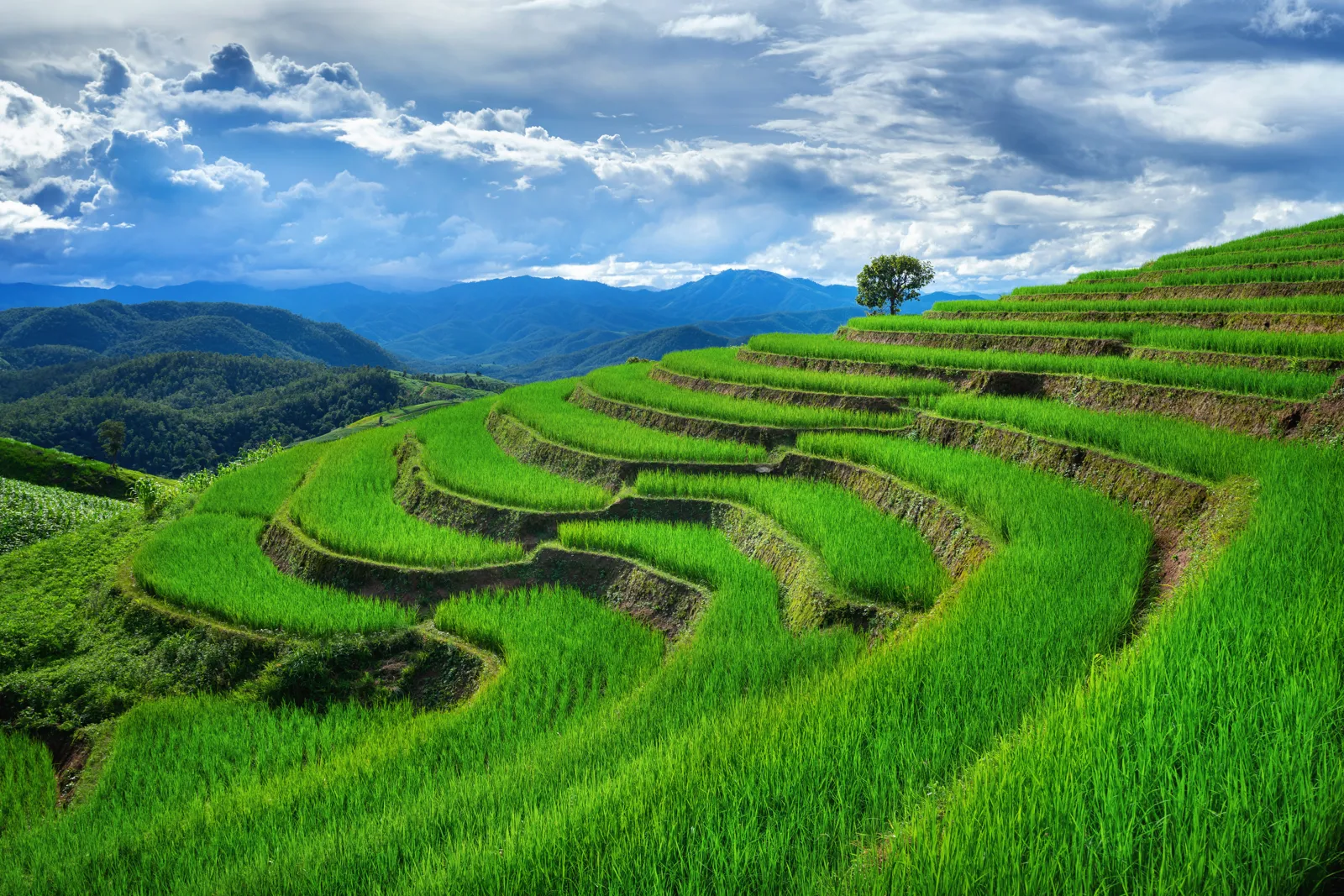
The southwest monsoon brings heavy rain to most of the country. In Bangkok, rainfall exceeds 200 mm (7.9 in) a month from May and peaks in September (336 mm / 13.2 in). The Andaman coast is hit hardest: over 300 mm (11.8 in) a month in Phuket from August to October, often with rough seas. This peak is analysed region by region in our page on Thailand in September.
- Pros: very green landscapes, flooded rice paddies in the north, much lower prices, fewer tourists
- Cons: rough sea and sometimes dangerous swimming on the Andaman side (red flags), some boat trips cancelled, possible flooding in September-October
- Good to know: some marine national parks, such as the Similan Islands, close every year during the monsoon, usually from mid-May to mid-October (check dates with the Department of National Parks)
- Who is it for? Budget travellers, and July-August travellers who can switch to the Gulf
When to go to Thailand by region
The big difference is between the two coasts. The Andaman coast takes the full force of the southwest monsoon from May to October. The Gulf of Thailand, sheltered on that side by the peninsula’s mountain range, gets its heaviest rain from October to December instead, with the northeast monsoon. Comparison of the normals for four cities:
| Month | Bangkok (centre) | Chiang Mai (north) | Phuket (Andaman) | Ko Samui (Gulf) |
|---|---|---|---|---|
| January | 32.7 °C (91 °F) / 24 mm (0.9 in) | 30.0 °C (86 °F) / 11 mm (0.4 in) | 33.0 °C (91 °F) / 50 mm (2.0 in) | 29.0 °C (84 °F) / 127 mm (5.0 in) |
| February | 33.7 °C (93 °F) / 21 mm (0.8 in) | 32.9 °C (91 °F) / 10 mm (0.4 in) | 34.0 °C (93 °F) / 24 mm (0.9 in) | 29.4 °C (85 °F) / 64 mm (2.5 in) |
| March | 34.7 °C (94 °F) / 51 mm (2.0 in) | 35.4 °C (96 °F) / 20 mm (0.8 in) | 34.4 °C (94 °F) / 81 mm (3.2 in) | 30.4 °C (87 °F) / 116 mm (4.6 in) |
| April | 35.7 °C (96 °F) / 93 mm (3.7 in) | 36.7 °C (98 °F) / 54 mm (2.1 in) | 34.2 °C (94 °F) / 135 mm (5.3 in) | 31.8 °C (89 °F) / 83 mm (3.3 in) |
| May | 35.1 °C (95 °F) / 217 mm (8.5 in) | 34.7 °C (94 °F) / 168 mm (6.6 in) | 33.2 °C (92 °F) / 237 mm (9.3 in) | 32.9 °C (91 °F) / 132 mm (5.2 in) |
| June | 34.1 °C (93 °F) / 199 mm (7.8 in) | 33.2 °C (92 °F) / 118 mm (4.6 in) | 32.6 °C (91 °F) / 249 mm (9.8 in) | 32.7 °C (91 °F) / 134 mm (5.3 in) |
| July | 33.5 °C (92 °F) / 190 mm (7.5 in) | 32.1 °C (90 °F) / 149 mm (5.9 in) | 32.3 °C (90 °F) / 240 mm (9.4 in) | 32.3 °C (90 °F) / 117 mm (4.6 in) |
| August | 33.3 °C (92 °F) / 227 mm (8.9 in) | 31.6 °C (89 °F) / 223 mm (8.8 in) | 32.2 °C (90 °F) / 309 mm (12.2 in) | 32.4 °C (90 °F) / 102 mm (4.0 in) |
| September | 33.2 °C (92 °F) / 336 mm (13.2 in) | 32.0 °C (90 °F) / 207 mm (8.1 in) | 31.8 °C (89 °F) / 350 mm (13.8 in) | 31.9 °C (89 °F) / 118 mm (4.6 in) |
| October | 33.3 °C (92 °F) / 289 mm (11.4 in) | 31.7 °C (89 °F) / 124 mm (4.9 in) | 31.8 °C (89 °F) / 336 mm (13.2 in) | 30.6 °C (87 °F) / 295 mm (11.6 in) |
| November | 33.1 °C (92 °F) / 45 mm (1.8 in) | 30.8 °C (87 °F) / 41 mm (1.6 in) | 32.1 °C (90 °F) / 178 mm (7.0 in) | 29.7 °C (85 °F) / 445 mm (17.5 in) |
| December | 32.3 °C (90 °F) / 12 mm (0.5 in) | 29.2 °C (85 °F) / 14 mm (0.6 in) | 32.1 °C (90 °F) / 82 mm (3.2 in) | 29.3 °C (85 °F) / 263 mm (10.4 in) |
Bangkok and central Thailand (Ayutthaya, Kanchanaburi)
Hot all year, with maximums between 32 °C (90 °F) and 36 °C (97 °F). The most comfortable period runs from November to February. March-April is very hot; from May to October, rain falls mostly as thunderstorms. Bangkok can be visited all year if you adjust your schedule. Details in our page on when to go to Bangkok.
The north (Chiang Mai, Chiang Rai, Pai)
The north has the most marked winter in the country: around 30 °C (86 °F) in the afternoon but 16 °C (61 °F) at night in January, and less at altitude. November to January is the best window. Avoid March and April if you can: heat (36.7 °C (98 °F) in April in Chiang Mai) and often severe air pollution from crop burning. The rainy season (May to October) makes the rice paddies beautiful, but some trekking trails become slippery. See also when to go to Chiang Mai.
The Andaman coast (Phuket, Krabi, Ko Lanta, Ko Phi Phi)
The ideal season runs from November to April, with the best weather from December to March (less than 85 mm (3.3 in) of rain per month in Phuket). From May to October, the southwest monsoon brings rough seas and over 230 mm (9.1 in) of rain every month. Some accommodation on Ko Lanta even closes during this period. Month by month: when to go to Phuket. With rough seas and closures in the monsoon, knowing what to do in Krabi in the dry season helps you make the most of the nearby islands.
The Gulf of Thailand (Ko Samui, Ko Phangan, Ko Tao)

This is the key point to remember: the Gulf has an offset rainy season. On Ko Samui, October (295 mm / 11.6 in), November (445 mm / 17.5 in) and December (263 mm / 10.4 in) are by far the wettest months, just as the rest of the country enters the dry season. Conversely, from February to September, rainfall generally stays between 65 mm (2.6 in) and 135 mm (5.3 in) a month. That makes it the ideal beach destination for a July-August trip, when Phuket is under the monsoon. January is a transition month, sometimes still wet.
Region-by-region summary: the right month for the part of the country you are targeting.
| Month | Bangkok and centre | North (Chiang Mai) | Andaman (Phuket, Krabi) | Gulf (Ko Samui) |
|---|---|---|---|---|
| January | ✅ Dry | ✅ Dry, cool nights | ✅ Dry | ⚠️ Transition |
| February | ✅ Dry | ✅ Dry | ✅ Dry | ✅ Good |
| March | ⚠️ Heat | ❌ Heat, polluted air | ✅ Dry | ✅ Good |
| April | ⚠️ Very hot | ❌ Heat, polluted air | ✅ End of dry season | ✅ Good |
| May | ⚠️ Rain | ⚠️ Rain | ⚠️ Monsoon | ✅ Good |
| June | ⚠️ Rain | ⚠️ Rain | ⚠️ Monsoon | ✅ Good |
| July | ⚠️ Rain | ⚠️ Rain | ⚠️ Monsoon | ✅ Good |
| August | ⚠️ Rain | ⚠️ Rain | ❌ Rough sea | ✅ Good |
| September | ❌ Peak rains | ⚠️ Rain | ❌ Rough sea | ✅ Good |
| October | ⚠️ Wet | ⚠️ Rain | ❌ Rough sea | ❌ Rain |
| November | ✅ Dry | ✅ Dry | ⚠️ Transition | ❌ Peak rains |
| December | ✅ Driest | ✅ Dry, cool nights | ✅ Dry | ❌ Rain |
✅ favourable conditions, ⚠️ possible with reservations, ❌ best avoided. Summary based on the normals quoted on this page and the regional advice above.

When to go to Thailand by type of trip
| Your trip | Best time | Where? |
|---|---|---|
| First trip (temples, the north, beaches) | November to February | Bangkok, Chiang Mai, Krabi or Phuket |
| Winter beach break | December to March | Phuket, Krabi, Ko Lanta, Ko Phi Phi |
| Summer beach break (July-August) | February to September | Ko Samui, Ko Phangan, Ko Tao |
| Scuba diving | November to April (Andaman); March to September (Gulf) | Similan Islands, Ko Tao |
| Trekking and hill villages in the north | November to January | Chiang Mai, Chiang Rai, Pai, Mae Hong Son |
| Tight budget | May-June, September-October | Bangkok and the north; the Gulf in May-June |
| Festivals | Mid-April (Songkran), November (Loy Krathong) | Bangkok, Chiang Mai, Sukhothai |
| Family trip | Winter and spring school holidays; July-August in the Gulf | Bangkok, Ko Samui, Krabi |
| Honeymoon | February-March, or July-August on the Gulf side | Ko Samui, Krabi, Ko Lanta |
Major events to plan your trip around
| When | Event | Where |
|---|---|---|
| Late January or February (lunar calendar) | Chinese New Year | Bangkok (Yaowarat), Phuket |
| 13 to 15 April | Songkran, the Thai New Year (water fights, big crowds) | Nationwide, especially Bangkok and Chiang Mai |
| September or October (lunar calendar) | Vegetarian Festival | Phuket |
| Full moon of the 12th lunar month, usually in November | Loy Krathong (floating offerings) | Nationwide, Sukhothai |
| Same time as Loy Krathong | Yi Peng (sky lanterns) | Chiang Mai |
| Every month, around the full moon | Full Moon Party | Ko Phangan (Haad Rin) |
| Late December – early January | Christmas and New Year holidays (peak prices) | Beaches and islands |
Thailand month by month
January: Excellent on the mainland and the Andaman side: dry, 32-33 °C (90-91 °F) in the afternoon, cool nights in the north. In the Gulf, the rains are easing but not yet over.
February: One of the best months everywhere, the Gulf included: dry and sunny. The first smoke from crop burning can appear in the north late in the month.
March: The heat sets in (close to 35 °C (95 °F) in Bangkok and Chiang Mai). Still very good on the Andaman side and in the Gulf. Air quality is often poor in the north.
April: The hottest month, and the month of Songkran in mid-April: a festive atmosphere, but transport and hotels are in high demand. A good month for Ko Samui.
May: The monsoon arrives: rainfall exceeds 200 mm (7.9 in) in Bangkok and Phuket. Prices drop. The Gulf remains the best beach option.
June: Green season on the mainland and the Andaman side, with frequent showers. A good time, with gentle prices, in the Gulf.
July: Rainy in Bangkok, the north and Phuket, but Ko Samui, Ko Phangan and Ko Tao enjoy their favourable season. Busier because of the Northern Hemisphere summer holidays.
August: Same situation as July: head for the Gulf for the beach. In Phuket, over 300 mm (11.8 in) of rain and often rough seas.
September: The wettest month in Bangkok and Phuket, with a risk of flooding. The Gulf stays reasonable. Low prices: best left to flexible travellers.
October: The rains ease on the mainland late in the month, but start heavily in the Gulf. A transition month, often unpredictable.
November: The dry season returns to Bangkok and the north, with Loy Krathong and Yi Peng. The Andaman coast improves, but Ko Samui gets its peak rainfall (445 mm / 17.5 in).
December: The driest month in Bangkok, ideal conditions on the Andaman side. Prices and crowds are very high over the holidays. Still wet in the Gulf.
When to book your trip to Thailand
For the high season, and especially for the Christmas to New Year period, book your flights 4 to 6 months in advance: fares rise quickly and the best-located island accommodation fills up early. The same applies to Songkran in mid-April and to the July-August holidays in the Gulf. In the low season (May-June, September-October), 1 to 2 months is usually enough. Most international flights land at Bangkok Suvarnabhumi (BKK) or Don Mueang (DMK), with Phuket (HKT) and Chiang Mai (CNX) also served internationally. For region-by-region details, see our page on Thailand in July.
Practical tips for your trip to Thailand
- Entry requirements: according to the Tourism Authority of Thailand (TAT Newsroom, 1 September 2026), since 15 September 2026 US and UK citizens can enter visa-free for tourism for up to 30 days per entry; land-border entries under this exemption are generally limited to 2 per calendar year. The UK FCDO (updated 12 October 2026) confirms the 30-day limit and requires a passport valid at least 6 months after arrival. The U.S. Department of State page (last updated August 20, 2026) asks US citizens to register online before arrival and strongly recommends a passport valid at least six months beyond arrival; it still mentions 60 days, but it predates the change. Check with the Royal Thai Embassy in Washington before you travel. The Thailand Digital Arrival Card (TDAC) is mandatory for all foreign nationals and can be completed within the 3 days before arrival. Details in our guide to the Thailand visa exemption.
- Time difference: +7 h from London in UK winter (+6 h in summer); +12 h from New York in US winter (+11 h in summer).
- Currency: the baht (THB). Cards are accepted in hotels and shopping malls, but markets, street food and small transport are paid in cash. ATM withdrawals are usually charged a fee by the local bank. Use our currency converter to estimate your budget.
- Health: dengue is present, especially in the rainy season: protect yourself from mosquitoes. See your doctor or a travel health clinic before you leave to check which vaccinations are recommended for you.
- Sea: in the monsoon season, respect red flags on the beaches, especially in Phuket: currents are dangerous.
To go further, read our complete Thailand travel guide.
Frequently asked questions
What is the best month to visit Thailand?
For a classic circuit (Bangkok, the north and the Andaman beaches), December, January and February are the most favourable months: dry weather, bearable heat and a calm sea. If you want to include Ko Samui or Ko Tao, February is the best compromise.
When is the best time to go to Ko Samui?
February to September. The Gulf of Thailand has an offset rainy season: October, November and December are the wettest months there, with nearly 445 mm (17.5 in) in November according to the official normals.
Can you visit Thailand in July or August?
Yes. It rains in Bangkok, the north and Phuket, but mostly as showers. For the beach, choose the Gulf islands (Ko Samui, Ko Phangan, Ko Tao), which are in their favourable season.
What is the cheapest time to visit Thailand?
May-June and September-October, during the rainy season on the mainland. Flights and accommodation are much cheaper than in December-January.
When should you avoid Thailand?
Avoid September and October if you are heading for Bangkok or Phuket (peak rainfall), October to December for Ko Samui, and March-April for the north (heat and air pollution). The Christmas and New Year holidays are the most expensive period. Our page on Thailand in March details this transition month into the hot season.
Is Thailand hot all year round?
Yes. In Bangkok, average maximums stay between 32 °C (90 °F) and 36 °C (97 °F) all year. Only the north has cool nights from December to February, around 16 °C (61 °F) in Chiang Mai.
What is the wettest month in Thailand?
It depends on the region. In Bangkok, it is September (336 mm (13.2 in) on average), followed by October (289 mm / 11.4 in). On Ko Samui, in the Gulf, it is November, with nearly 445 mm (17.5 in). Conversely, December is the driest month in Bangkok (12 mm / 0.5 in).
What is the weather like in Thailand in November?
November marks the return of the dry season in Bangkok (45 mm (1.8 in) of rain, 33 °C (91 °F) in the afternoon) and the north, with the Loy Krathong and Yi Peng festivals. The Andaman coast improves, but it is peak rainfall on Ko Samui: choose Phuket or Krabi for the beach.
Our sources
- Thai Meteorological Department, via the World Meteorological Organization 1991-2020 climate normals (NOAA archive): Bangkok Metropolis, Chiang Mai, Phuket and Ko Samui stations
- Entry requirements, safety and health checked on 24 October 2026: Tourism Authority of Thailand, TAT Newsroom, 1 September 2026: new 30-day visa exemption rules from 15 September 2026; UK FCDO, GOV.UK foreign travel advice: Thailand (updated 12 October 2026); U.S. Department of State, travel.state.gov: Thailand (last updated August 20, 2026)
- Our methodology
Updated October 2026.
Other destinations: when to go?



Transparency: this page contains affiliate links, labelled as such. If you book through them we may earn a commission at no extra cost to you; it does not influence our content or recommendations. How we fund the site.