Bangkok travel guide, safety first: the city is not in an area the UK or US governments advise against. The UK FCDO advises against all but essential travel to Pattani, Yala, Narathiwat and parts of southern Songkhla (Thailand–Malaysia border) and to areas within 20 km (12 mi) of the Cambodian land border, where land crossings with Cambodia are suspended. In Bangkok, as anywhere, stay away from demonstrations. Check the official advice before any excursion far from the capital.
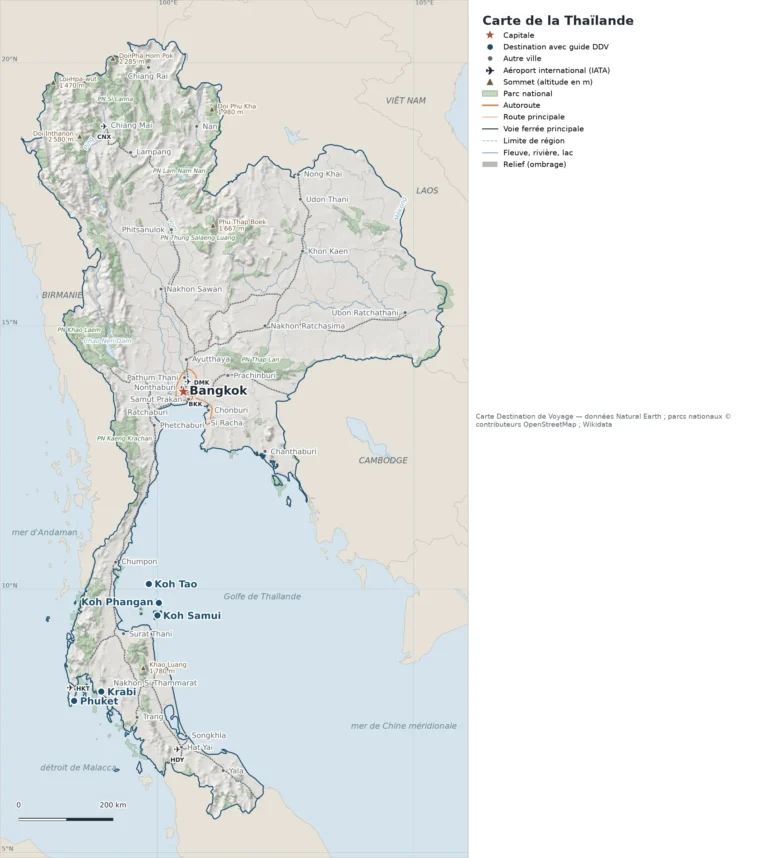
Bangkok is the gateway for most trips to Thailand. Behind the traffic jams and towers, the capital brings together some of the country’s most important temples, a great river busy with boats, markets and a renowned street food scene. What to do in Bangkok? This Bangkok travel guide helps you choose your sights, neighbourhoods and day trips for a stay of 2 to 5 days.
Flights London → Bangkok
“From” fare provided by Kiwi.com (affiliate link), seen in recent searches; it varies with dates.
Our travel deals for Bangkok
Affiliate links: we earn a commission, at no extra cost to you.
Learn the languageTargumiLearn a few words of Thai before you go — 30% off via our link.
AirportsSuvarnabhumi (BKK, international flights, linked to the centre by train) and Don Mueang (DMK, mainly low-cost airlines)
Getting thereBangkok has two airports, Suvarnabhumi (BKK) and Don Mueang (DMK): check which one is on your ticket
Ideal length of stay3 to 4 days, plus a day trip to Ayutthaya
Best time to goNovember to February (dry season)
Time differenceUTC+7, no daylight saving: +7 h from London in UK winter (+6 h in summer), +12 h from New York in US winter (+11 h in summer)
EntryUS and UK: visa-exempt for up to 30 days per entry, tourism only, since 15 September 2026 (Tourism Authority of Thailand); US: online pre-registration (State Department page of August 2026); passport valid 6 months; digital arrival card (TDAC). See tatnews.org, travel.state.gov and GOV.UK
CurrencyThai baht (THB)
Electricity220 V, type A/B/C/O plugs; US flat-pin plugs usually fit (check your device accepts 220 V), UK travellers need an adapter
Indicative budgetroughly ฿1,300–2,300 per person per day on a budget, ฿3,800–7,600 for comfort
Things to do in Bangkok: the highlights
The Grand Palace in Bangkok
The Grand Palace and Wat Phra Kaew
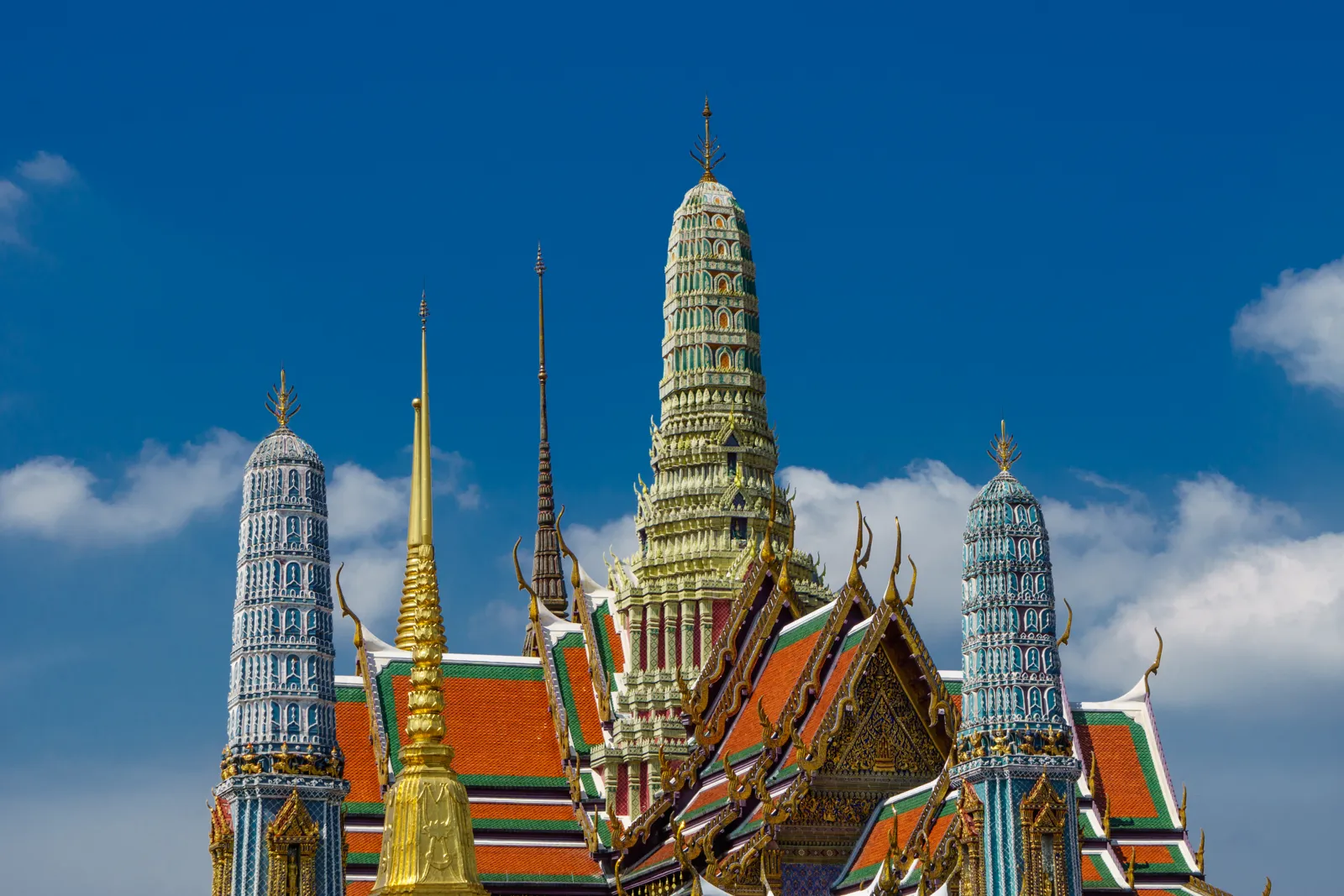
In the heart of Rattanakosin Island, the Grand Palace was the residence of the kings of Thailand. Its grounds house Wat Phra Kaew, the most sacred temple in the country, home to the Emerald Buddha, a small revered jade statue. The buildings covered in gilding, mosaics and ceramics form the most spectacular ensemble in the city. A dress code applies: shoulders and knees covered. Arrive at opening time to avoid the crowds and the heat.
Wat Pho and its reclining Buddha
A few minutes’ walk from the Grand Palace, Wat Pho houses a huge reclining Buddha covered in gold leaf, about 46 m (151 ft) long. One of the oldest temples in Bangkok, it is also a historic centre of traditional Thai massage: you can get a massage on site. Its courtyards, quieter than the palace’s, have many stupas decorated with ceramics.
Wat Arun and the Chao Phraya
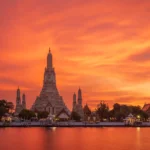
On the other bank of the river, Wat Arun, the Temple of Dawn, is recognisable by its tall central tower covered in porcelain. A cross-river ferry links it to Tha Tien pier, near Wat Pho, in a few minutes. The Chao Phraya River is the city’s historic axis: the express boats that ply it are a practical and cheap way to get around, and the sunset view of Wat Arun is one of the best known in Bangkok.
Chinatown (Yaowarat)
Chinatown stretches around Yaowarat Road. By day, its market lanes sell spices, fabrics and all kinds of goods; in the evening, the main street fills with neon signs and street food stalls. Wat Traimit, at the entrance to the district, houses a solid gold Buddha weighing several tonnes. It is one of the best places to try the city’s street food.
The canals of Thonburi
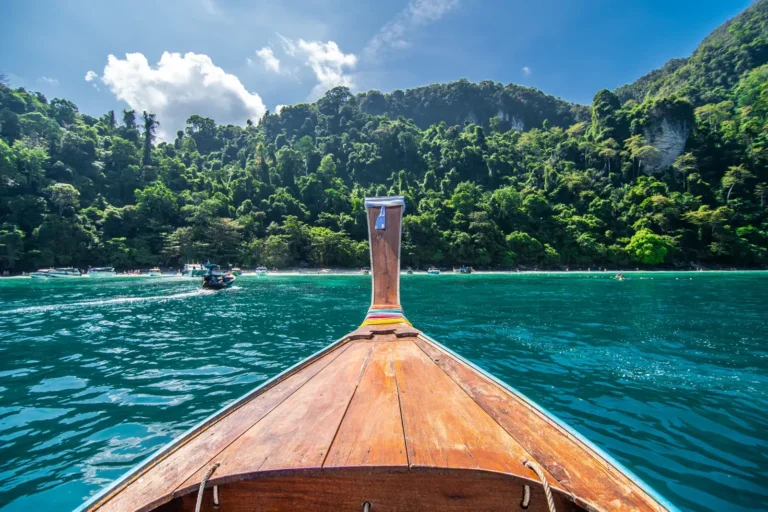
On the west bank of the river, Thonburi has kept its canals (khlongs), lined with stilt houses and small temples. A longtail boat ride lets you discover this older Bangkok. Agree the price and duration before boarding, or go through an established operator at the main piers.
Chatuchak market
Open at weekends, Chatuchak market is one of the largest open-air markets in Southeast Asia: thousands of stalls selling clothes, crafts, ceramics, plants and food. It is served by the Skytrain and the metro. Come in the morning, before the worst of the heat, and keep an eye on your belongings in the crowd.
Siam, Sukhumvit and the Jim Thompson House
The Siam district is home to the big shopping malls, connected by walkways. Nearby, the Jim Thompson House brings together several traditional teak houses and a collection of Asian art, around the story of the American who revived the Thai silk trade. Further east, Sukhumvit Road is lined with hotels, restaurants and bars along the Skytrain. Lumphini Park, in Silom, is the main green space in the centre. About two hours to the southeast, Pattaya and the eastern seaboard offer a quick beach escape from the capital.
The Golden Mount (Wat Saket)
Near the old city, Wat Saket is topped by an artificial hill, Phu Khao Thong, the « Golden Mount ». A spiral staircase leads up to a golden chedi, with views over the old city and the temple roofs. The visit combines easily with Khao San Road and the Banglamphu district.
Muay Thai, massage and rooftops
Bangkok has two major Thai boxing stadiums, Rajadamnern, near the old city, and Lumpinee: watching a fight is a classic night out. Traditional Thai massage is taught at Wat Pho, where you can also have one. In the evening, the bars on top of the towers of Silom, Sathorn and Sukhumvit offer views over the illuminated city; a dress code often applies.
Eating in Bangkok: street food
A good part of the experience happens at the table. Chinatown (Yaowarat) comes alive in the evening with its street stalls; markets and mall food courts let you try pad thai, tom yam soup, chicken rice or mango sticky rice for little money. Choose busy stalls, where ingredients turn over quickly.
Day trips from Bangkok
Ayutthaya, the former capital of the Kingdom of Siam and a UNESCO World Heritage Site, lies about 80 km (50 mi) north: its ruined temples can be visited by bike or tuk-tuk in a day, and you get there by train or minibus. To the west, Kanchanaburi is known for the Bridge on the River Kwai; it is better with an overnight stay. The floating markets (Damnoen Saduak, Amphawa) and the Maeklong railway market are often combined in one day; Damnoen Saduak has become very touristy, while Amphawa comes alive mainly at weekends in the late afternoon.
Bangkok neighbourhoods
Rattanakosin and Banglamphu (Khao San): close to the major temples, cheap accommodation, but no metro; party atmosphere around Khao San Road
Chao Phraya riverside: big hotels with views, access to the express boats
Siam and Ratchathewi: central, well connected, close to the malls and the airport rail line
Sukhumvit: a very wide choice of hotels and restaurants along the Skytrain; lively in the evening
Silom and Sathorn: business district, Lumphini Park, night markets and rooftop bars
Chinatown: authentic atmosphere and street food, on the metro
Itinerary: 2 to 5 days in Bangkok
Day 1: Grand Palace and Wat Phra Kaew at opening time, Wat Pho, ferry to Wat Arun; Chinatown in the evening
Day 2: boat trip on the Thonburi canals, Jim Thompson House, Siam district; dinner in Silom or on a rooftop
Day 3: Chatuchak market (at weekends) or Lumphini Park, then Sukhumvit; traditional massage
Day 4: day trip to Ayutthaya by train or minibus
Day 5: floating markets and Maeklong market, or Kanchanaburi with an overnight stay
With only two days, focus on the major temples, the river and Chinatown. For the rest of your trip, the night train and domestic flights link Bangkok with Chiang Mai, and frequent flights serve Phuket and the islands.
Airport transfer in Bangkok: Airport Rail Link, taxi, bus and private transfer
Most long-haul international flights arrive at Suvarnabhumi (BKK), east of the city. The information below comes from the transport guide published by the airport (Airports of Thailand).
Airport Rail Link
The station is on level B1 of the main terminal. The line runs from 5:30 am to midnight and goes to Phaya Thai, with a connection to the BTS Skytrain. The fare depends on distance and is displayed at the ticket machines; we did not find it on an official page of the operator.
Public metered taxi
Public taxis leave from level 1, between gates 4 and 7, 24 hours a day, with a queue ticket taken from a kiosk. The flag fall is 35 or 40 THB, then the meter runs according to the Department of Land Transport tariff. On top of that come a 50 THB airport surcharge for the driver and expressway tolls, paid by the passenger. Electric VIP taxis (EV Society, CABBY) have a 150 THB flag fall, plus a 100 THB service fee with CABBY.
Bus, Grab and limousines
Bus S1 links the airport with Khao San Road (Sanam Luang) from 6 am to 8 pm, from level 1, gate 7. The airport’s transport page gives a fare of 60 THB for the whole line. Grab, the authorised ride-hailing service, picks up passengers on level 1. The AOT Limousine counters are on level 2.
Option
Where to catch it
Official fare
Source
Airport Rail Link
Level B1
By distance (shown at the ticket machines)
suvarnabhumi.airportthai.co.th
Public taxi
Level 1, gates 4 to 7
35-40 THB + meter + 50 THB + tolls
suvarnabhumi.airportthai.co.th
Electric VIP taxi
Level 1, gates 3, 4 or 7
150 THB + meter
suvarnabhumi.airportthai.co.th
Bus S1
Level 1, gate 7
60 THB
suvarnabhumi.airportthai.co.th
AOT Limousine
Level 2
Fares at the counter
suvarnabhumi.airportthai.co.th
Booking your transfer in Bangkok
A private transfer booked in advance (driver waiting on arrival, price fixed at booking) makes most sense for a late arrival, bulky luggage, a family trip with young children or a group, when the price is shared. Check whether the price includes the 50 THB airport surcharge and tolls. Before booking, check: what the price includes (tolls, luggage, waiting time if the flight is delayed), the exact meeting point in the terminal, the cancellation terms and the name of the company actually providing the ride.
Sources: Suvarnabhumi Airport, « Ways to transport » and « Public Taxi » (suvarnabhumi.airportthai.co.th), checked on 24 October 2026.
Where to stay in Bangkok
The main criterion is being close to a Skytrain (BTS) or metro (MRT) station, or an express boat pier: that is what will save you time in a very congested city. Siam, Sukhumvit and Silom suit a first stay well. The riverside appeals for the views and boat access to the temples. Banglamphu, near Khao San Road, is the cheapest option and the closest to the Grand Palace, but has no metro.
The choice is very wide, from hostels to big international hotels, with good value in the mid-range. Many places have a pool, welcome in the hot season. Read recent reviews, especially for budget accommodation.
Getting around Bangkok
Skytrain (BTS) and metro (MRT): fast, air-conditioned and unaffected by traffic; they serve Siam, Sukhumvit, Silom, Chatuchak and Chinatown.
From Suvarnabhumi: the Airport Rail Link reaches the centre (terminus Phaya Thai, connecting with the BTS). By taxi, the U.S. Department of State advises asking the driver to use the meter or agreeing the fare beforehand.
Boats: the Chao Phraya express boats serve the Rattanakosin temples, Chinatown and the riverside hotels; boats also run on some canals.
Taxis and ride-hailing: plentiful and cheap, but slow at rush hour; ask for the meter or use an app.
Tuk-tuk: handy for short distances; agree the price before setting off and turn down very cheap rides that end up in shops.
On foot: pleasant in the old city and Chinatown in the morning or evening, harder in the middle of the day.
When to go to Bangkok
✓ Ideal~ Good, with caveats✕ AvoidAverage max. temperature · click a month to see where to go
✅ Best months: January, February, November, December
❌ Period to avoid: September, October
The best time is from November to February: this is the dry season, with less than 50 mm (2.0 in) of rain per month and nights around 23 to 25 °C (73 to 77 °F) according to Thai Meteorological Department normals. March to May is very hot (35.7 °C (96 °F) in April), and the rainy season lasts roughly from May to October, peaking in September. Month-by-month weather and events: our article on when to go to Bangkok.
Bangkok: who is it for?
Our verdict by traveller type, based on the information in this guide:
Profile
Our verdict
Why
Culture
✅ Ideal
Grand Palace, Wat Pho, Wat Arun and, as a day trip, the UNESCO-listed temples of Ayutthaya.
Budget travellers
✅ Ideal
Roughly ฿1,300–2,300 a day on a budget; street food, the metro and river boats remain affordable.
Food lovers
✅ Ideal
Chinatown stalls in the evening, markets and food courts to try pad thai, tom yam or mango sticky rice.
Nightlife
✅ Yes
Khao San Road, rooftop bars, Muay Thai fights at Rajadamnern or Lumpinee.
Families
⚠️ Possible
Heat and traffic: visit temples in the morning, alternate with boats and the Siam malls.
Beach and nature
❌ Not ideal
A city first and foremost: continue to Phuket or the islands, served by frequent flights.
Budget for a stay in Bangkok
Bangkok remains affordable for food and transport, even though hotels and restaurants in the business districts approach Western prices. Indicative amounts per person per day, excluding flights:
Item
Budget
Comfort
Accommodation (based on a shared double room)
roughly ฿550–1,150
roughly ฿1,900–4,200
Food
roughly ฿300–550
roughly ฿950–1,900
Getting around town
roughly ฿100–250
roughly ฿300–550
Sightseeing and activities
roughly ฿300–550
roughly ฿750–1,150
Total per day
roughly ฿1,300–2,300
roughly ฿3,800–7,600
Indicative estimates, varying with the season and the baht exchange rate; converted at about 38 THB to the euro (October 2026). Accommodation prices peak from mid-December to early January and around Songkran.
To cut costs: eat at simple eateries and night markets, use the metro and boats rather than taxis at rush hour, and choose May-June or September-October for accommodation.
Entry requirements, health and safety
Entry (US citizens): according to the U.S. Department of State (travel.state.gov, page updated August 20, 2026), pre-arrival online registration is required; a passport valid at least six months beyond arrival is strongly recommended, and you may be asked for an onward or return ticket or proof of funds.
Entry (UK citizens): according to the FCDO (GOV.UK, updated 12 October 2026), from 15 September 2026 visa-exempt entry is up to 30 days, for tourism only; passport valid at least 6 months after arrival with 1 blank page; you may need proof of funds (10,000 THB per person or 20,000 THB per family) and onward travel. Overstaying is fined 500 THB a day, up to 20,000 THB.
30 days for US citizens too: The U.S. State Department page (last updated August 20, 2026) still mentions 60 days, but it predates the change: under the Thai rules in force since 15 September 2026, US citizens are also limited to 30 days (Tourism Authority of Thailand, 1 September 2026). Check with the Royal Thai Embassy in Washington before you travel. For everyone, the Thailand Digital Arrival Card (TDAC) is mandatory and can be completed within the 3 days before arrival.
Health: routine vaccinations up to date; other vaccinations may be recommended depending on your trip. Dengue circulates: protect yourself from mosquitoes. Keep personal medicines in their original packaging with your prescription and check with Thailand Customs and the Thai Food and Drug Administration that they are legal (U.S. Department of State). The UK FCDO warns that medication sold on the street may not be genuine.
Crime: the UK FCDO (GOV.UK, updated 12 October 2026) warns of bag-snatchers, especially on motorbikes, and of drink spiking in tourist areas; the U.S. Department of State reports burglaries and scams involving gems, city tours and entertainment venues.
Demonstrations: stay away from political gatherings.
Roads: according to the UK FCDO (GOV.UK, updated 12 October 2026), Thailand has a high number of road traffic accidents, particularly with motorcycles.
Rain and flooding: in the rainy season, follow Thai Meteorological Department bulletins. Tourist Police number: 1155.
Practical tips for Bangkok
Money: cards are accepted in hotels, malls and mid-range restaurants; keep cash for markets, boats and street food. ATM withdrawals are generally subject to local fees.
Internet: a data SIM or eSIM makes transport apps and maps easier, and avoids your home carrier’s roaming charges. To choose before landing at Suvarnabhumi, read our Thailand eSIM comparison.
Temple dress code: shoulders and knees covered, shoes removed in the sanctuaries.
Respect for the monarchy: the royal family is highly respected and the law severely punishes any offence against it. The royal anthem is played before cinema screenings: everyone stands.
Classic scams: the temple « closed today » announced by a stranger, or the dirt-cheap tuk-tuk, often lead to jewellery or tailor shops.
Heat: drink plenty, protect yourself from the sun and plan outdoor visits in the morning.
Language: Before you leave, you can pick up some basic Thai with Targumi’s online lessons, with 30% off via our link.
Two days let you see the Grand Palace, Wat Pho, Wat Arun and Chinatown. Allow three to four days to add the canals, the markets and a day trip to Ayutthaya.
Which area should I stay in in Bangkok?
Siam, Sukhumvit or Silom for a first stay, near a Skytrain or metro station. Riverside hotels are handy for the temples; Banglamphu, near Khao San Road, is the cheapest.
How do I get from Suvarnabhumi Airport to the city centre?
By the Airport Rail Link to Phaya Thai, connecting with the Skytrain, or by licensed metered taxi. Taxis are slower at rush hour.
Do I need a visa for Bangkok?
Not for a short tourist stay. Since 15 September 2026, US and UK citizens can enter visa-free for tourism for up to 30 days per entry (Tourism Authority of Thailand, 1 September 2026; UK FCDO). The U.S. State Department page (last updated August 20, 2026) still mentions 60 days, but it predates the change. Check with the Royal Thai Embassy before you travel. You need a passport valid for six months and must complete the digital arrival card (TDAC).
Is Bangkok safe?
Yes, broadly: the city is not in any area the UK or US governments advise against. The UK FCDO advises avoiding protests and demonstrations. The main risks for travellers are bag snatching, scams and traffic.
What to do in Bangkok in 3 days?
Day 1: Grand Palace, Wat Pho and Wat Arun, then Chinatown in the evening. Day 2: Chatuchak market (at weekends) or the Jim Thompson House, then Siam and a rooftop at sunset. Day 3: day trip to Ayutthaya or a boat ride on the Thonburi canals. The details are in our itinerary above.
What to do in Bangkok in the evening?
Eat on the streets of Chinatown, go up to a rooftop in Silom or Sukhumvit, watch a Muay Thai fight at Rajadamnern or Lumpinee stadium, or wander around a night market.
Bangkok climate normals: 1991-2020 normals for the Bangkok Metropolis station, Thai Meteorological Department, via the World Meteorological Organization (NOAA archive)
Suvarnabhumi Airport (Airports of Thailand), « Ways to transport » and « Public Taxi » pages, checked on 24 October 2026
Wikipedia (accessed 5 October 2026): Wat Saket and Rajadamnern Stadium articles


 Learn the languageTargumiLearn a few words of Thai before you go — 30% off via our link.See the course