For a trip to Laos, allow 7 to 10 days for the north and center (Luang Prabang, Vang Vieng, Vientiane) and two weeks to continue south to the 4,000 Islands, on a budget of roughly US$35–55 per person per day when traveling cheaply (excluding flights). Laos is the only landlocked country in Southeast Asia. It is explored at the pace of the Mekong, between the temples of Luang Prabang, the mountains of the north, the Plain of Jars and the islands of the south. Less visited than its neighbors, it takes a little more time to get around. This Laos travel guide gathers the essentials for planning your trip. For entry, our page Laos visa compares the official e-visa and the visa on arrival.
To locate cities, regions, terrain, national parks and airports, see our map of Laos.
The best time is from November to February: dry season, clear skies, bearable heat and cool nights in the north. From March to May it is very hot and the air is often hazy because of agricultural burning. The rainy season, from May to October, makes the landscapes very green but complicates journeys in the mountains. All the details, with official climate data, are in our article best time to visit Laos.
Where to go in Laos: the highlights
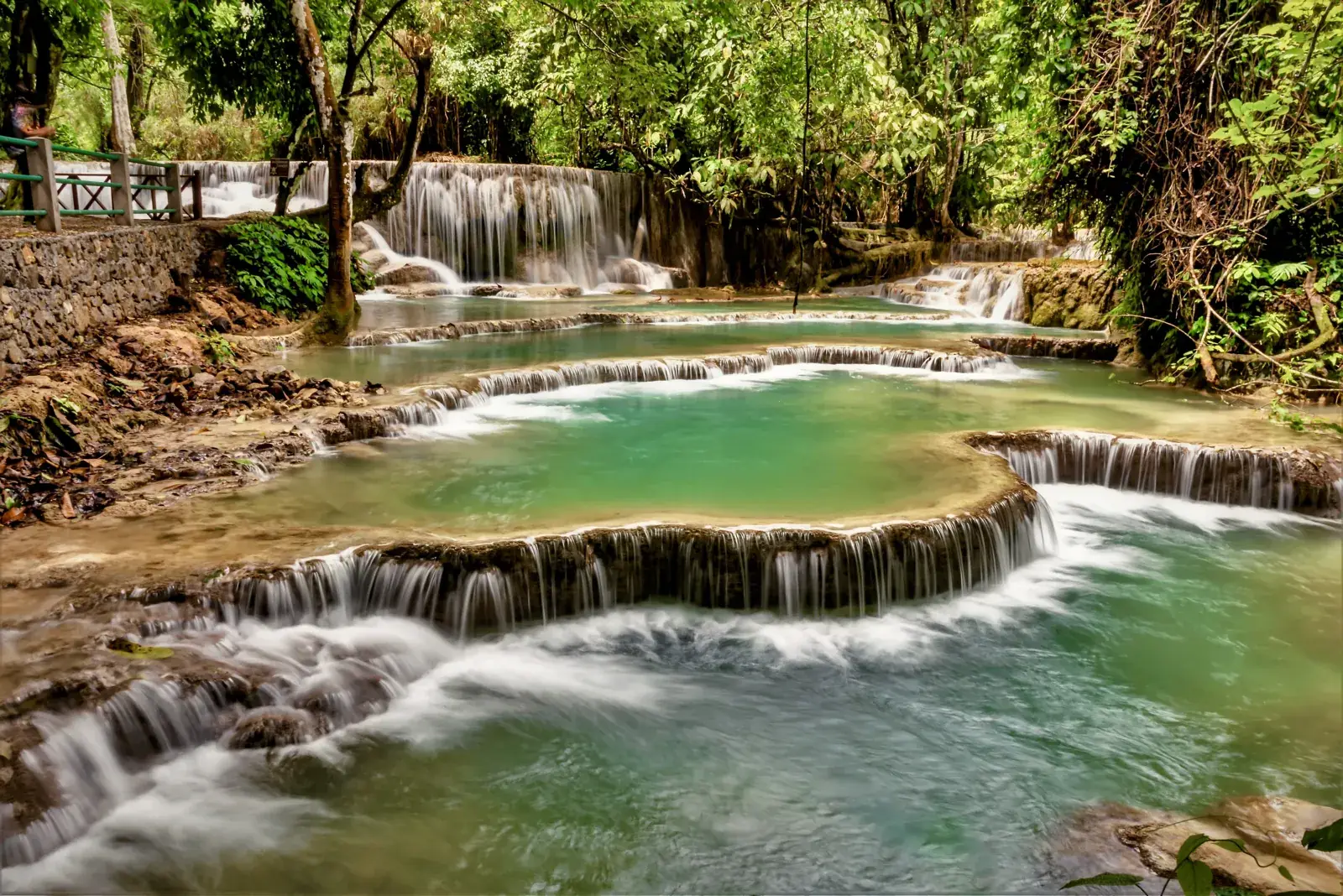
The turquoise Kuang Si waterfalls near Luang Prabang, Laos
Luang Prabang
A former royal capital and UNESCO World Heritage Site, Luang Prabang sits on a peninsula between the Mekong and the Nam Khan. People come for its temples, including Wat Xieng Thong, its colonial houses, the night market and Mount Phousi at sunset. Every morning, monks collect alms (Tak Bat): watch from a distance, without flash and without disturbing the procession. Nearby, the Kuang Si waterfalls and the Pak Ou caves, on the Mekong, make good day trips.
Vientiane
The capital is a small, calm city on the banks of the Mekong. Its main sights can be seen in one or two days: Pha That Luang, the golden stupa that symbolizes the country, Wat Sisaket, Patuxai and the evening walk along the river. The COPE center, dedicated to victims of unexploded ordnance, helps you understand the country’s recent history.
Vang Vieng
Between Vientiane and Luang Prabang, Vang Vieng is surrounded by limestone peaks, caves and rice fields. It is the capital of outdoor activities: kayaking, hiking, climbing, hot-air ballooning. The U.S. Department of State (travel.state.gov, last updated June 18, 2026) warns that rafting, kayaking, tubing and swimming in the Mekong are dangerous and that foreigners have drowned or been seriously injured; the UK FCDO (GOV.UK, updated 13 August 2026) advises using reputable, properly insured operators for adventure sports, including hot-air ballooning, and checking that lifejackets are provided.
Nong Khiaw and Muang Ngoi
North of Luang Prabang, these villages on the Nam Ou are the starting point for hikes to mountain villages and viewpoints over the cliffs. Muang Ngoi can only be reached by boat from Nong Khiaw. Only leave marked trails with a local guide.
The Plain of Jars
Around Phonsavan, on a high plateau, hundreds of ancient stone jars are scattered across several sites, listed as a UNESCO World Heritage Site in 2019. The region was very heavily bombed during the war: stay on the marked paths, between the demining markers.
The Mekong by slow boat
The trip down the Mekong between Huay Xai, on the Thai border, and Luang Prabang usually takes two days, with a night in Pakbeng. It is a simple, slow way to discover the riverbanks, villages and mountains of the north.
Pakse, Champasak and Wat Phou
In the south, Pakse is the base for the Khmer site of Wat Phou, near Champasak, a UNESCO World Heritage Site, and for the Bolaven Plateau, known for its coffee plantations and waterfalls.
Si Phan Don, the « 4,000 Islands »
Near the Cambodian border, the Mekong widens and splits into a multitude of islands and islets. Don Det and Don Khon, linked by an old colonial-era railway bridge, are explored by bike. You can see the Khone Phapheng and Li Phi falls. Life here is very slow: allow two or three nights.
Things to do in Laos: 10 experiences
To sum up what to see in Laos, here are the experiences described above, to choose according to the length of your stay:
Wander among the temples of Luang Prabang and climb Mount Phousi at sunset
Watch the alms-giving ceremony (Tak Bat) from a distance at dawn, without flash
Swim at the Kuang Si waterfalls and visit the Pak Ou caves
Travel down the Mekong by slow boat between Huay Xai and Luang Prabang (two days)
Kayak or hike among the limestone peaks of Vang Vieng, with a reputable operator
Reach Muang Ngoi by boat on the Nam Ou and hike to the villages with a guide
Discover the stone jars around Phonsavan, staying on the marked paths
Learn about recent history at the COPE center in Vientiane
Visit the Khmer site of Wat Phou and the Bolaven Plateau from Pakse
Cycle around Don Det and Don Khon and see the Khone Phapheng falls
Itinerary ideas: how many days in Laos?
7 to 10 days: the north and center
Days 1 and 2: Vientiane (That Luang, COPE center, Mekong riverside)
Days 3 and 4: train to Vang Vieng, caves and river
Days 5 to 8: train to Luang Prabang, temples, Kuang Si, Pak Ou
Days 9 and 10: Nong Khiaw and the Nam Ou, or return via Luang Prabang
2 weeks: from north to south
Days 1 to 4: Luang Prabang and its surroundings
Days 5 and 6: Nong Khiaw or the Plain of Jars
Days 7 and 8: Vang Vieng
Day 9: Vientiane
Days 10 and 11: flight or bus to Pakse, Champasak and Wat Phou
Days 12 to 14: Si Phan Don (Don Det, Don Khon), then cross into Cambodia or return to Pakse
Our verdict by traveler profile, based on the information in this guide:
Profile
Our verdict
Why
Budget travelers
✅ Ideal
Roughly US$35–55 a day when traveling cheaply, although Luang Prabang is more expensive than the rest of the country.
Culture
✅ Ideal
Temples of Luang Prabang, the Khmer site of Wat Phou, the stone jars of Phonsavan, the COPE center in Vientiane.
Nature and adventure
✅ Yes
Kayaking and hiking in Vang Vieng, the Nam Ou to Muang Ngoi, the Mekong slow boat, the 4,000 Islands by bike.
Couples
✅ Yes
A slow pace, sunset from Mount Phousi in Luang Prabang, Don Det and Don Khon.
Families
⚠️ Possible
The Vientiane – Vang Vieng – Luang Prabang train makes journeys easier, but mountain roads are slow and you must stay on marked paths.
Beach
❌ No
A landlocked country: the Kuang Si waterfalls and the Mekong take the place of the sea.
Budget for a trip to Laos
Laos is inexpensive once there, although Luang Prabang is more expensive than the rest of the country. Indicative amounts per person per day, excluding international flights (converted from our euro estimates into US dollars at the ECB rate of 23 October 2026, €1 = US$1.1193, as the kip is not among the ECB reference rates):
Item
Budget
Comfort
Accommodation (based on a shared double room)
roughly US$9–22
roughly US$45–110
Meals
roughly US$9–17
roughly US$22–45
Transport
roughly US$6–11
roughly US$17–28
Activities and sightseeing
roughly US$6–11
roughly US$17–34
Total per day
roughly US$35–55
roughly US$100–200
Indicative estimates, varying with the season and region. The kip has seen high inflation in recent years: local prices change quickly.
Getting around Laos
Train: the Laos-China high-speed line links Vientiane, Vang Vieng and Luang Prabang in a few hours. Buy your tickets in advance in high season, with your passport.
Bus and minibus: they serve the rest of the country, often slowly. The U.S. Department of State (travel.state.gov, last updated June 18, 2026) advises avoiding driving at night: roads are poorly lit, construction sites are badly marked and many vehicles have no working lights. The UK FCDO (GOV.UK, updated 13 August 2026) notes that travel after dark significantly increases the risk of an accident.
Plane: domestic flights link Vientiane, Luang Prabang and Pakse in particular, and save time to reach the south.
Boat: slow boat on the Mekong between Huay Xai and Luang Prabang, boats on the Nam Ou to Muang Ngoi, longtail boats between the islands of Si Phan Don. The U.S. Department of State warns that river speedboats are dangerous, especially when water levels are low.
In town: tuk-tuks and songthaews (agree on the price before getting in), ride-hailing apps in Vientiane, bikes in Luang Prabang and on the islands.
Scooter and car: common, but risky. According to the UK FCDO (GOV.UK, updated 13 August 2026), UK drivers need both the 1949 International Driving Permit (available only in the UK) and their UK licence. Rentals may not supply helmets, and you should never leave your passport as a deposit: rental scams involving « stolen » or damaged bikes are reported by both the UK FCDO and the U.S. Department of State.
Where to stay in Laos
In Luang Prabang, stay on the historic peninsula or just next to it so you can do everything on foot; options range from family guesthouses to boutique hotels in colonial houses. In Vientiane, the center near the Mekong (around Nam Phu) is the most convenient. In Vang Vieng, choose places a little away from the main street, quieter and often facing the limestone peaks. On the 4,000 Islands, Don Det is livelier and Don Khon quieter.
Outside the main towns, comfort remains simple: bungalows, guesthouses, sometimes a homestay during a trek. The UK FCDO (GOV.UK, updated 13 August 2026) notes that hotel and guesthouse safes are not necessarily secure: use your own lock where possible.
Mistakes to avoid on a trip to Laos
Underestimating journey times: away from the Vientiane – Vang Vieng – Luang Prabang railway, mountain roads are slow, especially in the rainy season.
Traveling by road at night: the U.S. Department of State advises against driving at night because of road conditions.
Leaving marked trails without a guide: unexploded ordnance remains in rural areas, including Xieng Khouang province, home of the Plain of Jars (travel.state.gov).
Forgetting the entry stamp or overstaying: you need a valid entry stamp and must be within your authorized stay to leave Laos, otherwise you will be fined and may be arrested (travel.state.gov).
Renting a scooter without the right permit or leaving your passport as a deposit: UK drivers need a 1949 IDP plus their UK licence (GOV.UK).
Counting on cards everywhere: most medical providers accept only cash (travel.state.gov); carry kip, as local prices change quickly with inflation.
Traveling in March–April without knowing it: intense heat and air polluted by burning (see best time to visit Laos).
Entry requirements for Laos, health and safety
US citizens
According to the U.S. Department of State (travel.state.gov, last updated June 18, 2026), your passport must have at least six months’ validity remaining from the date of entry and at least two blank visa pages. Tourist visas are required: visas on arrival are available at certain ports of entry and generally allow a stay of 30 days, and an eVisa (laoevisa.gov.la) can be used at certain ports of entry. The visa can be extended by up to 60 additional days through the Department of Immigration in Vientiane. To leave Laos, you need a valid entry stamp and must be within your authorized stay; otherwise you will be fined and may be arrested.
UK citizens
According to the UK FCDO (GOV.UK foreign travel advice, updated 13 August 2026), you must have a visa. Since 1 January 2025, tourist visas are valid for 30 days from arrival. You can apply online for a single-entry e-visa at least 5 days in advance (accepted at major entry points), or get a single-entry visa on arrival at many entry points, including Vientiane, Luang Prabang and Pakse airports. The visa can be extended twice in Laos, for a total of 60 additional days; failing to extend within 90 days means a fine worth US$2,000, deportation and a ban on returning. Your passport must be valid for at least 6 months after arrival with at least 2 blank pages. All foreign nationals must complete the digital Lao Digital Immigration Form (LDIF) within 3 days before arrival and before departure (at Wattay, Luang Prabang and Pakse airports and Friendship Bridge I).
Health: according to the UK FCDO (GOV.UK, updated 13 August 2026), dengue and malaria are endemic, with more dengue cases in the rainy season; anthrax has been found in cattle and buffalo near the 4,000 Islands, Pakse and the Bolaven Plateau; regional air pollution can be a problem. Check vaccine recommendations with a travel health clinic before you go. Medical care is basic outside the capital: the U.S. Department of State (travel.state.gov, last updated June 18, 2026) notes that serious cases frequently require medical evacuation to private hospitals in Thailand, and strongly recommends insurance covering evacuation.
Safety: the UK FCDO advises against all but essential travel to Xaisomboun Province, and the U.S. Department of State recommends reconsidering travel there. Both advise caution near the border with Myanmar (Burma), where drug traffickers and armed groups operate (UK FCDO: Bokeo Province and the Golden Triangle area). Unexploded ordnance is a hazard throughout Laos: keep to main routes in rural areas and never pick up metal objects. Bag snatching by people on motorcycles is regularly reported (GOV.UK; travel.state.gov).
Drugs: possession, trafficking and manufacture of drugs, including cannabis, are serious offences punished by long prison sentences or the death penalty (GOV.UK; travel.state.gov). « Happy » pizzas or shakes may contain opiates or unknown substances (travel.state.gov).
Other local laws: e-cigarettes (vapes), heated tobacco and shisha are illegal (GOV.UK). Methanol poisoning from alcoholic drinks has caused deaths (GOV.UK).
Entry requirements checked on 24 October 2026; they change often, so check them again before you travel.
Practical tips for Laos
Money: the kip is hard to exchange outside the country: change money as you go. There are ATMs in the towns, but not always in rural areas or on the islands; petty crime occurs around ATMs, so do not carry cards and cash in the same bag (GOV.UK). Keep some cash. Our currency converter helps you estimate your spending.
Internet: the mobile network covers towns and main roads, more patchily in the mountains. A local SIM card or an eSIM is useful for maps and apps.
In temples: shoulders and knees covered, for men and women (GOV.UK), shoes removed. Women should not touch a monk.
Monks’ alms round in Luang Prabang: stay at a distance, in silence, without flash. Only take part if you respect the ritual, and do not buy the poor-quality offerings sold to tourists on the spot.
Etiquette: do not touch a person’s head, do not point your feet at someone or at a Buddha, avoid raising your voice.
Police checks: police may stop your vehicle at any time, especially in the evening, and ask for ID (GOV.UK): keep your documents with you.
Food: Lao cuisine is based on sticky rice, laap (a salad of minced meat or fish with herbs) and papaya salad. Baguettes inherited from the colonial period are common at breakfast. Drink bottled water.
Yes. US and UK citizens need a tourist visa: an e-visa applied for online or a visa on arrival at many entry points, generally for 30 days and extendable in Laos by up to 60 days. Your passport must be valid at least six months beyond your arrival, with two blank pages (travel.state.gov, last updated June 18, 2026; GOV.UK, updated 13 August 2026). Checked on 24 October 2026; check the latest rules before you leave.
How many days do you need in Laos?
About ten days lets you see Vientiane, Vang Vieng and Luang Prabang thanks to the train. With two weeks, you can add the north (Nong Khiaw) or the Plain of Jars, and head south to the 4,000 Islands.
How much does a trip to Laos cost?
Excluding international flights, allow roughly US$35–55 per person per day when traveling cheaply and US$100–200 in comfort. Luang Prabang is the most expensive town.
Is Laos safe to visit?
Yes, with vigilance. The main risks are road accidents, poorly supervised adventure and water activities (especially in Vang Vieng), bag snatching and unexploded ordnance in rural areas. The UK FCDO advises against all but essential travel to Xaisomboun Province, and both the UK and US advise caution near the border with Myanmar (GOV.UK, updated 13 August 2026; travel.state.gov, last updated June 18, 2026).
How do you get to Laos?
The main international airports are Vientiane Wattay, Luang Prabang and Pakse; you can also enter overland from Thailand via the Friendship Bridge near Vientiane, which closes from 10 p.m. to 6 a.m. (travel.state.gov, last updated June 18, 2026). Check current routes with the airlines.
What budget for 15 days in Laos?
Excluding international flights, allow roughly US$500–840 per person for 15 days on a budget (US$35–55 a day), and roughly US$1,500–3,000 in comfort (US$100–200 a day). Luang Prabang is more expensive than the rest of the country.
Can you combine Laos and Cambodia?
Yes. The 4,000 Islands (Si Phan Don), in the far south of Laos, are close to the Cambodian border: a two-week itinerary can end by crossing into Cambodia. Land border crossings close at night (travel.state.gov): check the Cambodian entry rules for your nationality in advance.
Our sources
Climate normals: World Meteorological Organization 1991–2020 climate normals (NOAA archive) for Vientiane, Luang Prabang and Pakse
Entry, health, safety and driving information read on 24 October 2026: U.S. Department of State, Laos country information (travel.state.gov, last updated June 18, 2026), and UK FCDO, foreign travel advice for Laos (GOV.UK, updated 13 August 2026)
European Central Bank: euro reference rates of 23 October 2026 (budget conversions)
Transparency: this page contains affiliate links, labelled as such. If you book through them we may earn a commission at no extra cost to you; it does not influence our content or recommendations. How we fund the site.