Cambodia draws visitors first for the temples of Angkor, one of the largest archaeological sites in Asia. But the country also has a lively capital on the Mekong, countryside of rice paddies and sugar palms, and a still-quiet coastline around Kampot, Kep and the islands. This Cambodia travel guide covers what to see and do, itineraries from 10 days to 2 weeks, budget, transport and entry requirements to plan your trip.
To locate cities, regions, terrain, national parks and airports, see our map of Cambodia.
⚠️ Safety: the Thai border area. According to the UK FCDO (GOV.UK, updated 19 March 2026), the FCDO advises against all but essential travel to within 20 km (12 mi) of the land border with Thailand. Heavy fighting took place along parts of the border in 2025; a ceasefire was signed on 27 December 2025, but the situation remains tense. Land borders and crossings between Cambodia and Thailand remain suspended, some border temples such as Preah Vihear are closed, and there is unexploded ordnance, including landmines, in the border area. Phnom Penh, Siem Reap and the Angkor temples, Kampot, Kep and the Sihanoukville coast lie away from this zone. Check the latest advice for each stop before you leave.
Cambodia at a glance
CapitalPhnom Penh
LanguageKhmerEnglish is common in tourism; some older people speak French
Currencythe riel (KHR); the US dollar is widely used · currencies
Time zoneUTC+7, no daylight saving · details7 h ahead of London and 12 h ahead of New York in winter
AirportsPhnom Penh (Techo International) and Siem ReapNo nonstop flights from the US or UK: connect via a regional hub
EntryUS and UK: visa required (e-visa or visa on arrival), e-Arrival card for air arrivals · travel.state.gov · GOV.UK
Electricitycheck plug types and voltage before you travel · plugs
The best period is November to February: the start of the dry season, with very little rain in Siem Reap in December–January and temperatures still bearable for the temples. From March to May the heat becomes intense (about 35 °C / 95 °F), then the rainy season sets in from May–June to October, peaking in September. On the coast, around Sihanoukville and the islands, the monsoon is especially marked from June to September. All the details, month by month and with official normals, are in our article best time to visit Cambodia.
Things to do in Cambodia: the highlights
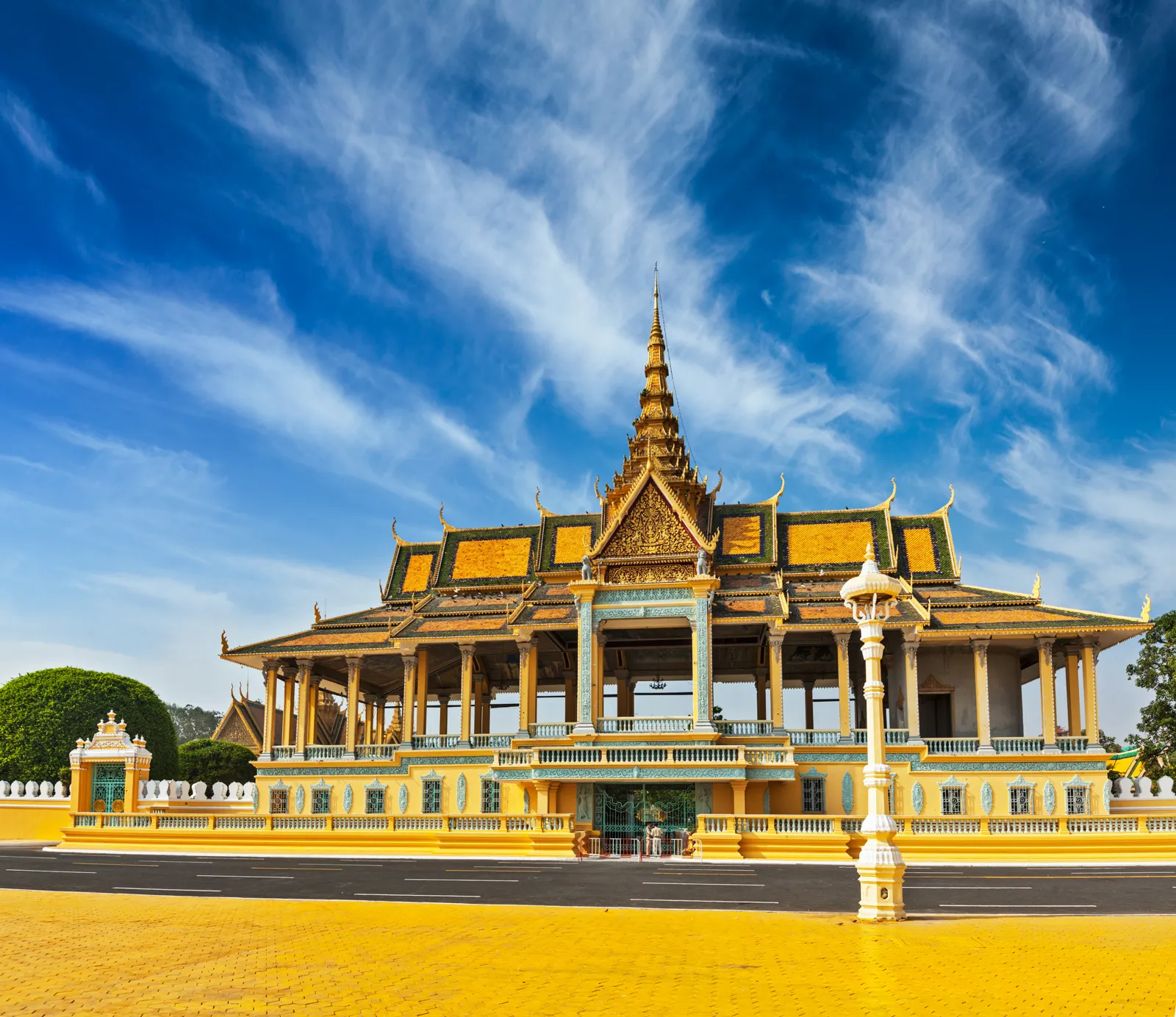
The Royal Palace in Phnom Penh, Cambodia
Siem Reap and the temples of Angkor
The Angkor Archaeological Park, a UNESCO World Heritage Site, brings together dozens of Khmer temples built between the 9th and 13th centuries: Angkor Wat, the walled city of Angkor Thom and the carved faces of the Bayon, Ta Prohm overrun by the roots of silk-cotton trees, and Banteay Srei with its pink sandstone carvings. Allow at least two to three days. Entry is with an Angkor Pass (1, 3 or 7 days), sold by Angkor Enterprise, the public body that runs ticketing: check prices on its official website. Neighboring Siem Reap has hotels, restaurants and night markets.
Phnom Penh
The capital, at the confluence of the Mekong and Tonle Sap rivers, can be explored in two or three days: the Royal Palace and Silver Pagoda, the National Museum, the Art Deco Central Market and the riverfront, lively in the late afternoon. To understand the country’s recent history, the Tuol Sleng Genocide Museum (former S-21 prison) and the Choeung Ek memorial are powerful visits, to be approached with respect.
Battambang
Cambodia’s second city has kept many colonial-era facades and a relaxed atmosphere. Visitors come for the surrounding countryside, explored by bike or tuk-tuk, the small bamboo train, Phnom Sampeau and its bats streaming out at dusk, and the local arts scene, including the Phare Ponleu Selpak circus.
Kampot and Kep
On the south coast, Kampot is a small riverside town known for its pepper, grown on nearby plantations. Bokor National Park and its former hill station are close by. Half an hour away by road, Kep is known for its crab market and seafood, and is the departure point for Rabbit Island (Koh Tonsay).
Koh Rong and Koh Rong Samloem
These two islands, reached by boat from Sihanoukville, offer white-sand beaches and simple bungalows. Koh Rong is livelier, Koh Rong Samloem quieter. They are best visited from December to March: from June to September, the monsoon often makes the sea rough. Sihanoukville itself, heavily built up, is mainly a transit point. For beaches, Kep has a calmer coast with much less rain during the monsoon (see best time to visit Cambodia).
Tonle Sap Lake
Southeast Asia’s largest lake changes size with the seasons: it fills during the monsoon and shrinks in the dry season. From Siem Reap, boat trips go to floating and stilt villages such as Kampong Phluk. Check the operator and what is included in the price before booking.
Kratie and the northeast
In Kratie, on the Mekong, boat trips let you see the rare Irrawaddy dolphins. Further east, the provinces of Mondulkiri and Ratanakiri offer wooded hills, waterfalls and villages of ethnic minorities. These regions are best visited in the dry season, when dirt roads are passable.
Sambor Prei Kuk and off-the-beaten-track temples
Between Phnom Penh and Siem Reap, Sambor Prei Kuk, a UNESCO World Heritage Site, preserves pre-Angkorian brick temples in the forest. From Siem Reap, Beng Mealea, a partly collapsed temple overgrown by vegetation, makes a fine day trip.
Itinerary ideas for Cambodia (10 days, 2 weeks)
7 to 10 days: the essentials
Days 1 to 3: Phnom Penh (Royal Palace, National Museum, Tuol Sleng, Choeung Ek)
Days 4 and 5: Kampot and Kep (pepper plantations, Bokor, crab market)
Day 6: back to Phnom Penh, then bus or flight to Siem Reap
Days 7 to 10: Siem Reap, the Angkor temples, Banteay Srei, Tonle Sap
2 weeks: temples, countryside and islands
Days 1 to 3: Phnom Penh
Days 4 and 5: Kratie (Irrawaddy dolphins), or Sambor Prei Kuk on the way north
Days 6 to 9: Siem Reap and the Angkor temples, Beng Mealea
Days 10 and 11: Battambang
Days 12 to 14: Kampot and Kep, or Koh Rong Samloem from December to March
To continue into southern Vietnam, the U.S. Department of State (travel.state.gov, last updated June 4, 2026) notes that visas are available at all major border crossings. Land crossings with Thailand, however, remain suspended (GOV.UK): to combine with Bangkok, plan a flight. See also our guides to Vietnam and Thailand.
Budget for a trip to Cambodia
Cambodia remains affordable once you are there, although Siem Reap in high season and the islands cost more than the rest of the country. Most tourist prices are quoted in US dollars. Indicative amounts per person per day, excluding international flights and the Angkor Pass (converted from our euro estimates at the ECB rate of 23 October 2026, roughly €1 = US$1.12):
Item
Budget
Comfort
Accommodation (based on a shared double room)
roughly US$9–22
roughly US$45–110
Meals
roughly US$9–17 (markets, small restaurants)
roughly US$22–45
Local transport
roughly US$6–11 (tuk-tuk, bus)
roughly US$17–28 (driver, domestic flights)
Activities and sightseeing
roughly US$6–11
roughly US$17–34
Total per day
roughly US$35–55
roughly US$100–200
Indicative estimates, varying by season and region. The Angkor Pass is extra for visiting the temples: prices on the official Angkor Enterprise website.
Also budget for the visa and, in Siem Reap, for a tuk-tuk or a driver by the day to get around the temples. Official e-visa fees are listed in our guide to the Cambodia visa.
Who is Cambodia for?
Our verdicts by traveler profile, based on the places, conditions and budget ranges in this guide:
Culture and history: ideal: the Angkor temples, Sambor Prei Kuk and Beng Mealea, the Royal Palace and National Museum in Phnom Penh, Tuol Sleng and the Choeung Ek memorial.
Budget travelers: a very good fit: roughly US$35–55 a day in guesthouses, eating at markets and traveling by bus or tuk-tuk. Add the visa and the Angkor Pass.
Nature: a good choice: Irrawaddy dolphins in Kratie, the floating villages of Tonle Sap, Bokor park, the hills of Mondulkiri and Ratanakiri in the dry season.
Beaches: as an add-on: Koh Rong and Koh Rong Samloem from December to March, Kep calmer and drier during the monsoon.
Couples: yes: boutique hotels in Siem Reap, the riverside in Kampot, bungalows on Koh Rong Samloem.
Families: possible: temples visited early in the morning, the Battambang bamboo train, a boat on Tonle Sap. Tuol Sleng and Choeung Ek are for teenagers and prepared adults.
Getting around Cambodia
Buses and minibuses: the most common way between Phnom Penh, Siem Reap, Battambang, Kampot and Sihanoukville. The U.S. Department of State (travel.state.gov, last updated June 4, 2026) advises caution on intercity buses, as bus accidents are frequent, and recommends traveling in daylight, between 6:30 a.m. and 5:30 p.m.; air-conditioned bus companies are generally more comfortable than minibuses.
Plane: domestic flights link Phnom Penh and Siem Reap. Phnom Penh is served by the new Techo International Airport, south of the city: allow time for the transfer.
Train: a line links Phnom Penh with Kampot and Sihanoukville, with few departures; check times locally.
Boat: essential for Koh Rong and Koh Rong Samloem from Sihanoukville. According to GOV.UK, accidents have happened on overloaded or poorly maintained boats, and tourist boats sometimes operate despite weather warnings.
In town: tuk-tuks (a trailer pulled by a motorbike; agree on the price first) and ride-hailing apps, widely used in Phnom Penh and Siem Reap, which show the fare in advance. Keep bags out of sight: tuk-tuk passengers are targeted by snatch thieves (travel.state.gov).
Two-wheelers and driving: according to the UK FCDO (GOV.UK, updated 19 March 2026), Cambodia has one of the highest rates of road accidents in Southeast Asia, police can fine you on the spot for riding without a helmet, and you should never hand over your passport as a guarantee for a rental. To hire a car or a motorcycle over 125cc you may need the 1949 International Driving Permit plus your UK licence, obtained in the UK before you travel. The U.S. Department of State advises against using moto-taxis and against driving at night outside cities. Check that your insurance covers you before renting a scooter.
Where to stay in Cambodia
In Phnom Penh, the riverside and the area around the Royal Palace are convenient for sightseeing on foot, while the BKK1 district has quieter hotels and restaurants. In Siem Reap, stay near the center and the Old Market for nightlife, or a little further out along the river for more calm: you will reach the temples by tuk-tuk anyway. In Kampot, riverside guesthouses are popular; on the islands, options range from simple bungalows to small beach hotels.
There are hostels, family-run guesthouses, boutique hotels and upscale properties, especially in Siem Reap. Book ahead for December–January and the February holiday period.
Entry requirements for Cambodia
US citizens
According to the U.S. Department of State (travel.state.gov, last updated June 4, 2026), you need a valid passport and a Cambodian visa. Tourist visas are valid for one month from the date of entry.
You can apply online, at the Cambodian Embassy in Washington, DC, or obtain a visa on arrival at Phnom Penh and Siem Reap airports and at all major border crossings. Your passport must be valid for at least six months beyond your date of entry. Fingerprints are collected electronically on arrival.
Overstays are usually fined US$10 per day; excessive overstays can lead to arrest and deportation at your own expense.
UK citizens
According to the UK FCDO (GOV.UK foreign travel advice, updated 19 March 2026), you need a visa; tourist visas are valid for 30 days from entry. Apply for an e-visa at least 4 days in advance (also via the official e-visa app), or get a visa on arrival at airports or land crossings, with a photo and payment in US dollars. A tourist visa can be extended in Cambodia.
Your passport must be valid for at least 6 months from your arrival date, and undamaged and complete: entry is normally refused with a damaged passport or missing pages.
If you arrive by air at Phnom Penh, Siem Reap or Sihanoukville, you must submit the free electronic e-Arrival Card within 7 days before arrival (in place since 1 September 2024). Keep your departure form.
Overstaying can lead to fines with no upper limit, detention and deportation. A yellow fever certificate is required if you come from a country with a risk of transmission.
GOV.UK warns that officials and tour operators can ask for unofficial fees or inflate visa prices at land borders: know the correct fees before you travel. Entry requirements checked on 24 October 2026; check them again before you travel.
Health and safety
Health: according to the UK FCDO (GOV.UK, updated 19 March 2026), check vaccine recommendations at least 8 weeks before your trip (TravelHealthPro); health risks include malaria and dengue, Zika, schistosomiasis and biting insects. The U.S. Department of State (travel.state.gov, last updated June 4, 2026) lists malaria, dengue and tuberculosis as serious concerns and warns that medicines sold in pharmacies can be fake. Protect yourself against mosquitoes and see a doctor before you leave.
Crime: most thefts are bag and phone snatchings by thieves on motorbikes, with hotspots on the Phnom Penh riverfront and BKK, and in Sihanoukville and the nearby islands (GOV.UK). The U.S. Department of State rates the crime rate as critical and reports drugged drinks in bars; GOV.UK also reports deaths from methanol in alcoholic drinks.
Scams: be wary of online offers of « easy jobs with high pay »: organized crime groups traffic victims to compounds around Sihanoukville, border areas and Kandal (GOV.UK). Watch for fake dollar bills given as change or from ATMs (GOV.UK, travel.state.gov).
Landmines: Cambodia remains heavily affected by landmines and unexploded ordnance; do not stray off main routes in rural areas, including around temple complexes (GOV.UK).
Emergency numbers: police 117, fire 118, ambulance 119 (GOV.UK). In Siem Reap, the tourist police office is next to the Angkor ticket booth.
Insurance: the U.S. Department of State strongly recommends insurance covering medical evacuation; most providers only accept cash.
Practical tips for Cambodia
Money: according to the U.S. Department of State (travel.state.gov, last updated June 4, 2026), the US dollar is widely used and most prices are quoted in dollars; the riel is mostly given as change and is common in smaller towns. Ripped, torn or stained dollar bills are not accepted. Credit cards are accepted in some places, often with a surcharge. Estimate your spending with our currency converter.
Internet: according to GOV.UK, Wi-Fi and mobile networks are good in the main cities and towns, but many islands and remote areas are poorly covered. A local SIM card or an eSIM is useful for ride-hailing apps.
Temples: you may be refused entry to religious sites, including Angkor Wat, in skirts or shorts above the knee; cover your shoulders (GOV.UK). Remove your shoes in active pagodas.
Etiquette: do not touch anyone’s head, do not point your feet at a person or a Buddha statue, and avoid raising your voice. Women should not touch a monk. Ask permission before photographing people, especially monks (GOV.UK).
Laws: criticizing or insulting the King, including online, can bring one to five years in prison (travel.state.gov). Never photograph military sites, government buildings, airfields or bridges.
Remembrance sites: at sites linked to the Khmer Rouge (Tuol Sleng, Choeung Ek), dress and behave soberly.
Tipping: not compulsory, but appreciated by guides, drivers and in restaurants.
Mistakes to avoid on a trip to Cambodia
Planning to cross overland from Thailand: land crossings are suspended (GOV.UK); take a flight.
Going near the Thai border: the UK FCDO advises against all but essential travel within 20 km (12 mi) of the border, where temples such as Preah Vihear are closed.
Forgetting the e-Arrival Card: it is required for all air arrivals at Phnom Penh, Siem Reap and Sihanoukville (GOV.UK).
Bringing damaged dollars: torn or stained bills are not accepted.
Visiting Angkor in the afternoon from March to May: the heat reaches about 35 °C (95 °F); visit early in the morning and late in the day.
Planning the islands from June to September: the monsoon makes the sea rough and some crossings are canceled.
Entering a temple with bare shoulders or knees: covering clothes are expected, especially for the upper levels of Angkor Wat.
Yes. US and UK citizens need a visa: an e-visa applied for online, or a visa on arrival at Phnom Penh and Siem Reap airports and major border crossings (travel.state.gov, GOV.UK). Your passport must be valid for at least 6 months from entry, and air arrivals must complete the e-Arrival Card. Checked on 24 October 2026; check the latest rules before you leave.
How many days do you need in Cambodia?
About ten days lets you see Phnom Penh, the Angkor temples and the Kampot and Kep coast. Two weeks leaves time to add Battambang, Kratie or an island.
How much does a trip to Cambodia cost?
Excluding international flights, allow roughly US$35–55 per person per day on a budget and US$100–200 in comfort. Add the visa and the Angkor Pass, whose prices are published on the official websites.
Is Cambodia safe?
The main tourist areas remain accessible, with caution against snatch theft and scams. The UK FCDO advises against all but essential travel within 20 km of the Thai border, and road accidents are frequent. Check the latest advice before you leave.
Can you travel overland from Thailand to Cambodia?
Not at the moment: according to the UK FCDO (GOV.UK, updated 19 March 2026), land crossings between Cambodia and Thailand remain suspended. Fly between Bangkok and Phnom Penh or Siem Reap instead.
What budget do you need for 10 days in Cambodia?
On the ground, allow roughly US$350–550 per person for 10 days on a budget, and roughly US$1,000–2,000 in comfort, based on our daily ranges. Add the international flight, the visa and the Angkor Pass.
What should you do in Cambodia on a first trip?
For a first visit, combine the Angkor temples from Siem Reap (two to three days), Phnom Penh and its history museums, then the Kampot and Kep coast. With two weeks, add Battambang, Kratie for the Irrawaddy dolphins, or an island such as Koh Rong Samloem from December to March.
Transparency: this page contains affiliate links, labelled as such. If you book through them we may earn a commission at no extra cost to you; it does not influence our content or recommendations. How we fund the site.