Berlin and its history, the castles of Bavaria, the Rhine Valley and its vineyards, the Hanseatic towns of the north, the Black Forest and the Christmas markets: Germany is easy to explore by train or car, and suits a long weekend as well as a two-week tour. This Germany travel guide tells you what to see and do, which itinerary to follow, what budget to plan and how to get around. For Cold War remains, our page where to see the Berlin Wall suggests a route from Bernauer Straße to the East Side Gallery.
To locate the towns, regions, relief, national parks and airports, see our map of Germany.
Germany at a glance
CapitalBerlin
LanguageGermanEnglish is common in cities and at tourist sites
EntryUS and UK: no visa for up to 90 days in 180 (Schengen); EU Entry/Exit System (EES) at the border · travel.state.gov · GOV.UK
Electricitycheck voltage and plug type before you travel · plugs
Budgetroughly €60–90 per person per day on a budget, €150–230 for comfort · details
When to go to Germany
The best time is from May to September. June, July and August are the warmest months (23 to 25 °C / 73 to 77 °F in the afternoon in Berlin and Munich), but also the busiest and, in Bavaria, the stormiest. May, June and September offer the best balance. From late November to Christmas, the Christmas markets make up for the cold and short days. All the details, month by month and region by region, are in our article on when to go to Germany.
Things to do in Germany by interest
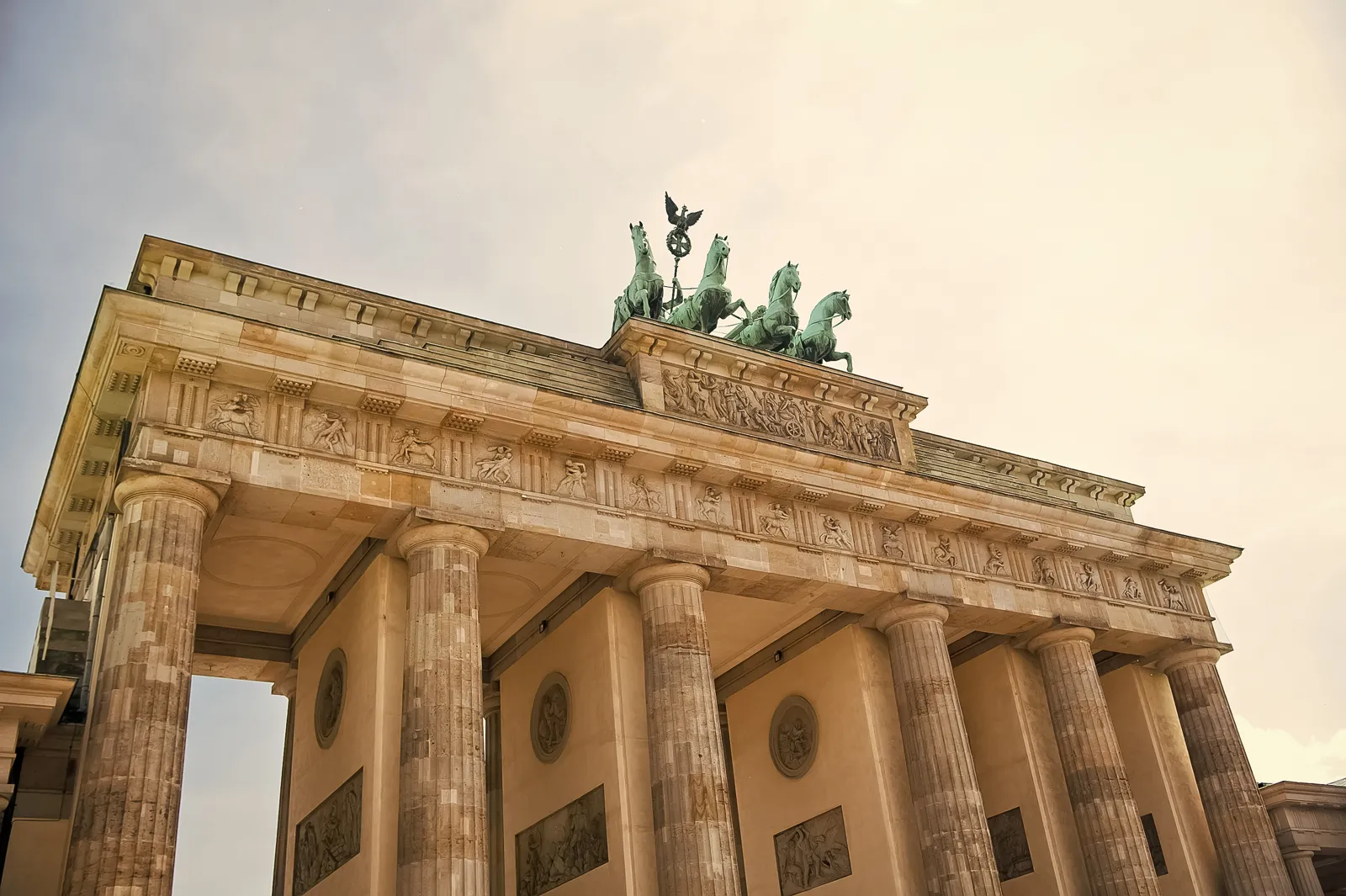
The Brandenburg Gate in Berlin
What you want
Where to go
Suggested time
History and museums
Berlin, Potsdam, Dresden, Leipzig, Nuremberg
3 to 5 days in Berlin
Castles and villages
Neuschwanstein, the Romantic Road (Rothenburg ob der Tauber), Heidelberg
3 to 4 days
Wine and river landscapes
Middle Rhine Valley, Moselle, Cologne
2 to 3 days
Mountains and lakes
Bavarian Alps, Black Forest, Lake Constance
3 to 5 days
Northern cities
Hamburg, Lübeck
2 to 3 days
Christmas markets
Nuremberg, Dresden, Munich, Cologne (late November to December)
The capital is best discovered through its 20th-century history. The Brandenburg Gate, the Reichstag and its glass dome (free visit with advance booking), the Memorial to the Murdered Jews of Europe and Checkpoint Charlie are all within walking distance. Remains of the Wall can be seen at the East Side Gallery, a long open-air mural, and at the Bernauer Strasse memorial. Museum Island, a UNESCO World Heritage Site, brings together five major museums, including the Neues Museum and its bust of Nefertiti. The Kreuzberg, Prenzlauer Berg and Friedrichshain districts show another side of the city. About an hour away, Potsdam and the Sanssouci palace park deserve a day.
Munich
The capital of Bavaria, Munich combines heritage and a relaxed way of life. Marienplatz and its New Town Hall, the Frauenkirche, the Residenz of the former Bavarian rulers and Nymphenburg Palace are the classics. The English Garden, one of the largest urban parks in Europe, and the Viktualienmarkt, an open-air market, set the rhythm of local life. The Pinakothek museums hold rich art collections. The Dachau concentration camp memorial is nearby. Viktualienmarkt, the Pinakotheks and Dachau: our Munich travel guide details these visits and the best time to go.
The castles of Bavaria and the Romantic Road
At the foot of the Alps, Neuschwanstein Castle, built for King Ludwig II, is one of the most visited monuments in the country: book your tickets in advance. Hohenschwangau is right next to it, and Linderhof a little further away. The Romantic Road links Franconia with the Alps through well-preserved medieval towns such as Rothenburg ob der Tauber, Dinkelsbühl and Nördlingen. Füssen, Garmisch-Partenkirchen and Berchtesgaden, with Lake Königssee, are good bases in the Bavarian Alps.
The Rhine Valley and Cologne
Between Bingen and Koblenz, the Upper Middle Rhine Valley, a World Heritage Site, is lined with hilltop castles, terraced vineyards and villages such as Bacharach and Sankt Goar, facing the Lorelei rock. River cruises and the cycle path along the river are good ways to explore it. Further north, Cologne is dominated by its Gothic cathedral, also a World Heritage Site. The Moselle Valley, with Cochem and Bernkastel-Kues, and the Roman city of Trier complete the region.
Hamburg and the Hanseatic towns
The country’s second city, Hamburg is a major port on the Elbe. The Speicherstadt, a World Heritage district of brick warehouses on piles, the Elbphilharmonie and its viewing platform, and the Sankt Pauli district are must-sees. Lübeck, the former capital of the Hanseatic League, has kept a brick old town and the famous Holstentor gate. Bremen and its market square, with the town hall and the Roland statue, complete a tour of the north.
Dresden, Leipzig and Saxony
Destroyed in 1945 and then rebuilt, Dresden has regained its Frauenkirche, the Zwinger and its art museums. To the south-east, Saxon Switzerland and its national park offer spectacular sandstone formations, including the Bastei bridge above the Elbe. Leipzig, Bach’s city, is known for its role in the peaceful demonstrations of 1989.
Heidelberg, the Black Forest and Lake Constance
Heidelberg, a university town on the Neckar, is dominated by the ruins of its castle. Further south, the Black Forest is an upland region covered with forests, villages and lakes, ideal for hiking and cycling. Freiburg im Breisgau is its main city. Lake Constance, shared with Austria and Switzerland, is explored by boat, with the flower island of Mainau and the island town of Lindau. The lake invites you across the border: check the best time to visit Austria.
Nuremberg and Franconia
Nuremberg has a medieval old town surrounded by ramparts and dominated by its imperial castle. The city also remembers its 20th-century history: the documentation centre on the former Nazi party rally grounds and the Nuremberg Trials memorial. Its Christmas market, the Christkindlesmarkt, is one of the most famous in Germany. Nearby Bamberg is a World Heritage Site.
Itinerary ideas for Germany
7 to 10 days: Berlin, Dresden and Saxony
Days 1 to 4: Berlin (Brandenburg Gate, Reichstag, Museum Island, remains of the Wall, neighbourhoods)
Day 5: Potsdam and Sanssouci
Days 6 and 7: Dresden
Day 8: Saxon Switzerland and the Bastei
Days 9 and 10: Leipzig, then back to Berlin or departure from Leipzig
2 weeks: from the Rhine to Bavaria
Days 1 and 2: Cologne
Days 3 and 4: Middle Rhine Valley (Bacharach, Lorelei) and the Moselle
Day 5: Heidelberg
Days 6 and 7: Black Forest (Freiburg im Breisgau)
Days 8 and 9: the Romantic Road (Rothenburg ob der Tauber, Dinkelsbühl)
Day 10: Füssen and Neuschwanstein
Days 11 to 13: Munich
Day 14: Nuremberg or a trip into the Bavarian Alps
The big cities are easily linked by train. A car is useful for the Romantic Road, the Black Forest and the Bavarian Alps, although many villages are served by regional trains or buses.
Budget for a trip to Germany
Germany is cheaper than the Scandinavian countries and on a par with many Western European destinations. Munich, Hamburg and Frankfurt are the most expensive cities; Berlin, Leipzig and Dresden are more affordable. Indicative amounts per person per day, excluding travel to Germany:
Item
Budget
Comfort
Accommodation (shared double room)
roughly €25–45 (youth hostel, guesthouse)
roughly €70–120
Meals
roughly €20–30 (bakeries, snacks, beer gardens)
roughly €50–80
Transport (regional trains, city transport)
roughly €8–15
roughly €15–25
Sights and activities
roughly €7–12
roughly €15–25
Total per day
roughly €60–90
roughly €150–230
Indicative estimates, varying by season, city and events (trade fairs, Oktoberfest, Christmas markets).
To keep costs down: book long-distance trains in advance to get discounted fares, look into the Deutschlandticket, a monthly pass for regional and city transport across the country, and the tourist cards of the big cities. A lunchtime dish of the day (Mittagstisch) costs less than dinner in a restaurant. Remember to return deposit bottles and cans (Pfand) to shops.
Getting around Germany
Getting there: Frankfurt and Munich are the main international hubs, and Berlin, Düsseldorf and Hamburg also have international airports.
Train: Deutsche Bahn links all the big cities with ICE and IC trains, and regional trains serve smaller towns. Delays are frequent: leave a margin for connections. The U.S. Department of State (travel.state.gov, last updated August 11, 2025) notes that strikes can disrupt public transport: check timetables before you travel.
City transport: underground (U-Bahn), suburban trains (S-Bahn), trams and buses cover the big cities. Validate your ticket if required: inspections are frequent. Taxis are available throughout the country, and Uber and other ride-hailing services operate in most cities (U.S. Department of State).
Car: useful for the Romantic Road, the Black Forest and the countryside. Traffic drives on the right. According to the U.S. Department of State, you can drive for up to six months on a valid US licence; speed limits are strictly enforced, seat belts are compulsory in front and back, the blood alcohol limit is 0.05%, and you must carry a first-aid kit, a reflective vest and a warning triangle; winter or all-season tyres are compulsory in snowy or icy conditions. According to GOV.UK (updated 11 August 2026), you can drive for up to 6 months on a UK photocard licence. Some city centres are low emission zones (Umweltzone) that only vehicles meeting set emission standards may enter (GOV.UK). After any accident, even a minor one, wait for the police.
Bike: the long-distance cycle routes along the Danube, Elbe, Rhine and Moselle are well signposted. The U.S. Department of State reminds visitors that cyclists have priority in bike lanes: check for them before turning, and before stepping into a bike lane on foot.
Long-distance coaches and boats: coaches are a cheap option between cities; river boats serve the Rhine, the Moselle and Lake Constance in season.
Where to stay in Germany
In Berlin, Mitte lets you do everything on foot; Prenzlauer Berg, Kreuzberg and Friedrichshain have a more local feel. In Munich, the old town (Altstadt) and the area around the main station are convenient, but prices soar during Oktoberfest. Station districts in the big cities are handy for transport, but stay alert: both GOV.UK and the U.S. Department of State point to pickpocketing at railway stations.
The choice is wide: chain hotels, family-run guesthouses (Pension, Gasthof), youth hostels, B&Bs and apartments. In the countryside and the mountains, a Gasthof with a restaurant is a typical option. Campsites are numerous and well equipped, especially by lakes and rivers.
Entry requirements for Germany
US citizens: Germany is in the Schengen area. According to the U.S. Department of State (travel.state.gov, last updated August 11, 2025), your passport should be valid for at least 3 months beyond your planned stay, and at least 6 months’ validity is recommended; you will need proof of sufficient funds and a return ticket. Check the German embassy’s website for current visa information.
UK citizens: according to the UK FCDO (GOV.UK, updated 11 August 2026), you can travel to the Schengen area, including Germany, without a visa for up to 90 days in any 180-day period, for tourism. Your passport must have been issued less than 10 years before the date you arrive and have an expiry date at least 3 months after the day you plan to leave the Schengen area. At the border you may be asked to show a return or onward ticket and enough money for your stay.
EES: GOV.UK explains that the EU Entry/Exit System is being implemented across the Schengen area: on entry you may have to register your fingerprints and a photo, free of charge, so allow extra time at the border. GOV.UK also notes that temporary border controls are in place at Germany’s land borders.
Customs: according to GOV.UK, you cannot bring meat, milk or products containing them into the EU (with a few exceptions such as powdered baby milk), and you must declare cash of more than €10,000. The U.S. Department of State notes that it is illegal to bring into or take out of Germany items that glorify fascism or the Nazi past. For what you can bring home, check your home country’s customs allowances (e.g. CBP in the US, HMRC in the UK).
Health and safety
Health: the U.S. Department of State (last updated August 11, 2025) describes medical care as generally high quality, with ambulances widely available; Medicare and Medicaid do not apply overseas. According to GOV.UK (updated 11 August 2026), UK travellers need a GHIC or EHIC for medically necessary state healthcare, which does not replace travel insurance. If you travel with medicines classed as narcotics in Germany, the U.S. Department of State notes that you may only carry a 30-day supply, with a certification form completed by your doctor. Use tick repellent when hiking in forests.
Safety: GOV.UK describes crime levels as similar to the UK; the U.S. Department of State says violent crime is rare. Pickpocketing mainly happens at railway stations, on public transport, at tourist sites and at large events: watch your belongings. Both sources mention the threat of terrorism and advise vigilance in crowded places; avoid demonstrations, which are frequent (U.S. Department of State). Only change money at banks, ATMs or official exchanges: GOV.UK notes arrests for paying with counterfeit currency.
Drugs: according to GOV.UK, illegal drugs, including cannabis, carry severe penalties, and airports scan baggage, including that of transiting passengers.
Mountains: for hiking, skiing or climbing in the Alps, GOV.UK recommends insurance covering mountain rescue and helicopter costs, and advises checking weather and avalanche conditions.
Emergency numbers: 112 (ambulance, fire), 110 (police), according to GOV.UK and the U.S. Department of State.
Practical tips for Germany
Money: the currency is the euro. Cash is still widely used: always carry some, as certain cafés, traditional restaurants and market stalls do not take cards.
Internet: check your carrier’s roaming charges before you leave, or use an eSIM. Coverage can be patchy on trains and in some rural areas.
Language: English is common in cities. « Guten Tag » (hello), « Danke » (thank you) and, in Bavaria, « Grüß Gott » are appreciated.
Opening hours: most shops close on Sundays, except at stations and in some tourist areas. Do your shopping on Saturday.
Etiquette: punctuality matters. Cross when the pedestrian light is green, and keep out of cycle lanes. In restaurants, people usually round up the bill by about 5 to 10%, telling the server the amount when paying.
Water: in restaurants, water is usually served bottled and charged for.
Germany: who is it for?
Short breaks: yes: Germany suits a long weekend in one city as well as a tour.
History and museums: yes: Berlin and Museum Island, Dresden, Leipzig, Nuremberg and its memorial sites.
Nature and cycling: yes: the Bavarian Alps, the Black Forest, Saxon Switzerland, and long signposted cycle routes along the Danube, Elbe, Rhine and Moselle.
Travelling without a car: yes for the cities: the train links all the big cities, and the Berlin – Potsdam – Dresden – Leipzig route can be done entirely by train. A car is still useful for the Romantic Road and the Black Forest.
Budget travellers: moderately: roughly €60–90 a day; Berlin, Leipzig and Dresden are more affordable than Munich or Hamburg.
Winter: yes for the Christmas markets, from late November to Christmas, and skiing in Bavaria.
Read also
To choose the season for your region, see when to go to Germany, month by month. If you cross the border at Lake Constance or in the Bavarian Alps, see also when to go to Austria.
Frequently asked questions
Do I need a visa for Germany?
No, not for US or UK citizens on a short stay in the Schengen area (up to 90 days in any 180-day period for UK citizens, according to GOV.UK, updated 11 August 2026). UK passports must have been issued less than 10 years ago and be valid at least 3 months after departure; the U.S. Department of State (last updated August 11, 2025) recommends at least 6 months’ validity for US passports.
How many days do you need in Berlin?
Three to four days let you see the essentials: the Brandenburg Gate, the Reichstag, Museum Island, remains of the Wall and a few neighbourhoods. Add a day for Potsdam and Sanssouci.
Is Germany expensive?
It is mid-range for Western Europe. Excluding travel to Germany, allow roughly €60–90 per person per day on a budget and €150–230 for comfort. Munich is the most expensive city, especially during Oktoberfest.
Can you pay by card everywhere in Germany?
Not always. Cards are increasingly accepted, but cash is still common, and some cafés, traditional restaurants and stalls only take cash. Keep a few notes on you.
When is the best time to visit Germany?
From May to September, with May, June and September the most balanced months. Late November and December draw visitors to the Christmas markets, and winter to the ski slopes of Bavaria.
What should you do on a first trip to Germany?
For a first trip, combine Berlin (history, museums, remains of the Wall) with a second region: Munich and the castles of Bavaria, or the Rhine Valley and Cologne. In 7 to 10 days, the Berlin – Potsdam – Dresden – Leipzig route can be done entirely by train; in 2 weeks, the Rhine-to-Bavaria itinerary covers Cologne, Heidelberg, the Black Forest, the Romantic Road and Munich. Our guide to Cologne and its cathedral helps you plan the Rhine stop.
What are the most beautiful natural landscapes in Germany?
The Bavarian Alps and Lake Königssee, the Black Forest and Lake Constance in the south-west, the Middle Rhine Valley and the Moselle in the west, and Saxon Switzerland (the Bastei rocks) near Dresden. For the best months for hiking, see our page on when to go to Germany.
In Rust, across the Rhine from Alsace, our guide visiting Europa-Park gives the calendar, prices and minimum heights for rides.
Our sources
Deutscher Wetterdienst (DWD) and World Meteorological Organization (WMO): 1991-2020 climate normals for Berlin, Hamburg and Munich
Transparency: this page contains affiliate links, labelled as such. If you book through them we may earn a commission at no extra cost to you; it does not influence our content or recommendations. How we fund the site.