A trip to Austria packs a lot into a small country: two cultural capitals, Vienna and Salzburg, a Danube valley covered in vineyards and a large part of the Eastern Alps, with lakes, trails and ski resorts. The country is safe, well served by trains and in the eurozone. This Austria travel guide brings together the essentials for planning your trip. If you are hesitating with Bohemia, see our comparison Prague or Vienna.
To locate cities, regions, terrain, national parks and airports, see our map of Austria.
Austria at a glance
CapitalVienna
LanguageGermanEnglish is widely understood in tourist areas
For cities, lakes and hiking, the best period runs from May to September, with June and September as the best compromise between weather, mountain facilities being open and crowds. July and August are peak season: hot in Vienna, stormy in the Alps and very busy in Hallstatt and Salzburg. From December to March, it is time for skiing, Advent markets and the Viennese balls. November, between seasons, is the least interesting month. All the details, region by region and month by month, are in our article best time to visit Austria. Skiing, Advent markets and Viennese balls in winter: the best time to visit Vienna depends as much on the atmosphere you are after as on the weather.
What to see in Austria: the highlights
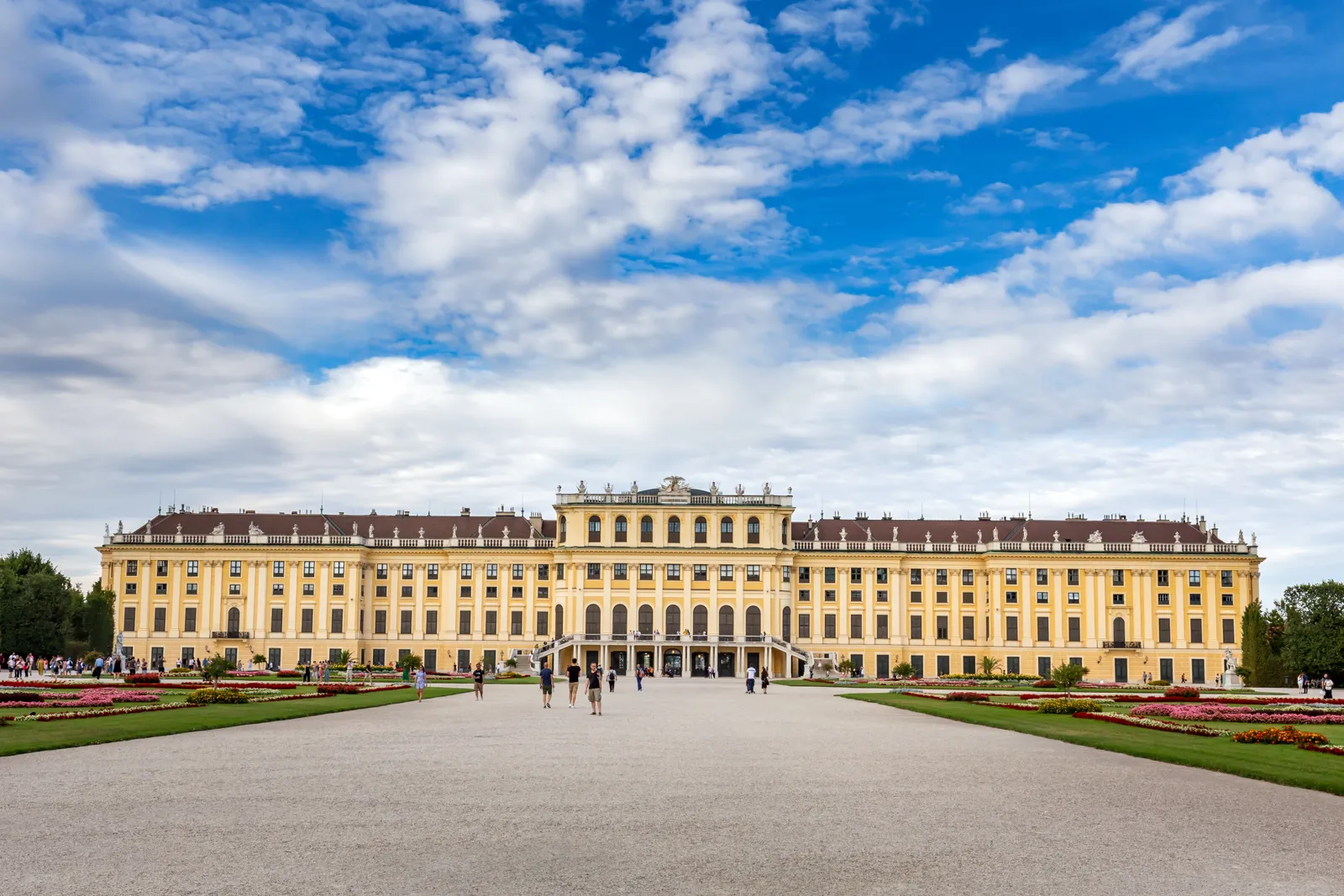
Schönbrunn Palace in Vienna
Vienna
The former Habsburg capital is best explored on foot and by tram. The UNESCO-listed historic center brings together St. Stephen’s Cathedral, the Hofburg and the Ring, lined with 19th-century buildings. Schönbrunn Palace and its gardens, also listed, the Belvedere and its Klimt paintings, the MuseumsQuartier, and the Prater with its giant Ferris wheel round off a visit of at least three days. Viennese coffee houses, listed by UNESCO as Austrian intangible cultural heritage, and the wine taverns (Heurigen) in the hills around the city are part of the experience. Coffee houses, Heurigen and the Ferris wheel take time: to plan your trip to Vienna, allow at least the three days mentioned here.
The Wachau
An hour from Vienna, this stretch of the Danube valley between Melk and Krems is covered in terraced vineyards and is a World Heritage Site. The Baroque Benedictine abbey of Melk overlooks the river; Dürnstein, with the ruins of the castle where Richard the Lionheart was held, is the best-known village. Explore it by boat, by bike along the Danube or by car.
Salzburg
Mozart’s birthplace, Salzburg has a UNESCO-listed Baroque old town dominated by Hohensalzburg Fortress. The composer’s birthplace, the cathedral, the Mirabell Gardens and Getreidegasse can be seen in a day; two days let you add Hellbrunn Palace and its trick fountains. In summer, the Salzburg Festival draws opera and music lovers.
Hallstatt and the Salzkammergut
East of Salzburg, the Salzkammergut is a region of lakes and mountains. Hallstatt, a lakeside village at the foot of the Dachstein massif, is part of the UNESCO-listed Hallstatt-Dachstein/Salzkammergut cultural landscape, and its salt mines can be visited. It is extremely busy: arrive early in the morning or stay overnight. The Wolfgangsee, the Traunsee and the village of Sankt Gilgen are quieter.
Innsbruck and Tyrol
The capital of Tyrol, Innsbruck is framed by mountains: a funicular and cable cars climb from the center to the Nordkette range. The old town and its « Golden Roof » can be seen in a few hours. Tyrol is the main region for hiking in summer and skiing in winter, with valleys such as the Zillertal, Ötztal and Stubaital.
The Grossglockner High Alpine Road
This scenic toll road crosses the Hohe Tauern National Park and climbs to the foot of the Grossglockner, Austria’s highest peak. It is only open in the warmer months, generally from May to autumn: check the opening dates before you go. Zell am See and Kaprun, to the north, make good bases.
Graz and Styria
The country’s second city, Graz has a historic center and Eggenberg Palace listed as World Heritage, as well as the Schlossberg hill and its clock tower. Further south, the Styrian wine road crosses hills covered in vineyards, best explored in September and October.
Things to do in Austria: experiences not to miss
Depending on the season, these are the activities that feature in most trips and tours of Austria:
Visit Schönbrunn, the Hofburg and the Belvedere in Vienna, then sit down in a Viennese coffee house or a Heuriger.
Travel down the Danube through the Wachau by boat or bike, from Melk to Dürnstein and Krems.
Follow in Mozart’s footsteps in Salzburg and climb to Hohensalzburg Fortress.
Visit the Hallstatt salt mines and tour the lakes of the Salzkammergut.
Drive the Grossglockner High Alpine Road in the warmer months, in Hohe Tauern National Park.
Hike in Tyrol in summer (Zillertal, Ötztal, Stubaital) or ride up to the Nordkette from Innsbruck.
Ski from December to March in the resorts of Tyrol, Salzburg or Vorarlberg.
Stroll through the Advent markets from late November to Christmas.
Itinerary ideas and road trips in Austria
7 to 10 days: Vienna, the Wachau and Salzburg
Days 1 to 3: Vienna
Day 4: the Wachau (Melk, Dürnstein, Krems)
Days 5 to 7: Salzburg and Hellbrunn
Days 8 and 9: Hallstatt and the Salzkammergut
Day 10: back to Vienna or fly home from Salzburg
2 weeks: from Vienna to Tyrol
Days 1 to 3: Vienna
Day 4: the Wachau
Days 5 and 6: Salzburg
Days 7 and 8: Hallstatt and the Salzkammergut
Days 9 and 10: Zell am See and the Grossglockner road (in the warmer months)
Days 11 to 14: Innsbruck and a Tyrolean valley for hiking
Austria combines easily with Budapest, less than three hours by train from Vienna, or with Munich and Bavaria, close to Salzburg. For a one-way route, fly into Vienna and out of Innsbruck or Salzburg. On a road trip, a car lets you string together lakes, valleys and the Grossglockner road (remember the motorway vignette). To extend your trip, see our guides to Hungary, Germany, Switzerland and Slovenia.
Budget for a trip to Austria
Austria is in line with prices in the rest of Western Europe, a little higher in ski resorts and in Salzburg during the festival. Indicative amounts per person per day, excluding international flights:
Item
Budget
Comfort
Accommodation (based on a shared double room)
roughly €35–55
roughly €90–150
Meals
roughly €25–35 (bakeries, snacks, Würstelstand)
roughly €50–75
Transport (trains, city transit)
roughly €10–20
roughly €20–35
Activities and sightseeing
roughly €10–15
roughly €20–40
Total per day
roughly €80–120
roughly €180–280
Indicative estimates, varying with the season and the city. Ski passes and equipment rental come on top in winter.
Admission to Vienna’s major sights (Schönbrunn, Hofburg, Belvedere) is a significant expense; city discount cards exist in Vienna, Salzburg and Innsbruck. Weekday lunch menus are often much cheaper than dinner.
Who is Austria for?
Our verdicts by traveler profile, based on the information in this guide:
Culture and music: ideal: Vienna and its palaces, Salzburg and its summer festival, Graz and Eggenberg Palace.
Mountains: yes: hiking in Tyrol in summer, skiing from December to March, the Grossglockner road in the warmer months.
Families: yes: a safe country well served by trains, the Prater in Vienna, the trick fountains of Hellbrunn in Salzburg.
Couples: yes: the Wachau by boat or bike, a night in Hallstatt, Viennese coffee houses.
Budget travelers: average: prices are similar to Western Europe, roughly €80–120 per person per day.
Advent markets: yes, from late November to Christmas.
Getting around Austria
Getting there: Vienna International Airport is the main gateway, with smaller airports in Salzburg and Innsbruck. Trains also link Vienna with Budapest, Munich and other neighboring capitals.
Train: the Austrian Federal Railways (ÖBB) network quickly links Vienna, Linz, Salzburg, Innsbruck and Graz. It is often the simplest way to travel between cities.
Regional buses: postbuses and regional buses serve the valleys and mountain villages, including many trailheads.
In cities: Vienna has a very dense network of subway, trams and buses; Salzburg and Innsbruck are easy to explore on foot and by bus.
Car: handy for the lakes, Alpine valleys and the Grossglockner road. All vehicles on motorways and expressways must display a vignette (toll sticker) inside the windscreen (UK FCDO, GOV.UK, updated 11 August 2026); the U.S. Department of State (travel.state.gov, last updated September 10, 2026) puts the on-the-spot fine at €120. Some tunnels and Alpine roads charge an extra toll. Winter tires may be required between November 1 and April 15 depending on where you drive, and your car insurance can be void in an accident without them (U.S. Department of State).
Driving licence: a UK photocard licence is valid if you are 18 or over, and you must carry insurance and vehicle ownership documents (UK FCDO). A US licence alone is not enough: it must be accompanied by an International Driving Permit or an official translation, available from AAA or the Austrian automobile clubs ÖAMTC and ARBÖ (U.S. Department of State).
Bike: the Danube cycle path, especially through the Wachau, is one of the busiest in Europe.
Where to stay in Austria
In Vienna, staying in the 1st district (Innere Stadt) lets you do everything on foot, but costs more; the neighboring districts (Neubau, Mariahilf, Wieden, Leopoldstadt) are well connected by subway and more affordable. In Salzburg, the old town and the other bank, around Linzer Gasse, are convenient. In the mountains, family guesthouses (Gasthof, Pension) and private rooms are plentiful, and mountain huts let you sleep at altitude in summer.
In Hallstatt, accommodation is limited and booked up well in advance; Obertraun, Bad Goisern and Bad Ischl are alternatives. In ski resorts, many places require Saturday-to-Saturday stays during the holiday season.
Entry requirements for Austria
Austria is in the Schengen area. Entry requirements checked on 24 October 2026; check them again before you travel.
US citizens
According to the U.S. Department of State (travel.state.gov, last updated September 10, 2026), anyone intending to stay longer than 90 days must obtain the appropriate visa; Schengen rules apply to shorter stays.
Your passport should be valid for at least three months beyond the period of stay.
You may be asked to show proof of sufficient funds and a return plane ticket.
UK citizens
According to the UK FCDO (GOV.UK, updated 11 August 2026), you can travel without a visa to the Schengen area, including Austria, for up to 90 days in any 180-day period as a tourist.
Your passport must have been issued less than 10 years before the day you arrive and be valid for at least 3 months after the day you plan to leave the Schengen area.
At the border you may need to show proof of accommodation, travel insurance, a return or onward ticket and enough money for your stay.
The EU Entry/Exit System (EES) is being rolled out: you may have to register your fingerprints and photo at the border, free of charge, and allow extra time.
Health and safety
Health: according to the UK FCDO (GOV.UK, updated 11 August 2026), check vaccine recommendations at least 8 weeks before your trip; health risks include tick-borne diseases, and altitude sickness is a risk in parts of Austria. UK travelers need a GHIC or EHIC for medically necessary state healthcare, which is not a substitute for travel insurance.
Medical costs: local hospitals will not settle bills directly with American insurers: you pay and claim reimbursement later. The State Department strongly recommends insurance covering medical evacuation. The Austrian Medicine Import Act restricts bringing in most prescription drugs, with allowances for medicines in your personal luggage (U.S. Department of State).
Safety: Austria has one of the lowest crime rates in Europe (U.S. Department of State), but pickpocketing occurs on public transport, in stations and around St. Stephen’s Cathedral in Vienna’s 1st district. The UK FCDO states that terrorists are likely to try to carry out attacks in Austria: stay vigilant in public places.
ID: by law, you must have easy access to your passport; Austrian authorities do not accept a UK driving licence as ID (UK FCDO). Illegal drugs, including cannabis, carry severe penalties.
Mountains: in winter, Alpine roads can be dangerous due to snow, ice or avalanches, and some are closed for long periods (U.S. Department of State). Check the forecasts and avalanche bulletins before setting out.
Money: Austria uses the euro. Customs rules: cash of €10,000 or more must be declared when entering (UK FCDO). Estimate your spending with our currency converter.
Internet: check your provider’s roaming rates before you leave; an eSIM can be a cheaper option.
Food in your luggage: you cannot bring meat, milk or products containing them into EU countries, apart from a few exceptions such as powdered baby milk (UK FCDO).
Viennese coffee houses: you can linger over a single coffee, served with a glass of water. You order at your table, not at the counter.
Etiquette: punctuality and quiet on public transport are appreciated. Greet people when entering a shop: Grüß Gott or Servus in the west, Guten Tag everywhere.
Not for a short stay if you are a US or British citizen: Austria is in the Schengen area, and UK citizens can stay up to 90 days in any 180-day period without a visa (GOV.UK, 11 August 2026); US citizens need a visa only beyond 90 days (travel.state.gov, September 10, 2026). Checked on 24 October 2026.
Do you need a vignette to drive in Austria?
Yes, on motorways and expressways: you must display a vignette inside the windscreen (UK FCDO). Some tunnels and Alpine roads, such as the Grossglockner road, also charge a toll.
How much does a trip to Austria cost?
Excluding flights, allow roughly €80–120 per person per day on a budget, and €180–280 in comfort. Ski resorts and Salzburg during the festival are more expensive.
How many days do you need in Austria?
A week to ten days lets you see Vienna, the Wachau, Salzburg and Hallstatt. Two weeks leaves time to add Tyrol and the Grossglockner road.
Can you visit Austria without a car?
Yes. Trains link all the major cities and regional buses serve most valleys. A car is still more practical for the lakes and Alpine roads.
What to see in Austria in a week?
In a week, combine Vienna (3 days), the Wachau (1 day) and Salzburg with Hallstatt and the Salzkammergut (3 days), by train or by car.
What to do in Austria in winter?
Skiing from December to March in the Alps (Tyrol, Salzburg, Vorarlberg), Advent markets from late November to Christmas and, in Vienna, the ball and opera season.
Our sources
Entry, health, safety and driving information read on 24 October 2026: U.S. Department of State, Austria country information (travel.state.gov, last updated September 10, 2026), and UK FCDO, foreign travel advice for Austria (GOV.UK, updated 11 August 2026)
Central Institute for Meteorology and Geodynamics (ZAMG, now GeoSphere Austria), climate normals for Vienna, Salzburg and Graz; WMO 1991–2020 normals for Innsbruck (NOAA NCEI)
Transparency: this page contains affiliate links, labelled as such. If you book through them we may earn a commission at no extra cost to you; it does not influence our content or recommendations. How we fund the site.