Many trips to Hungary boil down to Budapest, a capital split in two by the Danube and known for its thermal baths, Parliament and cafés. This Hungary travel guide shows that the country offers much more: Lake Balaton, the vineyards of Tokaj and Eger, the Danube Bend and the Great Plain in the east. It gathers the essentials to organise your trip to Hungary.
To locate the cities, regions, relief, national parks and airports, see our map of Hungary.
Hungary at a glance
CapitalBudapest
LanguageHungarianEnglish is common in Budapest and tourist areas, German too around Lake Balaton
Currencythe Hungarian forint (HUF); Hungary does not use the euro · currencies
Time zoneUTC+1, UTC+2 in summer: 1 hour ahead of London, 6 hours ahead of New York
AirportsBudapest Ferenc Liszt (BUD)Vienna is less than three hours away by train
EntrySchengen area: no visa for up to 90 days for US citizens (tourism or business) and UK citizens (in any 180-day period) · travel.state.gov · GOV.UKPassport valid at least 3 months beyond your stay (US) or after leaving the Schengen area (UK)
Electricitycheck voltage and plug types before you go · plugsReference: IEC World Plugs
The best time runs from May to June and from September to early October: it is mild in Budapest (afternoon highs of 22 to 26 °C, 72 to 79 °F), café terraces are open and crowds stay reasonable. July and August are hot, with late-afternoon storms: this is the season for Lake Balaton and festivals. Winter is cold (about 3 °C, 37 °F, in the afternoon in January), but it is the ideal season for the thermal baths and, in December, for the Christmas markets. All the details, region by region and month by month, are in our article on the best time to visit Hungary.
What to see in Hungary: the highlights
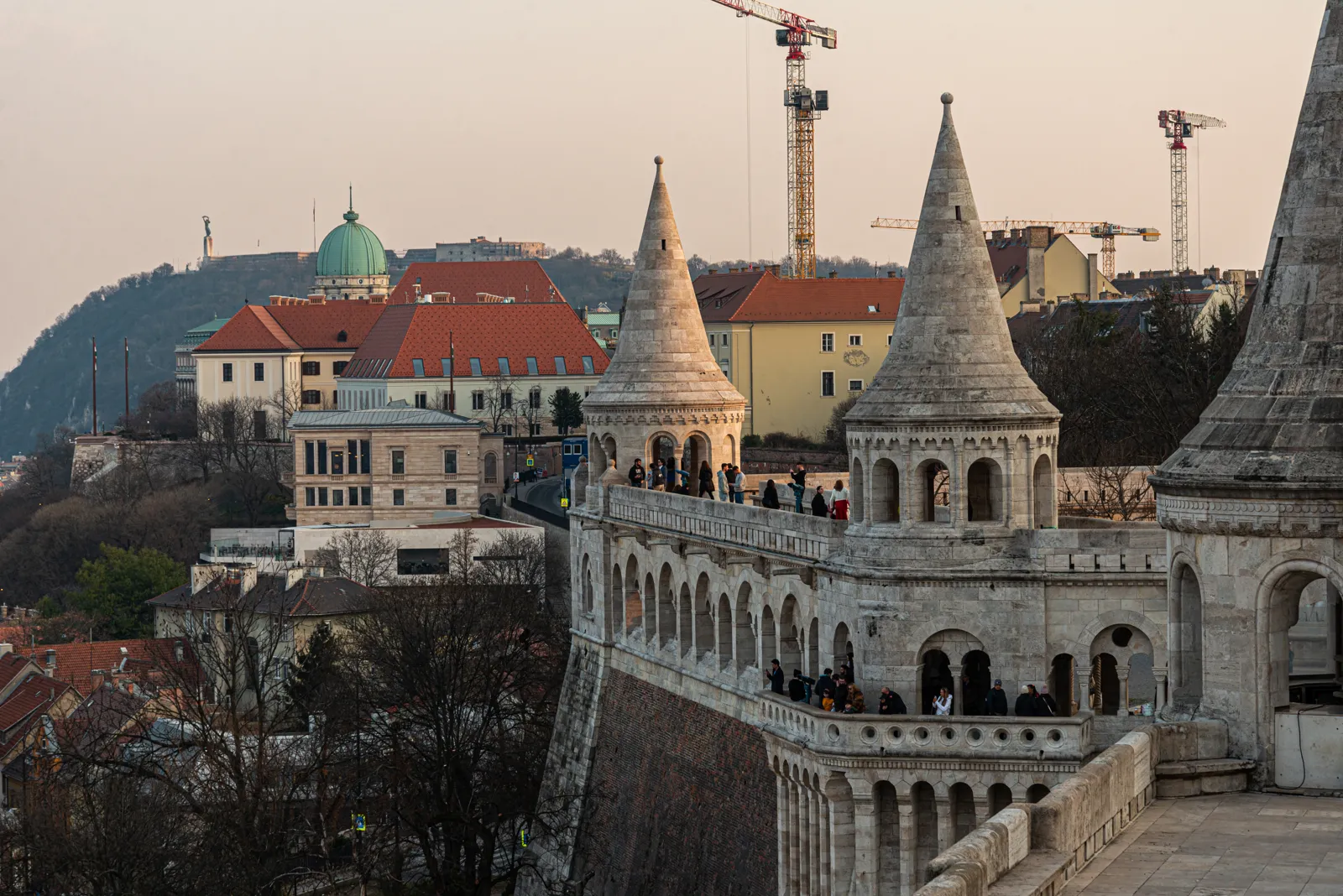
Fisherman’s Bastion in Budapest
Budapest
The capital brings together two historic towns: Buda, on the right bank, with Castle Hill, Fisherman’s Bastion and Matthias Church, and flatter Pest, with Parliament, St Stephen’s Basilica, Andrássy Avenue and the Opera. The banks of the Danube and the Castle District are UNESCO World Heritage-listed. Allow at least three days to add the Great Market Hall, Margaret Island, the Jewish Quarter and its ruin bars set in old buildings, plus an evening river cruise when the monuments are lit up.
The thermal baths
Hungary has a great many hot springs, and Budapest has turned them into a tradition. The Széchenyi Baths, in City Park (Városliget), are the largest, with outdoor pools used even in midwinter. The Rudas Baths, at the foot of Gellért Hill, preserve a 16th-century Ottoman hall. Outside the capital, Lake Hévíz, near Lake Balaton, is one of the largest natural thermal lakes you can swim in. Check opening hours and any works before you go: some historic baths close for renovation.
The Danube Bend: Szentendre, Visegrád, Esztergom
North of Budapest, the Danube makes a sharp bend between wooded hills. Szentendre is a small town of colourful houses, galleries and museums; Visegrád overlooks the river from its citadel; Esztergom has the country’s largest basilica, the historic seat of the Hungarian Church. They can be visited in a day by train, bus or, in the warmer months, by boat.
Lake Balaton
Central Europe’s largest lake is where Hungarians spend their summers. The south shore, around Siófok, has gently sloping beaches suitable for children and lively nightlife. The north shore is hillier and lined with vineyards, with the Tihany peninsula and its abbey, Balatonfüred and the volcanic hills of Badacsony. In the west, Keszthely has the Festetics Palace. Out of season, many establishments close.
Eger
At the foot of the Bükk Mountains, Eger is a baroque town known for its castle, which withstood an Ottoman siege in 1552, and its minaret, one of the northernmost of the Ottoman period in Europe. It is also famous for its red wine, Egri Bikavér, tasted in the cellars of the « Valley of the Beautiful Women ». Thermal baths round off the visit.
Tokaj
In the north-east, the Tokaj wine region, a UNESCO World Heritage Site, produces the famous sweet aszú wines. Its villages and rock-cut cellars are best explored by car at harvest time, in September–October.
Pécs
In the south, Pécs is a university town with a mild climate, which preserves an Ottoman mosque converted into a church on its main square and a World Heritage-listed early Christian necropolis. The Zsolnay Cultural Quarter, set in the former ceramics factory, is worth a visit.
Hortobágy and the Great Plain
In the east, the Hortobágy puszta, the country’s first national park and a UNESCO site, is a vast steppe of pastures, marshes and ponds. Here you can see traditional livestock farming (grey cattle, horses, racka sheep) and a great many birds, including cranes in autumn. Debrecen, Hungary’s second city, is the gateway to the region.
Things to do in Hungary
Beyond the cities and landscapes, these are the experiences that feature in most trips:
Soak in a thermal bath: Széchenyi or Rudas in Budapest, Lake Hévíz near Lake Balaton.
Take a Danube cruise in Budapest at nightfall, when Parliament and the castle are lit up.
Spend an evening in a ruin bar in Budapest’s Jewish Quarter.
Visit the Danube Bend by boat in the warmer months: Szentendre, Visegrád, Esztergom.
Taste Hungarian wines in the cellars of the Valley of the Beautiful Women in Eger or in the Tokaj region.
Swim in Lake Balaton in summer and climb up to Tihany Abbey.
Discover the Hortobágy puszta, its traditional farming and its birds.
Browse the Great Market Hall in Budapest and the capital’s historic cafés.
Itinerary ideas for Hungary: 7 days to 2 weeks
7 to 10 days: Budapest and the north
Days 1 to 4: Budapest (Buda, Pest, thermal baths, Danube cruise)
Day 5: the Danube Bend (Szentendre, Visegrád, Esztergom)
Days 6 and 7: Eger and its wine cellars
Days 8 and 9: Tokaj
Day 10: back to Budapest
2 weeks: Budapest, Lake Balaton and the south
Days 1 to 4: Budapest
Day 5: the Danube Bend
Days 6 to 9: Lake Balaton (Tihany, Balatonfüred, Badacsony, Keszthely and Lake Hévíz)
Days 10 and 11: Pécs
Days 12 and 13: Szeged or Eger depending on the season
Day 14: back to Budapest
Hungary combines easily with Vienna (see our Austria travel guide), less than three hours by train from Budapest, or with neighbouring Slovakia. For a short first visit, three or four days in Budapest are enough. With three or four days in the capital you need to prioritise: our page to plan your trip to Budapest helps you choose.
Budget for a trip to Hungary
Hungary remains cheaper than Western Europe, even though Budapest prices have risen a lot in recent years. Thermal baths and restaurants in the tourist centre are the main expenses. Approximate amounts per person per day, excluding international flights, converted into forints at the European Central Bank rate of 23 October 2026 (€1 = HUF 366.73) and rounded:
Item
Tight budget
Comfortable
Accommodation (based on a shared double room)
about HUF 7,000–15,000
about HUF 22,000–40,000
Meals
about HUF 6,000–9,000 (markets, canteens, bistros)
about HUF 13,000–20,000
Transport (city transport, trains, buses)
about HUF 2,000–4,000
about HUF 4,000–7,000
Activities and sightseeing (baths, museums)
about HUF 4,000–6,000
about HUF 7,000–13,000
Total per day
about HUF 18,000–29,000
about HUF 44,000–73,000
Rough estimates that vary with the season and city. Prices are usually shown in forints.
Outside Budapest and Lake Balaton in summer, prices drop noticeably, especially for accommodation. Admission to Budapest’s thermal baths costs more at weekends.
Getting around Hungary
In Budapest: the metro, trams (including lines 2, 4 and 6, very handy for visitors), buses and trolleybuses cover the whole city, and multi-day passes are available. Validate your ticket at the metro entrance or as soon as you board, validate a new one each time you change lines, and keep it until the end of your journey: inspectors can fine you on the spot (GOV.UK, updated 23 September 2026; travel.state.gov, last updated April 23, 2026). An express bus links Ferenc Liszt Airport with the centre.
Train: the national rail network radiates from Budapest and serves Lake Balaton, Eger, Pécs, Debrecen and Szeged. Trains also link Budapest with Vienna; the US Embassy regularly receives reports of pickpocketing on this route.
Bus: the intercity network complements the train for small towns and villages.
Car: useful for the vineyards, Lake Balaton and the puszta. Major motorways require an e-vignette bought before you use them, and Hungary has a zero-alcohol driving policy (GOV.UK). UK photocard licences can be used; US licences are valid for one year with a certified Hungarian translation attached, and AAA International Driving Permits are accepted with a valid state licence (travel.state.gov). Parking is paid and difficult in central Budapest.
Boat: in the warmer months, boats link Budapest with the Danube Bend, and ferries cross Lake Balaton, notably between Tihany and Szántód.
Taxi: in Budapest, official taxis are yellow and metered: insist on the meter (travel.state.gov), and be wary of drivers who suggest bars or clubs.
Getting there
Hungary’s main international airport is Budapest Ferenc Liszt (BUD). Many travellers also arrive by train from Vienna. Check current routes from your home airport with the airlines and the airport.
Where to stay in Hungary
In Budapest, most visitors stay in Pest: District V (Belváros-Lipótváros), in the centre, is convenient but more expensive; District VII (the Jewish Quarter) is lively but noisy at night because of the bars; District VI, around Andrássy Avenue, is a good compromise. Buda, around the castle and the Víziváros district, is quieter. The country also has many spa hotels, in Hévíz, Eger and Budapest.
At Lake Balaton, guesthouses, apartments and campsites are plentiful, but many open only in season. In the wine regions, some estates offer rooms. In July–August and during Advent in Budapest, book early.
Entry requirements for Hungary, health and safety
US citizens: Hungary is in the Schengen area: you may enter for up to 90 days for tourism or business without a visa. Your passport should be valid at least three months beyond your stay, and you need sufficient proof of funds and a return ticket (U.S. Department of State, travel.state.gov, last updated April 23, 2026).
UK citizens: no visa for up to 90 days in any 180-day period as a tourist. Your passport must have been issued less than 10 years before the day you arrive and be valid at least 3 months after the day you plan to leave the Schengen area; you may be asked for a return ticket. The EU Entry/Exit System (EES) is being implemented: fingerprints and a photo may be taken at your first entry, free of charge (GOV.UK, updated 23 September 2026).
ID: always carry your passport: you must show ID if the police ask, and a copy is not acceptable (GOV.UK).
Health: for vaccines, GOV.UK refers to TravelHealthPro’s Hungary guide and travel.state.gov advises being up to date on CDC-recommended vaccinations. UK travellers need a GHIC or EHIC for state healthcare; whatever your nationality, take out travel insurance covering medical costs and evacuation.
Safety: bag-snatching and pickpocketing are common, especially in Budapest and other cities, and theft from parked vehicles is common (GOV.UK).
Nightlife scams: GOV.UK reports that some bars, clubs and restaurants charge very high amounts, with tourists taken to cash machines to pay, and that some taxi drivers earn commissions for recommending them. Always ask for the menu and price list, check your bill, and never leave your drink unattended.
Money: use official ATMs, preferably inside banks, and never change money on the street (GOV.UK).
Practical tips for Hungary
Money: ATMs are readily available, and travellers’ cheques are not universally accepted (travel.state.gov). Keep some forints for markets and small places. When a cash machine or card terminal offers to charge you in your home currency, choose forints to avoid an unfavourable conversion. A tip of around 10% is customary in restaurants if service is not already included: check the bill.
Mobile data: check your home carrier’s roaming charges before you leave; an eSIM is a simple way to get local data.
Thermal baths: bring a swimsuit, towel and sandals; a swimming cap is sometimes required in the lap pools.
Language: Hungarian is unlike any neighbouring language. A few words are appreciated: jó napot (hello), köszönöm (thank you), egészségére (cheers).
Etiquette: people greet each other with a handshake. Tradition has it that you avoid clinking beer glasses, in memory of the repression of 1849: with wine or pálinka, no problem.
Hungary: who is it for?
Our verdict depending on how you like to travel, based on the information in this guide:
Weekend and city break: yes: three or four days are enough for a first visit to Budapest.
Couples: yes: a cruise on the illuminated Danube, thermal baths, the cellars of Eger and Tokaj.
Families: yes: the gently sloping beaches of Lake Balaton’s south shore, thermal baths, the Danube Bend by boat in the warmer months.
Tight budget: yes: roughly HUF 18,000–29,000 per person per day, with prices dropping outside Budapest and Lake Balaton in summer.
Culture: yes: Parliament, the Castle District, Budapest’s churches and historic cafés, Eger, Pécs and its early Christian necropolis.
Nature: yes: the Hortobágy puszta and its birds, the volcanic hills of Badacsony, Lake Hévíz.
Read also
The seasons for the baths, Lake Balaton and the Christmas markets are detailed month by month on our page the best time to visit Hungary. For a trip focused on the capital, our guide to visiting Budapest covers districts, baths and itineraries. To combine with Vienna, see our Austria travel guide.
Frequently asked questions
Do I need a visa to visit Hungary?
Not for short stays if you are a US or UK citizen: up to 90 days for tourism without a visa (in any 180-day period for UK citizens), with a passport valid at least 3 months beyond your stay. Check travel.state.gov or GOV.UK before you leave.
What currency is used in Hungary?
The Hungarian forint (HUF): Hungary does not use the euro. Pay in forints or by card.
How many days do you need to visit Budapest?
Three to four days let you see Buda, Pest and a thermal bath and take a Danube cruise. Add a day for the Danube Bend.
How much does a trip to Hungary cost?
Excluding flights, allow roughly HUF 18,000–29,000 per person per day on a budget trip and HUF 44,000–73,000 for a comfortable one. Budapest and Lake Balaton in summer are the most expensive.
When is the best time to visit Hungary?
May–June and September to early October for Budapest and sightseeing, June to early September for Lake Balaton, December for the Christmas markets.
What to do in Hungary in a week?
Spend four days in Budapest (Buda, Pest, a thermal bath, a Danube cruise), a day on the Danube Bend, then two days in Eger for its cellars, or at Lake Balaton in summer.
World Meteorological Organization, 1991-2020 normals for Budapest-Pestszentlőrinc, Keszthely and Szeged (NOAA NCEI); Hungarian Meteorological Service (HungaroMet), normals for Debrecen
European Central Bank, euro reference rates of 23 October 2026 (budget conversion)
Transparency: this page contains affiliate links, labelled as such. If you book through them we may earn a commission at no extra cost to you; it does not influence our content or recommendations. How we fund the site.