This Czech Republic travel guide covers Prague and its historic centre, the castles of Bohemia, the spa towns, the vineyards of Moravia and an age-old brewing tradition: the country offers a lot to see in a compact area at the heart of Europe. In the Schengen area, it suits a weekend in Prague as well as a one- or two-week tour. If you are hesitating with Austria, our Prague or Vienna comparison puts the two capitals side by side. For the capital’s museums and transport, compare the cards on our Prague City Pass page.
To locate the cities, regions, relief, national parks and airports, see our map of the Czech Republic.
Czech Republic at a glance
CapitalPrague
LanguageCzechEnglish is common in tourist areas, German sometimes
Currencythe Czech koruna or crown (CZK) · currenciesThe euro is not the official currency
Time zoneUTC+1, UTC+2 in summer; 1 hour ahead of London, 6 hours ahead of New York
AirportsPrague Václav Havel (PRG), Brno (BRQ)
EntrySchengen area: no visa for short stays for US and UK citizens · travel.state.gov · GOV.UKRegister your address within 3 days (usually done by your accommodation)
Electricitycheck plug types and voltage before you go · plugs
The best time is from May to September, with May, June and September the best compromise between mild weather (20 to 24 °C, or 68 to 75 °F, in the afternoon in Prague) and crowds. July and August are the warmest and busiest months. December is the other highlight, for the Christmas markets, despite the cold. From January to March it is cold and many provincial castles are closed, but Prague can be visited quietly and cheaply. All the details, month by month and region by region, are in our article on the best time to visit the Czech Republic.
What to see in the Czech Republic: the highlights
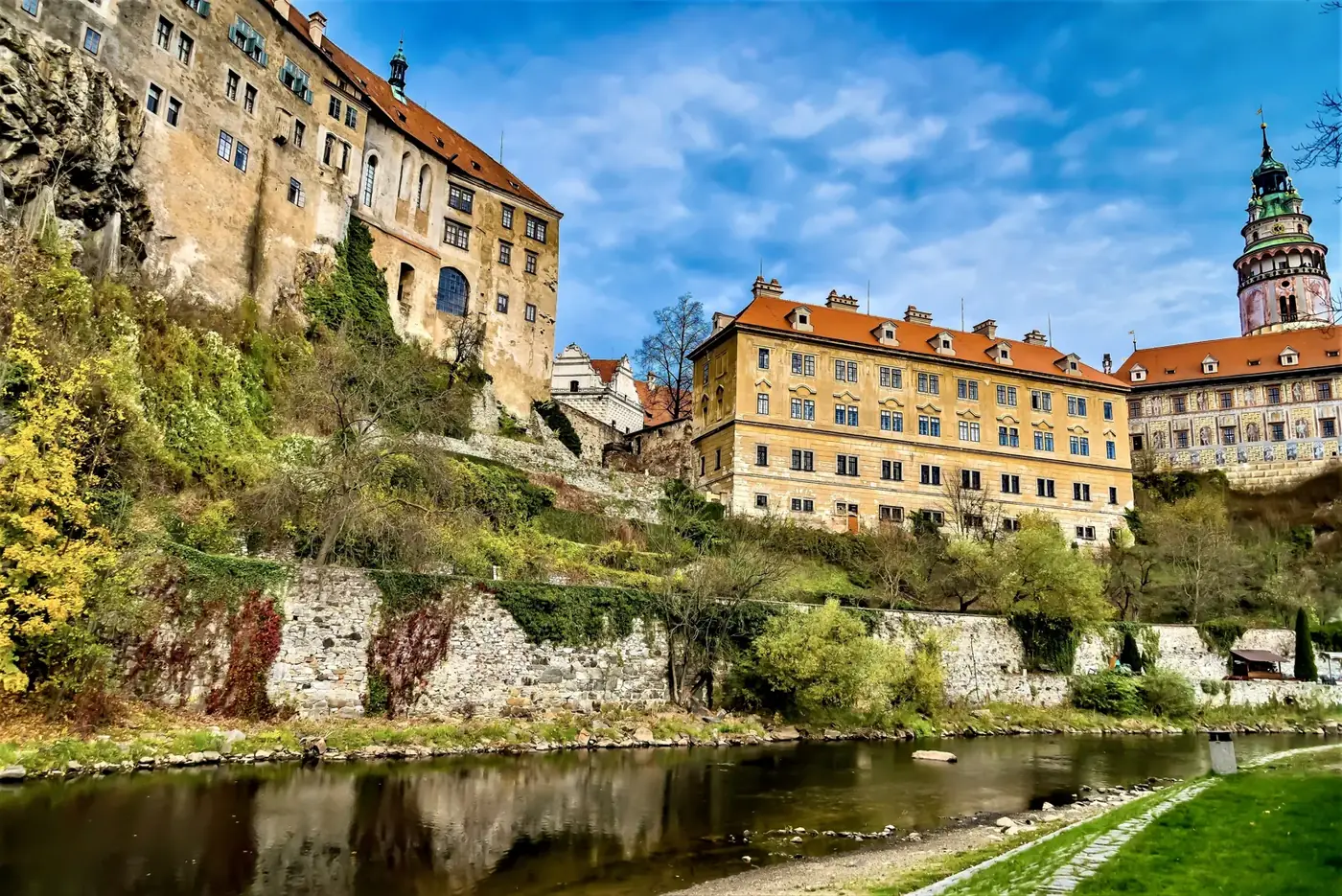
Český Krumlov Castle on the Vltava
Prague
Prague’s historic centre is a UNESCO World Heritage Site. On the left bank of the Vltava, Prague Castle, with St Vitus Cathedral and Golden Lane, overlooks the baroque Malá Strana district. Charles Bridge, lined with statues, leads to the Old Town: Old Town Square, the Church of Our Lady before Týn and the astronomical clock on the town hall. The Josefov Jewish quarter preserves several synagogues and its old cemetery. The New Town is organised around Wenceslas Square. For views, climb Petřín Hill or go to Vyšehrad. Come early in the morning to Charles Bridge and the castle to avoid the crowds. To go beyond Charles Bridge and the castle, our Prague travel guide covers districts, viewpoints and the pace of a visit.
Kutná Hora
About an hour from Prague, this former silver-mining town, a World Heritage Site, is the most popular day trip from the capital. Highlights include St Barbara’s Church, a Gothic masterpiece, the Italian Court, a former mint, and, in the Sedlec district, the ossuary decorated with human bones.
Český Krumlov
In South Bohemia, Český Krumlov is a small medieval and Renaissance town nestled in a bend of the Vltava, dominated by a large castle with a baroque theatre. Its centre is a World Heritage Site. Very busy during the day in summer, it is best discovered by staying the night. The surroundings are good for canoeing on the river. Nearby České Budějovice, with its large square, is known for its brewery.
Karlovy Vary and the spa towns
In western Bohemia, Karlovy Vary, Mariánské Lázně and Františkovy Lázně form a group of spa towns listed as World Heritage within the « Great Spa Towns of Europe ». In Karlovy Vary, you stroll along the colonnades, tasting the hot spring water from spouted cups. The town hosts an international film festival every summer.
Plzeň
The capital of West Bohemia, Plzeň gave its name to pilsner beer. A tour of the historic brewery and its cellars is the main attraction, along with the large square and St Bartholomew’s Cathedral. The city is about an hour and a half from Prague by train.
Brno and Olomouc
The country’s second city, Brno, capital of Moravia, is a lively student town. It is home to Villa Tugendhat, a Mies van der Rohe work listed as a World Heritage Site (visits by reservation), Špilberk Castle and the ossuary of St James’s Church. Further north, Olomouc, less touristy, has a fine main square with the Holy Trinity Column, a World Heritage Site.
South Moravia
The country’s wine region, South Moravia is explored by bike between wine cellars. The Lednice-Valtice Cultural Landscape, a designed landscape of chateaux, parks and pavilions, is a World Heritage Site. Mikulov, with its castle on a rock, and Telč, further west, with its square lined with arcaded Renaissance houses, complete the visit.
Bohemian Switzerland and the mountains
In the north-west, near the German border, Bohemian Switzerland National Park (České Švýcarsko) is known for its sandstone formations, including the Pravčická brána arch, and its gorges explored by boat. Further east, the Giant Mountains (Krkonoše) peak at Sněžka, the country’s highest summit, with hiking in summer and skiing in winter. In the south-west, the Šumava forest forms a large wooded massif.
Things to do in the Czech Republic
Beyond the sights, here are the experiences that best sum up the country:
Visit Prague Castle and cross Charles Bridge early in the morning, before the crowds.
Taste Czech beer in a traditional beer hall, and visit the historic brewery in Plzeň.
Canoe down the Vltava around Český Krumlov, in summer.
Drink the hot spring water along the colonnades of Karlovy Vary.
Cycle between the wine cellars of South Moravia, around Mikulov and Lednice-Valtice.
Hike to the Pravčická brána arch in Bohemian Switzerland, or in the Giant Mountains.
Wander through the Christmas markets of Prague in December.
Itinerary ideas for the Czech Republic
7 to 10 days: Prague and Bohemia
Days 1 to 3: Prague (castle, Malá Strana, Old Town, Josefov, Vyšehrad)
Day 4: day trip to Kutná Hora
Days 5 and 6: Český Krumlov, with a canoe trip in summer, and České Budějovice
Day 7: Plzeň
Days 8 and 9: Karlovy Vary and Mariánské Lázně
Day 10: back to Prague
2 weeks: Bohemia and Moravia
Days 1 to 4: Prague and a day trip (Kutná Hora or Karlštejn Castle)
Days 5 and 6: Bohemian Switzerland National Park
Days 7 and 8: Karlovy Vary, then Plzeň
Days 9 and 10: Český Krumlov
Day 11: Telč
Days 12 and 13: Brno, then South Moravia (Mikulov, Lednice-Valtice)
Day 14: Olomouc or back to Prague
Most stops can be reached by train or coach. A car makes it easier to visit South Moravia and the national parks.
Budget for a trip to the Czech Republic
The Czech Republic is generally cheaper than Western Europe, especially outside Prague. In the capital’s historic centre, restaurant and accommodation prices approach Western European levels. Approximate amounts per person per day, excluding international travel (converted at the European Central Bank rate of 23 October 2026 and rounded):
Item
Tight budget
Comfortable
Accommodation (based on a shared double room)
about CZK 500–850 (hostel, guesthouse)
about CZK 1,450–2,450
Meals
about CZK 350–600 (canteens, beer halls, lunch menus)
about CZK 850–1,450
Transport (train, coach, city transport)
about CZK 100–250
about CZK 250–500
Sightseeing and activities
about CZK 100–250
about CZK 350–600
Total per day
about CZK 1,200–1,950
about CZK 2,900–4,850
Rough estimates that vary with the season, the city and the koruna exchange rate.
To cut costs: eat away from Prague’s most touristy squares, take advantage of weekday lunch menus (« denní menu »), and stay in residential districts well served by metro and tram. Both GOV.UK and the State Department advise changing money only at banks or reputable exchange offices, never on the street.
Getting around the Czech Republic
Train: the rail network serves most towns. The state operator České dráhy and private operators link Prague, Brno, Plzeň, Olomouc and Český Krumlov (with a change).
Coach: often more direct than the train for some destinations, such as Český Krumlov or Karlovy Vary from Prague.
Getting around Prague: metro, trams and buses cover the whole city. According to GOV.UK (updated 11 August 2026), you must validate your ticket before starting your journey (unless bought from the self-service terminals on board), inspectors issue on-the-spot fines of CZK 1,000, and the Petřín funicular needs a specific ticket. GOV.UK also warns about fake taxis in unmarked cars.
Car: useful for the countryside and South Moravia. According to the State Department (travel.state.gov, last updated December 11, 2025), a toll sticker (vignette) is required on major highways, headlights must be on at all times, there is zero tolerance for alcohol, and US drivers need an International Driving Permit from AAA with their licence. UK photocard licences can be used (GOV.UK).
Bike: plenty of cycle routes, particularly in the South Moravian vineyards and along rivers.
Where to stay in the Czech Republic
In Prague, staying in the Old Town or Malá Strana lets you do everything on foot, but it is the most expensive and noisiest option. The Vinohrady, Karlín or Žižkov districts, close to the centre and well served by tram and metro, offer better value and a more local atmosphere.
Outside the capital, options include hotels in historic houses, family-run guesthouses and private rooms. In Český Krumlov, staying in the old town lets you enjoy it in the evening, once the day-trippers have left. In the spa towns, many hotels offer treatment packages. For the Christmas markets, New Year and summer, book early.
Entry requirements for the Czech Republic
US citizens: the Czech Republic (Czechia) applies Schengen rules. The State Department recommends a passport valid for at least six months beyond your arrival date in the Schengen area; you need sufficient proof of funds, a return ticket and proof of valid medical insurance covering hospitalisation and treatment costs (U.S. Department of State, travel.state.gov, last updated December 11, 2025).
UK citizens: no visa for up to 90 days in any 180-day period. Your passport must have been issued less than 10 years before the day you arrive and be valid at least 3 months after the day you plan to leave the Schengen area; you may be asked for a return or onward ticket. The EU Entry/Exit System (EES) is being implemented (GOV.UK, updated 11 August 2026).
Registration: according to GOV.UK, without a Czech residence permit you must register your address with the foreign police within 3 days of arrival, which hotels and accommodation services can do for you; failing to register can lead to a fine of up to CZK 3,000.
Health and safety
Health: UK travellers need a GHIC or EHIC for medically necessary state healthcare. The State Department warns of tick-borne encephalitis and Lyme disease from March to October if you camp or hike in long grass or woodland: a vaccine exists for encephalitis; use repellent and suitable clothing.
Theft and scams: pickpocketing is a problem in Prague’s main tourist areas. GOV.UK warns of criminals posing as plainclothes police asking to see your money and passport (Czech police have no right to do this), and the State Department advises checking card payments for overcharging.
Local laws: you are legally required to carry ID: always carry your passport (GOV.UK). Possession of drugs, including cannabis, is illegal, with severe penalties. Watch your drink in bars and clubs.
Emergencies: 112.
Practical tips for the Czech Republic
Money: the currency is the Czech koruna. Cards are very widely accepted. Our currency converter helps you estimate prices.
Mobile data: check your home carrier’s roaming charges before you leave. Wi-Fi is available in most accommodation and cafés.
Language: Czech is difficult, but « dobrý den » (hello) and « děkuji » (thank you) are appreciated. English is spoken in tourist areas.
At the table: beer is cheaper than water in many beer halls. Check the bill, especially in restaurants in tourist areas, and the price of snacks served without being ordered.
Tipping: rounding up or leaving about 10% in restaurants is customary if service is not already included.
The Czech Republic: who is it for?
Our verdict, profile by profile, based on the information in this guide:
Profile
Our verdict
City break
Ideal: Prague, compact and walkable, with many sights within a few days.
Beer and wine lovers
Ideal: the historic brewery in Plzeň, traditional beer halls, the wine cellars of South Moravia.
Couples
Yes: Český Krumlov in the evening, the colonnades of Karlovy Vary, Telč’s Renaissance square.
Nature and hiking
Yes: Bohemian Switzerland, the Giant Mountains, the Šumava forest.
Families
Yes: canoeing on the Vltava around Český Krumlov, castles, gorges explored by boat.
Tight budget
Yes: roughly CZK 1,200–1,950 per person per day, especially outside Prague, with lunch menus.
Not for short stays as a US or UK citizen. The Czech Republic is in the Schengen area: UK citizens can stay up to 90 days in any 180-day period, and the State Department recommends US citizens have six months of passport validity beyond arrival and proof of medical insurance. You must register your address within 3 days (usually via your accommodation).
Can you pay in euros in the Czech Republic?
The official currency is the Czech koruna. Some tourist businesses accept euros, but at an unfavourable rate. Pay by card in koruna or withdraw koruna from a bank ATM.
How many days do you need to visit Prague?
Three days let you see the essentials: the castle and Malá Strana, the Old Town and Josefov, the New Town and Vyšehrad. Add a day for a trip to Kutná Hora or Karlštejn Castle.
How much does a week in the Czech Republic cost?
Excluding international travel, allow roughly CZK 1,200–1,950 per person per day on a tight budget and CZK 2,900–4,850 for a comfortable trip. Prague is more expensive than the rest of the country.
When is the best time to visit the Czech Republic?
From May to September, with May, June and September the best compromise. December is worthwhile for the Christmas markets, despite the cold.
What budget for 3 days in Prague?
Based on our per-person estimates, excluding international travel, allow roughly CZK 3,650–5,850 for 3 days on a tight budget and CZK 8,750–14,600 for a comfortable trip. Staying outside the Old Town and taking weekday lunch menus cuts the bill.
What can you see in the Czech Republic in a week?
In 7 days: 3 days in Prague, a day trip to Kutná Hora, 2 days in Český Krumlov and České Budějovice, then a day in Plzeň or Karlovy Vary. With two weeks, add Bohemian Switzerland and Moravia (Telč, Brno, Mikulov).
The Czech Republic combines easily with its neighbours: see our guides to Austria, Hungary, Germany and Poland.
Discover our other destinations in Europe, such as Croatia.
Transparency: this page contains affiliate links, labelled as such. If you book through them we may earn a commission at no extra cost to you; it does not influence our content or recommendations. How we fund the site.