Kraków and its medieval centre, Warsaw rebuilt after the war, Gdańsk and the Baltic, the Tatra Mountains, the Masurian lakes and major sites of European memory: Poland offers a wide variety of trips, at still moderate prices. This Poland travel guide works as well for a weekend in Kraków as for a two-week tour: it tells you what to see, which itinerary to follow and what budget to plan.
To locate the cities, regions, relief, national parks and airports, see our map of Poland.
Poland at a glance
CapitalWarsaw
LanguagePolishEnglish is common among younger people and in tourist areas
Currencythe złoty (PLN); the euro is not the official currency · currencies
Time zoneUTC+1, UTC+2 in summer; 1 hour ahead of London, 6 hours ahead of New York
EntrySchengen area: no visa for short stays for US and UK citizens · travel.state.gov · GOV.UKPassport valid at least 3 months beyond your stay (US) or after leaving the Schengen area (UK)
Electricitycheck plug types and voltage before you go · plugs
The best time is from May to September, with May, June and September the best compromise between mild weather (20 to 23 °C, or 68 to 73 °F, in the afternoon in Kraków) and crowds. July and August are the warmest months, ideal for the Baltic, Masuria and the Tatras, but also the busiest and the most thundery. December is the other highlight, for the Christmas markets, and January–February for skiing in Zakopane. All the details, month by month and region by region, are in our article on the best time to visit Poland.
Where to go in Poland: the highlights
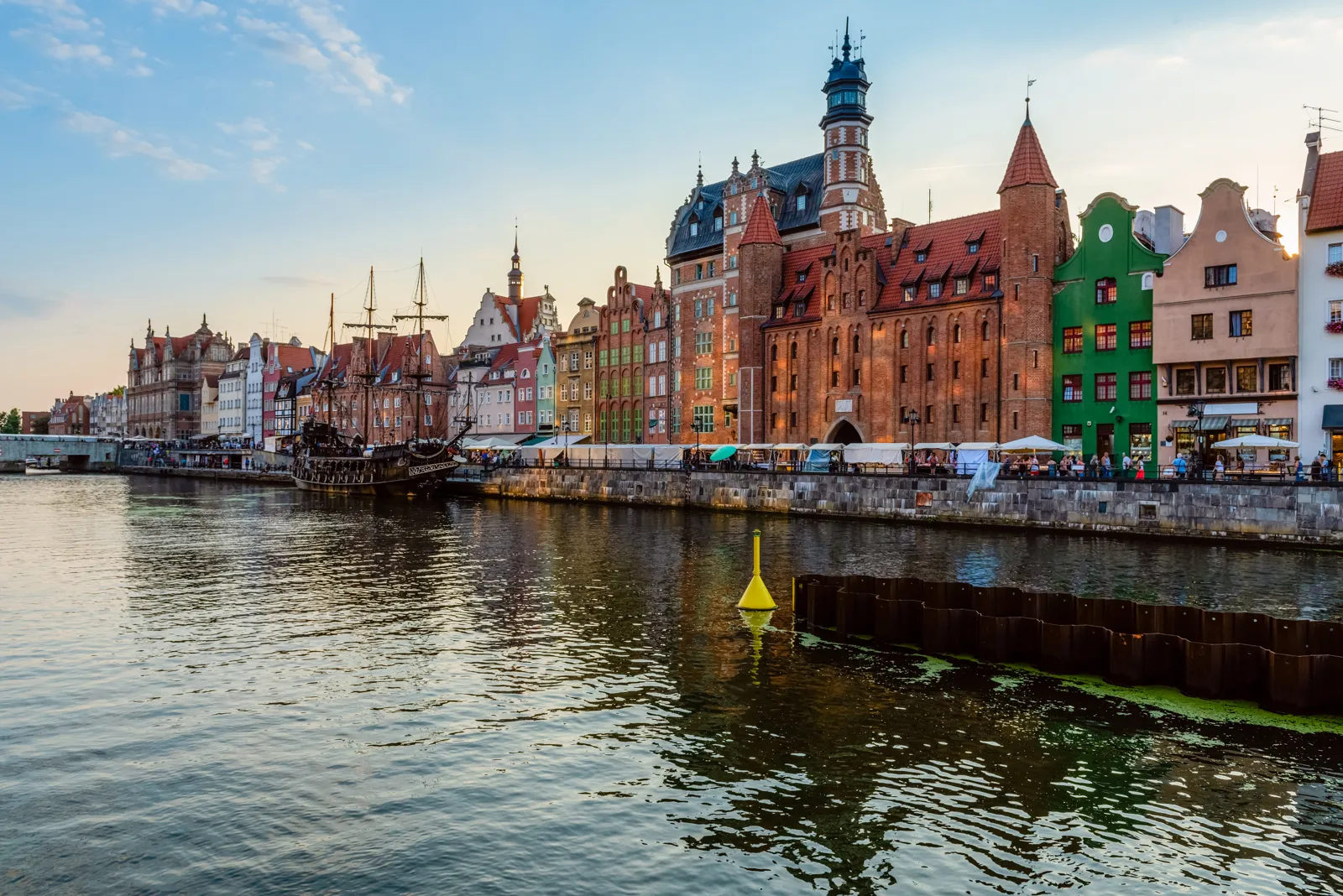
The historic façades along the Gdańsk waterfront, Poland
Kraków
A former royal capital, Kraków has a historic centre listed as a UNESCO World Heritage Site. The Main Market Square (Rynek Główny), one of the largest medieval squares in Europe, surrounds the Cloth Hall and St Mary’s Basilica, from which a trumpeter plays a tune every hour. The Royal Route leads to Wawel Hill, with its castle and cathedral. Kazimierz, the former Jewish quarter, has synagogues, cafés and lively nightlife. Across the Vistula, Oskar Schindler’s factory houses a museum on the occupation of the city. Between Kazimierz and the Schindler factory, our Kraków travel guide helps you spread your visits over several days.
Wieliczka and Auschwitz-Birkenau
Two classic excursions from Kraków, both World Heritage Sites. The Wieliczka Salt Mine, worked for centuries, is visited along an underground route of galleries and chapels carved into the salt. The Auschwitz-Birkenau Memorial and Museum, a former Nazi concentration and extermination camp, is an essential place of remembrance; allow a day and book your entry pass in advance on visit.auschwitz.org, the memorial’s official website. From 1 April to 31 October, between 10 am and 3 pm, entry is only possible with a tour led by a memorial guide-educator; outside these times, individual visits without a guide are possible (auschwitz.org, checked on 6 October 2026).
Warsaw
More than 80% destroyed during the Second World War, the capital rebuilt its old town identically, and it is a World Heritage Site for that reason. The Royal Route links the Royal Castle with Łazienki Park and its Palace on the Isle. Warsaw is also a city of museums: the Warsaw Rising Museum, the POLIN Museum of the History of Polish Jews and the Chopin Museum. The Palace of Culture and Science, a legacy of the Soviet era, offers a view over the whole city.
Gdańsk and the Baltic coast
A former Hanseatic city, Gdańsk charms with its Royal Way (Długi Targ) and colourful façades, the medieval crane on the Motława quay and the brick St Mary’s Basilica. It is also a place of 20th-century history: the Second World War began at Westerplatte in 1939, and the Solidarity trade union was born in the shipyards, where the European Solidarity Centre covers this period. Gdańsk forms a Baltic conurbation with Sopot, a seaside resort with a long pier, and Gdynia.
Malbork and Toruń
South-east of Gdańsk, Malbork Castle, built by the Teutonic Knights, is the largest brick castle in the world and a World Heritage Site. Further south, Toruń, Copernicus’s birthplace, has a medieval brick centre, also World Heritage-listed, and a gingerbread tradition.
Wrocław
The capital of Lower Silesia, in the west, Wrocław is built on several islands in the Oder. Its market square surrounds a Gothic town hall, and Cathedral Island (Ostrów Tumski) is one of the oldest districts. Visitors enjoy spotting the hundreds of small bronze dwarf statues scattered around the city. The Centennial Hall is a World Heritage Site.
Zakopane and the Tatras
In the south, on the Slovak border, Zakopane is the gateway to Tatra National Park, the country’s only high-mountain range. Morskie Oko lake, reached on foot, is the most popular hike, very crowded in summer. The town is known for its wooden architecture, the Zakopane style, and the mountain culture of the Górale. In winter, it becomes Poland’s main ski resort. Check conditions with the mountain rescue services before setting off.
Masuria and Białowieża Forest
In the north-east, the Masurian Lake District has thousands of lakes linked by canals, ideal for sailing, canoeing and cycling in summer. To the east, on the Belarusian border, Białowieża Forest, a World Heritage Site, is one of the last primeval forests in Europe and home to European bison. According to GOV.UK (updated 11 August 2026), access to parts of the border with Belarus is restricted, including areas controlled by the Białowieża border guard post: observe the regulations and follow the instructions of the Polish authorities.
Things to do in Poland: experiences not to miss
Explore Kraków: the Main Market Square, Wawel Hill and Kazimierz
Go down into the Wieliczka Salt Mine, on the edge of Kraków
Visit the Auschwitz-Birkenau Memorial, booking your slot in advance
Compare Warsaw and Gdańsk: two historic centres rebuilt after 1945, one in the capital, the other on the Baltic
Tour Malbork Castle, seat of the Teutonic Knights
Hike in the Tatras from Zakopane, up to Morskie Oko lake
Paddle in Masuria and look for bison in Białowieża Forest
Taste pierogi in a milk bar, Poland’s traditional canteens
Itinerary ideas for Poland
7 to 10 days: Kraków, Warsaw and the south
Days 1 to 3: Kraków (Main Market Square, Wawel, Kazimierz, Schindler’s factory)
Day 4: Wieliczka Salt Mine
Day 5: Auschwitz-Birkenau Memorial
Days 6 and 7: Zakopane and the Tatras (Morskie Oko in season)
Days 8 to 10: Warsaw (old town, Łazienki, museums), by train from Kraków
2 weeks: from the south to the Baltic
Days 1 to 4: Kraków, Wieliczka and Auschwitz-Birkenau
Days 5 and 6: Zakopane and the Tatras
Days 7 and 8: Wrocław
Days 9 and 10: Warsaw
Day 11: Toruń
Day 12: Malbork Castle
Days 13 and 14: Gdańsk and Sopot
The major cities are linked by fast, comfortable trains. A car is useful for Masuria, Białowieża Forest and small mountain roads.
Budget for a trip to Poland
Poland is generally cheaper than Western Europe, although prices have risen markedly in recent years, particularly in Warsaw and central Kraków. Approximate amounts per person per day, excluding international travel (converted at the European Central Bank rate of 23 October 2026 and rounded):
Item
Tight budget
Comfortable
Accommodation (based on a shared double room)
about PLN 90–150 (hostel, apartment, guesthouse)
about PLN 220–400
Meals
about PLN 70–110 (milk bars, canteens, pierogi)
about PLN 150–240
Transport (train, coach, city transport)
about PLN 20–40
about PLN 40–90
Sightseeing and activities
about PLN 20–40
about PLN 70–90
Total per day
about PLN 220–350
about PLN 480–790
Rough estimates that vary with the season, the city and the złoty exchange rate.
To cut costs: have lunch in a « bar mleczny » (milk bar), a cheap traditional canteen, take advantage of lunch menus and stay away from the central squares. In bars and clubs, always check the price list before ordering: GOV.UK reports visitors being overcharged for drinks at the end of the night when paying by card.
Getting around Poland
Train: the state operator PKP Intercity links the major cities with fast trains, such as Warsaw–Kraków or Warsaw–Gdańsk. Book ahead in summer and over long weekends.
Coach and minibus: handy for destinations less well served by train, such as Zakopane from Kraków.
City transport: trams and buses in all major cities, metro in Warsaw. Validate your ticket at the start of the journey: you will be fined if inspectors find you with an invalid or unvalidated ticket (GOV.UK; travel.state.gov).
Car: useful for Masuria, the east and the countryside. Tolls apply on some motorways, expressways and national roads. UK photocard licences can be used for up to 6 months (GOV.UK, updated 11 August 2026); US drivers need a US licence and an International Driving Permit, headlights must be on all year, there is zero tolerance for drink-driving, and fines are often paid on the spot in cash (travel.state.gov, last updated August 20, 2026). At night outside built-up areas, walkers and cyclists must wear a reflective item.
Taxis: unofficial taxi drivers often overcharge (GOV.UK). Use taxis from designated stands, with a company name and number, and a working meter.
Domestic flights: they exist between major cities, but the train is often just as fast from centre to centre.
Where to stay in Poland
In Kraków, staying in the old town or Kazimierz lets you do everything on foot; Kazimierz is livelier in the evening, so sometimes noisier. In Warsaw, the Śródmieście district in the centre is the most practical, and the old town the most picturesque. In Gdańsk, the Royal Way and the Motława quays are the most sought-after addresses; Sopot suits a beach stay.
Options include hotels of all categories, many apartments to rent, hostels and, in the countryside and mountains, guesthouses (« pensjonat ») and private rooms. In Zakopane, mountain-style wooden houses are plentiful. For July–August and the Christmas markets, book early.
Entry requirements for Poland
US citizens: Poland applies Schengen rules. Your passport should be valid for at least three months beyond the period of stay, and you need sufficient proof of funds and a return ticket. Entry from Belarus and Russia is restricted unless you meet one of the listed exceptions (U.S. Department of State, travel.state.gov, last updated August 20, 2026).
UK citizens: no visa for up to 90 days in any 180-day period. Your passport must have been issued less than 10 years before the day you arrive and be valid at least 3 months after the day you plan to leave the Schengen area; you may be asked for a return or onward ticket. The EU Entry/Exit System (EES) is being implemented (GOV.UK, updated 11 August 2026).
Border checks: according to GOV.UK, Polish border guards carry out controls at the German and Lithuanian borders, and access to parts of the borders with Belarus and Ukraine is restricted. Always carry ID (a printed copy of your passport photo page is acceptable, says GOV.UK).
Health and safety
Health: UK travellers need a GHIC or EHIC for medically necessary state healthcare; GOV.UK lists biting insects and ticks among the health risks. The State Department notes that adequate medical care is available but emergency services may be lacking in small towns and rural areas. Take out travel insurance covering medical costs.
Nightlife: GOV.UK reports victims of spiked drinks being robbed in bars and clubs, and overcharging; it is also illegal to drink alcohol in public places. The State Department advises going out in a group at night, particularly around Kraków’s Market Square and Warsaw’s Old Town.
Theft: thieves and pickpockets operate at major tourist sites, railway stations and on trains, trams and buses (travel.state.gov). Change money only at banks or legitimate exchange offices (kantor).
Emergencies: 112.
Practical tips for Poland
Money: the currency is the złoty. Cards are very widely accepted. The State Department considers ATMs at commercial banks, large hotels, shopping malls and airports the safest. Our currency converter helps you estimate prices.
Mobile data: check your home carrier’s roaming charges before you leave. Wi-Fi is available in most accommodation and cafés.
Language: « dzień dobry » (hello) and « dziękuję » (thank you) are appreciated. English is spoken in tourist areas; German is sometimes understood.
Tipping: about 10% in restaurants is customary if service is not included.
Memorial sites and religion: modest dress and respectful behaviour are expected in churches, which are well attended, and at memorial sites such as Auschwitz-Birkenau.
Photography and drones: GOV.UK advises against photographing or flying drones near military installations, national infrastructure and some border areas.
Our verdict, profile by profile, based on the information in this guide:
Profile
Our verdict
History and remembrance
Ideal: Kraków, Warsaw and its museums, the Auschwitz-Birkenau Memorial, Gdańsk and Westerplatte.
City break
Ideal: compact historic centres in Kraków, Warsaw, Gdańsk and Wrocław, linked by fast trains.
Tight budget
Ideal: roughly PLN 220–350 per person per day, with milk bars and lunch menus.
Nature and hiking
Yes: the Tatras from Zakopane, the Masurian lakes, Białowieża Forest and its bison.
Families
Yes: the Wieliczka Salt Mine, Wrocław’s bronze dwarfs, the Masurian lakes in summer.
Beach
Possible in summer: Sopot and the Baltic coast.
Read also
To choose between summer, the Tatras and the Christmas markets, read the best time to visit Poland. For a city-based stay, our Kraków guide spreads the visits over several days. Poland combines well with its neighbour: see our Czech Republic guide.
Frequently asked questions
Do I need a visa to visit Poland?
Not for short stays as a US or UK citizen. Poland is in the Schengen area: UK citizens can stay up to 90 days in any 180-day period, and US citizens need a passport valid at least three months beyond their stay. Check travel.state.gov or GOV.UK before you leave.
Can you pay in euros in Poland?
The official currency is the złoty. Some tourist businesses accept euros, but at an unfavourable rate. Pay by card in złotys or withdraw złotys from a bank ATM.
How many days do you need to visit Kraków?
Three days let you see the centre, Wawel and Kazimierz. Add a day for the Wieliczka Salt Mine and another for the Auschwitz-Birkenau Memorial.
How much does a trip to Poland cost?
Excluding international travel, allow roughly PLN 220–350 per person per day on a tight budget and PLN 480–790 for a comfortable trip. Warsaw and central Kraków are more expensive than the rest of the country.
When is the best time to visit Poland?
From May to September, with May, June and September the best compromise. July–August suit the Baltic and the Tatras; December the Christmas markets.
What can you see in Poland in a week?
In a week, focus on the south: three to four days in Kraków (with Wieliczka and Auschwitz-Birkenau), then Zakopane and the Tatras, or Warsaw by train. Gdańsk and the Baltic need a few more days.
How much does a week in Poland cost?
Based on our estimates per person per day (roughly PLN 220–350 on a tight budget, PLN 480–790 for a comfortable trip), a week on the ground costs roughly PLN 1,540–2,460 on a tight budget and PLN 3,380–5,540 for a comfortable trip, excluding international flights.
Transparency: this page contains affiliate links, labelled as such. If you book through them we may earn a commission at no extra cost to you; it does not influence our content or recommendations. How we fund the site.