Slovenia fits into a small territory, yet it combines Alpine peaks, mountain lakes, emerald rivers, vast karst caves and a stretch of coast with Venetian architecture. A member of the European Union and the eurozone, it is easy to organize. This Slovenia travel guide gathers the essentials for planning your trip: what to see, itineraries, budget and getting around.
To locate cities, regions, terrain, national parks and airports, see our map of Slovenia.
Slovenia at a glance
CapitalLjubljana
LanguageSlovenianEnglish is widely understood in tourist areas
The best periods are mid-May to late June and September to mid-October: mild temperatures, nature at its greenest, accessible mountains and fewer people than in high summer. July and August are the high season, ideal for the high mountains and swimming, but Bled, Vintgar and the Soča valley are then very busy. Winter is cold inland, good for skiing and Christmas markets. All the details, region by region and month by month, are in our article best time to visit Slovenia.
What to see in Slovenia: the highlights
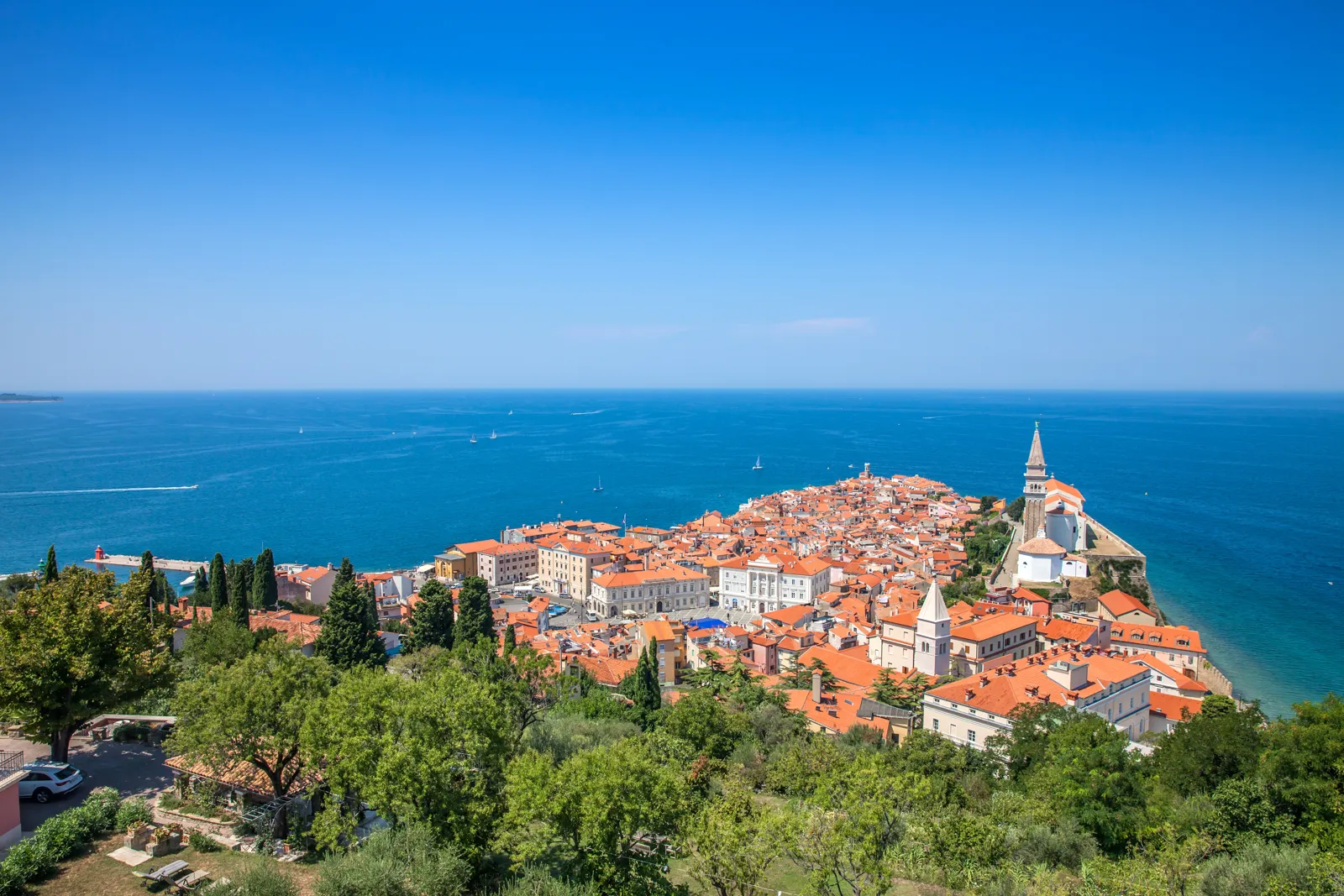
The town of Piran on the Slovenian Adriatic coast
Ljubljana
The capital is explored on foot, in a largely pedestrian center. The bridges by architect Jože Plečnik (the Triple Bridge, the Cobblers’ Bridge), the central market, the banks of the Ljubljanica and the castle overlooking the city are the highlights. Allow two days, adding Tivoli Park and the alternative Metelkova quarter.
Bled
Lake Bled, with its island topped by a church and its castle perched on a cliff, is the best-known image of the country. Walk around the lake (about 6 km, 3.7 mi), reach the island by traditional boat (pletna), and taste the Bled cream cake (kremšnita). The Ojstrica and Osojnica viewpoints overlook the lake. Nearby, the Vintgar Gorge is explored on wooden walkways, with paid, regulated access.
Lake Bohinj and Triglav National Park
Half an hour’s drive from Bled, Bohinj is a wilder lake at the heart of the country’s only national park. The Vogel cable car offers views over the Julian Alps, and a trail leads to the Savica waterfall. It is the starting point for many hikes, including the Triglav Lakes Valley. Triglav (2,864 m, 9,396 ft), the highest peak and national symbol, is usually climbed in two days with a night in a mountain hut, by experienced or guided hikers.
The Soča valley and the Vršič Pass
From Kranjska Gora, the Vršič Pass road crosses the Alps in a long series of hairpin bends, then descends to the valley of the Soča, a river with emerald water. Bovec is the base for white-water activities (rafting, kayaking, canyoning); Kobarid has a museum devoted to the Isonzo front during the First World War. The pass is closed part of the year.
Postojna and Škocjan caves
The Slovenian Karst gave its name to karst landscapes. Postojna Cave is partly visited by small train and is home to the olm, a blind amphibian. The Škocjan Caves, a UNESCO World Heritage Site, impress with their underground canyon carved by the Reka river. Predjama Castle, built into a rock face, combines easily with Postojna.
Piran and the coast
On Slovenia’s short coastline, Piran is the most attractive town: lanes of Venetian architecture, Tartini Square, walls with views over the Adriatic. Izola and Koper are more authentic and less touristy, Portorož more of a beach resort. The Sečovlje salt pans, to the south, can be visited within a nature park.
Ptuj and Maribor
In the east, Ptuj is an old town with its castle and lanes; in February it hosts Kurentovanje, a carnival with sheepskin costumes. Maribor, the country’s second city, is known for its very old vine on the façade of a house in the old quarter, and is a base for the Pohorje massif and the Štajerska vineyards.
Goriška Brda and the Vipava valley
Along the Italian border, these hilly wine regions are known for their white wines and cuisine. A pleasant stop between the Soča valley and the coast, especially in September and October.
Things to do in Slovenia: experiences not to miss
Reach the island in Lake Bled by pletna, the traditional boat, and taste the kremšnita
Walk through the Vintgar Gorge on its walkways, near Bled
Hike around Lake Bohinj and in Triglav National Park
Go rafting on the Soča and cross the Vršič Pass
Go underground in the Postojna and Škocjan caves
Stroll around Ljubljana, a city shaped by the architect Plečnik
Finish on the coast in Piran, with its Venetian architecture
Itinerary ideas for Slovenia
7 to 10 days: the essentials
Days 1 and 2: Ljubljana
Days 3 and 4: Bled and the Vintgar Gorge
Day 5: Bohinj and the Savica waterfall
Day 6: the Vršič Pass (in season) and the Soča valley
Day 7: the Škocjan or Postojna caves and Predjama Castle
Days 8 to 10: Piran and the coast, then back to Ljubljana
2 weeks: the full tour
Days 1 and 2: Ljubljana
Days 3 to 5: Bled, Bohinj and hikes in Triglav National Park
Days 6 and 7: Kranjska Gora, the Vršič Pass, Bovec
Day 8: Kobarid and Goriška Brda
Days 9 and 10: Piran, Izola and the salt pans
Day 11: the Škocjan and Postojna caves
Days 12 and 13: Maribor and Ptuj
Day 14: back to Ljubljana
Who is Slovenia for?
Our verdict by traveler profile, based on the information in this guide:
Profile
Our verdict
Why
Nature and hiking
✅ Ideal
Triglav National Park, Lake Bohinj, the Vršič Pass and the Soča valley.
Adventure
✅ Yes
Rafting, kayaking and canyoning in Bovec, on the Soča.
Couples
✅ Yes
The island in Lake Bled by pletna, Piran and its coast, the wine hills of Goriška Brda.
Families
✅ Yes
The Postojna Cave train, the walk around Lake Bled (about 6 km, 3.7 mi), the Vintgar Gorge walkways.
Budget travelers
⚠️ Possible
Accommodation prices close to Western European levels: roughly €60–90 per person per day; hostels, campsites and private rooms help.
Beaches
⚠️ Possible
A very short coast: Piran, Izola and Portorož, best at the end of a tour rather than for a beach holiday.
Budget for a trip to Slovenia
Accommodation prices are close to Western European levels, simple meals slightly cheaper. Prices rise sharply in July and August in Bled, Bovec and on the coast. Indicative amounts per person per day, excluding flights:
Item
Budget
Comfort
Accommodation (based on a shared double room)
roughly €25–40
roughly €60–110
Meals
roughly €20–30
roughly €40–60
Transport
roughly €8–12 (bus, train)
roughly €25–35 (rental car, vignette)
Activities and sightseeing
roughly €10–15
roughly €20–40 (caves, rafting)
Total per day
roughly €60–90
roughly €130–220
Indicative estimates, varying by season and region.
The Postojna and Škocjan caves, rafting and guided mountain outings are the main extra costs. Youth hostels, campsites and private apartments help keep the bill down.
Getting around Slovenia
Rental car: the most flexible option for the mountains, the Soča and the vineyards. According to the UK FCDO (GOV.UK, updated 11 August 2026), you must buy an e-vignette to drive on Slovenian motorways, from petrol stations, post offices, DARS offices or the official DARS website only. Headlights must be on at all times, and you must carry a warning triangle, reflective jacket and first aid kit. Winter equipment is compulsory from 15 November to 15 March and in winter conditions. Pass roads such as the Vršič are closed part of the year.
Driving rules: the blood alcohol limit is 0.05%, and zero for drivers under 21 or with less than two years’ experience; hand-held phones are banned and turning right on red is illegal (U.S. Department of State, travel.state.gov, last updated May 21, 2026). US drivers need a valid US licence and an International Driving Permit (from AAA or AATA); UK licences are accepted (GOV.UK).
Bus: a good network links Ljubljana with Bled, Bohinj, Bovec, Piran and Maribor, with more services in summer.
Train: practical on some routes, for example Ljubljana – Maribor or Ljubljana – Koper.
Bicycle: very popular, with cycle paths around the lakes and in the Soča valley. Ljubljana has bike sharing. Drivers must yield to cyclists (U.S. Department of State).
Taxis: generally safe and reliable; ask for an estimated fare first and make sure the meter is running (U.S. Department of State).
Where to stay in Slovenia
In Ljubljana, stay in or near the old town to do everything on foot. Around Bled, the town concentrates the accommodation, but Bohinj, Radovljica or neighboring villages are quieter. In the Soča valley, Bovec and Kobarid offer guesthouses, campsites and apartments. On the coast, Piran has the most charm, Portorož the most hotels.
In the mountains, huts welcome hikers in season. Tourist farms are a good option in the countryside. In July and August, book early around Bled, Bohinj and Bovec.
Entry requirements for Slovenia
US citizens: according to the U.S. Department of State (travel.state.gov, last updated May 21, 2026), you need a valid passport but no visa for tourism or routine business of less than 90 days; the 90 days count from your entry into the Schengen area. Your passport must be valid for at least three months beyond your stay, and you need proof of sufficient funds and a return ticket. Get your passport stamped on entering the Schengen area.
UK citizens: according to the UK FCDO (GOV.UK foreign travel advice, updated 11 August 2026), you can travel without a visa for up to 90 days in any 180-day period. Your passport must have been issued less than 10 years before you arrive and expire at least 3 months after the day you plan to leave the Schengen area. You may need to show a return ticket and enough money. There are checks at the land borders with Italy and Austria. Under the EU Entry/Exit System (EES), you may need to register your fingerprints and photo.
Police registration: you must register within 3 days of arrival; registered hotels and guesthouses do it for you, otherwise check with your host or register at a police station. Failure to register can lead to a fine (GOV.UK; travel.state.gov).
Customs: you cannot bring meat, milk or products containing them into the EU, and you must declare cash of €10,000 or more (GOV.UK). For the return, check your home country’s allowances (e.g. CBP in the US, HMRC in the UK). Entry requirements checked on 24 October 2026; check them again before you travel.
Health and safety in Slovenia
Health: the UK FCDO (GOV.UK, updated 11 August 2026) advises checking vaccine recommendations at least 8 weeks before your trip and flags tick bites and tick-borne encephalitis; UK travelers need a GHIC or EHIC for medically necessary state healthcare. According to the U.S. Department of State, Slovenia has a high incidence of Lyme disease and tick-borne encephalitis: consider the TBE vaccine (available in Slovenia, not in the US), use repellent and check for ticks after being outdoors. Medical care is comparable to US standards; take insurance covering medical evacuation. Tap water is drinkable.
Medication: carry prescription medication in its original packaging with your prescription; some medicines sold over the counter in the US, such as ibuprofen above 200 mg, need a prescription in Slovenia (U.S. Department of State).
Mountains: according to the UK FCDO (GOV.UK, updated 11 August 2026), bears are present in wooded areas throughout Slovenia, including near cities, and hikers occasionally encounter bears and wolves. Plan for the weakest member of your group, use a map with marked paths, check that mountain huts are open and never take closed trails or shortcuts; some routes include via ferrata sections requiring a harness and helmet. Off-piste skiing carries an avalanche risk. The U.S. Department of State notes that many mountain rescues involve unprepared foreign visitors. Mountain rescue: 112.
Safety: the overall crime rate is low; pickpocketing and purse snatching occur in tourist areas (U.S. Department of State). Always carry ID: you can be fined €50–200 if you cannot show it (GOV.UK). Jaywalking carries heavy fines.
Natural hazards: sudden, violent storms can cause landslides and road closures; flash floods happen with little warning; western Slovenia is on an earthquake fault line (GOV.UK). A nationwide siren is tested on the first Saturday of every month at noon.
Emergencies: 112 for ambulance, fire and mountain rescue; 113 for police (GOV.UK).
Practical tips for Slovenia
Money: the euro; credit cards are broadly accepted and ATMs are common in cities and increasingly in rural areas (U.S. Department of State). Keep some cash for mountain huts, some parking lots and small farms. Always ask for a receipt: inspectors can check it as you leave a business, and you can be fined without one.
Internet: check your provider’s roaming charges before you leave; Wi-Fi is common in accommodation.
Nature: follow the rules of parks and protected sites (swimming areas, drones, camping) and the regulated access to sites such as Vintgar; ask locally.
Etiquette: a « dober dan » (hello) and a « hvala » (thank you) are appreciated. Tipping is not compulsory; rounding up the bill is common.
Mountain huts: bring cash and check opening dates.
Not for a short stay if you are a US or British citizen: Slovenia is in the Schengen area, and both can stay up to 90 days visa-free (travel.state.gov; GOV.UK). Your passport must be valid at least three months beyond your stay. Checked on 24 October 2026.
What is the best time to visit Slovenia?
From mid-May to late June and from September to mid-October. July and August suit the high mountains and swimming, but the main sights are then very busy.
How much does a trip to Slovenia cost?
Excluding flights, allow roughly €60–90 per person per day on a budget, and €130–220 in comfort. Prices are higher in summer in Bled, Bovec and on the coast.
How many days do you need in Slovenia?
A week lets you see Ljubljana, Bled, Bohinj, a Karst cave and Piran. With two weeks, you add the Soča valley, hikes in Triglav National Park, the vineyards and the east of the country.
Do you need a vignette to drive in Slovenia?
Yes. According to GOV.UK (updated 11 August 2026), you must buy an e-vignette to drive on motorways; buy it only from the official website of DARS, the Slovenian motorway company, or at petrol stations, post offices and DARS offices.
What can you see in Slovenia in a week?
In a week: Ljubljana, Bled and the Vintgar Gorge, Bohinj, the Soča valley via the Vršič Pass (in season), the Postojna or Škocjan caves, then Piran on the coast.
How much does a week in Slovenia cost?
Based on our per person per day estimates (roughly €60–90 on a budget, €130–220 in comfort), a week on the ground comes to roughly €420–630 on a budget and €910–1,540 in comfort, excluding international flights.
Discover our other destinations in Europe, including our guides to neighboring Croatia, Austria and Italy.
Transparency: this page contains affiliate links, labelled as such. If you book through them we may earn a commission at no extra cost to you; it does not influence our content or recommendations. How we fund the site.