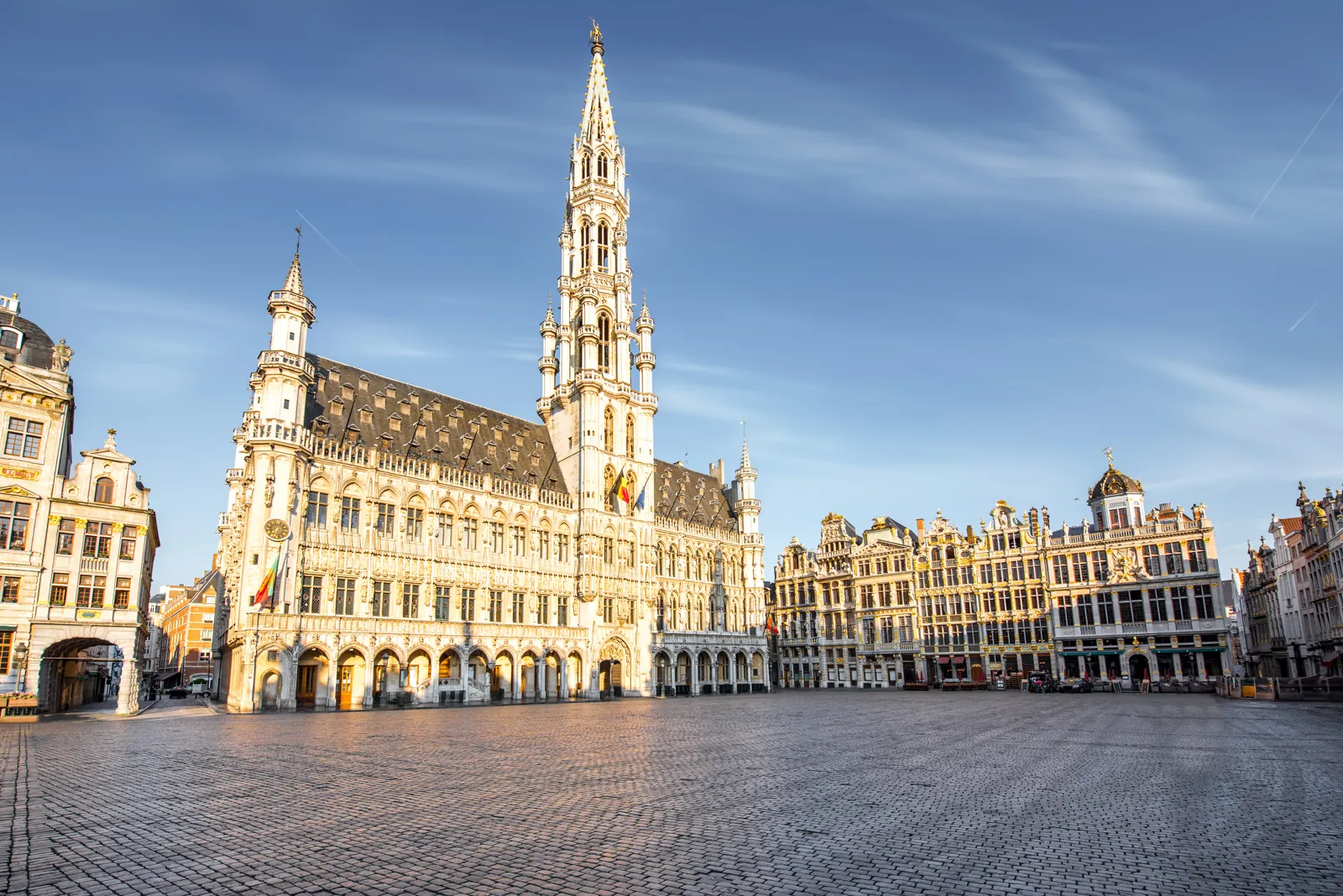
Brussels’ Grand-Place, the canals of Bruges, the cathedrals of Ghent and Antwerp, the citadels of the Meuse and the forests of the Ardennes: Belgium packs a lot into a small country that is easy to explore by train. French-speaking in the south and in Brussels, Dutch-speaking in the north, it works as well for a weekend as for a one- or two-week tour. This Belgium travel guide tells you what to do, which cities to visit, which itinerary to follow and what budget to plan. In the southeast, the neighboring grand duchy has its own guide: visit Luxembourg.
To locate cities, regions, terrain, national parks and airports, see our map of Belgium.
Belgium at a glance
CapitalBrussels
LanguagesDutch (Flanders), French (Wallonia) and German (east)Brussels is bilingual French-Dutch
The best period runs from May to September: 18 to 23 °C (64 to 73 °F) in the afternoon in Brussels according to the RMI 1991–2020 normals, long days, festivals and the coastal season. April and October suit city breaks well. Winter, cool (6 to 7 °C, or 43 to 45 °F, in the afternoon) and gray, lends itself to a city break built around museums and Christmas markets in December. It rains a little every month: pack a raincoat. All the details are in our article best time to visit Belgium.
Things to do in Belgium: the essentials by interest
The Belgian capital, seat of the main European institutions, is centered on the Grand-Place, a UNESCO World Heritage Site lined with the Gothic town hall and the guild houses. A few streets away, the Manneken Pis, the Royal Saint-Hubert Galleries and the Sablon district complete a visit of the center. Brussels has many museums: the Royal Museums of Fine Arts (including the Magritte Museum), the Musical Instruments Museum, a center devoted to comics, and a trail of comic-strip murals in the streets. To the north, the Atomium, built for the 1958 World’s Fair, has become a symbol. Several houses by the architect Victor Horta, a leading figure of Art Nouveau, are also UNESCO-listed. To plan your visit to the spheres, our guide to the Atomium: tickets, opening hours and access has the practical information.
Bruges
Its UNESCO-listed historic center has kept its canals, brick houses and medieval squares. The Markt is dominated by the belfry, which you can climb; the Burg brings together the town hall and the Basilica of the Holy Blood. The beguinage, the Minnewater (« Lake of Love »), the Groeninge Museum and its Flemish Primitives, and a boat trip on the canals round off the visit. Bruges is very busy in summer and on weekends: stay overnight to enjoy the town early in the morning and in the evening. Canals, Flemish Primitives and the town at night: our guide to visiting Bruges helps you plan a night there.
Ghent
A lively university city, Ghent combines a rich medieval heritage with an intense cultural life. St. Bavo’s Cathedral houses the Van Eyck brothers’ altarpiece, The Adoration of the Mystic Lamb, one of the major works of Flemish painting. Gravensteen castle, the belfry, the Graslei and Korenlei quays and the Patershol district can all be explored on foot. Ghent is a good alternative, or complement, to Bruges, and often less crowded.
Antwerp
The country’s second city and a major European port, Antwerp is Rubens’ city: his house and studio can be visited, and several of his paintings adorn the Cathedral of Our Lady. The Plantin-Moretus Museum, a former printing house listed by UNESCO, the Grote Markt and its town hall, the MAS museum by the docks and the monumental Central Station are among the sights. Antwerp is also known for fashion, design and the diamond trade.
Liège
In the Meuse valley, Liège is a lively, down-to-earth city. Climb the Montagne de Bueren, a long staircase leading to the citadel slopes, stroll through the Outremeuse district and the Sunday La Batte market along the Meuse. Guillemins station, designed by the architect Santiago Calatrava, is worth a detour. Liège is also the gateway to Spa and the High Fens (Hautes Fagnes).
Namur, Dinant and the Meuse valley
The capital of Wallonia, Namur is dominated by its citadel, at the confluence of the Sambre and the Meuse. Upriver, Dinant, birthplace of Adolphe Sax, stretches out at the foot of a cliff topped by a citadel, next to the collegiate church with its onion-domed bell tower. The valley can be explored by car, by bike or by boat; the gardens of Annevoie and Maredsous Abbey are nearby.
The Ardennes
In the southeast, the Belgian Ardennes offer forests, rivers and small towns: Durbuy, Bouillon and its castle, La Roche-en-Ardenne and the Semois valley. The caves of Han-sur-Lesse and the neighboring park are among the most visited sites in Wallonia. This is the region for hiking, kayaking and mountain biking, from May to October.
The Belgian coast, Ypres and Mons
The roughly 70 km (44 mi) of Belgian coastline are served by a coastal tram linking the resorts, from Knokke-Heist to De Panne via Ostend and De Haan. Inland, Ypres and the Westhoek preserve many First World War memorial sites, including the Menin Gate. In the southwest, Mons, capital of Hainaut, has a UNESCO-listed belfry and a big popular festival, the Doudou.
Itinerary ideas for Belgium
7 to 10 days: the art cities
Days 1 to 3: Brussels (Grand-Place, museums, Sablon, Atomium, Art Nouveau)
Day 4: Antwerp (cathedral, Rubens House, Plantin-Moretus Museum)
Days 5 and 6: Ghent (Mystic Lamb, Gravensteen, the quays)
Days 7 and 8: Bruges, with half a day on the coast (Ostend or De Haan)
Days 9 and 10: Ypres and the Westhoek, or back via Brussels
2 weeks: Flanders, the Meuse and the Ardennes
Days 1 to 3: Brussels
Days 4 to 7: Ghent, Bruges and the coast
Day 8: Antwerp
Days 9 and 10: Liège and Spa
Days 11 and 12: the Ardennes (Durbuy, La Roche-en-Ardenne, Bouillon or Han-sur-Lesse)
Days 13 and 14: Dinant and Namur, then back to Brussels
The Flemish cities and the Brussels – Namur – Liège line are well connected by train: you do not need a car for the first part. In the Ardennes, a car becomes very useful, as the small towns are less well served.
Budget for a trip to Belgium
Belgium is in line with prices in neighboring Western European countries. Accommodation is the biggest expense, especially in Bruges and in Brussels on weekends; during the week, Brussels business hotels often lower their rates. Trains are relatively cheap over short distances. Indicative amounts per person per day, excluding travel to Belgium:
Item
Budget
Comfort
Accommodation (based on a shared double room)
roughly €30–50
roughly €80–150
Meals
roughly €25–35
roughly €45–75
Transport (train, tram, bus)
roughly €5–15
roughly €15–25
Sightseeing and museums
roughly €10–15
roughly €20–30
Total per day
roughly €70–110
roughly €160–280
Indicative estimates, varying with the season, the day of the week and the city.
To cut costs: travel midweek, stay in Ghent rather than Bruges, have the dish of the day at lunch, and look into museum passes and free offers in some cities (check them on the official websites).
Who is Belgium for?
Our verdicts by traveler profile, based on the places, conditions and budget ranges in this guide:
City breaks: ideal: Brussels, Bruges or Ghent can be seen in two or three days, by train.
Culture and art: excellent: the Grand-Place, Victor Horta’s houses, the Magritte Museum, the Mystic Lamb in Ghent, Rubens House and the Plantin-Moretus Museum in Antwerp.
Couples: yes: the canals of Bruges early in the morning or in the evening, the Graslei quays in Ghent, B&Bs in the Ardennes.
Families: yes: the Atomium, the comic-strip mural trail in Brussels, the caves of Han-sur-Lesse, the coastal tram, kayaking in the Ardennes from May to October.
Nature and activities: a good choice in the south: the forests and rivers of the Ardennes for hiking, kayaking and mountain biking; flat Flanders is ideal by bike.
Without a car: very well suited to the cities: the rail network links Brussels, Ghent, Bruges, Antwerp, Namur and Liège. In the Ardennes, a car becomes very useful.
Budget travelers: average: roughly €70–110 a day. Traveling midweek and staying in Ghent rather than Bruges helps reduce the bill.
Getting around Belgium
Getting there: Brussels Airport is the main gateway. According to the U.S. Department of State (U.S. Department of State, travel.state.gov, last updated July 30, 2026), trains, buses and ferries connect Brussels with the United Kingdom, France, Germany, Luxembourg and the Netherlands, and travelers have experienced significant delays at passport control at Brussels Airport: check your airline’s check-in cutoff.
Train: the SNCB/NMBS network is dense and links all the major cities, often several times an hour; it is the simplest way to tour the cities. Brussels has three main stations (Midi/Zuid, Central, Nord/Noord).
In cities: Brussels has a metro, trams and buses (STIB); Antwerp and Ghent have good tram networks (De Lijn). The historic centers are best explored on foot.
Coastal tram: it runs the whole length of the coast and serves the seaside resorts.
Car: useful for the Ardennes and the countryside. Brussels, Ghent and Antwerp have low emission zones, and foreign vehicles must be pre-registered on the cities’ websites; always carry your driving licence, insurance papers and passports (UK FCDO, GOV.UK, updated 17 October 2026). Speed limits are 120 km/h (75 mph) on highways, 50 km/h (31 mph) in urban areas and 30 km/h (19 mph) in central Brussels; traffic from the right generally has priority at uncontrolled intersections, and the alcohol limit is 0.5 g/l (U.S. Department of State).
Bike: very practical in Flanders, which is flat and has many cycle paths.
Where to stay in Belgium
In Brussels, the historic center (around the Grand-Place and Central Station) lets you do everything on foot; the Sablon and the Saint-Gilles or Ixelles districts are quieter and more residential. In Bruges, stay in the historic center to enjoy the town outside peak hours. In Ghent, the center, around the Graslei and the Patershol, is ideal. In Antwerp, choose the old town or the South district (Zuid). In the Ardennes, accommodation is mostly B&Bs, holiday cottages and small hotels.
Options range from youth hostels to boutique hotels in old houses. In Brussels, prices vary with the European calendar and the day of the week; in Bruges and on the coast, book early for summer weekends.
Entry requirements for Belgium
Belgium is in the Schengen area. Entry requirements checked on 24 October 2026; check them again before you travel.
US citizens
According to the U.S. Department of State (travel.state.gov, last updated July 30, 2026), your passport should be valid for at least three months beyond the period of stay, and you will need sufficient proof of funds and a return plane ticket.
Belgium does not recognize the 12-page U.S. emergency passport as a valid travel document for visa-free entry.
UK citizens
According to the UK FCDO (GOV.UK, updated 17 October 2026), you can travel without a visa to the Schengen area, including Belgium, for up to 90 days in any 180-day period as a tourist.
Your passport must have been issued less than 10 years before the day you arrive and be valid for at least 3 months after the day you plan to leave the Schengen area. At the border you may need to show a return or onward ticket and enough money for your stay.
The EU Entry/Exit System (EES) is being rolled out: you may have to register your fingerprints and photo at the border, free of charge.
Children: adults traveling with children aged 17 or under may have to prove their relationship, for example with a birth certificate, particularly if surnames differ. Cash: declare €10,000 or more at customs (UK FCDO, GOV.UK, updated 17 October 2026).
Health and safety
Health: UK travelers need a GHIC or EHIC for medically necessary state healthcare, and non-emergency consultations and prescriptions are charged (UK FCDO). High-quality medical facilities are widely available; the State Department strongly recommends insurance covering medical evacuation, as US health insurance is generally not accepted.
Terrorism: according to the UK FCDO (GOV.UK, updated 17 October 2026), terrorists are likely to try to carry out attacks in Belgium, and the Belgian government has set the national threat level at 3 (« Serious »): expect an increased police presence.
Pickpockets: theft and pickpocketing are common in crowded areas; take extra care in major railway stations and on public transport, especially at Brussels-Midi (the Eurostar terminal) and Brussels-Nord (UK FCDO). Thieves sometimes target cars stopped at traffic lights: keep doors locked and valuables out of sight (U.S. Department of State).
Laws: you must carry your passport at all times, and illegal drugs, including cannabis, can lead to a minimum 3-month prison sentence (UK FCDO).
Emergencies: 112; police 101 (U.S. Department of State).
Practical tips for Belgium
Languages: in Flanders the language is Dutch: signs read Brugge, Gent, Antwerpen, and sometimes very different names (Liège becomes Luik, Mons becomes Bergen). English is widely spoken in Flanders.
Money: Belgium uses the euro. Estimate your spending with our currency converter.
Internet: check your provider’s roaming rates before you leave; an eSIM can be a cheaper option. Wi-Fi is common in accommodation and cafés.
Food and drink: fries, mussels, waffles, chocolate and beer: Belgium has a great many breweries, including several Trappist ones. Belgian beers are often strong.
Weather: a waterproof jacket is useful in every season.
Read more
To choose your season, our page best time to visit Belgium details the climate month by month and the main events. If you are only staying in Brussels, our Brussels travel guide covers the sights district by district. To continue north, see our Netherlands travel guide, and for a year-end trip, our selection where to go in December compares the region’s Christmas markets with other ideas.
Frequently asked questions
Do I need a visa for Belgium?
Not for a short stay if you are a US or British citizen: Belgium is in the Schengen area, and UK citizens can stay up to 90 days in any 180-day period without a visa (GOV.UK, 17 October 2026). US citizens need a passport valid at least three months beyond their stay, proof of funds and a return ticket (travel.state.gov, July 30, 2026). Checked on 24 October 2026.
How many days do you need in Belgium?
A weekend is enough for Brussels or Bruges. Allow a week for Brussels, Ghent, Bruges and Antwerp, and two weeks to add Liège, the Meuse valley and the Ardennes.
Bruges or Ghent: which to choose?
Bruges has the best-preserved medieval center, but it is very touristy. Ghent is bigger, livelier and often less crowded, with the Mystic Lamb. The two are about half an hour apart by train, so you can easily combine them.
How much does a trip to Belgium cost?
Excluding travel to Belgium, allow roughly €70–110 per person per day on a budget, and €160–280 in comfort. Bruges and Brussels are the most expensive for accommodation, especially on weekends.
What is the best time to visit Belgium?
May to September, for the mild weather and long days. April and October suit city breaks; December is popular for the Christmas markets.
What to do in Belgium in a weekend?
The simplest option is to pick one city: Brussels (Grand-Place, museums, Sablon, Atomium), Bruges or Ghent. With three days, combine Brussels with Ghent or Bruges, which are well connected by train.
What to see in Wallonia?
Liège, Namur and Dinant on the Meuse, Spa, then the Ardennes: Durbuy, La Roche-en-Ardenne, Bouillon and the caves of Han-sur-Lesse. A car is very useful there, as the small towns are less well served than those in Flanders.
In Wallonia, between Mons and Ath, our guide to visiting Pairi Daiza covers prices, themed worlds and access by train.
Our sources
Entry, health, safety and driving information read on 24 October 2026: U.S. Department of State, Belgium country information (travel.state.gov, last updated July 30, 2026), and UK FCDO, foreign travel advice for Belgium (GOV.UK, updated 17 October 2026)
Royal Meteorological Institute of Belgium (RMI/IRM): 1991–2020 climate normals for Uccle (Brussels), Bruges, Ostend, Antwerp and Liège
Transparency: this page contains affiliate links, labelled as such. If you book through them we may earn a commission at no extra cost to you; it does not influence our content or recommendations. How we fund the site.