Cyprus, an island in the eastern Mediterranean and a member of the European Union, combines beaches, UNESCO-listed ancient sites, mountain villages and the painted churches of the Troodos. The island has been divided since 1974: the Republic of Cyprus controls the south, where most stays are concentrated, while the north is not under its control. This Cyprus travel guide helps you choose what to see, where to stay, your itinerary and your budget. To weigh it against the Maltese archipelago, read Malta or Cyprus: which to choose.
⚠️ Safety notice (read on 24 October 2026):
Regional context: according to the UK FCDO (UK FCDO, GOV.UK, updated 14 August 2026), the situation in the Middle East remains unpredictable; events there have led to heightened tensions and demonstrations are likely: avoid protests and political gatherings.
The north: the UK FCDO can only provide limited consular support in areas not controlled by the Republic of Cyprus.
UN buffer zone (« Green Line »): never attempt to enter it anywhere other than a designated crossing point (U.S. Department of State, travel.state.gov, last updated August 13, 2026).
Arriving on the island: enter and leave the Republic of Cyprus only via Larnaca and Paphos airports or the seaports of Limassol, Larnaca and Paphos; the Republic does not consider entry via Ercan Airport in the north to be legal (U.S. Department of State).
Check the official travel advice for Cyprus (GOV.UK, travel.state.gov) just before you leave.
To locate cities, regions, terrain, national parks and airports, see our map of Cyprus.
Cyprus at a glance
CapitalNicosia
LanguagesGreek and Turkish (official languages)English is very widely spoken
Currencythe euro (EUR) in the Republic of Cyprus · currenciesTurkish lira in the north
Time zoneUTC+2 (Eastern European Time)2 h ahead of London and 7 h ahead of New York
AirportsLarnaca and PaphosThe only legal points of entry by air into the Republic of Cyprus
EntryUS and UK: visa-free up to 90 days; Cyprus is not in Schengen · travel.state.gov · GOV.UK
The best periods are April to June and September to October: 22 to 31 °C (72 to 88 °F) in the afternoon on the coast, almost no rain and a pleasant sea from late May. July and August are very hot (32 °C, or 90 °F, in Larnaca, over 37 °C, or 99 °F, in Nicosia) and very busy. Winter is mild on the coast but rainy, and snow can fall on the Troodos. Month-by-month climate and advice by type of trip: our article best time to visit Cyprus. For a green spring without the crowds, our page Cyprus in April details temperatures, the sea and Orthodox Easter.
What to see in Cyprus: the highlights
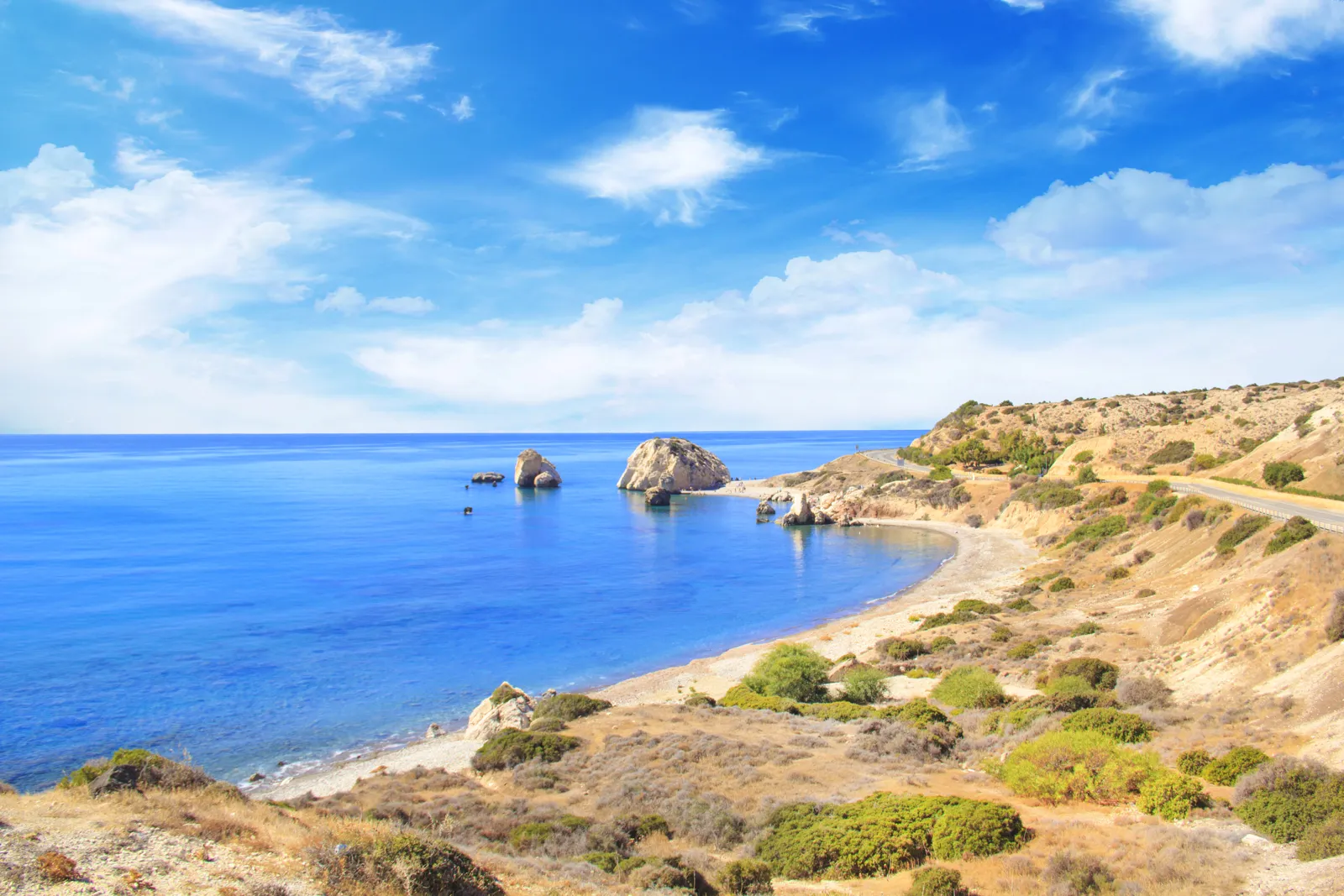
Aphrodite's Rock (Petra tou Romiou) on the south coast of Cyprus
Paphos and its mosaics
A town listed in its entirety as a UNESCO World Heritage Site, Paphos has an archaeological park with Roman mosaics among the finest in the Mediterranean, as well as the Tombs of the Kings, a necropolis carved into the rock. The harbor, its fort and the old town can be explored on foot. Paphos is also the best base for the west of the island.
The Akamas peninsula and the Baths of Aphrodite
At the northwestern tip, the Akamas is the wildest region in the south of the island: scrub-covered hills, coves and waymarked trails starting from the Baths of Aphrodite, near Polis. The Blue Lagoon, a cove with clear water, can be reached by boat or 4×4. Spring or autumn is best for walking.
Aphrodite’s Rock and Kourion
Between Paphos and Limassol, the coast offers two classic stops: Petra tou Romiou, the rock where legend says Aphrodite was born, and the ancient site of Kourion, with its Greco-Roman theater facing the sea and its houses with mosaics. The Sanctuary of Apollo Hylates is nearby.
Limassol
The country’s second city, Limassol combines a long seafront, a marina, a medieval castle and a lively old town. It is a convenient base for Kourion, the wine villages in the Troodos foothills and the south coast.
The Troodos mountains and their painted churches
In the west-center of the island, the Troodos rises to Mount Olympus. Its pine forests, stone villages (Omodos, Kakopetria, Platres) and Byzantine churches with frescoes, ten of them UNESCO-listed, make it the ideal escape from the summer heat. Kykkos Monastery is one of the most important on the island. Allow at least one night there: the roads are winding.
Larnaca
Close to the main airport, Larnaca is a pleasant seaside town, with the Finikoudes promenade, the Church of Saint Lazarus and, in winter, the salt lake where flamingos gather. The Hala Sultan Tekke mosque stands on the lakeshore. Larnaca is a convenient starting point for the east of the island.
Ayia Napa, Protaras and Cape Greco
In the east, Ayia Napa and Protaras have the island’s busiest pale-sand beaches, with lively nightlife in Ayia Napa in summer. Cape Greco nature park offers cliffs, sea caves and coastal trails. The area is very popular from June to September: book early.
Nicosia, a divided capital
Nicosia is the last divided capital in Europe. In the southern part, the old town within its Venetian walls is home to the Cyprus Museum, rich in antiquities, and pedestrian Ledra Street. The Ledra Street crossing point, for pedestrians only (UK FCDO), leads to the northern part of the city: bring your passport. Do not take photographs near military buildings, as you could be arrested (UK FCDO).
The north: Kyrenia, Famagusta, Salamis
The north of the island has well-known sites: Kyrenia harbor, Bellapais Abbey, St. Hilarion Castle, the walled old town of Famagusta and the ancient ruins of Salamis. US citizens can cross at recognized checkpoints by showing a valid passport and stay for less than 90 days (U.S. Department of State); the Republic of Cyprus counts time spent in the north toward the 90-day limit (UK FCDO). Consular support there is limited. If you cross by car, you need separate insurance, which can be bought at the crossing points, as insurance from the south is not valid in the north (U.S. Department of State).
Things to do in Cyprus: experiences not to miss
See the Paphos mosaics and the Tombs of the Kings
Explore the Akamas peninsula and its coves
Visit the ancient site of Kourion and its theater facing the sea
Follow the painted churches route in the Troodos and its villages
Cross Nicosia via the Ledra Street crossing point
Swim at Cape Greco and on the beaches of Ayia Napa and Protaras
Share a meze and try grilled halloumi
Itinerary ideas for Cyprus
Cyprus in 7 to 10 days
Days 1 to 3: Paphos (archaeological park, Tombs of the Kings, old town), with a day in the Akamas
Day 4: Aphrodite’s Rock and Kourion, night in Limassol
Days 5 and 6: the Troodos (Omodos, painted churches, Kykkos, hiking)
Day 7: Nicosia, the old town and the Cyprus Museum
Days 8 to 10: Larnaca and the east coast (Cape Greco, Protaras beaches)
Cyprus in 2 weeks
Days 1 to 4: Paphos, the Akamas, Polis and the Baths of Aphrodite
Days 5 and 6: Kourion, Aphrodite’s Rock and Limassol
Days 7 to 9: the Troodos, its villages and churches, with one or two hikes
Days 10 and 11: Nicosia, and the northern part of the city on foot via the Ledra crossing if you wish
Days 12 to 14: Larnaca, Ayia Napa, Protaras and Cape Greco
Budget for a trip to Cyprus
Prices in Cyprus are comparable to southern Europe, with big variations between the summer beach season and winter. Indicative amounts per person per day, excluding flights:
Item
Budget
Comfort
Accommodation (based on a shared double room)
roughly €30–50
roughly €70–150
Meals
roughly €25–35
roughly €45–80
Transport (bus or share of a rental car)
roughly €10–15
roughly €20–35
Activities and sightseeing
roughly €5–10
roughly €15–30
Total per day
roughly €70–110
roughly €150–280
Indicative estimates. Accommodation prices peak in July–August and around Orthodox Easter.
Getting around Cyprus
Rental car: the most practical option for the Akamas, the Troodos and the villages. Traffic drives on the left; modern motorways link the major cities, but secondary roads in the mountains are narrow and winding, and speeding and tailgating are common (U.S. Department of State, travel.state.gov, last updated August 13, 2026). A UK photocard licence is valid in Cyprus (UK FCDO, GOV.UK, updated 14 August 2026).
Your passport: rental companies sometimes ask for your passport as a deposit, which is illegal: never hand it over (UK FCDO).
Bus: intercity lines link the main towns (Nicosia, Limassol, Larnaca, Paphos, Ayia Napa) and the airports. They rarely serve mountain villages.
Taxis: plentiful in towns; shared taxis also link some cities.
Crossing to the north: on foot in Nicosia (Ledra Street, Ledra Palace) or by car at the road crossing points, with separate insurance bought at the crossing. Cars hired in the south often have no insurance cover in the north: check with your rental company that the vehicle may cross the line.
Where to stay in Cyprus
For a first trip, split your stay between two or three bases: Paphos for the west and the Akamas, a Troodos village for the mountains, and Larnaca or Protaras for the east. Limassol is a central alternative, convenient for day trips. Ayia Napa mostly suits beach and party stays in summer.
Options range from large beach resorts to apartments, restored guesthouses in agrotourism villages and small mountain hotels.
Entry requirements for Cyprus
Cyprus is in the EU but not in the Schengen area. Entry requirements checked on 24 October 2026; check them again before you travel.
US citizens
According to the U.S. Department of State (travel.state.gov, last updated August 13, 2026), you may enter the Republic of Cyprus for up to 90 days for tourism or business without a visa; longer stays require a temporary residency visa.
Your passport should be valid for at least three months beyond your stay.
Enter only via Larnaca or Paphos airports or the ports of Limassol, Larnaca and Paphos.
UK citizens
According to the UK FCDO (GOV.UK, updated 14 August 2026), you can travel without a visa to Cyprus for up to 90 days. Because Cyprus is not in the Schengen area, time there does not count toward your Schengen limit, and the Entry/Exit System (EES) does not apply.
Your passport must have been issued less than 10 years before you arrive, be valid for at least 3 months after the day you plan to leave, and have at least one blank page for stamps. Make sure it is stamped on entry and exit.
Entering the Republic of Cyprus via the north (such as Ercan Airport) is considered illegal entry.
Health and safety
Goods from the north: there are controls on goods bought in the north and taken across the Green Line; for example, the Republic of Cyprus enforces a 40-cigarette limit per person, and goods can be confiscated (UK FCDO).
Health: UK travelers need a GHIC or EHIC for medically necessary state healthcare (UK FCDO); take out insurance covering medical costs and repatriation.
Safety: crime against tourists is not common (UK FCDO) and crime rates are generally low (U.S. Department of State). There is a high risk of wildfires from April to October: register your phone for emergency alerts and call 112 if you are in danger. Cyprus also experiences earthquakes and tremors (UK FCDO).
Emergencies: 112.
Practical tips for Cyprus
Money: the euro in the south, the Turkish lira in the north. Estimate your spending with our currency converter.
Internet: check your provider’s roaming rates before you leave, especially for the north, where mobile networks may be charged differently; an eSIM can be a cheaper option.
Etiquette: cover shoulders and knees to visit churches and monasteries. The partition of the island is a sensitive subject: approach it with tact.
Heat: in summer, drink plenty of water, visit sites early in the morning and bring a hat and sunscreen.
Food: try a meze, a succession of small dishes to share, and halloumi, the island’s signature cheese.
Not for a short stay if you are a US or British citizen: up to 90 days without a visa (travel.state.gov, August 13, 2026; GOV.UK, 14 August 2026). Cyprus is not in the Schengen area. UK passports must have been issued less than 10 years ago, be valid 3 months after departure and have a blank page. Checked on 24 October 2026.
Can you visit northern Cyprus?
Yes, by crossing the Green Line at the official crossing points with your passport. Consular support in the north is limited, and entering the island via Ercan Airport or northern ports is not considered legal entry by the Republic of Cyprus (UK FCDO, U.S. Department of State).
How many days do you need in Cyprus?
A week lets you see Paphos, Kourion, the Troodos and part of the coast. Allow two weeks to add the Akamas, Nicosia and the east of the island without rushing.
Do you need a car in Cyprus?
It is strongly recommended for the Troodos, the Akamas and the villages, which are poorly served by buses. Traffic drives on the left.
What is the best time to visit Cyprus?
April to June and September–October, for temperatures of 22 to 31 °C (72 to 88 °F) on the coast and a pleasant sea from late spring. July and August are very hot and very busy.
What to see in Cyprus in a week?
In a week, split your time between Paphos and the Akamas, Kourion and Aphrodite’s Rock, Limassol, the Troodos and its painted churches, and Nicosia. Leave Larnaca and Cape Greco for the end of the trip.
How much does a week in Cyprus cost?
Based on our per-person daily estimates (roughly €70–110 on a budget, €150–280 in comfort), a week on the ground comes to roughly €490–770 on a budget and €1,050–1,960 in comfort, excluding international flights.
Our sources
Entry, health, safety and driving information read on 24 October 2026: U.S. Department of State, Cyprus country information (travel.state.gov, last updated August 13, 2026), and UK FCDO, foreign travel advice for Cyprus (GOV.UK, updated 14 August 2026)
Climate normals: published by the Cyprus Department of Meteorology for the Larnaca, Paphos, Limassol, Nicosia and Prodromos (Troodos) stations (reference period not specified by the source)
Other Mediterranean destinations: Malta, Greece and Crete, and all our destinations in Europe.
Transparency: this page contains affiliate links, labelled as such. If you book through them we may earn a commission at no extra cost to you; it does not influence our content or recommendations. How we fund the site.