Singapore is a city-state a few dozen kilometers across, at the southern tip of the Malay Peninsula. A few metro stops take you from the Marina Bay skyscrapers to the Chinese, Indian and Malay districts, and on to tropical gardens. Clean, safe and very well organized, it is an ideal destination for a stopover of a few days in Asia. What to do in Singapore, how many days to plan, what budget: this Singapore travel guide brings together the essentials for planning your stay. The bay’s iconic hotel has its own page: visiting Marina Bay Sands.
To locate districts, terrain, nature reserves and the airport, see our map of Singapore.
Singapore at a glance
CapitalSingapore (city-state)
LanguagesEnglish, Malay, Mandarin and TamilEnglish is the everyday working language
Singapore can be visited all year round: afternoon temperatures reach 30 to 32 °C (86 to 90 °F) every month. The least rainy months are February, March and April, and June to September. November, December and January are the wettest, with sometimes continuous rain at the start of the northeast monsoon. Some years, smoke from forest fires in Indonesia degrades air quality: the UK FCDO (GOV.UK, updated 19 March 2026) places this haze risk between June and October. All the details, month by month and with official climate data, are in our article best time to visit Singapore. These haze episodes follow the Indonesian dry season, described on our page best time to visit Indonesia.
Things to do in Singapore: the highlights
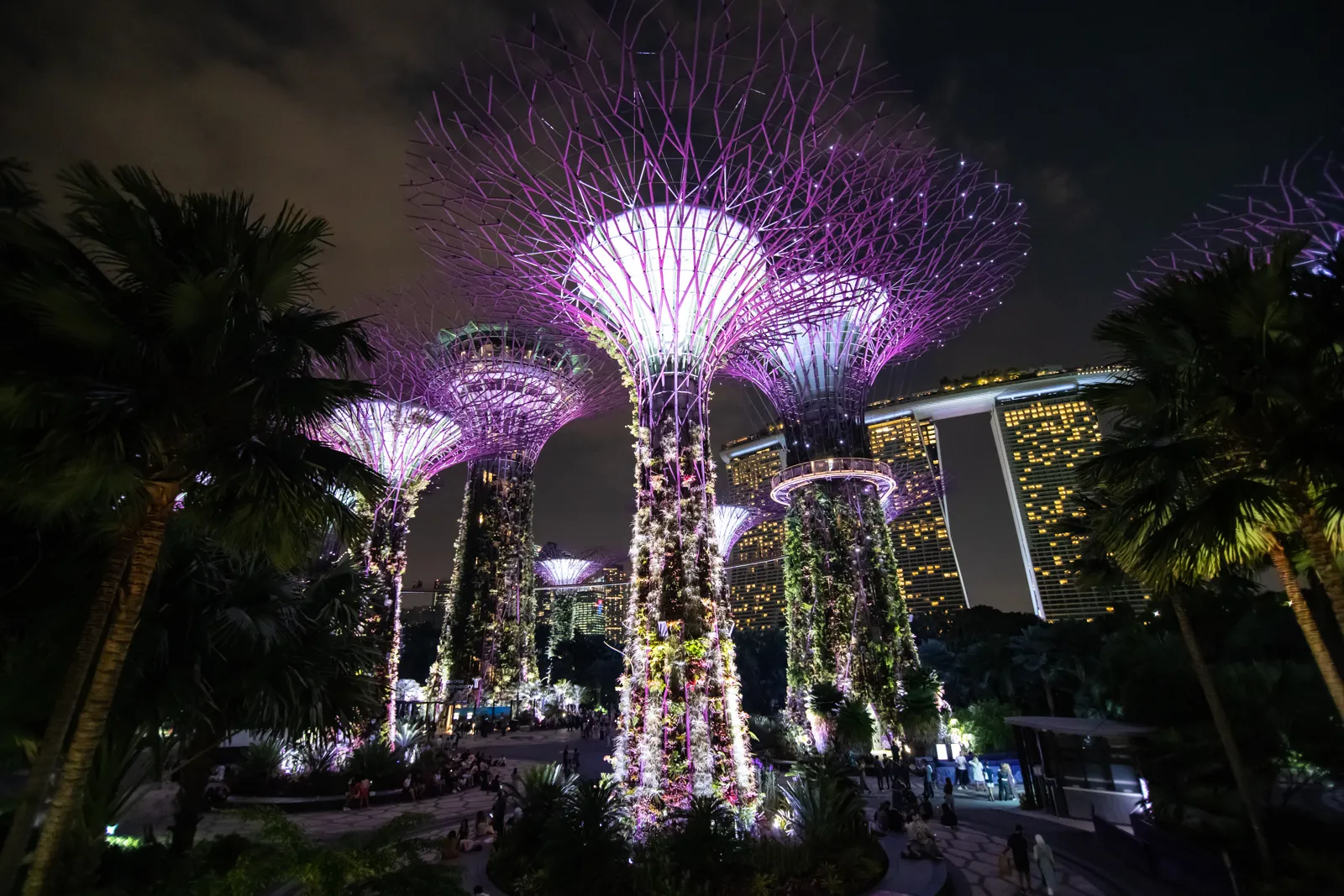
The Supertrees of Gardens by the Bay lit up at night in Singapore
Marina Bay
The postcard Singapore: Marina Bay Sands and its observation deck, the Merlion facing the bay, the lotus-shaped ArtScience Museum and the promenade around the bay. In the evening, a free light and water show is staged on the waterfront. The neighboring historic district around the Padang has the National Gallery, the Asian Civilisations Museum and the lively riverbanks of Clarke Quay and Boat Quay. Before you leave, check the entry requirements in our guide do you need a visa for Singapore?.
On the bay, our page on Marina Bay Sands covers SkyPark tickets, opening hours and the Spectra show.
Gardens by the Bay
Just behind Marina Bay, this large park is known for its « Supertrees », plant-covered metal structures that light up every evening. Two large air-conditioned conservatories, the Flower Dome and the Cloud Forest with its indoor waterfall, charge admission. The outdoor gardens are free.
Chinatown
Among shops, colorful shophouses and food centers, Chinatown is home to the Buddha Tooth Relic Temple, the Sri Mariamman Temple, Singapore’s oldest Hindu temple, and Chinatown Complex, one of the city’s great hawker centres. It is the best place to experience Chinese New Year.
Little India and Kampong Glam
Little India is the city’s liveliest and most colorful district: temples, flower garlands, grocery stores and South Indian restaurants, with Tekka Centre for a quick meal. A few minutes’ walk away, Kampong Glam, the former Malay and Arab quarter, centers on the Sultan Mosque, with pedestrian Haji Lane and its boutiques. Little India sometimes inspires a trip to the real thing: the best time to visit India depends heavily on the monsoon and the region.
The Botanic Gardens
A UNESCO World Heritage Site, the Singapore Botanic Gardens is a vast free park, ideal for a morning walk. It includes the National Orchid Garden (admission charged), which displays hundreds of species and hybrids. It lies close to Orchard Road, the main shopping avenue.
Sentosa
Linked to the main island by a boardwalk, a monorail and a cable car, Sentosa island is devoted to leisure: developed beaches, theme parks, an aquarium and hotels. It is a favorite day out for families. Allow a full day.
Nature reserves and Pulau Ubin
Singapore has kept patches of rainforest surprisingly close to the center. Around MacRitchie Reservoir, trails and a canopy suspension bridge let you spot monkeys and monitor lizards; do not feed the monkeys. Pulau Ubin island, a few minutes by boat to the northeast, can be explored by bike and has kept a fishing village.
Singapore Flyer and the Peranakan Museum
On Marina Bay, the Singapore Flyer is a 165 m (541 ft) observation wheel: a ride in its glass capsules lasts about 30 minutes and offers a 360° view over the bay. To understand the city’s mixed culture, the Peranakan Museum, on Armenian Street in the colonial district, presents the art and traditions of the Peranakan communities; it is open daily.
Singapore Zoo and the Night Safari
In the north of the island, Mandai Wildlife Reserve brings together Singapore Zoo, Bird Paradise, River Wonders and the Night Safari, billed as the world’s first nocturnal wildlife park. It opens every evening from 6 p.m. to midnight (last entry 11:15 p.m.): you explore it by tram or on walking trails. Combined tickets let you do the zoo by day and the Night Safari in the evening.
Bukit Timah Nature Reserve
Bukit Timah Hill, 163 m (535 ft), is Singapore’s highest natural point. Its reserve protects one of the island’s rare patches of primary rainforest and is one of the country’s two ASEAN Heritage Parks. Set off early in the morning, before the heat and the afternoon storms.
Eat at a hawker centre
Hawker culture, those food halls where dozens of stalls serve Chinese, Malay and Indian dishes at low prices, has been on UNESCO’s Intangible Cultural Heritage list since 2020. Chinatown Complex, Tekka Centre in Little India and Maxwell Food Centre near Chinatown are good places to start: a meal there is one of the things to do in Singapore, whatever your budget.
Jewel Changi
Attached to the Changi Airport terminals, this complex has an indoor waterfall surrounded by a multi-level forest. It is accessible without going through departure controls: an easy visit at the start or end of your stay.
Itinerary ideas for Singapore
3 days: the essentials of Singapore
Day 1: Marina Bay, the Merlion, Gardens by the Bay at sunset and the Supertree show
Day 2: colonial district and museums in the morning, Chinatown in the afternoon, dinner at a hawker centre
Day 3: Botanic Gardens early in the morning, Little India and Kampong Glam, evening on the quays
5 to 7 days: city, nature and leisure
Days 1 to 3: the program above
Day 4: Sentosa
Day 5: MacRitchie Reservoir in the morning, Orchard Road in the afternoon
Day 6: Pulau Ubin by bike
Day 7: Jewel Changi before your flight
10 days to 2 weeks: Singapore and a neighboring country
Days 1 to 3: Singapore
Days 4 to 14: Malaysia (Kuala Lumpur, Malacca, Penang or Langkawi) by road or by air, or Bali on a regional flight, depending on the season
Singapore is one of the most expensive destinations in Asia, especially for accommodation. Food, on the other hand, can stay very affordable in the hawker centres. Indicative amounts per person per day, excluding international flights (converted from our euro estimates at the ECB rate of 23 October 2026, €1 = S$1.43):
Item
Budget
Comfort
Accommodation (based on a shared double room)
roughly S$43–86 (hostel, basic hotel)
roughly S$170–360
Meals
roughly S$21–36 (hawker centres)
roughly S$72–143
Local transport
roughly S$7–14
roughly S$21–43
Activities and sightseeing
roughly S$21–43
roughly S$43–86
Total per day
roughly S$100–170
roughly S$285–570
Indicative estimates. Hotel prices rise sharply over the holidays, Chinese New Year and the Formula 1 Grand Prix.
To keep costs down: eat in the hawker centres, make the most of the many free sights (the Botanic Gardens, the outdoor gardens of Gardens by the Bay, the Marina Bay light shows, the historic districts) and use public transport.
Getting around Singapore
Metro (MRT): fast, air-conditioned and extensive, it serves Changi Airport and most sights. You can pay directly with a contactless bank card. The U.S. Department of State (travel.state.gov, last updated March 12, 2026) describes public transport and taxis as abundant, inexpensive and reliable.
Buses: the network complements the metro, with the same payment options.
Taxis and ride-hailing: plentiful and reliable, with apps such as Grab. Fares are higher at peak times and at night.
On foot: pleasant early in the morning and in the evening; during the day, the heat and storms make the covered walkways and malls that link many districts more appealing.
Driving: Singapore drives on the left (U.S. Department of State). UK licence holders can drive on their licence for up to 30 days, then need a 1949 International Driving Permit obtained in the UK (GOV.UK).
To Malaysia: cross-border buses and trains link Singapore with Johor Bahru and beyond, and many regional flights leave from Changi.
Singapore airport transfer (Changi): MRT, bus, taxi and private transfer
Changi Airport is in the east of the island. The airport’s official website lists four ways to reach the city: metro (MRT), public buses, taxis and ride-hailing, and a transfer service booked at the Ground Transport Concierge counter, open 24 hours.
MRT: change required
Changi Airport station is connected to Terminals 2 and 3. For the center you must change: at Tanah Merah for the East West Line toward Tuas Link, or at Expo for the Downtown Line. According to the airport, the first train to Tanah Merah leaves at 5:31 a.m. Monday to Saturday (5:59 a.m. on Sundays and public holidays); the last train connecting toward Tuas Link leaves at 11:18 p.m. You pay by contactless bank card or transit card; the airport notes that foreign bank cards incur an administration fee.
Public buses
At Terminals 1, 2 and 3, the stops are in the basement, served by routes 24, 27, 34, 36, 53, 110 and 858. At Terminal 4, routes 24, 34, 36 and 110 stop near car park 4B. If paying cash, bring the exact fare: no change is given. Most buses and the MRT do not run at night.
Taxi: the official surcharges
Taxi stands are in the arrival areas of Terminals 1 to 4. The airport says a trip to the city « takes about 30 minutes » and costs between S$25 and S$45 on the meter. On top of that come an airport surcharge of S$8 from 5 p.m. to 11:59 p.m. and S$6 at other times, +50% from midnight to 5:59 a.m., and +25% at peak times (weekdays 6 a.m. to 9:29 a.m., weekends and public holidays 10 a.m. to 1:59 p.m., and every evening 5 p.m. to 11:59 p.m.). Ride-hailing services (Grab, Gojek, Zig, Tada, Ryde, Geolah) are booked in their apps, with pick-up at dedicated points.
Option
Where to get it
Official fare
Source
MRT
Changi Airport station (T2, T3)
Contactless payment or card (fee for foreign cards)
changiairport.com
Buses 24, 27, 34, 36, 53, 110, 858
Basement of T1–T3; T4 near the car parks
Exact fare required in cash
changiairport.com
Taxi
Arrivals at T1 to T4
About S$25–45 + surcharges
changiairport.com
Ground Transport Concierge transfer
Airport counter, 24 hours
S$70 (4 seats), S$75 (6 seats)
changiairport.com
Booking a private transfer in Singapore
A private transfer booked in advance is useful if you arrive late at night, travel as a family or with a lot of luggage, or if your accommodation is far from bus and train lines. Before paying, check: the total price (tolls, luggage, child seats, night surcharge), the meeting point at the airport, flight tracking in case of delay, the waiting time included and the cancellation terms. Compare with the official fares in the table above: for a solo traveler with light luggage, public transport is often enough. At Changi, the official Ground Transport Concierge counter charges a fixed price per vehicle to any destination in Singapore (except surcharges for a few industrial areas): it is the benchmark for comparison.
Source: Changi Airport, « Leaving the airport » page (MRT, buses, taxis, ride-hailing, transfers), checked on 24 October 2026.
Where to stay in Singapore
Marina Bay and the colonial district are the most convenient for sightseeing, but also the most expensive. Chinatown offers a good compromise, with hotels in former shophouses and plenty of restaurants. Little India and Kampong Glam have the most affordable accommodation, including hostels, while staying close to the metro. Orchard Road suits shoppers, and Sentosa families who want leisure and the beach.
Rooms are often small for the price. Check whether there is a window (some entry-level rooms have none) and the walking distance to the nearest metro station. According to the UK FCDO, strict laws prevent private homes from being used for short-term rentals, including for tourists.
Entry requirements for Singapore
US citizens
According to the U.S. Department of State (travel.state.gov, last updated March 12, 2026), you do not need a visa for tourist or business visits of up to 90 days. Your passport must be valid for at least six months beyond your intended stay. All travelers must submit the free SG Arrival Card, with an electronic health declaration, no more than three days (including the day of arrival) before arriving.
UK citizens
According to the UK FCDO (GOV.UK foreign travel advice, updated 19 March 2026), British citizens can visit without a visa for tourism or business; the length of stay is set by the immigration officer and is normally between 30 and 90 days. Your passport must have an expiry date 6 months after the date you arrive. You must complete the electronic SG Arrival Card in the 3 days before arrival; overstaying can lead to fines, imprisonment, caning and deportation.
Drug screening: you can be screened for drugs on arrival, even in transit, and charged even if the drugs were taken in another country where they are legal (GOV.UK). Penalties include prison, caning and the death penalty.
Prohibited items: e-cigarettes and vaporizers, chewing gum for sale, weapons and replica guns, among others (GOV.UK).
Vaccines: a yellow fever certificate is required if you arrive from, or have been in the previous six days in, a country with a transmission risk (GOV.UK).
Medication: check whether you need approval from the Health Sciences Authority, and carry medication in its original packaging with your prescription (GOV.UK and U.S. Department of State).
Entry requirements checked on 24 October 2026; check them again before you travel.
Health and safety
Health: health risks include dengue, Zika and chikungunya (GOV.UK). Healthcare is of a high quality and expensive (GOV.UK); hospitals may require payment up front (U.S. Department of State). Insurance covering medical costs and evacuation is strongly recommended.
Safety: violent crime and theft are rare (GOV.UK), but online and phone scams are common. Terrorist attacks cannot be ruled out.
Strict laws: jaywalking, littering or spitting can lead to arrest, vandalism to caning (U.S. Department of State). Drinking alcohol in public places is illegal between 10:30 p.m. and 7 a.m., and Geylang and Little India are liquor control zones (GOV.UK). Foreigners who are not permanent residents may not attend outdoor demonstrations.
Passport: you may be taken in for questioning if you do not have your passport with you (U.S. Department of State).
Emergencies: ambulance and fire 995, police 999.
Practical tips for Singapore
Money: bank cards are accepted almost everywhere, including on the metro. Keep a little cash for some hawker stalls. Our currency converter helps you estimate your spending.
Internet: the mobile network is excellent and Wi-Fi is widespread. A local SIM card or an eSIM is handy for transport apps.
Hawker centres: these food halls gather dozens of low-cost stalls. Locals sometimes reserve a table by leaving a packet of tissues on it: choose another seat.
Etiquette: do not eat or drink on the metro, do not drop litter (police can issue on-the-spot fines, according to GOV.UK) and cross at designated crossings.
Smoking: it is banned in all public parks and beaches, and Orchard Road is a no-smoking zone (GOV.UK).
Places of worship: cover shoulders and knees, and take off your shoes in temples and mosques.
Climate: bring light clothing, an umbrella and a light sweater for air-conditioned places, which are often very cool.
Who is Singapore for?
Stopover: yes, it is the ideal use: clean, safe and very well organized, with the essentials in three days and Jewel Changi accessible without going through security.
Families: yes: Sentosa is a favorite family outing, with the zoo, Bird Paradise and the Night Safari as extras.
Food lovers: yes: the hawker centres, on UNESCO’s Intangible Cultural Heritage list, serve Chinese, Malay and Indian dishes at low prices.
Nature: yes, as an extra: the Botanic Gardens, the MacRitchie and Bukit Timah reserves, Pulau Ubin by bike.
Budget travelers: so-so: roughly S$100–170 a day, as accommodation is expensive; hawker centres and the many free sights keep the bill down.
Beach: not ideal: the developed beaches are mainly on Sentosa; for the sea, combine Singapore with Malaysia or Bali.
Singapore pass: Go City or Singapore Tourist Pass?
Two cards come up when you search for a « Singapore pass ». The Go City Singapore pass bundles paid attractions; the Singapore Tourist Pass, « a product by SimplyGo », covers public transport. They do different things and can be combined.
Go City option
How it works
Validity
Starting price shown
Essentials
1 headline attraction (Gardens by the Bay, Big Bus, zoo or Night Safari) + 2 others
30 days after activation
from SGD 99
Explorer
Choice of a set number of attractions
30 days after activation
from SGD 134
All-Inclusive
Unlimited for the chosen duration
Chosen duration
from SGD 299
According to gocity.com/fr/singapore, accessed on 24 October 2026.
Go City lists more than 50 attractions, including the Gardens by the Bay domes (Flower Dome and Cloud Forest), the zoo, the Night Safari, River Wonders, Bird Paradise, the cable car (SkyPass), DUCKtours and the Canopy Park at Jewel Changi. An unactivated pass is refundable within 90 days of purchase, according to the same page.
For transport, the Singapore Tourist Pass gives unlimited rides on basic bus services, MRT and LRT: SGD 17 (1 day), SGD 24 (2 days) or SGD 29 (3 days) on its official website on 24 October 2026; days must be consecutive, and premium services (Sentosa Express, express buses) are excluded. Compare it with contactless bank card payment, accepted on the metro: for a few trips a day, that may be enough.
Method: list the paid attractions you would visit anyway, note their prices on their official websites, add them up and compare with the Go City price for your option. The zoo, the Night Safari and Bird Paradise weigh heavily: without them, the pass rarely pays off.
Buying a pass for Singapore
Buy from the issuer or from a reseller that clearly names the product, and check the option, any timed reservations required by some attractions and the refund terms.
Sources: Go City, « Singapore » page (gocity.com/fr/singapore); Singapore Tourist Pass, « Type of passes » (thesingaporetouristpass.com.sg); checked on 24 October 2026.
Frequently asked questions
Do I need a visa for Singapore?
No, not for US or British tourists. US citizens can stay up to 90 days visa-free with a passport valid six months beyond the stay (travel.state.gov, last updated March 12, 2026); for British citizens, the stay is set on arrival, normally 30 to 90 days, with a passport valid 6 months after arrival (GOV.UK, updated 19 March 2026). Everyone must complete the SG Arrival Card online within the 3 days before arrival. Checked on 24 October 2026.
How much does a trip to Singapore cost?
Excluding international flights, allow roughly S$100–170 per person per day on a budget and S$285–570 in comfort. Accommodation is the biggest expense; meals can stay cheap in the hawker centres.
How many days do you need in Singapore?
Three days are enough for the essentials, and five to seven days let you add Sentosa, the nature reserves and Pulau Ubin. Singapore is often combined with Malaysia, Bali or Thailand.
What is the best time to visit Singapore?
February to April and June to September are the least rainy periods. November, December and January are the wettest, but the city can be visited all year round.
What should you not miss in Singapore?
Marina Bay and the Merlion, Gardens by the Bay and its Supertrees, the Chinatown, Little India and Kampong Glam districts, the UNESCO-listed Botanic Gardens and Sentosa island. Add a meal at a hawker centre and, in the evening, the Night Safari.
What to do in Singapore in 3 days?
Day 1: Marina Bay and Gardens by the Bay at sunset. Day 2: the colonial district and museums, then Chinatown. Day 3: the Botanic Gardens in the morning, Little India and Kampong Glam. With an extra evening, add the Night Safari.
Is Singapore safe?
Yes. Violent crime and theft are rare, according to the UK FCDO. The main points to watch are the very strict laws (drugs, littering, alcohol in public), scams, storms and, some years, haze from forest fires in neighboring countries.
Meteorological Service Singapore (National Environment Agency), 1991–2020 climate normals and climate description
Official websites of Changi Airport, Visit Singapore (Singapore Flyer), the Peranakan Museum, Mandai Wildlife Reserve (Night Safari), NParks (Bukit Timah), UNESCO (hawker culture), Go City and the Singapore Tourist Pass, accessed in October 2026
European Central Bank, euro foreign exchange reference rates of 23 October 2026 (budget conversion)
Transparency: this page contains affiliate links, labelled as such. If you book through them we may earn a commission at no extra cost to you; it does not influence our content or recommendations. How we fund the site.