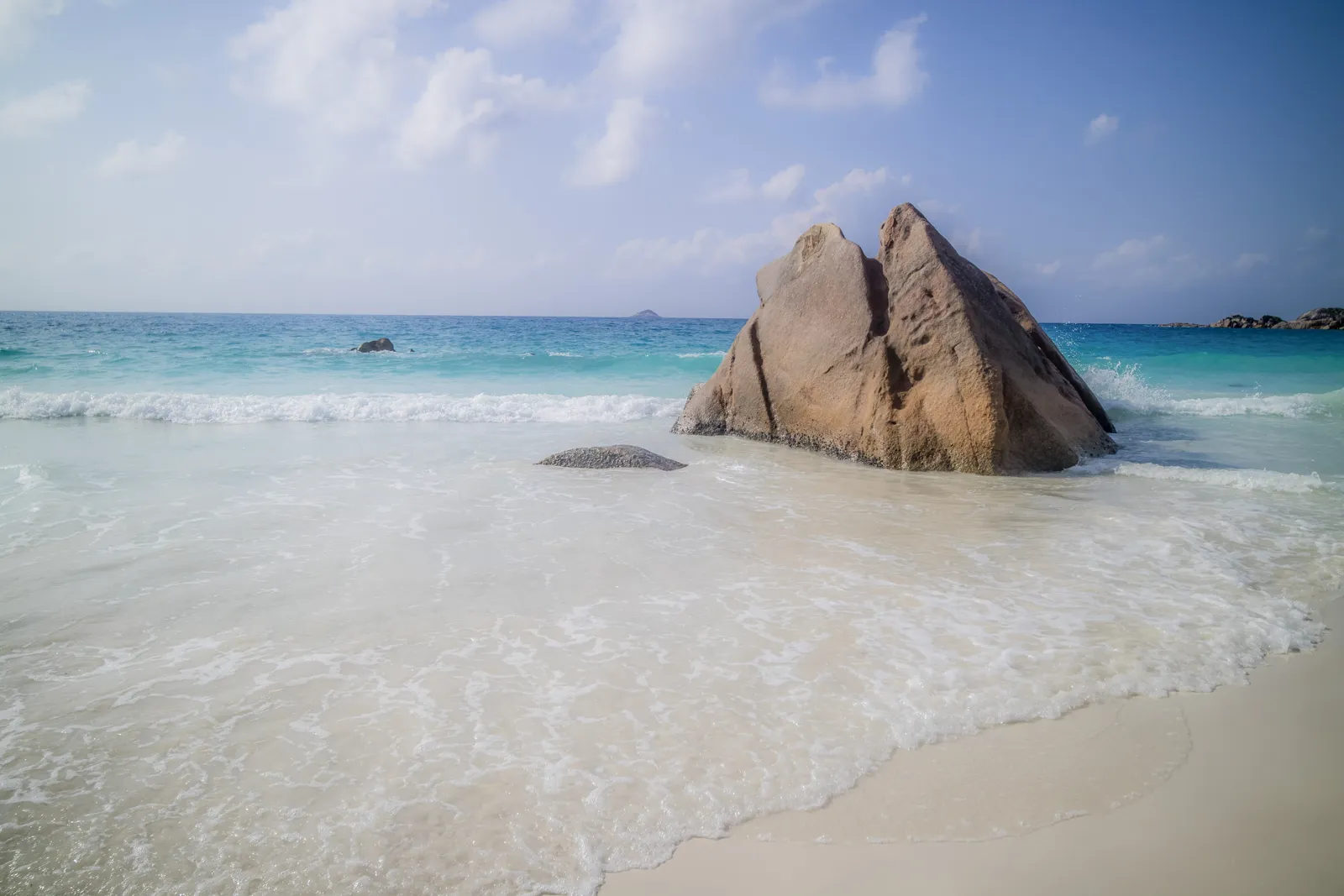
The Maldives are made up of nearly 1,200 coral islands spread across 26 natural atolls, southwest of India. People come for the lagoons, snorkeling and diving, staying in a hotel that occupies its own island or, more and more often, on a local island with a more moderate budget. To plan a trip to the Maldives, two choices come first: the type of stay (resort island or local island), which sets the budget, and the season, with January to April the driest. This Maldives travel guide gathers the essentials: atolls, activities, budget, transfers and entry requirements.
To locate cities, regions, terrain, national parks and airports, see our map of the Maldives.
The Maldives at a glance
CapitalMalé
LanguageDhivehiEnglish is spoken in hotels and guesthouses
Currencythe Maldivian rufiyaa (MVR) · currenciesResorts usually bill in US dollars
Time zoneUTC+5, no daylight saving · details5 h ahead of London and 10 h ahead of New York in winter
AirportsMalé, Velana International (MLE)Most routes involve a connection; check current routes with the airlines
EntryUS and UK: free 30-day visa on arrival, IMUGA declaration within 96 hours · travel.state.gov · GOV.UK
Electricitycheck the voltage and plug type before you travel · plugs
The best time is from January to April, during the northeast monsoon: this is the dry season, with calm seas and the most sunshine, but also the highest prices. From May to November, the southwest monsoon brings more frequent showers and rougher seas, with lower rates and the manta ray season in Baa Atoll. The heat is constant, around 30–32 °C (86–90 °F) all year. All the details, atoll by atoll and with official climate data, are in our article best time to visit the Maldives.
Resort islands or local islands: two ways to travel
This is the first choice to make, because it determines the budget, the atmosphere and the rules to follow.
Resort islands: a single property occupies the whole island. You sleep, eat and book your activities on site. Alcohol is served and beachwear is fine. It is the simplest and most comfortable option, but also the most expensive: on top of the room rate come meals (often half board, full board or all-inclusive), the transfer and taxes. The choice of atoll and transfer matters a lot.
Local islands: since guesthouse tourism was opened up in the early 2010s, guesthouses and small hotels have developed on the islands inhabited by Maldivians. Prices are much lower and you get a glimpse of everyday life in the archipelago. In return, alcohol is banned, covered clothing is expected outside the beaches set aside for tourists (« bikini beaches »), and comfort is simpler. Day trips let you snorkel on nearby reefs or spend a day at a resort.
A mix is possible: a few nights on a local island, then the end of the stay at a resort.
Overwater bungalows: how to choose
Aerial view of a Maldives resort island and its overwater villas
Overwater villas (« water villas ») are built above the lagoon, with a deck and usually direct access to the water by a ladder. They have become the image of the Maldives, but they are not all equal.
The different types
Classic overwater villa: bedroom, bathroom and deck above the water, lagoon access by a ladder
Overwater villa with pool: a private pool on the deck, useful if the lagoon is shallow at low tide
« Sunset » or « sunrise » villa: the same villa, facing west or east; west-facing ones are usually more expensive
Villas at the end of the jetty: more secluded and quieter, but further from the restaurant and the beach
Alternatives: the beach villa, often cheaper and at ground level on the sand, popular with families with young children
What drives the price
The season: the gap between high season (Christmas, February–March, Easter) and the wet season can be large
The transfer: a seaplane costs much more than a speedboat from the airport, and it is charged per person
The meal plan: on an isolated island there is no option other than the resort’s restaurants; a half-board or all-inclusive package is often cheaper than eating à la carte
Taxes: advertised prices do not always include the service charge, the tourism tax and the green tax, charged per night and per person
The rest: villa size, private pool, orientation, hotel category and the condition of the reef around the island
Our tips for choosing
Look at the quality of the house reef: a reef close to the villas lets you snorkel straight from your deck.
Check the depth of the lagoon under the villas: some lagoons are very shallow at low tide, and the ladder is then of little use.
Compare the total price (villa + transfer + meals + taxes), not just the nightly rate.
With young children, an overwater villa calls for constant attention: many resorts set a minimum age, so ask first.
To cut costs, combine a few nights in a beach villa with a few nights over the water, or book in the wet season.
Things to do in the Maldives
Most of a stay is spent in or beside the water. The main activities, depending on the atoll and the season:
Snorkeling: on your island’s house reef, or on trips to nearby reefs from the local islands.
Diving: channels with sharks and rays (Ari, Vaavu), tiger sharks at Fuvahmulah for experienced divers, the British Loyalty wreck at Addu.
Whale sharks: in the south of Ari Atoll, seen all year, often from Dhigurah or Maamigili.
Manta rays: at Hanifaru Bay (Baa Atoll), usually from June to November, on guided snorkeling trips only.
Surfing: North Malé Atoll has most of the archipelago’s main breaks.
Boat trips: dolphin watching, a picnic on a sandbank, depending on the operator.
Malé: a few hours between transfers for the coral-stone Old Friday Mosque and the markets.
Local life: on an inhabited island, respecting the dress rules and the alcohol ban.
Try Maldivian food
It is based on tuna, coconut and rice. The national dish is garudhiya, a fish broth, usually made with tuna and served with rice. Mas huni combines finely shredded tuna and grated coconut, eaten with a flatbread (roshi). Rihaakuru is a thick tuna paste, and hedhika are small snacks, often with tuna, served in the cafés of local islands.
Where to go in the Maldives: the main atolls
Malé
The very dense capital occupies a small island linked to the airport and to Hulhumalé by a bridge. You can spend a few hours there between transfers: the Old Friday Mosque (Hukuru Miskiy), built of coral stone, the fish market and the fruit and vegetable market, Sultan Park. Hulhumalé, a newer district, has convenient accommodation for an arrival or departure night.
North and South Malé Atolls (Kaafu)
The closest to the airport, reached by speedboat in 20 minutes to just over an hour. They have many resort islands and the most touristy local islands, such as Maafushi, Guraidhoo and Himmafushi. North Malé Atoll is also the archipelago’s main surfing area.
Ari Atoll (Alifu)
West of Malé, one of the best-known atolls for diving. Its southern tip is known for whale sharks, seen all year, often on trips from the local island of Dhigurah or from Maamigili. Manta rays also visit several sites in the atoll. Access by seaplane, or by speedboat and domestic flight depending on the island.
Baa Atoll
A UNESCO biosphere reserve, Baa Atoll is home to Hanifaru Bay, where manta rays gather in large numbers to feed on plankton, usually from June to November. The site is protected: only snorkeling with an approved guide is allowed, under strict rules. Access by seaplane or by domestic flight to Dharavandhoo.
Vaavu Atoll
Sparsely populated, south of South Malé, Vaavu is popular with divers for its channels full of sharks and rays. The local island of Fulidhoo has a few guesthouses in a very quiet setting.
Raa Atoll and the northern atolls
Further away, the northern atolls (Raa, Lhaviyani, Noonu, Haa Alifu…) have newer resorts, often far from any other island. They have the most pronounced dry season in the archipelago. Access is by seaplane or by domestic flight followed by a boat ride.
The southern atolls: Laamu, Fuvahmulah and Addu
Less visited, they are reached by domestic flight. Fuvahmulah, an isolated single-island atoll, is known among experienced divers for its tiger sharks. Addu, the southernmost atoll, offers diving on the British Loyalty wreck and manta ray sites, and its islands are linked by a road.
Itinerary ideas for the Maldives
7 to 10 days: a resort island stay
Day 1: arrival in Malé and transfer by speedboat or seaplane (if your flight lands late, plan a night in Hulhumalé)
Days 2 to 8 or 9: beach, snorkeling on the house reef, one or two excursions (diving, dolphin trip, sandbank)
Last day: transfer to the airport, possibly with a few hours of sightseeing in Malé
2 weeks: local islands and a resort
Day 1: arrival, night in Hulhumalé
Days 2 to 5: Maafushi or Guraidhoo (South Malé), snorkeling and sandbank trips
Days 6 to 9: Dhigurah (South Ari) for whale sharks and manta rays
Days 10 to 13: a resort island of your choice, perhaps in an overwater villa
Day 14: back to Malé, a visit of the capital before your flight
These itineraries depend on ferry and speedboat timetables, which do not run every day between all islands: check them before booking.
Who are the Maldives for?
Our verdict by traveler profile, based on the information in this guide:
Profile
Our verdict
Why
Couples
✅ Ideal
Resort island, overwater villa, lagoon: the simplest option for a trip for two.
Diving and snorkeling
✅ Ideal
House reefs, channels with sharks and rays, whale sharks in South Ari, manta rays at Hanifaru Bay.
Families
✅ Yes
Beach villas suit families; overwater villas need constant attention, and some resorts set a minimum age.
Budget travelers
⚠️ Possible
Roughly US$90–170 a day on a local island, against at least US$280–340 at a resort.
Culture
⚠️ Limited
A few hours in Malé and life on the inhabited islands, respecting local rules.
Partying
❌ Not a good fit
No alcohol on local islands; a stay focused on the water and quiet.
Budget for a trip to the Maldives
The budget varies hugely depending on whether you stay on a local island or at a resort. Indicative amounts per person per day, excluding international flights (converted from our euro estimates at the ECB rate of 23 October 2026, roughly €1 = US$1.12; resorts usually price in US dollars):
Item
Budget (local island)
Comfort (resort island)
Accommodation (based on a shared double room)
roughly US$35–80
roughly US$170–450 and more
Meals
roughly US$15–35
roughly US$65–170 (meal plan)
Local transport
roughly US$5–45 (public ferry or shared speedboat)
round-trip transfer of roughly US$170–780 depending on the mode, spread over the stay
Activities and sightseeing
roughly US$20–65 (snorkeling trips, sandbank)
roughly US$55–170 (diving, excursions)
Total per day
roughly US$90–170
from roughly US$280–340, often much more
Indicative estimates, highly variable with the season, the atoll and the hotel category. Taxes, service charges and the green tax may be added to advertised prices.
How much does a trip to the Maldives cost for two?
Applying the ranges above to a couple for 7 nights, excluding international flights: roughly US$1,200–2,400 on a local island, and from roughly US$3,900–4,700 at a resort, often much more in an overwater villa or in high season. Flight prices depend mostly on the dates: avoiding school holidays and the high season (see best time to visit the Maldives) often lowers the bill.
Getting around the Maldives
Seaplane: serves resorts on more distant atolls directly from Malé airport. According to the U.S. Department of State (travel.state.gov, last updated October 16, 2025), seaplanes fly only in daylight, and many resorts stop boat transfers after sunset: if your international flight lands in the evening, expect a night near the airport and confirm your transfer in advance. Baggage weight is limited: check the allowance with your hotel.
Speedboat: the usual way to reach resorts and local islands in the Malé atolls, and some islands in Ari. Shared services to local islands are much cheaper than a private transfer. The UK FCDO advises paying attention to safety briefings and making sure life jackets are provided, especially on small excursion boats (GOV.UK, updated 12 August 2026).
Domestic flights: they link Malé to regional airports (Baa, Laamu, Gan, Kadhdhoo, Hanimaadhoo…), followed by a boat ride to the island; some also operate at night (travel.state.gov).
Public ferries: slow but very cheap, they link local islands on fixed timetables; some routes do not run every day, especially on Fridays.
In Malé: taxis charge a fixed fee per journey, buses cost MVR 10 per ride, and the airport is linked to Malé by road or public ferry (travel.state.gov, last updated October 16, 2025). Visitors generally do not drive; traffic drives on the left. UK drivers need the correct International Driving Permit together with their UK licence (GOV.UK).
Where to stay in the Maldives
For a resort island, choose first by transfer time (speedboat in the Malé atolls, seaplane or domestic flight beyond), then by reef, villa type and meal plan. North and South Malé suit short stays; Ari and Baa suit marine-life lovers; the northern and southern atolls suit travelers looking for more seclusion.
For a local island stay, Maafushi is the most developed (many guesthouses, a tourist beach, excursions), Guraidhoo, Thulusdhoo and Ukulhas are quieter, and Dhigurah is ideal for whale sharks. Hulhumalé works for a night before or after a flight.
Entry requirements for the Maldives, health and safety
US citizens
According to the U.S. Department of State (travel.state.gov, last updated October 16, 2025), you need a valid passport, an onward or return ticket and sufficient funds. A free 30-day visitor visa is issued on arrival. All travelers must submit a Traveler Declaration within 96 hours before travel, only on the government IMUGA site: non-government sites charging for visa services are scams. Extensions of up to 90 days are routinely approved with proof of funds and a resort or hotel stay (or a letter from a local sponsor); staying more than 60 days without authorization can bring a fine of MVR 15,000 and/or deportation. A yellow fever certificate is required for travelers over nine months old arriving from a country with a risk of transmission, including after a transit of more than 12 hours there.
UK citizens
According to the UK FCDO (GOV.UK foreign travel advice, updated 12 August 2026), you get a 30-day visa on arrival as a tourist. Your passport must have an expiry date at least one month after the date you arrive, and must not be damaged. You must complete the IMUGA traveller declaration within 96 hours before your flight arrives. A yellow fever certificate is required if you come from a country listed as a transmission risk.
The two sources differ in detail (for example on passport validity): if in doubt, check with the Maldives Department of Immigration and Emigration or the Maldivian embassy or high commission.
Customs: it is illegal to bring in anything deemed contrary to Islam, including idols for worship, pork and pork products, and alcohol (GOV.UK, updated 12 August 2026). The U.S. Department of State adds weapons, pornography and vaping devices: e-cigarettes and vaping liquids have been banned since November 15, 2024 and are confiscated, with possible fines or arrest (travel.state.gov, last updated October 16, 2025). For what you can bring home, check your home country’s customs allowances (e.g. CBP in the US, HMRC in the UK).
Health: the UK FCDO lists dengue and measles among the health risks and advises checking vaccine recommendations at least 8 weeks before the trip (GOV.UK). Medical facilities are limited: the only fully equipped hospitals are in Malé and Hulhumalé, and many resorts are several hours from emergency treatment (GOV.UK). The U.S. Department of State strongly recommends insurance covering medical evacuation and notes that tap water is not drinkable (travel.state.gov). If you dive, make sure your insurance covers it.
Diving and swimming: many resort islands are more than an hour from the nearest of the country’s 3 hyperbaric chambers: ask your dive operator how they would get you there (GOV.UK). Strong tidal currents cause drownings, and there have been fatal propeller accidents around the whale shark sites of South Ari: take local advice before swimming (GOV.UK).
Safety: crime is low on resort islands, but there is gang-related violence in Malé and Hulhumalé; avoid protests, which occasionally take place in Malé, and note that terrorist attacks cannot be ruled out (GOV.UK, updated 12 August 2026). Drug offences carry severe penalties, up to the death penalty for the most serious, and airports scan the baggage of transit passengers (GOV.UK).
Emergencies: ambulance 102, police 119, fire 118 (GOV.UK).
Entry requirements checked on 24 October 2026; they change often, so check them again before you travel.
Practical tips for the Maldives
Money: at resorts, everything is paid in US dollars and by card. On local islands, bring small US dollar bills and some rufiyaa; not every business takes cards, and ATMs are rare outside Malé and the larger islands. Our currency converter helps you estimate your spending.
Internet: Wi-Fi is available in most hotels and guesthouses. SIM cards and eSIMs can be bought at the airport on arrival, and international roaming is generally very expensive (travel.state.gov, last updated October 16, 2025).
Alcohol: only available on resort islands; do not take any out of your resort. You can be arrested and deported for possessing or drinking alcohol, or being drunk, outside resorts and on inhabited islands (GOV.UK, updated 12 August 2026). Some local islands have a bar boat anchored offshore, and alcohol is also served on licensed dive cruise boats.
Dress on local islands: the Maldives are an Islamic country. Outside resorts, including on beaches used by locals, men and women should cover their shoulders, avoid short or tight shorts and cover arms and upper legs when bathing; nudism and topless sunbathing are not allowed anywhere, including at resorts (GOV.UK). Use the signposted bikini beaches.
Local rhythm and laws: shops close briefly at prayer times, and Friday is the day of rest. During Ramadan, do not eat, drink or smoke in public in the daytime outside resorts (GOV.UK). Public observance of a religion other than Islam is illegal, and same-sex relations are illegal (GOV.UK; travel.state.gov).
Environment: do not walk on coral or touch animals. It is illegal to take coral or tortoiseshell items out of the Maldives (GOV.UK).
US and UK tourists get a free 30-day visa on arrival and must complete the IMUGA traveller declaration within 96 hours before arrival. US travelers need an onward or return ticket and sufficient funds (travel.state.gov, last updated October 16, 2025); UK travelers need a passport valid at least one month after arrival (GOV.UK, updated 12 August 2026). Checked on 24 October 2026. Our guide Maldives visa: entry requirements covers the details.
Can you visit the Maldives on a budget?
Yes, by staying on a local island: allow roughly US$90–170 per person per day, excluding flights, in a guesthouse with excursions. Alcohol is banned there and clothing must stay covered outside the beaches set aside for tourists.
How much does a night in an overwater bungalow cost?
The price varies enormously with the resort, the season and the villa type. On top of the nightly rate, add the transfer (seaplane or speedboat), the meal plan and taxes, which can make up a large share of the total budget.
What is the best time to visit the Maldives?
January to April, during the dry season of the northeast monsoon. From May to November, it rains more but prices drop, and it is manta ray season in Baa Atoll.
How much does a trip to the Maldives cost for two people?
For 7 nights, excluding flights, allow roughly US$1,200–2,400 for two on a local island, and from roughly US$3,900–4,700 at a resort, often more in an overwater villa, in high season or all-inclusive. The transfer (speedboat or seaplane) and taxes are often added to the advertised price.
Why do some people advise against the Maldives?
Mostly because of the cost: at a resort, meals, the transfer and taxes quickly add up. Local islands are cheaper, but alcohol is banned and covered clothing is expected outside tourist beaches. Healthcare is limited outside Malé and Hulhumalé, so insurance covering medical evacuation is strongly recommended (travel.state.gov; GOV.UK). Read the US and UK advice before you leave.
How do you get to the Maldives?
International flights land at Velana International Airport in Malé, usually after a connection in a major hub. Seaplanes fly only in daylight and many resorts stop boat transfers after sunset, so if you land at night, plan a night near the airport (travel.state.gov, last updated October 16, 2025).
Can you drink alcohol in the Maldives?
Yes, but only on resort islands and licensed boats. Alcohol is banned on inhabited islands, and it is illegal to bring it into the country (GOV.UK, updated 12 August 2026).
Our sources
Entry, customs, health, safety and transport information read on 24 October 2026: U.S. Department of State, Maldives country information (travel.state.gov, last updated October 16, 2025), and UK FCDO, foreign travel advice for the Maldives (GOV.UK, updated 12 August 2026)
Transparency: this page contains affiliate links, labelled as such. If you book through them we may earn a commission at no extra cost to you; it does not influence our content or recommendations. How we fund the site.