A trip to Morocco brings together UNESCO-listed medinas, the Atlas Mountains, the dunes of the Sahara and two coastlines, on the Mediterranean and the Atlantic. This Morocco travel guide works as well for a weekend in Marrakech as for a two-week tour of the imperial cities, the southern valleys and the ocean, and brings together the essentials for planning your stay. If a shorter beach break also appeals, our Morocco or Tunisia comparison helps you choose between these two neighboring destinations.
To locate cities, regions, terrain, national parks and airports, see our map of Morocco.
Morocco at a glance
CapitalRabat
LanguageArabic and Amazigh (Berber)French is widely spoken in cities and in tourism
Safety: according to the UK FCDO (GOV.UK, updated 19 August 2026), terrorists are likely to try to carry out attacks in Morocco, including in places visited by foreigners; stay alert and follow the advice of local authorities. The land and sea borders with Algeria are closed and it is illegal to cross them without authorization. Western Sahara is a disputed territory covered by separate UK advice, and the U.S. Department of State (travel.state.gov, last updated July 30, 2026) warns of thousands of unexploded mines there. Check the latest advice before you leave. On the Atlantic coast, our guide to traveling to Agadir adds practical advice for a beach stay.
When to go to Morocco
The best periods are March to May and late September to November: afternoons reach 23 to 29 °C (73 to 84 °F) in Marrakech, and both the desert and the Atlas are pleasant. Summer is very hot inland (close to 38 °C (100 °F) in Marrakech in July and August), but the Atlantic coast stays mild, around 22 °C (72 °F) in Essaouira. Winter is sunny by day and cold at night, especially in the south and in the mountains. All the details, region by region and with official climate data, are in our article best time to visit Morocco. If you are aiming for autumn, Morocco’s weather in November details the gap between day and night in the south and in the mountains.
Things to do in Morocco: the highlights
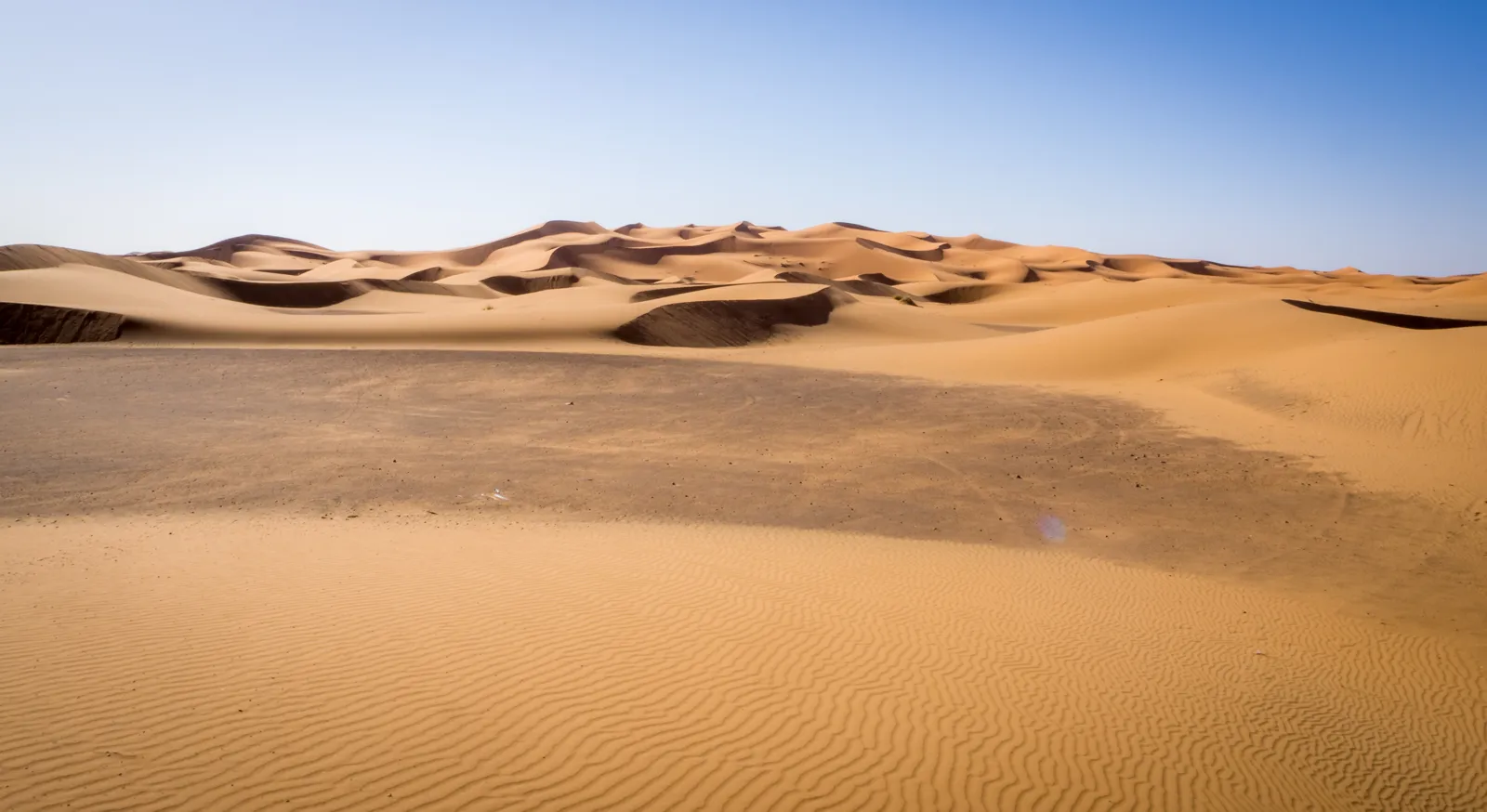
The dunes of Erg Chebbi near Merzouga, in the Moroccan Sahara
Marrakech
The « Red City » is the gateway for most trips. Its medina, a World Heritage Site, is organized around Jemaa el-Fna square, which comes alive in the late afternoon with food stalls, storytellers and musicians. Allow two or three days (details in our Marrakech guide) for the souks, the Koutoubia minaret, Bahia Palace, the Saadian Tombs, Ben Youssef Madrasa and the Majorelle Garden. Just outside the city, the Agafay stone desert and the Ourika Valley make good day trips.
Fes
Fes el-Bali, the oldest of the imperial cities, is a pedestrian medina of several thousand alleys where donkeys and mules still carry goods. Visit the Chouara tanneries, seen from the terraces of nearby shops, the Bou Inania and el-Attarine madrasas and the craft quarters. An official guide is useful on a first visit: the UK FCDO advises checking that medina guides carry an official badge. Tanneries, madrasas and craft quarters: our guide to traveling to Fes covers these visits and the best time to do them.
Meknes and Volubilis
An hour’s drive from Fes, Meknes, the former capital of Sultan Moulay Ismail, is quieter, with the monumental Bab Mansour gate. Nearby, the Roman site of Volubilis has fine mosaics, and the holy town of Moulay Idriss rises on a neighboring hill.
Chefchaouen and the north
Tucked into the Rif Mountains, Chefchaouen is known for its blue-walled medina. It is a pleasant stop between Fes and Tangier, and a starting point for hikes toward Talassemtane National Park. The U.S. Department of State describes roads through the Rif and Atlas Mountains as steep, narrow, winding and dangerous: drive carefully and in daylight. These points are worth checking when you plan your trip to Chefchaouen.
Rabat and Casablanca
Rabat, the capital, is an airy city, with the Kasbah of the Udayas by the ocean, Hassan Tower and the Mausoleum of Mohammed V. Casablanca, the largest city in the country, is mainly worth a visit for the Hassan II Mosque, built partly over the sea and open to visitors, and for its Art Deco architecture. Both cities are linked to Tangier by the Al Boraq high-speed train. Linked to Rabat and Casablanca by Al Boraq, Tangier deserves its own stop: our guide to traveling to Tangier helps you plan it. For the economic capital, see our guide to visiting Casablanca, with the Hassan II Mosque.
Ouarzazate, Aït Ben Haddou and the Draa Valley
From Marrakech, the road crosses the High Atlas via the Tizi n’Tichka pass to reach Ouarzazate. The ksar of Aït Ben Haddou, a UNESCO-listed fortified mud-brick village, is the essential stop on the way. Further south, the Draa Valley lines up palm groves and kasbahs as far as Zagora and M’Hamid, at the edge of the Erg Chigaga dunes.
The Dades and Todra gorges
Between Ouarzazate and Merzouga, the « Road of a Thousand Kasbahs » follows the Dades Valley, known for its roses in May, then the Dades and Todra gorges, with walls several hundred meters high. The villages of Boumalne Dades and Tinghir are the usual stops.
Merzouga and Erg Chebbi
The dunes of Erg Chebbi, near Merzouga, are the most visited in the country. Most people spend a night in a desert camp, after a camel ride or a 4×4 trip at sunset. From Marrakech, allow at least three days for the round trip on a tour, as the road is long.
Essaouira, Agadir and the Atlantic coast
Essaouira, formerly Mogador, is a small walled town on the ocean, with a lively fishing port and a UNESCO-listed medina. Further south, Agadir is the country’s main beach resort, and the village of Taghazout attracts surfers. According to the UK FCDO (GOV.UK, updated 19 August 2026), many beaches have limited or no lifeguard cover, and strong currents and unexpected waves can occur: take care when entering the water and avoid swimming in isolated areas. Strong currents, careful swimming: knowing what to do in Essaouira beyond the beach, between the medina and the port, helps you make the most of the town.
The High Atlas and Toubkal
About an hour and a half from Marrakech, the village of Imlil is the starting point for hikes to Toubkal (4,167 m / 13,671 ft), the highest peak in North Africa, usually climbed in two days between May and October. The UK FCDO advises hiring a professional guide for hikes in the Atlas and notes that the 2023 earthquake killed almost 3,000 people: ask your guide or accommodation about the state of trails and villages.
Itinerary ideas for Morocco: 7 days and 2 weeks
7 to 10 days: Marrakech, the desert and the ocean
Days 1 to 3: Marrakech (medina, souks, palaces, gardens)
Day 4: drive to Ouarzazate over the Tizi n’Tichka, stopping at Aït Ben Haddou
Day 5: Dades Valley and gorges, Todra Gorge
Day 6: Merzouga, night in a desert camp in Erg Chebbi
Days 7 and 8: back toward Marrakech (a long drive, with an overnight stop)
Days 9 and 10: Essaouira
2 weeks: imperial cities, the desert and Marrakech
Days 1 and 2: arrive in Tangier or Rabat
Days 3 and 4: Chefchaouen
Days 5 to 7: Fes, with a day trip to Meknes and Volubilis
Days 8 and 9: across the Middle Atlas via Ifrane and Midelt, then Merzouga and a night in the dunes
Days 10 and 11: Todra and Dades gorges, Ouarzazate, Aït Ben Haddou
Days 12 to 14: Marrakech, or Marrakech then Essaouira
These tours can be done by rental car, with a private driver or on an organized excursion. The desert route is not recommended in midsummer because of the heat.
Budget for a trip to Morocco
Morocco remains affordable once you are there, even if Marrakech and boutique riads can be expensive. Indicative amounts per person per day, excluding international flights (converted from our euro estimates at the ECB rate of 23 October 2026, €1 = US$1.12):
Item
Budget
Comfort
Accommodation (based on a shared double room)
roughly US$17–35 (hostel, simple riad)
roughly US$65–145 (boutique riad, hotel)
Meals
roughly US$11–20
roughly US$35–65
Transport
roughly US$6–17 (bus, train, grand taxis)
roughly US$30–55 (car rental, driver)
Activities and sightseeing
roughly US$6–11
roughly US$20–45
Total per day
roughly US$45–80
roughly US$145–280
Indicative estimates, varying by season and city. Prices rise during European school holidays and the year-end holidays.
A multi-day desert trip from Marrakech is often the biggest expense of a tour: compare what is included (transport, nights, meals, camel ride) before booking.
Getting around Morocco
Train: ONCF runs a comfortable network between Tangier, Rabat, Casablanca, Marrakech, Fes and Oujda, and the Al Boraq high-speed train links Tangier to Casablanca via Rabat. The U.S. Department of State (travel.state.gov, last updated July 30, 2026) notes that the train system has a good safety record, although theft sometimes occurs. There is no train to the south (Ouarzazate, the desert) or to Essaouira and Agadir.
Bus: CTM and Supratours serve the whole country cheaply, including Essaouira, Agadir, Ouarzazate and the south. The U.S. Department of State notes that buses are often overcrowded and that city buses are not considered safe.
Grand and petit taxis: grand taxis link towns, often shared; petit taxis run within cities. The UK FCDO (GOV.UK, updated 19 August 2026) advises agreeing the fare in advance or checking that the meter is used, and warns that many cars booked through ride-hailing apps may be unlicensed.
Car: renting lets you explore the south freely. UK drivers need the 1968 International Driving Permit (the 1949 version is no longer accepted) plus their UK licence, and must get the IDP in the UK before travel (UK FCDO). The U.S. Department of State states that foreign licences are valid in Morocco for up to one year. Both sources warn about driving at night because of poor lighting; drink-driving with any alcohol in your system is punishable (UK FCDO). A car with driver is a good alternative.
Plane: several airlines run domestic flights, which save time on long distances, especially to the south.
Where to stay in Morocco
The typical place to stay is a riad, a traditional medina house built around a courtyard, often with a roof terrace. In Marrakech and Fes, staying in the medina means you can do everything on foot, but the alleys cannot be reached by car: ask the riad to meet you at the entrance. The modern districts (Gueliz and Hivernage in Marrakech, the Ville Nouvelle in Fes) offer more conventional hotels and easy access by taxi. Around Marrakech, the Palmeraie and the Agafay plateau have hotels with gardens and pools. Gueliz, Palmeraie or a medina riad: your choice also depends on when to visit Marrakech, as the summer heat weighs heavily.
In the south, you stay in restored kasbahs or guesthouses, and in fixed desert camps in the dunes of Merzouga or Erg Chigaga. In Agadir, large beachfront hotels dominate; Essaouira and Taghazout mostly offer guesthouses and hostels. In winter, check that your accommodation is heated.
Entry requirements for Morocco
US citizens
According to the U.S. Department of State (travel.state.gov, last updated July 30, 2026), you need a valid passport with at least one blank page; no visa is required for visits of less than 90 days. If you stay beyond 90 days without requesting an extension, you will have to appear before a judge before leaving. Carry a copy of your passport at all times.
UK citizens
According to the UK FCDO (GOV.UK foreign travel advice, updated 19 August 2026), you can visit without a visa for up to 90 days for tourism; to stay longer, request an extension at a Moroccan police station. Your passport must have an expiry date at least 3 months after the date you arrive and must not be damaged, as some travelers with damaged passports have been refused entry. Make sure your passport is stamped on entry. A polio vaccination certificate is required if you are coming from a polio-affected country.
Drones and customs: to fly a drone you need permission from the Directorate General for Civil Aviation, or you risk fines and confiscation (UK FCDO); customs may also strictly regulate drones (U.S. Department of State). Foreign currency worth 100,000 dirhams or more must be declared on entry and exit (UK FCDO). For what you can bring home, check your home country’s customs allowances (e.g. CBP in the US, HMRC in the UK). Entry requirements checked on 24 October 2026.
Health and safety
Health: check vaccine recommendations at least 8 weeks before your trip (TravelHealthPro, according to the UK FCDO, GOV.UK, updated 19 August 2026; CDC for US travelers). Rabies is present and stray dogs are common: do not approach them and seek medical advice immediately after a bite or scratch (UK FCDO). In many areas tap water is not drinkable and ice may be made with tap water (U.S. Department of State).
Medical costs: public facilities provide limited care and private clinics are of a higher standard (UK FCDO); most providers only accept cash and may require a deposit before admission (U.S. Department of State). Insurance covering medical costs and repatriation is essential.
Crime: petty crime is common in medinas and on beaches, including pickpocketing, bag-snatching and theft by motorcyclists; criminals have used knives in street attacks in major cities and along beaches (UK FCDO). Avoid quiet areas after dark and do not carry large amounts of money.
Women travelers: women may receive unwanted attention, especially when traveling alone (UK FCDO); the U.S. Department of State advises traveling with a companion or in a group where possible and ignoring harassment.
Earthquakes: earthquakes are a risk in Morocco; familiarize yourself with the safety instructions in your hotel (UK FCDO).
Emergencies: police 190, gendarmerie 177, ambulance and fire 150 according to the UK FCDO; the U.S. Department of State gives 15 for emergency services. Numbers differ between the sources: check locally on arrival.
Practical tips for Morocco
Money: the dirham is a closed currency that cannot easily be exchanged outside Morocco (UK FCDO). Dirhams can be changed back into US dollars before departure only with a receipt showing you exchanged them in Morocco (U.S. Department of State): keep your exchange receipts. Be alert when using ATMs, and note that credit card fraud is common (UK FCDO). Our currency converter helps you estimate your spending.
Bargaining: it is customary in the souks. Agree the price before any service (taxi without a meter, guide, porter), and be wary of people posing as official guides who offer to take you somewhere (UK FCDO).
Internet: a local SIM card or an eSIM is handy for navigating the medinas.
Dress and etiquette: dress modestly away from beaches and hotels. Drinking alcohol in the street or anywhere other than a licensed restaurant or bar is illegal (UK FCDO). Always ask before photographing people, especially children, and do not photograph military or sensitive sites, palaces or government buildings (UK FCDO, U.S. Department of State).
Ramadan: eating, drinking or smoking in public during the day may cause offense; the next Ramadan starts in February 2027, and driving can be erratic at dusk (UK FCDO).
Laws: same-sex sexual relations are illegal (UK FCDO; up to three years’ imprisonment according to the U.S. Department of State). Sex outside marriage is illegal for Moroccan nationals; the rule on unmarried couples sharing a hotel room does not generally apply to foreign visitors (UK FCDO). Morocco has a zero-tolerance approach to drugs, including cannabis, with long prison sentences (UK FCDO).
Tipping: common and expected in restaurants and for guides, drivers and riad staff.
Scams: the UK FCDO warns that credit card fraud and scams are common, including substituting inferior goods for those you bought, and the U.S. Department of State reports frequent internet romance and financial scams. Never share your bank details with unsolicited contacts.
Who is Morocco for?
Our verdicts by traveler profile, based on the information in this guide:
Short break: yes: Marrakech can be seen in two or three days.
Couples: yes: medina riads, a night in a desert camp in Erg Chebbi, Essaouira.
Families: yes, at an adapted pace: the road to Merzouga is long (at least three days for the round trip from Marrakech) and the desert route is not recommended in midsummer.
Budget travelers: yes: roughly US$45–80 per person per day, with trains, CTM and Supratours buses and simple riads.
Culture: yes: the medinas of Marrakech and Fes, Meknes and Volubilis, the ksar of Aït Ben Haddou.
Adventure and nature: yes: Toubkal from Imlil, the Dades and Todra gorges, the Erg Chebbi dunes; surfing in Taghazout.
Not for a tourist stay of up to 90 days if you are a US or British citizen (travel.state.gov, last updated July 30, 2026; GOV.UK, updated 19 August 2026). US citizens need a valid passport with one blank page; British passports must be valid for at least 3 months after arrival and undamaged. Checked on 24 October 2026; check the latest rules before you leave.
How much does a week in Morocco cost?
Excluding flights, allow roughly US$45–80 per person per day on a budget, and US$145–280 in comfort, in a boutique riad with a driver. A multi-day desert trip often comes on top.
What is the best time to visit Morocco?
Spring (March to May) and autumn (late September to November), when it is mild across the country. Summer suits mainly the Atlantic coast, and winter suits Marrakech and Agadir, with cold nights in the south.
How many days do you need in Morocco?
A week lets you see Marrakech, the southern route to the desert and Essaouira. Two weeks leaves time to add Fes, Meknes and Chefchaouen without too many long drives.
Is Morocco safe for tourists?
Millions of visitors travel there, but the UK FCDO (GOV.UK, updated 19 August 2026) considers terrorist attacks likely and reports petty crime in medinas and on beaches, sometimes with knives. The border with Algeria is closed, and Western Sahara is a disputed territory with unexploded mines (U.S. Department of State). Follow official advice and stay alert in crowded places.
What is there to do in Morocco?
Wander the medinas of Marrakech and Fes, visit Meknes and Volubilis, Chefchaouen and Rabat, follow the kasbah route via Ouarzazate, Aït Ben Haddou and the Dades and Todra gorges, sleep in the Erg Chebbi dunes at Merzouga, hike in the High Atlas around Toubkal and finish on the Atlantic coast in Essaouira or Agadir.
Entry, health and safety information read on 24 October 2026: U.S. Department of State, Morocco country information (travel.state.gov, last updated July 30, 2026), and UK FCDO, foreign travel advice for Morocco (GOV.UK, updated 19 August 2026)
Direction générale de la Météorologie du Maroc, 1991–2020 climate normals (via the World Meteorological Organization, NOAA archive)
European Central Bank, euro reference exchange rates of 23 October 2026 (budget conversion)
Transparency: this page contains affiliate links, labelled as such. If you book through them we may earn a commission at no extra cost to you; it does not influence our content or recommendations. How we fund the site.