Planning a trip to Tunisia means choosing between medinas, ancient sites, beaches and desert oases. This Tunisia travel guide covers a country with UNESCO-listed medinas, some of the best-preserved Roman sites in North Africa, more than 1,000 km (620 mi) of coastline and the oases of the Sahara. It brings together the essentials for planning your stay, including the areas to avoid.
To locate cities, regions, terrain, national parks and airports, see our map of Tunisia.
Tunisia at a glance
CapitalTunis
LanguageArabic (official language)French is very widely understood
Safety: areas to avoid according to official advice
Against all travel (UK FCDO): Chaambi Mountains National Park and the military operations zones of Mount Salloum, Mount Sammamma and Mount Mghila; the militarized zone south of El Borma and Dhehiba; within 20 km (12 mi) of the Libyan border north of Dhehiba; the town of Ben Guerdane and its surroundings
Against all but essential travel (UK FCDO): within 75 km (47 mi) of the Libyan border, excluding Zarzis, the C118 road and the areas of Medenine Governorate north of it; Kasserine Governorate, including Sbeitla; within 20 km of the Algerian border in El Kef and Jendouba governorates south of Jendouba; areas north and west of Ghardimaou; within 10 km (6 mi) of the rest of the Algerian border; Mount Orbata
U.S. Department of State: do not travel within 16 km (10 mi) of the Algerian border (except Tabarka and Ain Draham) or the Libyan border, to the Chaambi, Salloum, Sammamma, Mghila and Orbata mountain areas, or to the desert south of Remada (military zone)
A state of emergency has been in place since 2015. Sources: GOV.UK (updated 24 July 2026) and travel.state.gov (last updated June 4, 2026), read on 24 October 2026
When to go to Tunisia
The best periods are April to June and September–October: 22 to 31 °C (72 to 88 °F) in Tunis, little rain and fewer crowds than in summer. July and August are the high season for beaches, hot (34 °C (93 °F) in Tunis) and expensive. The desert is best visited from October to April, as summer there is scorching. All the details month by month, with official normals, are in our article best time to visit Tunisia. If Morocco also tempts you for the desert from October to April, our comparison for choosing between Morocco and Tunisia compares budgets and tours.
What to see in Tunisia: the highlights
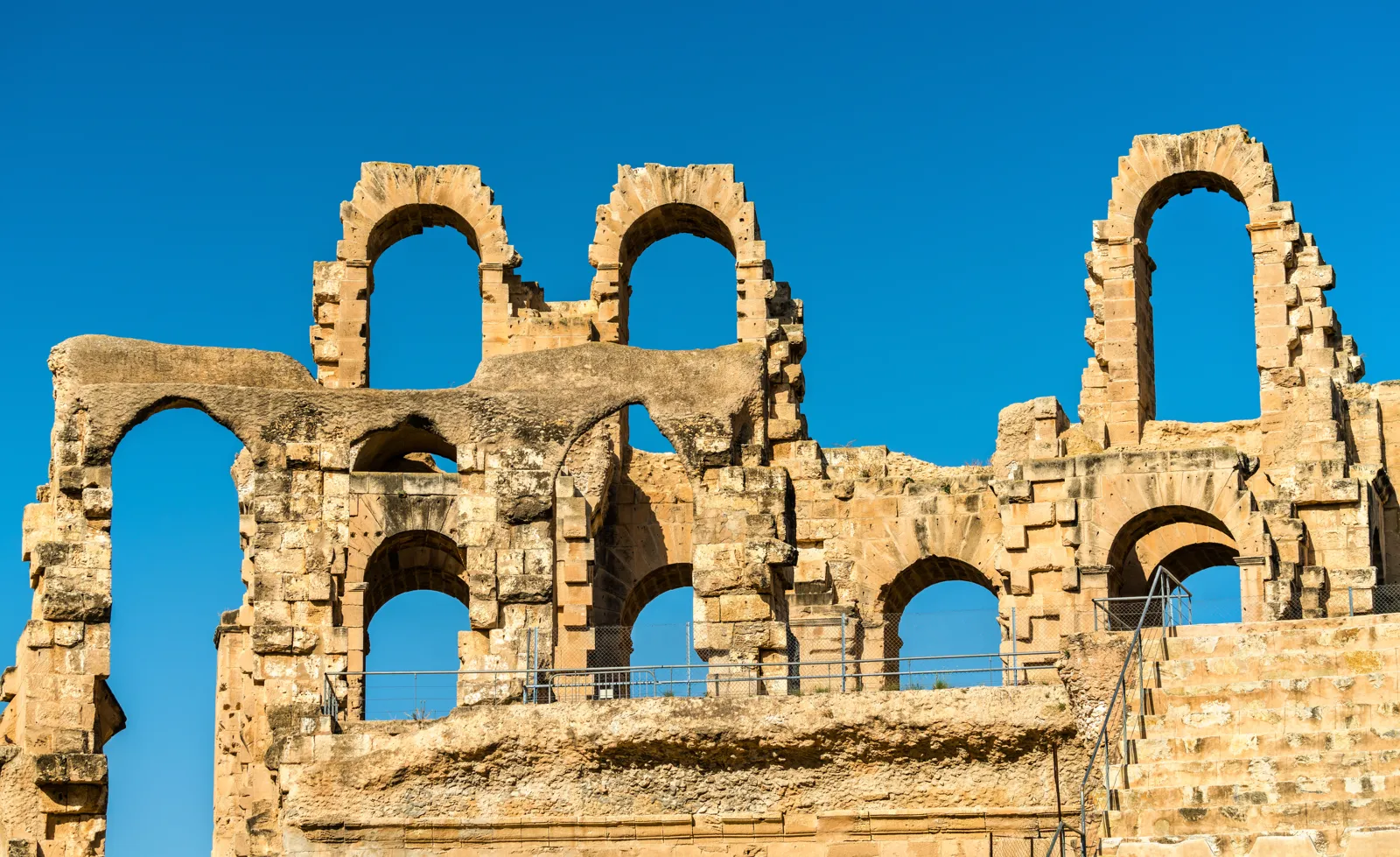
The Roman amphitheater of El Jem, Tunisia
Tunis and its medina
The medina of Tunis, a UNESCO World Heritage Site, is explored on foot around the Zitouna Mosque, among covered souks, palaces and old mansions. The Bardo National Museum houses one of the largest collections of Roman mosaics. The modern city, with Avenue Habib Bourguiba, has kept many early 20th-century buildings. The U.S. Department of State notes that spontaneous demonstrations take place, especially at weekends, near embassies on Avenue Habib Bourguiba: avoid them.
Carthage and Sidi Bou Said
About twenty kilometers (12 mi) from the center, linked by the TGM suburban train, the remains of Carthage (Antonine Baths, Punic ports, Byrsa Hill) are scattered among residential areas. Next door, Sidi Bou Said and its white houses with blue doors overlook the gulf. Do not photograph government buildings or security forces (UK FCDO, U.S. Department of State): this applies around the presidential palace in Carthage.
Hammamet and Cap Bon
Hammamet is the country’s historic beach resort, with a small medina by the sea and long beaches. Neighboring Cap Bon is more rural: the Punic site of Kerkouane (UNESCO), the beaches of Kelibia, vineyards and orchards.
Sousse, Monastir and Mahdia
On the Sahel coast, Sousse combines a UNESCO-listed medina, with its ribat and great mosque, and a lively hotel zone. Monastir has a well-preserved ribat and the Bourguiba Mausoleum. Mahdia, quieter, juts out on a peninsula and is popular for its beaches.
Kairouan and El Jem
Inland, Kairouan is one of the holy cities of Islam; its Great Mosque and medina are UNESCO-listed. El Jem has a monumental Roman amphitheater, one of the best preserved in the world, also listed. Both are easy to visit from Sousse.
Dougga
In the northwest, Dougga is an ancient Roman town on a hill, with a capitol, theater and houses with mosaics, a World Heritage Site. It is reachable on a day trip from Tunis. It lies outside the border areas covered by official warnings, but check the latest advice before continuing west toward the Algerian border in El Kef and Jendouba governorates.
Djerba
The largest island in North Africa combines beaches, white villages, pottery in Guellala and the El Ghriba synagogue, a pilgrimage site. Houmt Souk, the main town, has kept its fondouks (old caravanserais). The UK FCDO recalls that a shooting at the Jewish pilgrimage site on Djerba killed five people in 2023, and advises against all travel to the town of Ben Guerdane, on the mainland toward Libya. Between El Ghriba, the fondouks of Houmt Souk and the beaches, our page on planning a trip to Djerba helps you plan your days.
Tozeur, Nefta and Chott el Jerid
In the southwest, Tozeur is known for its palm grove and the brick architecture of its old town. Chott el Jerid, a vast salt lake, separates the region from Douz, the gateway to the Grand Erg Oriental. The U.S. Department of State notes that the National Guard encourages desert travelers to register their trip beforehand, usually through tour operators, and that the desert south of Remada is a military zone.
Matmata and the Berber south
About forty kilometers (25 mi) southwest of Gabès, the village of Matmata is known for its troglodyte dwellings dug into the rock around a courtyard. The Hotel Sidi Driss served as the set for Luke Skywalker’s family home in Star Wars. Before heading further south, check the official advice: the UK FCDO advises against all but essential travel within 75 km of the Libyan border, outside the exclusions listed above.
Things to do in Tunisia: activity ideas
Wander the medinas and souks of Tunis, Sousse, Kairouan or Houmt Souk, bargaining courteously
Visit the ancient sites: Carthage, Dougga, El Jem and Kerkouane, ideally in spring or autumn
Enjoy the beaches of Hammamet, the Sahel and Djerba, from June to September
Discover the oases and the desert around Tozeur, Nefta and Douz, from October to April
Taste Tunisian food: fish couscous, brik with egg, ojja, lablabi
Relax at a thalassotherapy spa in Hammamet, Monastir or Djerba, a popular option outside summer
Itinerary ideas for Tunisia: 7 days to 2 weeks
7 to 10 days: Tunis, the Sahel and ancient sites
Days 1 to 3: Tunis (medina, Bardo), Carthage and Sidi Bou Said
Day 4: day trip to Dougga
Days 5 and 6: Kairouan then El Jem, night in Sousse or Mahdia
Days 7 to 10: beach in Sousse, Monastir or Hammamet, with a day on Cap Bon
2 weeks: from Tunis to the oases
Days 1 to 3: Tunis, Carthage, Sidi Bou Said
Days 4 and 5: Kairouan and El Jem
Days 6 to 8: Tozeur, Nefta and Chott el Jerid (October to April, by plane or on main roads)
Day 9: Douz, staying outside the areas covered by official warnings
Days 10 to 14: Djerba, beaches and villages
Who is Tunisia for?
Here are our verdicts by profile, based on the stops, budget and conditions presented in this guide to Tunisia.
Profile
Our verdict
Beach
✅ Hammamet, Sousse, Monastir, Mahdia and Djerba, from June to September.
Families
✅ All-inclusive resort hotels on the coast, many short-haul connections from Europe.
Culture and history
✅ The medinas of Tunis, Sousse and Kairouan, Carthage, Dougga, the El Jem amphitheater.
Budget travelers
✅ Roughly US$35–55 per day on a budget, outside July and August.
Desert and oases
⚠️ Tozeur, Nefta and Douz from October to April, staying outside the areas covered by official warnings.
Wellness
✅ Thalassotherapy in Hammamet, Monastir or Djerba, popular outside summer.
Budget for a trip to Tunisia
Tunisia remains an affordable destination, especially outside July and August. All-inclusive resort stays are often the cheapest option for the beach, while an independent tour takes a little more organization. Indicative amounts per person per day, excluding flights (converted from our euro estimates at the ECB rate of 23 October 2026, €1 = US$1.12):
Item
Budget
Comfort
Accommodation (based on a shared double room)
roughly US$13–30
roughly US$50–100
Meals
roughly US$9–17
roughly US$20–45
Local transport
roughly US$4–9
roughly US$17–35 (car, driver)
Activities and sightseeing
roughly US$6–11
roughly US$11–30
Total per day
roughly US$35–55
roughly US$100–180
Indicative estimates, varying by season. Prices rise sharply in July and August and during European school holidays.
Also budget for the hotel tax payable on arrival: 8 dinars per person per night in 3-star hotels and 12 dinars in 4- and 5-star hotels, for a maximum of ten nights (UK FCDO, GOV.UK, updated 24 July 2026).
Getting around Tunisia
Train: SNCFT links Tunis with Sousse, Monastir (via the Sahel metro), Sfax and Gabès. The TGM serves Carthage and Sidi Bou Said from Tunis. Rail travel is generally safe, but there is a risk of petty crime on trains (UK FCDO).
Louages: these shared taxis leave when full and link almost all towns cheaply. The U.S. Department of State advises caution: they may be overcrowded and driven unsafely.
Plane: domestic flights link Tunis with Djerba and Tozeur, a practical way to reach the southwest.
Car: handy for Cap Bon or the Sahel, but driving is demanding. UK drivers need the 1968 International Driving Permit plus their UK licence, obtained in the UK before travel, and a green card for insurance (UK FCDO). The U.S. Department of State advises against driving after dark outside Tunis and the main resort areas or on country roads; drink-driving can land you in jail. Expect police and military checkpoints.
Taxis: plentiful in towns; ask for the meter.
Where to stay in Tunisia
In Tunis, the medina has guesthouses in old mansions (dar), while Sidi Bou Said and Gammarth offer a quieter seaside setting. On the coast, Hammamet (Yasmine Hammamet), Sousse, Monastir and the Djerba tourist zone have the large hotels, often all-inclusive. In the south, hotels and guesthouses in Tozeur and Douz are bases for the oases. These all-inclusive hotels in the tourist zone are best booked once you know when to go to Djerba, between swimming season and mild winter.
In summer, heatwaves can lead to temporary power cuts, including in some hotels, affecting air conditioning, mobile networks and card payments (UK FCDO). In July and August, book seaside hotels early.
Entry requirements for Tunisia
US citizens
According to the U.S. Department of State (travel.state.gov, last updated June 4, 2026), a valid passport is required and no visa is needed for stays of up to 90 days; longer stays require a residence permit. Dual US-Tunisian citizens are expected to enter and leave on their Tunisian passport.
UK citizens
According to the UK FCDO (GOV.UK foreign travel advice, updated 24 July 2026), you can visit without a visa for up to 90 days; make sure your passport is stamped, as the length of stay is checked on departure and overstays are fined. Your passport should be valid for the duration of your stay and in good condition. Border officials may ask for your contact details, a return or onward ticket and proof of accommodation; a few visitors have been refused entry for lack of proof of accommodation.
Customs: Tunisia has strict currency controls: check whether you need to declare foreign currency on arrival, keep the declaration and your exchange receipts, and note that you cannot take dinars out of the country (UK FCDO). Drones are prohibited without authorization and are confiscated, and some smart glasses and walkie-talkies may be held on arrival. Entry requirements checked on 24 October 2026.
Health and safety
Health: check vaccine recommendations at least 8 weeks before travel; health risks include biting insects and ticks (UK FCDO, GOV.UK, updated 24 July 2026). There is no free medical care for foreigners and private clinics must be paid on the spot, sometimes before treatment; the U.S. Department of State also reports severe shortages of medications. Insurance covering medical costs and repatriation is essential. In many areas tap water is not drinkable.
Terrorism: terrorists are likely to try to carry out attacks; a state of emergency has been in place since 2015, and security forces are visible in many places (UK FCDO). Stay alert in tourist and religious sites and crowded places.
Crime and harassment: most visits are unaffected by crime, theft being the most common (UK FCDO). Reports of sexual harassment and assault increase in summer, in busy places at night and in quiet parks and beaches by day; the U.S. Department of State reports an increase in harassment and assaults against women in Tunis.
Demonstrations: avoid demonstrations, protests and strikes, and obey any curfews.
Local laws: drug penalties are severe whatever the quantity; same-sex sexual activity is illegal (up to three years in prison according to the U.S. Department of State). Removing antiquities requires prior authorization.
Emergencies: ambulance 190, police 197 in towns, National Guard 193 in rural areas, fire and car accidents 198 (UK FCDO).
Practical tips for Tunisia
Money: ATMs are found in towns and hotels; keep cash for souks, louages and small restaurants, keep your currency declaration and exchange receipts, and spend or change your dinars before leaving, as they cannot be exported (UK FCDO). Our currency converter helps you prepare your budget.
Internet: a local SIM card or an eSIM is handy for navigation and apps.
Dress: beachwear is fine in resorts, but dress modestly when visiting religious sites or remote areas (UK FCDO). Entry to the inside of mosques is often reserved for Muslims: ask locally.
Bargaining: customary in the souks, always courteously.
Ramadan: eating, drinking or smoking in public in the daytime may cause offense; alcohol sales are banned during Ramadan outside resorts, and the next Ramadan starts in February 2027 (UK FCDO).
ID: you must carry ID, such as a copy of your passport photo page (UK FCDO); the U.S. Department of State notes that you may be questioned if you do not have your passport with you.
On the road: driving standards can be low, lane discipline is poor and pedestrians walk on the roads; at night outside towns, roads are unlit and livestock may be on the road (UK FCDO). If you rent a car, drive by day and defensively.
Food: Tunisian cuisine is based on couscous (often with fish on the coast), brik with egg, ojja, lablabi (chickpea soup) and harissa, found on almost every table. Dishes can be spicy: ask for a milder version if needed. Drink bottled water and be careful with raw vegetables and cold buffets.
Beaches: some beaches have a flag system: learn it and follow the warnings, and get local advice where there are no lifeguards (UK FCDO). Avoid deserted beaches at night.
No, not for a stay of up to 90 days if you are a US or British citizen (travel.state.gov, last updated June 4, 2026; GOV.UK, updated 24 July 2026). British travelers may be asked for proof of accommodation and a return ticket. Checked on 24 October 2026; check the latest rules before you leave.
Is Tunisia dangerous?
Most visits are unaffected by crime, but the UK FCDO considers terrorist attacks likely and a state of emergency has been in place since 2015. Official advice is against travel to some areas: the Libyan border region including Ben Guerdane, the desert militarized zone and the mountains near the Algerian border. Check GOV.UK and travel.state.gov before you leave.
How much does a week in Tunisia cost?
Excluding flights, allow roughly US$35–55 per person per day on a budget, and US$100–180 in comfort. All-inclusive resort packages are often good value outside July and August.
What is the best time to visit Tunisia?
April to June and September–October for the coast and sightseeing. The desert is best from October to April.
What can you do in Tunisia in a week?
Combine Tunis (medina, Bardo Museum), Carthage and Sidi Bou Said, then Kairouan and El Jem, and finish with two or three days on the beach in Sousse, Monastir or Hammamet. The south and Djerba need more like two weeks.
What is there to see in southern Tunisia?
Tozeur and its palm grove, Nefta, Chott el Jerid, Douz and the troglodyte dwellings of Matmata. Check official advice before any trip to the far south, parts of which are covered by warnings.
Can I pay in dollars or euros in Tunisia?
The dinar is the currency for everyday use. Change or withdraw money locally, check whether you need to declare foreign currency on arrival, and keep your exchange receipts: dinars cannot be taken out of the country (UK FCDO).
Can women travel alone in Tunisia?
Yes, but the UK FCDO reports that sexual harassment and assault increase in summer, and the U.S. Department of State reports more harassment of women in Tunis. Dress modestly in the medinas, use official taxis and recommended accommodation, and avoid isolated places at night.
Our sources
Entry, health and safety information read on 24 October 2026: U.S. Department of State, Tunisia country information (travel.state.gov, last updated June 4, 2026), and UK FCDO, foreign travel advice for Tunisia (GOV.UK, updated 24 July 2026)
Institut National de la Météorologie de Tunisie, climate normals (Tunis-Carthage, Monastir, Djerba and Tozeur stations)
Wikipedia, « Matmata » article (troglodyte dwellings), consulted October 2026
European Central Bank, euro reference exchange rates of 23 October 2026 (budget conversion)
Transparency: this page contains affiliate links, labelled as such. If you book through them we may earn a commission at no extra cost to you; it does not influence our content or recommendations. How we fund the site.