For a trip to Nepal, allow 10 days for the Kathmandu Valley, Pokhara and a short trek, two weeks to add Chitwan, and two to three weeks for Everest Base Camp. Nepal is home to eight of the world’s ten highest peaks, including Everest, but also to a Kathmandu Valley full of temples and royal squares, and to a tropical plain where rhinos and elephants live. It is Asia’s leading trekking destination, and it also suits travelers who prefer cultural visits and short walks. This Nepal travel guide gathers the essentials to plan your trip.
To locate cities, regions, terrain, national parks and airports, see our map of Nepal.
Safety: the main risks are natural: earth tremors are common, monsoon floods and landslides cut roads, and high-mountain conditions must be taken seriously (UK FCDO, GOV.UK, updated 1 October 2026; U.S. Department of State, travel.state.gov, last updated April 9, 2026). Check the latest advice before you leave. For entry, our guide to the Nepal visa details the application and lengths of stay.
When to go to Nepal
The best time is October to November, just after the monsoon: clear skies over the Himalayas, dry trails and mild temperatures in the Kathmandu Valley. March and April are the second trekking season, with rhododendrons in bloom. Winter (December–February) is dry but cold at altitude, and the monsoon (June–September) brings most of the year’s rain, with roads often cut. All the details, region by region and with official climate data, are in our article best time to visit Nepal.
Where to go in Nepal: the highlights
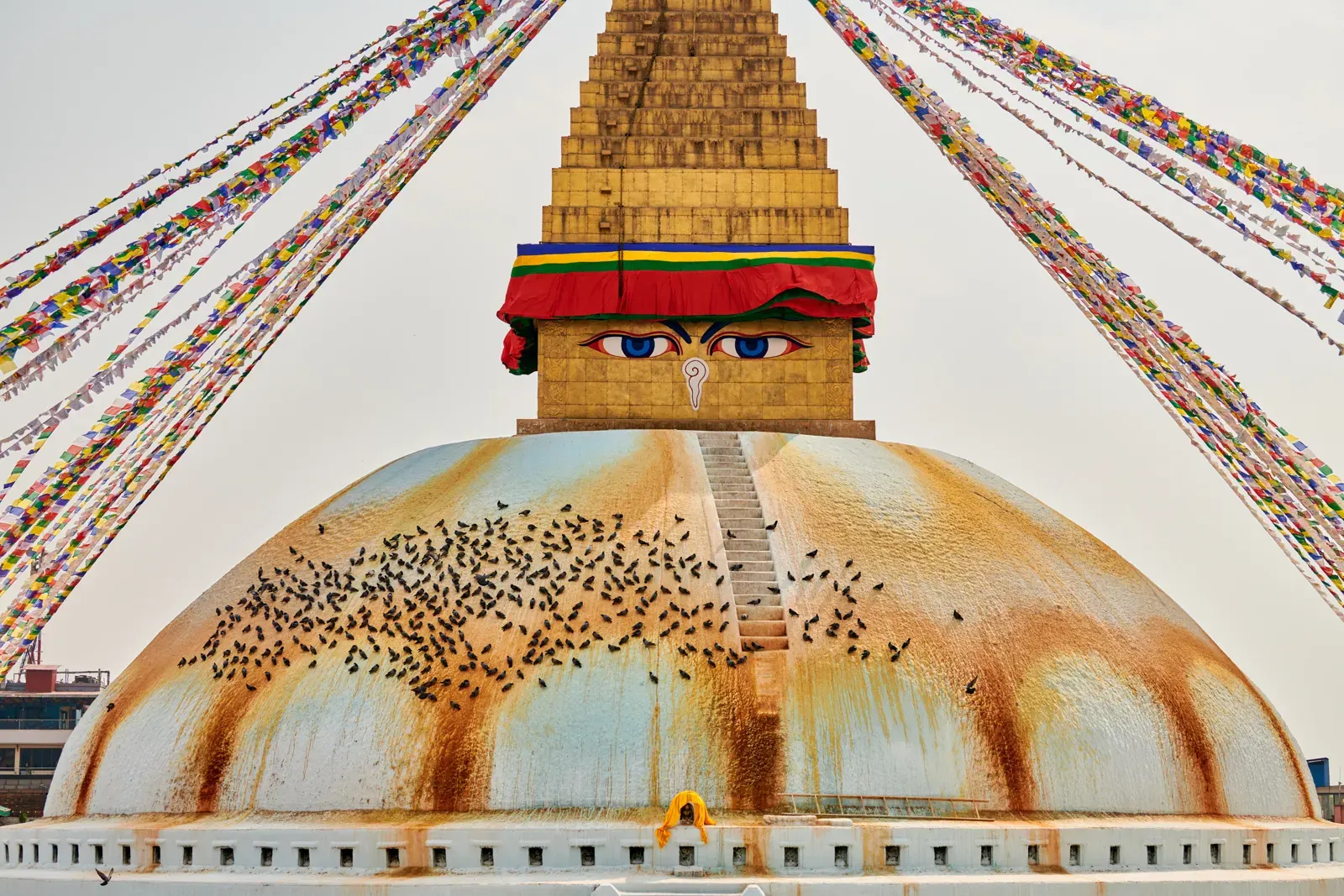
Boudhanath stupa and its prayer flags in Kathmandu
Kathmandu
The capital is the arrival point for almost every trip. The Kathmandu Valley is a UNESCO World Heritage Site for its seven monument zones, several of them in the city: Durbar Square and its palaces, the hilltop stupa of Swayambhunath, the great stupa of Boudhanath, heart of the Tibetan community, and the Hindu temple of Pashupatinath on the Bagmati River. The Thamel district concentrates hotels, trekking agencies and gear shops. It is lively and practical, but pickpocketing and bag-snatching happen at popular tourist spots (travel.state.gov).
Patan and Bhaktapur
These two former royal cities of the valley can each be visited in a day from Kathmandu. Patan, almost joined to the capital, is known for its Durbar Square and bronze workshops. Bhaktapur, about 15 km (9 mi) east, has kept its pedestrian streets, pagoda squares and pottery tradition. Foreign visitors pay to enter the historic center. Staying overnight lets you enjoy the squares in the evening, once the groups have left.
Pokhara
The country’s second tourist city, Pokhara stretches along Phewa Lake, facing the Annapurna range and the pointed summit of Machapuchare. It is a relaxed base for hiking, paragliding, boating on the lake and sunrise from Sarangkot. You get there by road from Kathmandu (a day by bus) or by domestic flight.
The country’s most-hiked range has its own guide: the Annapurna trek, with permits, the mandatory guide and the best season.
The Annapurnas
The Annapurna range offers the widest variety of treks: the short Poon Hill circuit (4 to 5 days), Annapurna Base Camp in the heart of an amphitheater of peaks, or the full Annapurna Circuit, which crosses a pass above 5,000 m (16,404 ft). To the north, the Kali Gandaki valley and Jomsom open onto the arid landscapes of Mustang, drier in summer.
The Everest region (Khumbu)
Sagarmatha National Park, a World Heritage Site, is home to Everest and the Sherpa village of Namche Bazaar. Most hikers fly to the small airstrip at Lukla, then walk to Everest Base Camp or the Gokyo lakes. Allow about twelve days for Base Camp, respecting the acclimatization stages. Lukla flights depend entirely on the weather: keep spare days. Trekking to Everest is not the only way into the Himalayas: our guide on things to do in Bhutan presents another mountain trip.
Chitwan National Park
In the Terai plain, a few hours’ drive from Kathmandu or Pokhara, Chitwan National Park is a World Heritage Site. You can see the one-horned rhinoceros, many birds, crocodiles and, with a lot of luck, a tiger. Outings are by jeep, dugout canoe or on foot with naturalist guides. Choose operators that do not offer elephant rides.
Lumbini
Birthplace of Siddhartha Gautama, the future Buddha, Lumbini is a major pilgrimage site and a World Heritage Site. Around the Maya Devi temple lies a vast zone of monasteries built by different Buddhist countries. It combines well with Chitwan, on the same plain.
Bandipur and Nagarkot
Bandipur, a small Newar town perched on a ridge between Kathmandu and Pokhara, has kept its brick houses and a car-free main street. Nagarkot, east of the Kathmandu Valley, is known for its sunrise views over the Himalayan range on clear days, especially from October to March.
Things to do in Nepal: 10 experiences
To sum up what to see and do in Nepal, here are the experiences described above:
Visit Durbar Square, Swayambhunath, Boudhanath and Pashupatinath in Kathmandu
Spend a night in Bhaktapur or Patan to enjoy the squares in the evening
Watch the sunrise over the Annapurnas from Sarangkot, above Pokhara
Hike the short Poon Hill trek (4 to 5 days) with a licensed guide
Walk to Annapurna Base Camp or do the full Annapurna Circuit
Climb to Everest Base Camp via Namche Bazaar, respecting acclimatization
See the one-horned rhinoceros in Chitwan National Park, by jeep, canoe or on foot
Travel to Lumbini, birthplace of the Buddha
Stop in Bandipur, a car-free Newar town
Admire the Himalayan range at dawn from Nagarkot, on a clear day
Itinerary ideas: how many days in Nepal?
10 days: culture and a short trek
Days 1 to 3: Kathmandu (Durbar Square, Swayambhunath, Boudhanath, Pashupatinath) and Patan
Day 4: Bhaktapur, overnight there or in Nagarkot
Day 5: road to Pokhara, with a possible stop in Bandipur
Days 6 to 9: Poon Hill trek with a licensed guide, back to Pokhara
Day 10: domestic flight back to Kathmandu
2 weeks: the valley, the Annapurnas and Chitwan
Days 1 to 4: Kathmandu, Patan and Bhaktapur
Day 5: road to Pokhara
Days 6 to 10: trek in the Annapurnas (Poon Hill extended to Ghandruk, or Mardi Himal)
Day 11: rest day in Pokhara
Days 12 and 13: Chitwan National Park
Day 14: back to Kathmandu
2 to 3 weeks: the Everest Base Camp trek
Days 1 and 2: Kathmandu, paperwork and last purchases
Days 3 to about 14: flight to Lukla, then a gradual climb via Namche Bazaar to Base Camp, with acclimatization days
Days 15 and 16: safety margin in case of a canceled flight, then sightseeing in the Kathmandu Valley
Who is Nepal for?
Our verdict by traveler profile, based on the information in this guide:
Profile
Our verdict
Why
Trekkers
✅ Ideal
Annapurnas, Everest Base Camp, Poon Hill: a licensed guide and a TIMS card are required.
Culture
✅ Ideal
Monument zones of the Kathmandu Valley, Patan, Bhaktapur, Lumbini.
Budget travelers
✅ Yes
Roughly US$35–55 a day on a budget, excluding an organized trek (guide, porter, permits).
Couples
✅ Yes
Pokhara on Phewa Lake, sunrise at Sarangkot, Bandipur and Nagarkot.
Families
⚠️ Possible
Chitwan, Pokhara and the short Poon Hill trek (4 to 5 days) are accessible; above 2,500 m (8,202 ft), acclimatization is essential.
Beach
❌ No
A landlocked Himalayan country.
Budget for a trip to Nepal
Nepal remains affordable once there. Trekking is what makes the budget vary: guide and porter, protected-area permits and domestic flights come on top of everyday spending. Indicative amounts per person per day, excluding international flights (converted from our euro estimates into US dollars at the ECB rate of 23 October 2026, €1 = US$1.12; the Nepalese rupee is not among the ECB reference rates):
Item
Budget
Comfort
Accommodation (based on a shared double room)
roughly US$9–22
roughly US$45–110
Meals
roughly US$9–17
roughly US$22–45
Local transport
roughly US$3–9
roughly US$17–34 (car with driver, domestic flights)
Activities and sightseeing
roughly US$6–11
roughly US$17–34
Total per day
roughly US$35–55
roughly US$100–200
Indicative estimates, excluding an organized trek (guide, porter, permits), varying with the season. In the mountains, food and drink prices rise with altitude.
For a trek, ask your agency for a detailed quote: the guide’s and porter’s wages and insurance, permits, TIMS card, transport and lodge nights. Lodge prices rise with altitude, as everything is carried up by people or pack animals.
Getting around Nepal
Plane: domestic flights link Kathmandu with Pokhara, Bharatpur (Chitwan), Bhairahawa (Lumbini) and mountain airstrips such as Lukla. They are fast but weather-dependent: delays and cancellations are common in high mountain areas (GOV.UK, updated 1 October 2026). The U.S. Department of State notes that domestic air safety is a concern and that mountain airports such as Lukla and Jomsom are notoriously dangerous (travel.state.gov, last updated April 9, 2026).
Tourist buses: they link Kathmandu, Pokhara and Chitwan. Mountain roads are slow: allow a day for Kathmandu–Pokhara. Bus accidents are common; avoid overloaded buses and never ride on bus roofs (GOV.UK; travel.state.gov).
Car with driver or jeep: more flexible and comfortable, booked through an agency or your hotel. Roads are in poor condition and traffic is poorly regulated (travel.state.gov). According to the UK FCDO (GOV.UK, updated 1 October 2026), UK drivers need a 1968 International Driving Permit, obtained in the UK before travel, plus their UK licence; the 1949 IDP is no longer accepted. The U.S. Department of State says Nepali law requires a valid Nepali licence; foreigners must either pass the local driving test or obtain an online International Driving Permit, and driving after any amount of alcohol can lead to arrest.
In town: taxis (agree on the fare before getting in) and ride-hailing apps in the Kathmandu Valley and Pokhara.
Monsoon: floods and landslides regularly cut roads and can isolate towns for days (GOV.UK). Keep slack in your schedule.
Where to stay in Nepal
In Kathmandu, Thamel is the most practical district for a first stay, with a wide choice of hotels and the agencies close by. For more calm, look around the Boudhanath stupa or in Patan, where Newar houses have been turned into guesthouses. In Pokhara, the Lakeside district, on Phewa Lake, has most of the options. In Chitwan, lodges are mainly around Sauraha, on the edge of the park.
On a trek, you sleep in teahouses or lodges: simple rooms, often unheated, with meals in a common room around the stove. In October–November they are in high demand on the Everest and Annapurna routes, and the U.S. Department of State advises booking ahead in peak trekking seasons; your agency usually handles reservations.
Mistakes to avoid on a trip to Nepal
Planning a trek without a guide: foreign independent trekkers must use a local licensed guide or porter in national parks and protected areas, with a permit and a TIMS card (GOV.UK; travel.state.gov). Failure to comply can lead to considerable fines.
Falling for a suspiciously cheap deal: the UK FCDO reports isolated cases of guides taking trekkers up too fast and then calling expensive helicopter evacuations; use a reputable trekking agency.
Climbing too fast: altitude sickness can affect anyone, whatever their age, experience or fitness (travel.state.gov); plan acclimatization days.
Booking your international flight right after Lukla: mountain flights are often delayed or canceled, so keep spare days.
Setting off on a trek without cash: ATMs are not reliable outside the main tourist sites, and cards may not be accepted in remote areas (GOV.UK).
Traveling without mountain evacuation cover: helicopter rescues can be very costly (travel.state.gov). Check your policy carefully.
Volunteering on a tourist visa: Nepal treats volunteering as work requiring a work visa (travel.state.gov).
Aiming for the monsoon for a trek: from June to September, roads are cut and peaks hidden (see best time to visit Nepal).
Entry requirements for Nepal, health and safety
US citizens
According to the U.S. Department of State (travel.state.gov, last updated April 9, 2026), US citizens can get a visa on arrival at Tribhuvan International Airport and at designated land border crossings, or apply in advance at a Nepali embassy or through the Department of Immigration’s online service. Your passport must be valid for at least six months on entry, with one blank visa page. Multiple-entry tourist visas are issued for 15 days (approx. US$30), 30 days (approx. US$50) or 90 days (approx. US$125), payable in US dollars; at land borders, only new US banknotes in good condition are accepted. Visitors on arrival visas may stay no more than 150 days per calendar year; extensions are granted by Department of Immigration offices (not at the airport) and must be requested before your visa expires. Currency above US$5,000 must be declared.
UK citizens
According to the UK FCDO (GOV.UK foreign travel advice, updated 1 October 2026), you need a visa to visit Nepal for up to 90 days. You can apply online for a visa on arrival up to 15 days ahead, then collect and pay at the airport, or apply at the airport itself; you can also get a tourist visa in advance from a Nepal embassy. Your passport must expire at least 6 months after your date of entry, and border officers may ask for travel insurance covering healthcare and repatriation. Visas can be extended online up to a total of 150 days in one year; overstaying is a serious crime. You must declare more than US$5,000 in banknotes (or US$10,000 in notes and travellers’ cheques combined), and convert all Nepali currency before you leave.
Trekking: a valid permit and a TIMS card are needed to enter the main trekking regions, obtained through authorized trekking agencies registered with the Government of Nepal, and independent trekkers must use a local licensed guide or porter (GOV.UK, updated 1 October 2026; travel.state.gov, last updated April 9, 2026). Some remote areas require special permits. Do not trek alone.
Health: a yellow fever certificate is required only if you arrive from a country with a transmission risk, and a polio certificate if you come from certain countries (GOV.UK). Check vaccine recommendations at least 8 weeks before your trip; risks include dengue, air pollution and altitude sickness in trekking areas (GOV.UK), and rabies from stray animals (travel.state.gov). Tap water is not safe to drink in many areas, and ice may be made with tap water (travel.state.gov). Healthcare is poor outside the Kathmandu Valley and Pokhara (GOV.UK). See a doctor or travel health clinic before any high-altitude trek.
Safety: Nepal is at high risk of major earthquakes, and floods and landslides are frequent during the monsoon (travel.state.gov). Political protests, demonstrations and strikes are fairly common and can turn violent: avoid all demonstrations (GOV.UK). Products containing CBD can lead to drug-possession charges (GOV.UK).
Insurance: essential, including search and helicopter evacuation in the mountains; helicopter companies generally require evacuation insurance or pre-approval (travel.state.gov).
Entry requirements checked on 24 October 2026; they change often, so check them again before you travel.
Practical tips for Nepal
Money: ATMs are found in Kathmandu and Pokhara but are not reliable outside the main tourist sites (GOV.UK): withdraw enough cash before heading into the mountains. Our currency converter helps you estimate your spending.
Internet: mobile coverage is limited in remote areas, including long stretches of the Annapurna Circuit (GOV.UK). Many lodges offer paid Wi-Fi. A local SIM card or an eSIM is useful in town. Coverage on treks and plans: our Nepal eSIM page.
Power: in the mountains, charging devices often costs extra. A power bank is useful.
In temples: avoid shorts and sleeveless tops, remove your shoes where required; non-Hindus are not permitted inside certain parts of Hindu temples (GOV.UK), such as the main shrine at Pashupatinath. Walk clockwise around stupas and ask before photographing people.
Etiquette: greet people with « Namaste », palms joined. Eat and give with your right hand, and avoid public displays of affection.
Water: do not drink tap water. On a trek, a filter bottle or purification tablets save buying plastic bottles.
Yes. US and UK citizens need a visa, available on arrival at Kathmandu airport or in advance from a Nepal embassy or online; tourist visas are issued for 15, 30 or 90 days (approx. US$30, US$50 or US$125), up to 150 days per year, with a passport valid at least six months (travel.state.gov, last updated April 9, 2026; GOV.UK, updated 1 October 2026). Checked on 24 October 2026; check the latest rules with Nepal’s Department of Immigration before you leave.
Can you trek in Nepal without a guide?
No. Foreign independent trekkers must use a local licensed guide or porter in Nepal’s national parks and protected areas, and need a permit and a TIMS card obtained through an authorized trekking agency (GOV.UK, updated 1 October 2026; travel.state.gov, last updated April 9, 2026).
How much does a two-week trip to Nepal cost?
Excluding international flights, allow roughly US$35–55 per person per day on a budget, and US$100–200 in comfort. A guided trek adds the cost of the guide, permits and possibly a porter.
What is the best time to visit Nepal?
October to November, after the monsoon, then March to April. The monsoon, from June to September, is the least favorable time for hiking.
Is Nepal safe to visit?
Crime is relatively low, but pickpocketing happens at tourist spots (travel.state.gov). The main risks are natural (earthquakes, landslides, altitude), road and domestic air travel, and protests, which can turn violent (GOV.UK, updated 1 October 2026). Travel with insurance that covers mountain evacuation.
How many days do you need in Nepal?
Ten days are enough for the Kathmandu Valley, Pokhara and a short trek such as Poon Hill. Allow two weeks to add Chitwan, and two to three weeks for the Everest Base Camp trek, including spare days for Lukla flights.
Which trek should you choose for a first trip to Nepal?
The Poon Hill trek, in the Annapurnas, takes 4 to 5 days from Pokhara. Annapurna Base Camp and Everest Base Camp take longer and require good acclimatization. In every case, a licensed guide is mandatory.
Our sources
Entry, health, safety, trekking and driving information read on 24 October 2026: U.S. Department of State, Nepal country information (travel.state.gov, last updated April 9, 2026), and UK FCDO, foreign travel advice for Nepal (GOV.UK, updated 1 October 2026)
Department of Hydrology and Meteorology (DHM) of Nepal, 1991–2020 climate normals (via the World Meteorological Organization)
European Central Bank: euro reference rates of 23 October 2026 (budget conversions)
Discover our other destinations in Asia, including neighboring India, Sri Lanka and Thailand. Remember to take out travel insurance that covers trekking before you leave.
Transparency: this page contains affiliate links, labelled as such. If you book through them we may earn a commission at no extra cost to you; it does not influence our content or recommendations. How we fund the site.