A small Himalayan kingdom squeezed between India and China, Bhutan is visited for its dzongs (fortress-monasteries overlooking the valleys), its religious festivals and its mountain forests. The country has chosen a regulated, high-cost model of tourism: a visa arranged in advance and a daily sustainable development fee. This Bhutan travel guide gathers the essentials for planning your trip: what to see, itineraries, budget and entry requirements.
To locate cities, regions, terrain, national parks and airports, see our map of Bhutan.
Bhutan at a glance
CapitalThimphu
LanguageDzongkhaEnglish is widely spoken (GOV.UK)
Currencythe ngultrum (BTN); Indian rupees are widely accepted · currencies
Time zoneUTC+6, no daylight saving5 h ahead of London and 10 h ahead of New York in winter
AirportsParo (PBH), the only international airportNo nonstop flights from the US or UK; land entry at Phuentsholing
EntryUS and UK: visa required, arranged in advance; US$100 per night sustainable development fee · travel.state.gov · GOV.UK
Electricitycheck plug types and voltage before you travel · plugs
Safety: according to the UK FCDO (GOV.UK, updated 10 December 2025), crime levels are low across Bhutan; the U.S. Department of State (travel.state.gov, last updated September 3, 2026) notes that petty crime such as pickpocketing is occasionally reported. The main risks are natural: altitude, earthquakes (several parts of the country lie on active fault zones) and monsoon landslides that can cut roads for days (GOV.UK).
When to go to Bhutan
The best period is October to November, after the monsoon: clear skies over the peaks, almost no rain and mild afternoons in the valleys. March and April are the second season, with rhododendrons in bloom and the Paro festival. Winter is dry and bright, but nights freeze in Thimphu and Paro; the monsoon, from June to September, brings almost daily rain. All the details, valley by valley and with official data, are in our article best time to visit Bhutan.
What to see in Bhutan: the highlights
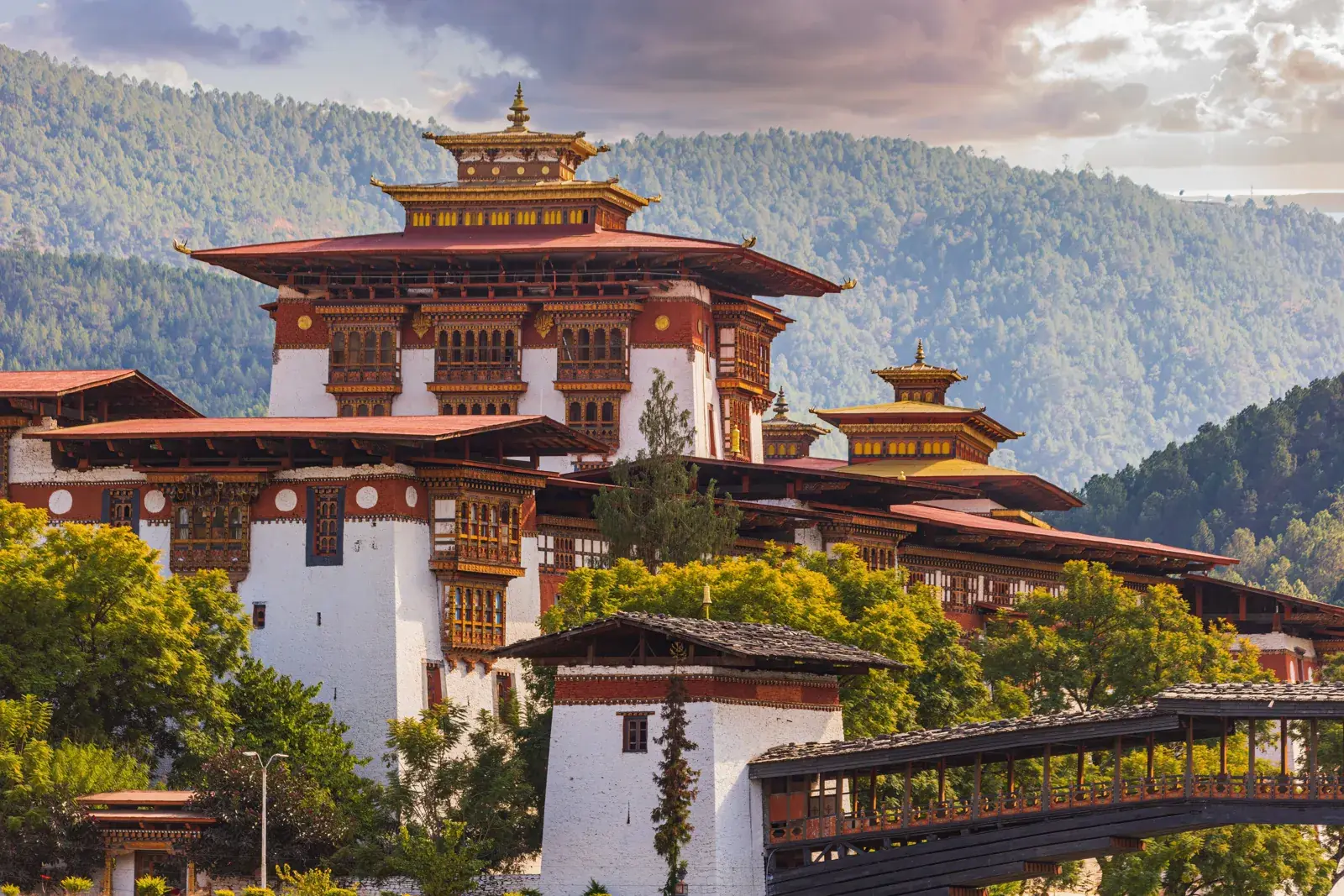
Punakha Dzong at the confluence of two rivers, Bhutan
Paro and Taktsang Monastery
The Paro valley is home to the country’s only international airport. It has several major sights: Rinpung Dzong, the fortress that hosts the Paro Tsechu in spring, the National Museum in a former watchtower, and above all Taktsang Monastery, the « Tiger’s Nest », clinging to a cliff at around 3,100 m (10,200 ft). The walk up usually takes several hours there and back: keep this hike for the end of your stay, once you are acclimatized.
Thimphu
The capital is one of the few in the world without traffic lights; traffic at the main intersection is directed by a police officer. Sights include Tashichho Dzong, seat of the government and the monastic body, the giant Buddha Dordenma statue overlooking the valley, the Memorial Chorten where residents walk around it in prayer, and several institutions dedicated to traditional arts. It is also the liveliest town in the country, with cafés and a weekend market.
Dochula Pass
On the road from Thimphu to Punakha, this pass at about 3,100 m (10,200 ft) is marked by 108 memorial chortens (stupas). On clear days, especially from October to February, you can see the Himalayan range and its snow-capped peaks. It is a stop of a few dozen minutes, often in fog during the monsoon.
Punakha
A former capital, Punakha is known for its dzong built at the confluence of two rivers, the Pho Chhu and the Mo Chhu, often considered one of the most beautiful in the country. The valley, lower than Thimphu, is mild in winter and surrounded by terraced rice fields. Short walks lead through the fields to Chimi Lhakhang temple or up to the Khamsum Yulley Namgyal chorten.
Phobjikha Valley
This wide glacial valley, at around 3,000 m (9,800 ft), is one of the best-preserved landscapes in the country. It is home to Gangtey Monastery and, in winter, to black-necked cranes arriving from the Tibetan plateau. Marked trails cross pine forests and peat bogs. Nights are cold all year round.
Bumthang
Bumthang, in the center of the country, groups four valleys considered the spiritual heart of Bhutan. Around Jakar are some of the kingdom’s oldest temples, such as Jambay Lhakhang and Kurjey Lhakhang, as well as Jakar Dzong. The region is reached after several days on the road from the west, via Trongsa and its imposing dzong. Allow at least a week to include it.
Haa Valley
Opened to tourism later than the neighboring valleys, Haa is reached from Paro over the Chele La pass, one of the highest road passes in the country at nearly 4,000 m (13,100 ft). It attracts travelers looking for quiet villages, day hikes and homestays.
Things to do in Bhutan
Hike up to Taktsang Monastery, the « Tiger’s Nest », ideally at the end of your stay once acclimatized
Attend a tsechu, such as the Paro Tsechu in spring
Visit the dzongs of Punakha, Paro (Rinpung Dzong) and Thimphu (Tashichho Dzong)
Walk to Chimi Lhakhang through the rice fields of Punakha
Watch black-necked cranes in the Phobjikha valley in winter
Trek the Druk Path between Paro and Thimphu with a licensed guide
Stay with a family in the Haa valley
Itinerary ideas for Bhutan
7 days: western Bhutan
Day 1: arrive in Paro, drive to Thimphu
Days 2 and 3: Thimphu (Tashichho Dzong, Buddha Dordenma, Memorial Chorten, crafts)
Day 4: Dochula Pass, then Punakha and its dzong
Day 5: walks around Punakha (Chimi Lhakhang, Khamsum Yulley Namgyal), return toward Paro
Day 6: hike up to Taktsang Monastery
Day 7: Rinpung Dzong and the National Museum, depart
10 days: add Phobjikha and Haa
Days 1 to 3: Paro and Thimphu
Days 4 and 5: Dochula and Punakha
Day 6: Phobjikha valley and Gangtey Monastery
Day 7: return toward Paro
Day 8: Haa valley via the Chele La pass
Day 9: Taktsang
Day 10: depart from Paro
2 weeks: as far as Bumthang
Days 1 to 5: Paro, Thimphu, Dochula and Punakha
Day 6: Phobjikha
Day 7: drive to Trongsa and its dzong
Days 8 to 10: Bumthang (Jakar, Jambay Lhakhang, Kurjey Lhakhang, valley hikes)
Days 11 and 12: return west by road, or by domestic flight depending on availability
Days 13 and 14: Taktsang and Paro, depart
Hikers can replace part of the circuit with the Druk Path, a multi-day trek between Paro and Thimphu past high-altitude lakes. According to the UK FCDO (GOV.UK, updated 10 December 2025), mountaineering is banned in Bhutan but trekking is possible, and you need to use tour guides when visiting places of interest.
Budget for a trip to Bhutan
Bhutan is an expensive destination because of the sustainable development fee (SDF): US$100 per adult per night, according to both the U.S. Department of State (travel.state.gov, last updated September 3, 2026) and the UK FCDO (GOV.UK, updated 10 December 2025). Guide, vehicle, accommodation and meals come on top, usually bundled in a tour operator’s quote. Indicative amounts per person per day, excluding flights (converted from our euro estimates at the ECB rate of 23 October 2026, roughly €1 = US$1.12):
Item
Budget
Comfort
Sustainable development fee (SDF)
US$100
US$100
Accommodation (based on a shared double room)
roughly US$45–90
roughly US$135–450 and up
Meals
roughly US$15–35
roughly US$45–90
Guide and vehicle with driver
roughly US$45–90
roughly US$65–135
Entrance fees and activities
roughly US$5–20
roughly US$10–45
Total per day
roughly US$220–340
roughly US$390 and up
Indicative estimates to compare with quotes from licensed tour operators; the cost per person falls when the guide and vehicle are shared. Add the one-off visa fee of US$40.
Children aged 6 to 12 pay a reduced SDF of US$50 per night and children under 6 pay nothing, according to the U.S. Department of State (travel.state.gov, last updated September 3, 2026). The fee and discounts can change: check them on Bhutan.travel when you book, and ask for a detailed quote separating the fee, accommodation, guide, vehicle and regional flights.
Getting around Bhutan
Car with driver: the usual way to travel; according to GOV.UK (updated 10 December 2025), car rentals come with a driver, and if you want to drive your own vehicle you must hire a guide to travel with you. Mountain roads are winding: allow several hours for distances under 100 km (62 mi).
Road conditions: according to the U.S. Department of State (travel.state.gov, last updated September 3, 2026), roads outside cities are in poor condition, with steep drop-offs and blind curves, and landslides can block them during heavy rain. GOV.UK advises avoiding night travel where possible.
Domestic flights: a few routes link Paro with airstrips in central and eastern Bhutan. Weather regularly affects domestic and international flights (GOV.UK). Ask your agency.
In town: Thimphu and Paro can be partly explored on foot; taxis operate in Thimphu.
Guides: according to the U.S. Department of State (travel.state.gov, last updated September 3, 2026), Bhutan no longer requires visitors to book through an accredited tour operator, but travelers visiting sites outside Paro or Thimphu must be accompanied by an accredited guide.
Monsoon: from June to September, landslides can slow or cut mountain pass roads. Leave some slack in your schedule.
Where to stay in Bhutan
Your tour operator usually books accommodation, but you can ask for a specific level of comfort. Options range from family-run hotels in traditional style to upscale lodges in several valleys. In Thimphu, staying in the center lets you stroll in the evening; in Paro, hotels are spread across the valley, sometimes a few kilometers from town. In Punakha, many places overlook the river or the rice fields.
In Bumthang, the Haa valley or Phobjikha, farmstays let you share family life, with simpler comfort. Bring warm clothes: outside the higher-end hotels, rooms are often heated by a simple stove or space heater.
Entry requirements for Bhutan
US citizens
According to the U.S. Department of State (travel.state.gov, last updated September 3, 2026), your passport must be valid for at least 6 months past your date of arrival, and all visitors need a Bhutanese visa to enter and leave the country.
You can apply on the Bhutanese Department of Immigration website; the visa fee is US$40. Processing a correctly filed application can take up to 5 days, and you cannot buy plane tickets to Bhutan without visa clearance.
The sustainable development fee is US$100 per person per night (US$50 for children aged 6 to 12, free under 6).
For stays longer than two weeks, Bhutan requires an HIV test completed within the 6 months before the visit; check this with the Permanent Mission of Bhutan to the United Nations in New York.
UK citizens
According to the UK FCDO (GOV.UK foreign travel advice, updated 10 December 2025), your passport must have an expiry date at least 6 months after the date you plan to leave Bhutan.
You must have a visa, applied for in advance: it is pre-approved and issued on arrival. You can arrange it through a Bhutanese tour operator, a Bhutanese hotel or directly on the Department of Immigration website, with a non-refundable fee of US$40. Make sure the border officer stamps your visa in your passport.
You enter or leave by air through Paro international airport or by land at Phuentsholing. Permits are needed for some areas; your tour guide will help obtain them.
All adult visitors pay the sustainable development fee of US$100 per night, with a lower rate for children.
The two sources measure passport validity differently (from arrival for the US, from departure for the UK): to be safe, make sure your passport is valid for at least 6 months after you leave. Entry requirements checked on 24 October 2026; check them again before you travel. If you transit through India, the U.S. Department of State notes that you need an Indian transit visa if you leave the airport or spend a night in India.
Health and safety
Vaccines: according to the U.S. Department of State (travel.state.gov, last updated September 3, 2026), the Government of Bhutan recommends tetanus, typhoid and hepatitis A vaccines; hepatitis B, Japanese encephalitis and rabies vaccines are recommended for prolonged stays for people at risk. The UK FCDO advises checking the latest recommendations at least 8 weeks before your trip (TravelHealthPro).
Healthcare: according to GOV.UK (updated 10 December 2025), one hospital in Thimphu (Jigme Dorji Wangchuck National Referral Hospital) can provide surgery and emergency treatment; elsewhere, hospitals generally provide only basic care, and complex cases require evacuation to India or Thailand. The U.S. Department of State notes that helicopter evacuation from remote areas is limited and at the traveler’s expense.
Altitude: Paro and Thimphu already lie at around 2,300–2,400 m (7,500–7,900 ft), and several passes exceed 3,000 m (9,800 ft). Altitude sickness is a risk in parts of Bhutan (GOV.UK); the U.S. Department of State advises consulting a healthcare provider 4 to 6 weeks before a trip above 8,000 ft (2,400 m). Ascend gradually and tell your guide about any symptoms.
Emergency numbers: ambulance 112, fire 110, police 113 (GOV.UK).
Insurance: GOV.UK recommends insurance covering medical treatment, emergency helicopter evacuation and repatriation; check that it covers activities at altitude.
Practical tips for Bhutan
Money: according to the U.S. Department of State (travel.state.gov, last updated September 3, 2026), a limited number of ATMs are available in the main cities and card systems often go down: carry cash. Indian rupees are usually accepted, though many shops refuse notes above 100 rupees. GOV.UK states you can take up to 30,000 ngultrum into or out of Bhutan. Estimate your spending with our currency converter.
Internet: the mobile network covers towns and the main roads; hotels generally offer Wi-Fi. A local SIM card or an eSIM is useful.
Dzongs and temples: dress respectfully, arms and legs covered (GOV.UK); remove your hat and walk clockwise around chortens and prayer wheels.
Tobacco: according to GOV.UK (updated 10 December 2025), you can bring a small supply for personal use, but you must pay taxes and duties and keep proof of payment; buying and selling tobacco has been legal since 2020 but smoking is frowned upon. The U.S. Department of State still states that tobacco sale is unlawful. Check with your guide where you can smoke.
Food: the national dish, ema datshi, combines chilies and cheese. Restaurants for visitors often tone down the heat: ask if you prefer it spicier.
Etiquette: Bhutanese people take their customs very seriously; avoid criticizing the King (GOV.UK) and follow your guide’s advice. Littering is illegal anywhere in Bhutan.
Who is Bhutan for?
Our verdicts by traveler profile, based on the information in this guide:
Culture and spirituality: yes, it is the heart of the trip: the dzongs of Punakha, Paro and Thimphu, Taktsang Monastery, the temples of Bumthang, tsechus such as the Paro Tsechu.
Hiking: yes: the climb to Taktsang, the Druk Path between Paro and Thimphu, the trails of Phobjikha, with a licensed guide.
Couples: yes, for a slow, guided trip, with lodges in the valleys or a farmstay.
Families: possible, at an adapted pace: slow mountain roads, altitude already around 2,300–2,400 m (7,500–7,900 ft) in Paro and Thimphu, cold nights.
Budget travelers: no: the US$100 nightly fee brings the budget to roughly US$220–340 per person per day even on a simple trip.
Fully independent travel: limited: you can now get the visa yourself, but sites outside Paro and Thimphu require an accredited guide and car rentals come with a driver.
Read more
The festival calendar, the monsoon and the rhododendron season are detailed valley by valley on our page best time to visit Bhutan. If you are planning a first trip to Asia and still undecided, our Asia destinations hub gathers guides to neighboring countries.
Frequently asked questions
Can you travel independently in Bhutan?
Partly. According to the U.S. Department of State (travel.state.gov, last updated September 3, 2026), Bhutan no longer requires visitors to book through an accredited tour operator and you can apply for the visa on the Department of Immigration website, but travelers visiting sites outside Paro or Thimphu must be accompanied by an accredited guide. You can travel solo or as a couple, with a guide and driver for most of the trip.
How much does a trip to Bhutan cost?
Allow for the sustainable development fee of US$100 per adult per night, the visa (US$40), then accommodation, guide, vehicle and meals. In total, roughly US$220–340 per person per day on a simple trip, more in comfort, excluding flights.
Are there nonstop flights to Bhutan from the US or UK?
No. Paro is the only international airport, served from a handful of cities in Asia, so you need a connection. According to the U.S. Department of State, flights into and out of Paro are restricted to daylight hours and depend on the weather: allow at least 24 hours for connections.
What is the best time to visit Bhutan?
October to November, after the monsoon, then March to April. The monsoon, from June to September, is the least favorable period for hiking and Himalayan views.
Is Bhutan safe?
Yes: crime levels are low across Bhutan according to the UK FCDO (GOV.UK, updated 10 December 2025). The main risks are altitude, earthquakes and monsoon landslides on mountain roads.
What can you see in Bhutan in one week?
Western Bhutan: Paro and Taktsang Monastery, Thimphu (Tashichho Dzong, Buddha Dordenma), Dochula Pass and Punakha. In 10 days, add the Phobjikha and Haa valleys; Bumthang needs about two weeks.
How long does the hike to Taktsang take?
The walk up to Taktsang Monastery, at around 3,100 m (10,200 ft), usually takes several hours there and back. Keep it for the end of your stay, once you are acclimatized.
Our sources
Entry, health and safety information read on 24 October 2026: U.S. Department of State, Bhutan country information (travel.state.gov, last updated September 3, 2026), and UK FCDO, foreign travel advice for Bhutan (GOV.UK, updated 10 December 2025)
European Central Bank: euro reference rates of 23 October 2026 (budget conversion)
National Center for Hydrology and Meteorology (NCHM) of Bhutan, Climate Data Book of Bhutan (2018), 1996–2017 normals
Transparency: this page contains affiliate links, labelled as such. If you book through them we may earn a commission at no extra cost to you; it does not influence our content or recommendations. How we fund the site.